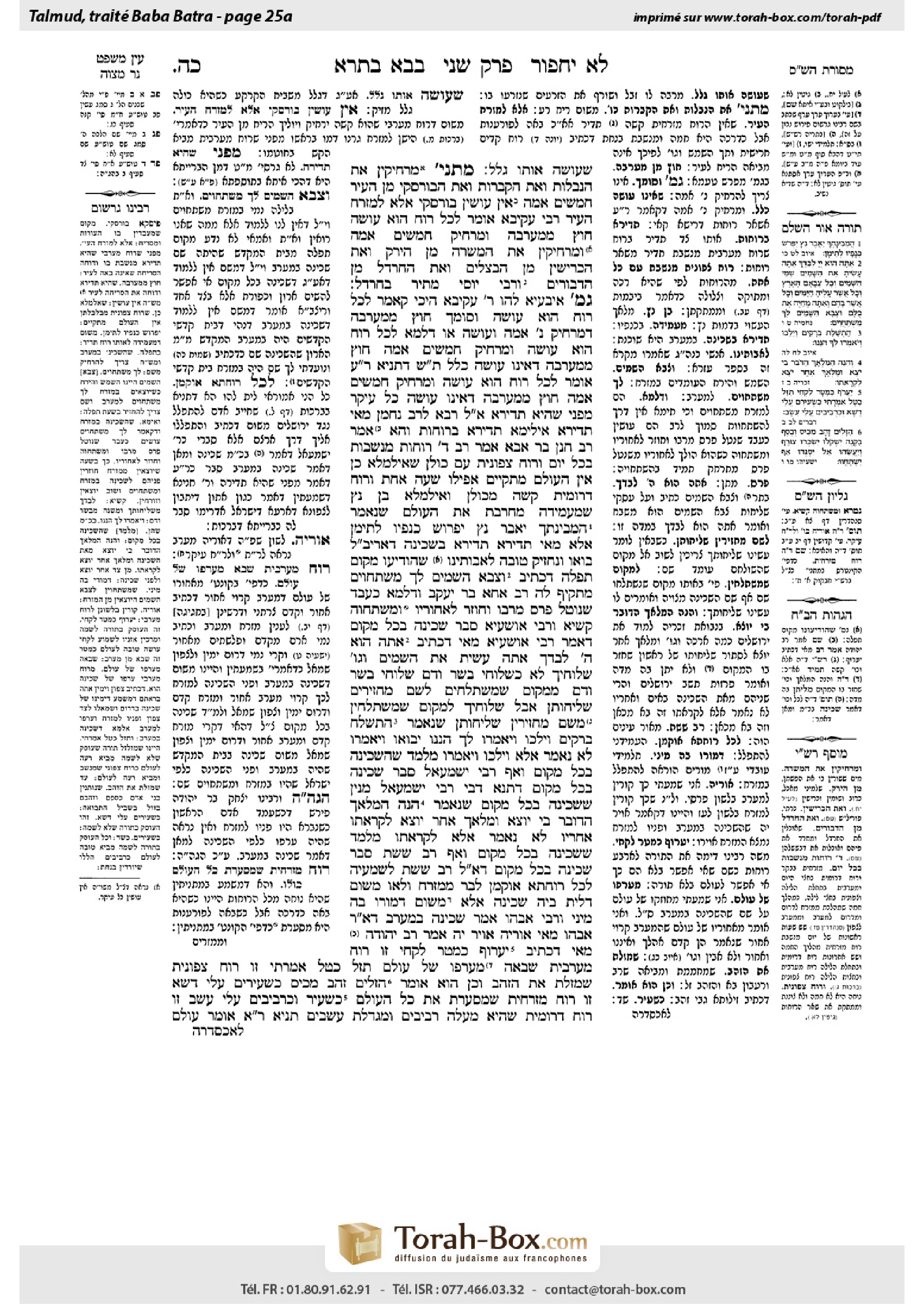
Bava Batra 25a: Talmud study for Daf Yomi
Study the Talmud for Daf Yomi with scanned pages, Hebrew text, English translations from Sefaria and AI-generated French translations.
Passage selection and English or AI-generated French translation are available where the scan has annotations. Daf Study is independent of Torah-Box and Sefaria.
Browse Bava Batra · בבא בתרא · All tractatesBava Batra 25a text and translations
This page of Bava Batra includes the Aramaic text, an English translation and an AI-generated French translation, alongside the scan above.
בבא בתרא כ״ה א · Aramaic and Hebrew text
שֶׁעוֹשֶׂה אוֹתוֹ גָּלָל.
מַתְנִי׳ מַרְחִיקִין אֶת הַנְּבֵלוֹת וְאֶת הַקְּבָרוֹת וְאֶת הַבּוּרְסְקִי מִן הָעִיר – חֲמִשִּׁים אַמָּה. אֵין עוֹשִׂין בּוּרְסְקִי אֶלָּא לְמִזְרַח הָעִיר. רַבִּי עֲקִיבָא אוֹמֵר: לְכׇל רוּחַ הוּא עוֹשֶׂה, חוּץ מִמַּעֲרָבָהּ; וּמַרְחִיק חֲמִשִּׁים אַמָּה. וּמֵרְחִיקִין אֶת הַמִּשְׁרָה מִן הַיָּרָק, וְאֶת הַכְּרֵישִׁין מִן הַבְּצָלִים, וְאֶת הַחַרְדָּל מִן הַדְּבוֹרִים. וְרַבִּי יוֹסֵי מַתִּיר בְּחַרְדָּל.
גְּמָ׳ אִיבַּעְיָא לְהוּ: רַבִּי עֲקִיבָא הֵיכִי קָאָמַר? לְכׇל רוּחַ הוּא עוֹשֶׂה וְסוֹמֵךְ, חוּץ מִמַּעֲרָבָהּ – דְּמַרְחִיק חֲמִשִּׁים אַמָּה וְעוֹשֶׂה; אוֹ דִּלְמָא: לְכׇל רוּחַ הוּא עוֹשֶׂה וּמַרְחִיק חֲמִשִּׁים אַמָּה, חוּץ מִמַּעֲרָבָהּ – דְּאֵינוֹ עוֹשֶׂה כְּלָל?
תָּא שְׁמַע: דְּתַנְיָא, רַבִּי עֲקִיבָא אוֹמֵר: לְכׇל רוּחַ הוּא עוֹשֶׂה וּמַרְחִיק חֲמִשִּׁים אַמָּה, חוּץ מִמַּעֲרָבָהּ דְּאֵינוֹ עוֹשֶׂה כׇּל עִיקָּר, מִפְּנֵי שֶׁהִיא תְּדִירָא.
אֲמַר לֵיהּ רָבָא לְרַב נַחְמָן: מַאי תְּדִירָא? אִילֵּימָא תְּדִירָא בְּרוּחוֹת, וְהָא אָמַר רַב חָנָן בַּר אַבָּא אָמַר רַב: אַרְבַּע רוּחוֹת מְנַשְּׁבוֹת בְּכׇל יוֹם, וְרוּחַ צְפוֹנִית עִם כּוּלָּן; שֶׁאִילְמָלֵא כֵּן – אֵין הָעוֹלָם מִתְקַיֵּים אֲפִילּוּ שָׁעָה אַחַת. וְרוּחַ דְּרוֹמִית קָשָׁה מִכּוּלָּן, וְאִילְמָלֵא בֶּן נֵץ שֶׁמַּעֲמִידָהּ – מַחְרֶבֶת אֶת הָעוֹלָם, שֶׁנֶּאֱמַר: ״הֲמִבִּינָתְךָ יַאֲבֶר נֵץ, יִפְרֹשׂ כְּנָפָו לְתֵימָן״!
אֶלָּא מַאי תְּדִירָא – תְּדִירָא בִּשְׁכִינָה. דְּאָמַר רַבִּי יְהוֹשֻׁעַ בֶּן לֵוִי: בּוֹאוּ וְנַחֲזִיק טוֹבָה לַאֲבוֹתֵינוּ, שֶׁהוֹדִיעוּ מְקוֹם תְּפִלָּה – דִּכְתִיב: ״וּצְבָא הַשָּׁמַיִם לְךָ מִשְׁתַּחֲוִים״.
מַתְקֵיף לַהּ רַב אַחָא בַּר יַעֲקֹב: וְדִלְמָא כְּעֶבֶד שֶׁנּוֹטֵל פְּרָס מֵרַבּוֹ, וְחוֹזֵר לַאֲחוֹרָיו וּמִשְׁתַּחֲוֶה! קַשְׁיָא.
וְרַבִּי אוֹשַׁעְיָא סָבַר: שְׁכִינָה בְּכׇל מָקוֹם. דְּאָמַר רַבִּי אוֹשַׁעְיָא, מַאי דִּכְתִיב: ״אַתָּה הוּא ה׳ לְבַדֶּךָ, אַתָּה עָשִׂיתָ אֶת הַשָּׁמַיִם וְגוֹ׳״? שְׁלוּחֶיךָ לֹא כִּשְׁלוּחֵי בָּשָׂר וָדָם; שְׁלוּחֵי בָּשָׂר וָדָם, מִמָּקוֹם שֶׁמִּשְׁתַּלְּחִים – לְשָׁם מַחֲזִירִים שְׁלִיחוּתָן; אֲבָל שְׁלוּחֶיךָ, לְמָקוֹם שֶׁמִּשְׁתַּלְּחִין – מִשָּׁם מַחְזִירִין שְׁלִיחוּתָן, שֶׁנֶּאֱמַר: ״הַתְשַׁלַּח בְּרָקִים וְיֵלֵכוּ וְיֹאמְרוּ לְךָ הִנֵּנוּ״ – ״יָבוֹאוּ וְיֹאמְרוּ״ לֹא נֶאֱמַר, אֶלָּא ״וְיֵלֵכוּ וְיֹאמְרוּ״, מְלַמֵּד שֶׁהַשְּׁכִינָה בְּכׇל מָקוֹם.
וְאַף רַבִּי יִשְׁמָעֵאל סָבַר שְׁכִינָה בְּכׇל מָקוֹם. דְּתָנָא דְּבֵי רַבִּי יִשְׁמָעֵאל: מִנַּיִן שֶׁשְּׁכִינָה בְּכׇל מָקוֹם? שֶׁנֶּאֱמַר: ״הִנֵּה הַמַּלְאָךְ הַדֹּבֵר בִּי יֹצֵא, וּמַלְאָךְ אַחֵר יֹצֵא לִקְרָאתוֹ״ – ״אַחֲרָיו״ לֹא נֶאֱמַר, אֶלָּא ״לִקְרָאתוֹ״, מְלַמֵּד שֶׁשְּׁכִינָה בְּכׇל מָקוֹם.
וְאַף רַב שֵׁשֶׁת סָבַר שְׁכִינָה בְּכׇל מָקוֹם. דַּאֲמַר לֵיהּ רַב שֵׁשֶׁת לְשַׁמָּעֵיהּ: לְכׇל רוּחָתָא אוֹקְמַן, לְבַר מִמִּזְרָח. וְלָאו מִשּׁוּם דְּלֵית בֵּיהּ שְׁכִינָה, אֶלָּא מִשּׁוּם דְּמוֹרוּ בֵּהּ מִינֵי.
וְרַבִּי אֲבָהוּ אָמַר: שְׁכִינָה בַּמַּעֲרָב – דְּאָמַר רַבִּי אֲבָהוּ: מַאי ״אוֹרְיָה״? אֲוִיר יָהּ.
אָמַר רַב יְהוּדָה, מַאי דִּכְתִיב ״יַעֲרֹף כַּמָּטָר לִקְחִי״? זוֹ רוּחַ מַעֲרָבִית, שֶׁבָּאָה מֵעׇרְפּוֹ שֶׁל עוֹלָם.
״תִּזַּל כַּטַּל אִמְרָתִי״ – זוֹ רוּחַ צְפוֹנִית, שֶׁמַּזֶּלֶת אֶת הַזָּהָב. וְכֵן הוּא אוֹמֵר: ״הַזָּלִים זָהָב מִכִּיס״.
״כִּשְׂעִירִם עֲלֵי דֶשֶׁא״ – זוֹ רוּחַ מִזְרָחִית, שֶׁמַּסְעֶרֶת אֶת כׇּל הָעוֹלָם כְּשָׂעִיר. ״וְכִרְבִיבִים עֲלֵי עֵשֶׂב״ – זוֹ רוּחַ דְּרוֹמִית, שֶׁהִיא מַעֲלָה רְבִיבִים וּמְגַדֶּלֶת עֲשָׂבִים.
תַּנְיָא, רַבִּי אֱלִיעֶזֶר אוֹמֵר: עוֹלָם
Bava Batra 25a · English translation
he turns it into manure, i.e., the chaff acts like manure, and an excessive amount of manure damages the seeds.
MISHNA: One must distance animal carcasses, and graves, and a tannery [haburseki], a place where hides are processed, fifty cubits from the city. One may establish a tannery only on the east side of the city, because winds usually blow from the west and the foul smells would therefore be blown away from the residential area. Rabbi Akiva says: One may establish a tannery on any side of a city except for the west, as the winds blowing from that direction will bring the odors into the city, and one must distance it fifty cubits from the city. One must distance from vegetables water in which flax is steeped, because this water ruins them; and likewise one must distance leeks from onions, and mustard from bees. And Rabbi Yosei permits one not to do so in the case of mustard.
GEMARA: A dilemma was raised before the Sages: With regard to what case is Rabbi Akiva speaking? Did he mean that one may establish a tannery on any side of a city, and one may even place the tannery close to the city, except for the west side, where one must establish it at a distance of fifty cubits? Or perhaps he meant that one may establish a tannery on any side and distance it fifty cubits, except for the west side, where one may not establish a tannery at all.
The Gemara cites a proof: Come and hear, as it is taught in a baraita: Rabbi Akiva says that one may establish a tannery on any side of the city and distance it fifty cubits, except for the west side, where one may not establish a tannery at all, because the western wind is frequent.
§ With regard to the last statement of the baraita, Rava said to Rav Naḥman: What does frequent mean in this context? If we say it means frequent among the winds, i.e., this wind blows all the time, that is difficult. But doesn’t Rav Ḥanan bar Abba say that Rav says: Four winds blow every day from different directions, and the northern wind blows with each of the other three; as, if this were not so, i.e., if it did not blow, the world would not exist for even one hour, as the northern wind is pleasant and tempers the bitter effects of the other winds. And the southern wind is harsher than all of them, and were it not for the angel named Ben Netz, who stops it from blowing even harder, it would destroy the entire world, as it is stated: “Does the hawk [netz] soar by your wisdom, and stretch her wings toward the south?” (Job 39:26). This indicates that the northern wind is the most constant, not the western wind.
Rather, what is the meaning of frequent? It means frequent with the Divine Presence, i.e., the Divine Presence is found on the western side, and therefore it is inappropriate to set up a tannery there with its foul odors. As Rabbi Yehoshua ben Levi says: Come and let us be grateful to our ancestors who revealed to us the place of prayer, as it is written: “And the hosts of heaven bow down to You” (Nehemiah 9:6). Since the celestial bodies move from east to west, they bow in that direction, which indicates that the Divine Presence is in the west.
Rav Aḥa bar Ya’akov objects to this: But perhaps the celestial bodies are like a servant who receives a gift from his master and walks backward while bowing. If so, the Divine Presence is in the east and the celestial bodies are moving backward. The Gemara comments: Indeed, this is difficult, i.e., the verse does not provide a definitive proof.
The Gemara comments: And Rabbi Oshaya holds that the Divine Presence is found in every place, as Rabbi Oshaya says: What is the meaning of that which is written: “You are the Lord, even You alone, You have made heaven…You preserve them all alive and the hosts of heaven bow down to You” (Nehemiah 9:6)? This indicates that Your messengers are not like the messengers of flesh and blood. The messengers of flesh and blood return to the place from where they were sent to report on their mission. But Your messengers return and report on their mission from the very same place to which they are sent, as it is stated “Can you send forth lightnings, that they may go out and say to you: Here we are?” (Job 38:35). The verse does not state: They will come and say, i.e., they do not return to their point of departure, but: “They may go out and say,” which teaches that the Divine Presence is found in every place.
The Gemara comments: And Rabbi Yishmael, too, holds that the Divine Presence is in every place, as one of the Sages of the school of Rabbi Yishmael taught: From where is it derived that the Divine Presence is in every place? As it is stated: “And behold the angel who spoke with me went forth, and another angel went out to meet him” (Zechariah 2:7). Although both angels were coming from the Divine Presence, the verse does not state: After him, but: “To meet him,” which teaches that the Divine Presence is in every place, and therefore the angels depart for their missions from every place.
And Rav Sheshet, too, holds that the Divine Presence is in every place, as Rav Sheshet said to his servant: Set me facing any direction to pray except for the east. Rav Sheshet, who was blind, required the assistance of his aide to prepare for prayer. He explained to his servant: And the reason I do not wish to face east is not because it does not contain the Divine Presence, but because the heretics instruct people to pray in that direction.
But Rabbi Abbahu says: The Divine Presence is in the west, as Rabbi Abbahu says: What is the meaning of oriyya, which is a name for the west? It means the air of God [avir Yah], i.e., this is the place of the Divine Presence.
The Gemara cites a statement connected to the four winds. Rav Yehuda said: What is the meaning of that which is written: “My doctrine shall drop as the rain, my speech shall distill as the dew; as the small rain upon the tender growth, and as the showers upon the herb” (Deuteronomy 32:2)? “My doctrine shall drop [ya’arof ] as the rain”; this is the western wind, which comes from the back of [me’orpo] the world, as the west is also referred to as the back.
“My speech shall distill [tizzal] as the dew”; this is the northern wind, which brings dry air that reduces the rain and grain and thereby devalues [mazzelet] gold. When grain crops are reduced their price appreciates, and consequently the value of gold decreases. And in addition, it says: “You who lavish [hazzalim] gold out of the bag” (Isaiah 46:6).
“As the small rain [kisirim] upon the tender growth”; this is the eastern wind that rages through [maseret] the entire world like a demon [sa’ir] when it blows strongly. “And as the showers upon the herb”; this is the southern wind, which raises showers and causes herbs to grow.
It is taught in a baraita that Rabbi Eliezer says: The world
Bava Batra 25a · Traduction française (IA)
il le transforme en fumier, c'est-à-dire que la paille agit comme du fumier, et une quantité excessive de fumier nuit aux semences.
MICHNA : On doit éloigner les cadavres d'animaux, les sépultures, et une tannerie [haburseki], un lieu où les peaux sont traitées, à cinquante coudées de la ville. On peut établir une tannerie uniquement à l'est de la ville, car les vents soufflent généralement du nord-ouest et les odeurs nauséabondes seraient ainsi éloignées du quartier résidentiel. Rabbi Akiva dit : On peut établir une tannerie sur n'importe quel côté de la ville, sauf au nord-ouest, car les vents soufflant de cette direction apporteraient les odeurs dans la ville, et on doit éloigner la tannerie de cinquante coudées de la ville. On doit éloigner de la végétation l'eau dans laquelle on immerge le lin, car cette eau ruine les plantes ; de même, on doit éloigner les oignons des échalotes, et les moutardes des abeilles. Et Rabbi Yosei permet de ne pas le faire dans le cas des moutardes.
GUEMARA : Un dilemme a été soulevé devant les Sages : À quel cas Rabbi Akiva fait-il référence ? Voulait-il dire qu'on peut établir une tannerie sur n'importe quel côté de la ville et la placer à proximité, sauf au nord-ouest, où on doit l'éloigner de cinquante coudées ? Ou bien voulait-il dire qu'on peut établir une tannerie sur n'importe quel côté et l'éloigner de cinquante coudées, sauf au nord-ouest, où on ne peut pas l'établir du tout.
La Guemara cite une preuve : Venez écouter, car il est enseigné dans une baraïta : Rabbi Akiva dit qu'on peut établir une tannerie sur n'importe quel côté de la ville et l'éloigner de cinquante coudées, sauf au côté ouest, où on ne peut pas établir une tannerie du tout, car le vent d'ouest est fréquent.
§ Concernant la dernière déclaration de la baraïta, Rava dit à Rav Naḥman : Quelle est la signification de « fréquent » dans ce contexte ? Si nous disons qu'il signifie fréquent parmi les vents, c'est-à-dire que ce vent souffle constamment, cela est difficile. Mais ne dit pas Rav Ḥanan bar Abba que Rav dit : Quatre vents soufflent chaque jour de directions différentes, et le vent du nord souffle avec chacun des trois autres ; car, si ce n'était pas le cas, c'est-à-dire s'il ne soufflait pas, le monde ne subsisterait pas même une heure, car le vent du nord est agréable et tempère les effets pénibles des autres vents. Et le vent du sud est plus rude que tous les autres, et sans l'ange nommé Ben Netz, qui l'arrête de souffler encore plus fort, il détruirait le monde entier, comme il est dit : « Est-ce que le faucon [netz] vole par votre sagesse, et étire ses ailes vers le sud ? » (Job 39:26). Cela indique que le vent du nord est le plus constant, pas le vent d'ouest.
Plutôt, quelle est la signification de « fréquent » ? Cela signifie fréquent avec la Divine Présence, c'est-à-dire que la Divine Présence est trouvée à l'ouest, et donc il est inapproprié d'établir une tannerie là-bas avec ses odeurs nauséabondes. Comme Rabbi Yehoshua ben Levi dit : Venez et soyons reconnaissants envers nos ancêtres qui nous ont révélé la place de la prière, comme il est écrit : « Et les multitudes du ciel vous rendent hommage » (Néhémie 9:6). Puisque les corps célestes se déplacent de l'est vers l'ouest, ils se prosternent dans cette direction, ce qui indique que la Divine Présence est à l'ouest.
Rav Aḥa bar Ya’akov s’oppose à cela : Mais peut-être les corps célestes sont comme un serviteur qui reçoit un cadeau de son maître et marche en arrière tout en se prosternant. Si c’est le cas, la Divine Présence est à l’est et les corps célestes se déplacent en arrière. La Guemara commente : En effet, cela est difficile, c’est-à-dire que le verset ne fournit pas une preuve définitive.
La Guemara commente : Et Rabbi Oshaya affirme que la Divine Présence est trouvée partout, comme Rabbi Oshaya dit : Quelle est la signification de ce qui est écrit : « Vous êtes le Seigneur, même Vous seul, Vous avez fait le ciel… Vous conservez tous vivants et les multitudes du ciel vous rendent hommage » (Néhémie 9:6) ? Cela indique que vos messagers ne sont pas comme les messagers de chair et de sang. Les messagers de chair et de sang retournent au lieu d’où ils sont partis pour rapporter leur mission. Mais vos messagers retournent et rapportent leur mission du même lieu d’où ils sont envoyés, comme il est dit : « Puis-je envoyer des éclairs, qu’ils sortent et disent : Ici nous sommes ? » (Job 38:35). Le verset ne dit pas : Ils viendront et diront, c’est-à-dire qu’ils ne retournent pas à leur point de départ, mais : « Ils sortent et disent », ce qui enseigne que la Divine Présence est trouvée partout.
La Guemara commente : Et Rabbi Yishmael aussi affirme que la Divine Présence est trouvée partout, comme l’un des Sages de la maison de Rabbi Yishmael a enseigné : D’où est tiré que la Divine Présence est trouvée partout ? Comme il est dit : « Et voici l’ange qui parlait avec moi est sorti, et un autre ange est sorti pour le rencontrer » (Zacharie 2:7). Bien que les deux anges soient partis de la Divine Présence, le verset ne dit pas : Après lui, mais : « Pour le rencontrer », ce qui enseigne que la Divine Présence est trouvée partout, et donc les anges partent pour leurs missions de partout.
Et Rav Sheshet aussi affirme que la Présence divine est trouvée partout, comme Rav Sheshet a dit à son serviteur : Placez-moi face à toute direction pour prier, sauf l'est. Rav Sheshet, qui était aveugle, avait besoin de l'aide de son serviteur pour se préparer à prier. Il expliquait à son serviteur : Et la raison pour laquelle je ne veux pas me tourner à l'est n'est pas parce qu'il ne contient pas la Présence divine, mais parce que les hérétiques instruisent les gens à prier dans cette direction.
Mais Rabbi Abbahu dit : La Présence divine est à l'ouest, comme Rabbi Abbahu dit : Quelle est la signification d'oriyya, qui est un nom pour l'ouest ? Cela signifie l'air de Dieu [avir Yah], c'est-à-dire que c'est la place de la Présence divine.
La Guemara cite un propos lié aux quatre vents. Rav Yéhouda dit : De quelle manière faut-il comprendre ce qui est écrit : « Mon enseignement tombera comme la pluie, ma parole se condensera comme la rosée ; comme la pluie fine sur la jeune végétation, et comme les avers sur les herbes » (Deutéronome 32:2) ? « Mon enseignement tombera [ya’arof] comme la pluie » ; c’est le vent du west, qui vient de l’arrière [me’orpo] du monde, car le west est aussi appelé l’arrière.
« Ma parole se condensera [tizzal] comme la rosée » ; c’est le vent du nord, qui apporte un air sec qui réduit la pluie et les céréales, et donc déprécie [mazzelet] l’or. Lorsque les récoltes de céréales sont réduites, leur prix augmente, et par conséquent la valeur de l’or diminue. Et en outre, il dit : « Toi qui verses [hazzalim] de l’or de la sacoche » (Yézékia 46:6).
« Comme la pluie fine [kisirim] sur la jeune végétation » ; c’est le vent de l’est qui souffle [maseret] à travers tout le monde comme un démon [sa’ir] lorsqu’il souffle fort. « Et comme les avers sur les herbes » ; c’est le vent du sud, qui provoque des avers et fait pousser les herbes.
Il est enseigné dans une baraïta que Rabbi Éliézer dit : Le monde est fondé sur trois choses : la justice, la compassion et la vérité.
Traduction française générée par IA à partir de l’édition anglaise de Sefaria. Vérifie toujours un passage avec le texte source.
Text from Sefaria: William Davidson Edition - Vocalized Aramaic (CC BY NC); William Davidson Edition - English (CC BY NC).