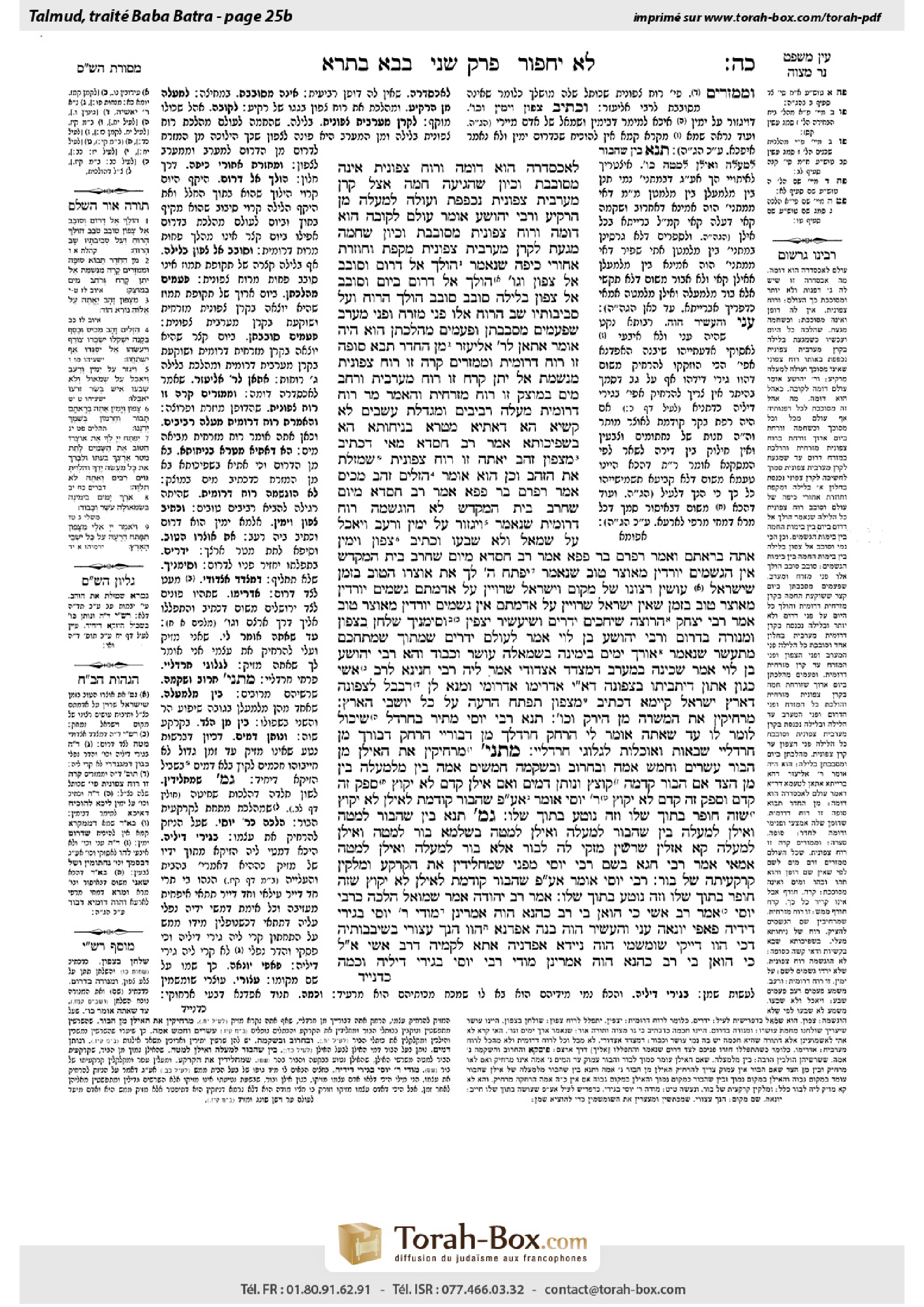
Bava Batra 25b: Talmud study for Daf Yomi
Study the Talmud for Daf Yomi with scanned pages, Hebrew text, English translations from Sefaria and AI-generated French translations.
Passage selection and English or AI-generated French translation are available where the scan has annotations. Daf Study is independent of Torah-Box and Sefaria.
Browse Bava Batra · בבא בתרא · All tractatesBava Batra 25b text and translations
This page of Bava Batra includes the Aramaic text, an English translation and an AI-generated French translation, alongside the scan above.
בבא בתרא כ״ה ב · Aramaic and Hebrew text
לְאַכְסַדְרָה הוּא דּוֹמֶה, וְרוּחַ צְפוֹנִית אֵינָהּ מְסוּבֶּבֶת, וְכֵיוָן שֶׁהִגִּיעָה חַמָּה אֵצֶל קֶרֶן מַעֲרָבִית צְפוֹנִית – נִכְפֶּפֶת וְעוֹלֶה לְמַעְלָה מִן הָרָקִיעַ. וְרַבִּי יְהוֹשֻׁעַ אוֹמֵר: עוֹלָם לְקוּבָּה הוּא דּוֹמֶה, וְרוּחַ צְפוֹנִית מְסוּבֶּבֶת, וְכֵיוָן שֶׁחַמָּה מַגַּעַת לְקֶרֶן מַעֲרָבִית צְפוֹנִית – מַקֶּפֶת וְחוֹזֶרֶת אֲחוֹרֵי כִיפָּה;
שֶׁנֶּאֱמַר: ״הוֹלֵךְ אֶל דָּרוֹם, וְסוֹבֵב אֶל צָפוֹן וְגוֹ׳״; ״הוֹלֵךְ אֶל דָּרוֹם״ – בַּיּוֹם. ״וְסוֹבֵב אֶל צָפוֹן״ – בַּלַּיְלָה. ״סוֹבֵב סֹבֵב הוֹלֵךְ הָרוּחַ וְעַל סְבִיבֹתָיו שָׁב הָרוּחַ״ – אֵלּוּ פְּנֵי מִזְרָח וּפְנֵי מַעֲרָב, שֶׁפְּעָמִים מְסַבַּבְתָּן וּפְעָמִים מְהַלַּכְתָּן.
הוּא הָיָה אוֹמֵר – אֲתָאן לְרַבִּי אֱלִיעֶזֶר: ״מִן הַחֶדֶר תָּבֹא סוּפָה״ – זוֹ רוּחַ דְּרוֹמִית. ״וּמִמְּזָרִים קָרָה״ – זוֹ רוּחַ צְפוֹנִית. ״מִנִּשְׁמַת אֵל יִתֶּן קָרַח״ – זוֹ רוּחַ מַעֲרָבִית. ״וְרֹחַב מַיִם בְּמוּצָק״ – זוֹ רוּחַ מִזְרָחִית.
וְהָאָמַר מָר: רוּחַ דְּרוֹמִית מַעֲלָה רְבִיבִים וּמְגַדֶּלֶת עֲשָׂבִים! לָא קַשְׁיָא; הָא דְּאָתְיָא מִטְרָא בְּנִיחוּתָא, הָא בִּשְׁפִיכוּתָא.
אָמַר רַב חִסְדָּא, מַאי דִּכְתִיב: ״מִצָּפוֹן זָהָב יֶאֱתֶה״? זוֹ רוּחַ צְפוֹנִית שֶׁמַּזֶּלֶת אֶת הַזָּהָב. וְכֵן הוּא אוֹמֵר: ״הַזָּלִים זָהָב מִכִּיס״.
אָמַר רַפְרָם בַּר פָּפָּא אָמַר רַב חִסְדָּא: מִיּוֹם שֶׁחָרַב בֵּית הַמִּקְדָּשׁ לֹא הוּגְשְׁמָה רוּחַ דְּרוֹמִית, שֶׁנֶּאֱמַר: ״וַיִּגְזֹר עַל יָמִין וְרָעֵב, וַיֹּאכַל עַל שְׂמֹאל וְלֹא שָׂבֵעוּ״, וּכְתִיב: ״צָפוֹן וְיָמִין אַתָּה בְרָאתָם״.
וְאָמַר רַפְרָם בַּר פָּפָּא אָמַר רַב חִסְדָּא: מִיּוֹם שֶׁחָרַב בֵּית הַמִּקְדָּשׁ אֵין הַגְּשָׁמִים יוֹרְדִין מֵאוֹצָר טוֹב, שֶׁנֶּאֱמַר: ״יִפְתַּח ה׳ לְךָ אֶת אוֹצָרוֹ הַטּוֹב״ – בִּזְמַן שֶׁיִּשְׂרָאֵל עוֹשִׂין רְצוֹנוֹ שֶׁל מָקוֹם, וְיִשְׂרָאֵל שְׁרוּיִין עַל אַדְמָתָם – גְּשָׁמִים יוֹרְדִין מֵאוֹצָר טוֹב; בִּזְמַן שֶׁאֵין יִשְׂרָאֵל שְׁרוּיִין עַל אַדְמָתָם – אֵין גְּשָׁמִים יוֹרְדִין מֵאוֹצָר טוֹב.
אָמַר רַבִּי יִצְחָק: הָרוֹצֶה שֶׁיַּחְכִּים – יַדְרִים, וְשֶׁיַּעֲשִׁיר – יַצְפִּין, וְסִימָנָיךְ: שֻׁלְחָן בַּצָּפוֹן וּמְנוֹרָה בַּדָּרוֹם. וְרַבִּי יְהוֹשֻׁעַ בֶּן לֵוִי אָמַר: לְעוֹלָם יַדְרִים, שֶׁמִּתּוֹךְ שֶׁמִּתְחַכֵּם מִתְעַשֵּׁר – שֶׁנֶּאֱמַר: אֹרֶךְ יָמִים בִּימִינָהּ, בִּשְׂמֹאלָהּ עֹשֶׁר וְכָבוֹד״.
וְהָא רַבִּי יְהוֹשֻׁעַ בֶּן לֵוִי אָמַר: שְׁכִינָה בַּמַּעֲרָב! דְּמַצְדֵּד אַצְדּוֹדֵי. אֲמַר לֵיהּ רַבִּי חֲנִינָא לְרַב אָשֵׁי: כְּגוֹן אַתּוּן, דְּיָתְבִיתוּ בִּצְפוֹנָהּ דְּאֶרֶץ יִשְׂרָאֵל – אַדְרִימוּ אַדְרוֹמֵי. וּמְנָא לַן דְּבָבֶל לִצְפוֹנָהּ דְּאֶרֶץ יִשְׂרָאֵל קָיְימָא? דִּכְתִיב: ״מִצָּפוֹן תִּפָּתַח הָרָעָה עַל כׇּל יֹשְׁבֵי הָאָרֶץ״.
מַרְחִיקִין אֶת הַמִּשְׁרָה מִן הַיָּרָק וְכוּ׳. תָּנָא: רַבִּי יוֹסֵי מַתִּיר בַּחַרְדָּל, שֶׁיָּכוֹל לוֹמַר לוֹ: עַד שֶׁאַתָּה אוֹמֵר לִי הַרְחֵק חַרְדָּלֶךָ מִן דְּבוֹרַיי; הַרְחֵק דְּבוֹרֶךָ מִן חַרְדָּלַיי, שֶׁבָּאוֹת וְאוֹכְלוֹת לִגְלוּגֵי חַרְדָּלַיי.
מַתְנִי׳ מַרְחִיקִין אֶת הָאִילָן מִן הַבּוֹר עֶשְׂרִים וְחָמֵשׁ אַמָּה, וּבְחָרוּב וּבַשִּׁקְמָה – חֲמִשִּׁים אַמָּה; בֵּין מִלְּמַעְלָה בֵּין מִן הַצַּד. אִם הַבּוֹר קָדְמָה – קוֹצֵץ וְנוֹתֵן דָּמִים, וְאִם אִילָן קָדַם – לֹא יָקוֹץ. סָפֵק זֶה קָדַם וְסָפֵק זֶה קָדַם – לֹא יָקוֹץ. רַבִּי יוֹסֵי אוֹמֵר: אַף עַל פִּי שֶׁהַבּוֹר קוֹדֶמֶת לָאִילָן – לֹא יָקוֹץ, שֶׁזֶּה חוֹפֵר בְּתוֹךְ שֶׁלּוֹ וְזֶה נוֹטֵעַ בְּתוֹךְ שֶׁלּוֹ.
גְּמָ׳ תָּנָא: בֵּין שֶׁהַבּוֹר לְמַטָּה וְאִילָן לְמַעְלָה, בֵּין שֶׁהַבּוֹר לְמַעְלָה וְאִילָן לְמַטָּה. בִּשְׁלָמָא בּוֹר לְמַטָּה וְאִילָן לְמַעְלָה – קָא אָזְלִין שׇׁרָשִׁין מַזְּקִי לַהּ לְבוֹר. אֶלָּא בּוֹר לְמַעְלָה וְאִילָן לְמַטָּה, אַמַּאי? אָמַר רַבִּי חַגָּא בְּשֵׁם רַבִּי יוֹסֵי: מִפְּנֵי שֶׁמַּחְלִידִין אֶת הַקַּרְקַע וּמַלְקִין קַרְקָעִיתָהּ שֶׁל בּוֹר.
רַבִּי יוֹסֵי אוֹמֵר: אַף עַל פִּי שֶׁהַבּוֹר קוֹדֶמֶת לְאִילָן – לֹא יָקוֹץ, שֶׁזֶּה חוֹפֵר בְּתוֹךְ שֶׁלּוֹ וְזֶה נוֹטֵעַ בְּתוֹךְ שֶׁלּוֹ. אָמַר רַב יְהוּדָה אָמַר שְׁמוּאֵל: הֲלָכָה כְּרַבִּי יוֹסֵי. אָמַר רַב אָשֵׁי: כִּי הֲוָאן בֵּי רַב כָּהֲנָא הֲוָה אָמְרִינַן: מוֹדֵי רַבִּי יוֹסֵי בְּגִירֵי דִידֵיהּ.
פָּאפִּי יוֹנָאָה עָנִי וְהֶעֱשִׁיר הֲוָה. בְּנָה אַפַּדְנָא. הֲווֹ הָנָךְ עָצוֹרֵי בְּשִׁיבָבוּתֵיהּ, דְּכִי הֲווֹ דָּיְיקִי שׁוּמְשְׁמֵי הֲוָה נָיְידָא אַפַּדְנֵיהּ. אֲתָא לְקַמֵּיהּ דְּרַב אָשֵׁי, אֲמַר לֵיהּ: כִּי הֲוָאן בֵּי רַב כָּהֲנָא הֲוָה אָמְרִינַן: מוֹדֵי רַבִּי יוֹסֵי בְּגִירֵי דִילֵיהּ.
וְכַמָּה?
Bava Batra 25b · English translation
is similar to a partially enclosed veranda [le’akhsadra], enclosed on three sides, and the northern side of the world is not enclosed with a partition like the other directions. The sun begins its revolution in the east and passes to the south and the west, and once the sun reaches the northwestern corner it turns around and ascends throughout the night above the sky to the east side and does not pass the north side. And Rabbi Yehoshua says: The world is similar to a small tent [lekubba], and the north side is enclosed with a partition as well, but once the sun reaches the northwestern corner it emerges from this small tent, and circles and passes behind the dome, i.e., outside the northern partition, until it reaches the east.
As it is stated: “The sun also rises and the sun goes down, and hastens to its place, where it rises again. It goes toward the south, and turns about to the north; round and round goes the wind, and on its circuits the wind returns” (Ecclesiastes 1:5–6). The verse is understood as describing the sun’s movements, as follows: “It goes toward the south” during the day, “and turns about to the north,” on the outside of the firmament, at night. “Round and round goes the wind [ruaḥ] and the wind returns again to its circuits”; as the word ruaḥ can also mean direction or side, Rabbi Yehoshua explains that these are the face of the east and the face of the west. Sometimes, in the short winter days, the sun turns about them without being seen, and sometimes, in the long summer days, it traverses them visibly.
The baraita continues: He would say. Before continuing its citation, the Gemara interjects: In this statement, we arrive at the opinion of Rabbi Eliezer that the world is like a partially enclosed veranda. The Gemara resumes its citation of the baraita: There is proof from a verse that the north side is open: “Out of the chamber comes the storm”; this is the southern side that forms a room with the other two sides. “And cold out of the dispersed parts” (Job 37:9); this is the northern side, which is open, and from which a cold wind comes. “By the breath of God ice is given”; this is the western side. “And the breadth of the waters is straitened” (Job 37:10); this is the eastern side, from which the rains come.
The Gemara asks: But doesn’t the Master say that the southern wind raises showers and causes herbs to grow? The Gemara answers that this is not difficult: This is referring to rain that falls gently, which waters plants and brings growth; that is referring to a downpour of rain that causes damage.
Rav Ḥisda said: What is the meaning of that which is written: “Out of the north comes gold” (Job 37:22)? This is the northern wind, which devalues gold by causing a drought that raises the price of grain. And, in addition, it says: “You who lavish gold out of the bag” (Isaiah 46:6).
§ Rafram bar Pappa says that Rav Ḥisda says: From the day the Temple was destroyed the southern wind has not brought rain, as it is stated in the description of the destruction of the Temple: “He decrees on the right and there is hunger, and consumes on the left and they are not satisfied” (Isaiah 9:19). This means that God decreed that the southern wind, which is called right, shall bring famine with it. And it is written: “North and right, You have created them” (Psalms 89:13). This proves that the term right means south.
And Rafram bar Pappa says that Rav Ḥisda says: From the day the Temple was destroyed, the rains no longer descend from the good storehouse, as it is stated: “The Lord will open to you His good storehouse, the skies, to give the rain of your land in its season” (Deuteronomy 28:12). In a time when the Jewish people perform God’s will, and the Jewish people are settled in their land, rain descends from the good storehouse. In a time when the Jewish people are not settled in their land, rain does not descend from the good storehouse.
Rabbi Yitzḥak says: One who wishes to become wise should face south, and one who wishes to become wealthy should face north. And your mnemonic for this is that in the Temple the Table, which symbolized blessing and abundance, was in the north, and the Candelabrum, which symbolized the light of wisdom, was in the south of the Sanctuary. And Rabbi Yehoshua ben Levi says: One should always face south, as once he becomes wise he will subsequently also become wealthy, as it is stated with regard to the Torah: “Length of days is in her right hand; in her left hand are riches and honor” (Proverbs 3:16).
The Gemara asks: But Rabbi Yehoshua ben Levi says that the Divine Presence is in the west. How, then, can one pray facing south? The Gemara explains that one should turn aside slightly, so that he faces southwest. Rabbi Ḥanina said to Rav Ashi: An individual such as you, who lives to the north of Eretz Yisrael, should face south when you pray. And from where do we derive that Babylonia is located to the north of Eretz Yisrael? As it is written in a prophecy concerning the destruction of Jerusalem by the Babylonians: “Out of the north evil shall break forth upon all the inhabitants of the land” (Jeremiah 1:14).
§ The mishna teaches that one must distance from vegetables the water in which flax is steeped, and distance mustard from bees. A Sage taught that Rabbi Yosei permits one not to do so in the case of mustard because he can say to the beekeeper: Before you tell me: Distance your mustard from my bees, I can tell you: Distance your bees from my mustard, as they come and eat my mustard plants. In other words, you are also causing damage to my property. Since they each cause damage to the other, neither can force his neighbor to move.
MISHNA: One must distance a tree twenty-five cubits from a cistern, and in the case of a carob and of a sycamore tree, whose roots extend farther, one must distance the tree fifty cubits. This is the halakha whether the cistern or tree is located above or to the side of the other. If the digging of the cistern preceded the tree, the owner of the tree cuts down the tree and the owner of the cistern pays him money. And if the tree preceded the cistern the owner of the tree need not cut down the tree. If it is uncertain whether this came first or that came first, the owner of the tree need not cut down the tree. Rabbi Yosei says: Even if the cistern preceded the tree, the owner of the tree need not cut down the tree. This is due to the fact that this one digs in his own property, and that one plants in his own property.
GEMARA: The Gemara discusses the mishna’s statement that a tree must be distanced if it is above a cistern. A Sage taught: This is the halakha whether the cistern is below and the tree is above, or whether the cistern is above and the tree is below. The Gemara asks: Granted, if the cistern is below and the tree is above, it will cause damage, as the roots extend and damage the cistern when they breach its walls. But if the cistern is above and the tree is below, why should he have to distance the tree, considering that the roots extend downward? Rabbi Ḥagga says in the name of Rabbi Yosei: He must distance the tree because its roots form holes in the ground and ruin the floor of the cistern.
Rabbi Yosei says: Even if the cistern preceded the tree, the owner of the tree need not cut down the tree. This is due to the fact that this one digs in his own property, and that one plants in his own property. Rav Yehuda says that Shmuel says: The halakha is in accordance with the opinion of Rabbi Yosei. Rav Ashi said: When we were studying in the study hall of Rav Kahana, we would say that Rabbi Yosei concedes with regard to one’s arrows, i.e., one must distance his activities from his neighbor if his actions will cause immediate damage to his neighbor, even if he is acting on his own property.
The Gemara relates that a man called Pappei Yona’a was poor and became wealthy. He built a mansion [appadna] on his land. There were these sesame seed pressers in his neighborhood who would work, and when they would press the sesame seeds their activity would shake his mansion. He came before Rav Ashi to complain. Rav Ashi said to him: When we were studying in the study hall of Rav Kahana, we would say that Rabbi Yosei concedes with regard to one’s arrows. Here too, because the sesame seed pressers cause immediate damage they must distance themselves.
The Gemara asks: And how much must the mansion shake for the owner to have the right to compel the sesame seed pressers to distance themselves?
Bava Batra 25b · Traduction française (IA)
Il est semblable à une véranda partiellement enclose [le’akhsadra], enclose sur trois côtés, et le côté nord du monde n’est pas enclos avec une cloison comme les autres directions. Le soleil commence sa révolution à l’est et passe vers le sud et l’ouest, et une fois que le soleil atteint le coin nord-ouest, il fait demi-tour et monte toute la nuit au-dessus du ciel vers le côté est et ne passe pas le côté nord. Et Rabbi Yéhoshua dit : Le monde est semblable à un petit abri [lekubba], et le côté nord est également enclos avec une cloison, mais une fois que le soleil atteint le coin nord-ouest, il sort de cet abri petit, et fait le tour et passe derrière le dôme, c’est-à-dire en dehors de la cloison du nord, jusqu’à ce qu’il atteigne l’est.
Comme il est dit : « Le soleil monte aussi et le soleil descend, et hâte son retour, où il renaît. Il va vers le sud, et tourne vers le nord ; tour à tour va le vent, et sur ses circuits le vent revient » (Ecclésiaste 1:5–6). La versette est comprise comme décrivant les mouvements du soleil, comme suit : « Il va vers le sud » pendant la journée, « et tourne vers le nord », en dehors du firmament, la nuit. « Tour à tour va le vent [ruaḥ] et le vent revient à ses circuits » ; comme le mot ruaḥ peut aussi signifier direction ou côté, Rabbi Yéhoshua explique que ces sont les faces de l’est et de l’ouest. Parfois, en jours d’hiver courts, le soleil tourne autour sans être vu, et parfois, en jours d’été longs, il traverse visiblement ces côtés.
La baraïta continue : Il disait. Avant de reprendre sa citation, le Guemara interrompt : Dans cette déclaration, nous arrivons à l’opinion de Rabbi Eléazar que le monde est comme une véranda partiellement enclose. Le Guemara reprend sa citation de la baraïta : Il y a une preuve d’un verset que le côté nord est ouvert : « De la chambre vient la tempête » ; c’est le côté sud qui forme une pièce avec les deux autres côtés. « Et le froid sort des parties dispersées » (Job 37:9) ; c’est le côté nord, qui est ouvert, d’où vient un vent froid. « Par le souffle de Dieu est donnée la glace » ; c’est le côté ouest. « Et la largeur des eaux est resserrée » (Job 37:10) ; c’est le côté est, d’où viennent les pluies.
Le Guemara demande : Mais n’a-t-il pas dit le Maître que le vent du sud provoque des pluies et fait pousser les herbes ? Le Guemara répond que cela n’est pas difficile : cela fait référence à des pluies légères qui arrosent les plantes et favorisent la croissance ; cela fait référence à une pluie torrentielle qui cause des dégâts.
Rav Ḥisda dit : Quelle est la signification de ce qui est écrit : « De l’or est venu du nord » (Job 37:22) ? C’est le vent du nord, qui déprécie l’or en causant une sécheresse qui fait monter le prix du blé. Et, en outre, il est dit : « Toi qui verses l’or de la sacoche » (Isaïe 46:6).
§ Rafram bar Pappa dit que Rav Ḥisda dit : Depuis que le Temple a été détruit, le vent du sud n’a plus apporté la pluie, comme il est dit dans la description de la destruction du Temple : « Il ordonne à la droite et là il y a faim, et consume à la gauche et ils ne sont pas rassasiés » (Isaïe 9:19). Cela signifie que Dieu a ordonné que le vent du sud, qui est appelé droite, apporte la famine avec lui. Et il est dit : « Nord et droite, tu les as créés » (Psaumes 89:13). Cela prouve que le terme droite signifie le sud.
Et Rafram bar Pappa dit que Rav Ḥisda dit : Depuis que le Temple a été détruit, les pluies ne descendent plus du bon entrepôt, comme il est dit : « L’Eternel ouvrira à toi son bon entrepôt, les cieux, pour donner la pluie de ta terre à sa saison » (Deutéronome 28:12). À une époque où le peuple juif accomplit la volonté d’Elohim et est établi dans sa terre, les pluies descendent du bon entrepôt. À une époque où le peuple juif n’est pas établi dans sa terre, les pluies ne descendent pas du bon entrepôt.
Rabbi Yitzḥak dit : Celui qui veut devenir sage devrait se tourner vers le sud, et celui qui veut devenir riche devrait se tourner vers le nord. Et votre mnémonique pour cela est que dans le Temple, la Table, qui symbolisait la bénédiction et l’abondance, était au nord, et le Candelabre, qui symbolisait la lumière de la sagesse, était au sud du Sanctuaire. Et Rabbi Yéhoshua ben Levi dit : On devrait toujours se tourner vers le sud, car une fois qu’on devient sage, on deviendra ensuite aussi riche, comme il est dit concernant la Torah : « La longue durée des jours est à sa main droite ; à sa main gauche sont les richesses et l’honneur » (Proverbes 3:16).
Le Guemara demande : Mais Rabbi Yéhoshua ben Levi dit que la Présence divine est à l’ouest. Comment alors peut-on prier en se tournant vers le sud ? Le Guemara explique qu’on devrait se détourner légèrement, de sorte que l’on face vers le sud-ouest. Rabbi Ḥanina dit à Rav Ashi : Un individu tel que vous, qui vit au nord d’Eretz Yisrael, devrait se tourner vers le sud lors de vos prières. Et d’où dérivons-nous que Babylone est située au nord d’Eretz Yisrael ? Comme il est écrit dans une prophétie concernant la destruction de Jérusalem par les Babyloniens : « Du nord sortira le mal sur tous les habitants de la terre » (Jérémie 1:14).
§ La mishna enseigne qu’il faut s’éloigner des légumes de l’eau dans laquelle on immerge le lin, et s’éloigner de la moutarde des abeilles. Un Sage enseigna que Rabbi Yosei permet à l’individu de ne pas le faire dans le cas de la moutarde, car il peut dire au propriétaire des abeilles : Avant que vous ne me disiez : Éloignez votre moutarde de mes abeilles, je peux vous dire : Éloignez vos abeilles de ma moutarde, car elles viennent et mangent mes plantes de moutarde. En d’autres termes, vous me causez aussi des dégâts. Puisque chacun cause des dégâts à l’autre, aucun ne peut obliger son voisin à se déplacer.
MICHNA : On doit éloigner un arbre vingt-cinq coudées d'un puits, et dans le cas d'un carob ou d'un saul, dont les racines s'étendent davantage, on doit éloigner l'arbre cinquante coudées. C'est la halakha, qu'importe que le puits ou l'arbre soient situés au-dessus ou à côté de l'autre. Si la construction du puits a précédé l'arbre, l'propriétaire de l'arbre abat l'arbre et l'propriétaire du puits lui paie de l'argent. Et si l'arbre a précédé le puits, l'propriétaire de l'arbre n'a pas besoin d'abattre l'arbre. Si on ne sait pas si c'est celui-ci ou celui-là qui a précédé, l'propriétaire de l'arbre n'a pas besoin d'abattre l'arbre. Rabbi Yosei dit : Même si le puits a précédé l'arbre, l'propriétaire de l'arbre n'a pas besoin d'abattre l'arbre. Cela est dû au fait que celui-ci creuse sur sa propre propriété, et celui-là plante sur sa propre propriété.
GUEMARA : La Guemara discute de la déclaration de la Michna selon laquelle un arbre doit être éloigné s'il est au-dessus d'un puits. Un Sage a enseigné : C'est la halakha, qu'importe que le puits soit en dessous et l'arbre au-dessus, ou que le puits soit au-dessus et l'arbre en dessous. La Guemara pose la question : D'accord, si le puits est en dessous et l'arbre au-dessus, cela causera un préjudice, car les racines s'étendent et endommagent le puits lorsqu'elles percèrent ses murs. Mais si le puits est au-dessus et l'arbre en dessous, pourquoi doit-on éloigner l'arbre, sachant que les racines s'étendent vers le bas ? Rabbi Ḥagga, en nom de Rabbi Yosei, dit : On doit éloigner l'arbre car ses racines forment des trous dans le sol et ruinent le plancher du puits.
Rabbi Yosei dit : Même si le puits a précédé l'arbre, l'propriétaire de l'arbre n'a pas besoin d'abattre l'arbre. Cela est dû au fait que celui-ci creuse sur sa propre propriété, et celui-là plante sur sa propre propriété. Rav Yehuda dit que Shmuel dit : La halakha suit l'opinion de Rabbi Yosei. Rav Ashi a dit : Lorsque nous étudiions dans la salle de study de Rav Kahana, nous disions que Rabbi Yosei concède en ce qui concerne les flèches d'une personne, c'est-à-dire qu'on doit éloigner ses activités de son voisin si ses actions causent un préjudice immédiat à son voisin, même s'il agit sur sa propre propriété.
La Guemara rapporte qu'un homme appelé Pappei Yona’a était pauvre et est devenu riche. Il a construit une maison [appadna] sur sa terre. Il y avait ces presses de grain de sésame dans son voisinage qui travaillaient, et lorsqu'ils pressaient les graines de sésame, leur activité secouait sa maison. Il est venu devant Rav Ashi pour se plaindre. Rav Ashi a dit à lui : Lorsque nous étudiions dans la salle de study de Rav Kahana, nous disions que Rabbi Yosei concède en ce qui concerne les flèches d'une personne. Ici aussi, car les presses de grain de sésame causent un préjudice immédiat, elles doivent s'éloigner.
La Guemara pose la question : Et jusqu'à quel point la maison doit-elle trembler pour que l'propriétaire ait le droit de faire s'éloigner les presses de grain de sésame ?
Traduction française générée par IA à partir de l’édition anglaise de Sefaria. Vérifie toujours un passage avec le texte source.
Text from Sefaria: William Davidson Edition - Vocalized Aramaic (CC BY NC); William Davidson Edition - English (CC BY NC).