Bava Batra 26a: Talmud study for Daf Yomi
Study the Talmud for Daf Yomi with scanned pages, Hebrew text, English translations from Sefaria and AI-generated French translations.
Passage selection and English or AI-generated French translation are available where the scan has annotations. Daf Study is independent of Torah-Box and Sefaria.
Browse Bava Batra · בבא בתרא · All tractatesBava Batra 26a text and translations
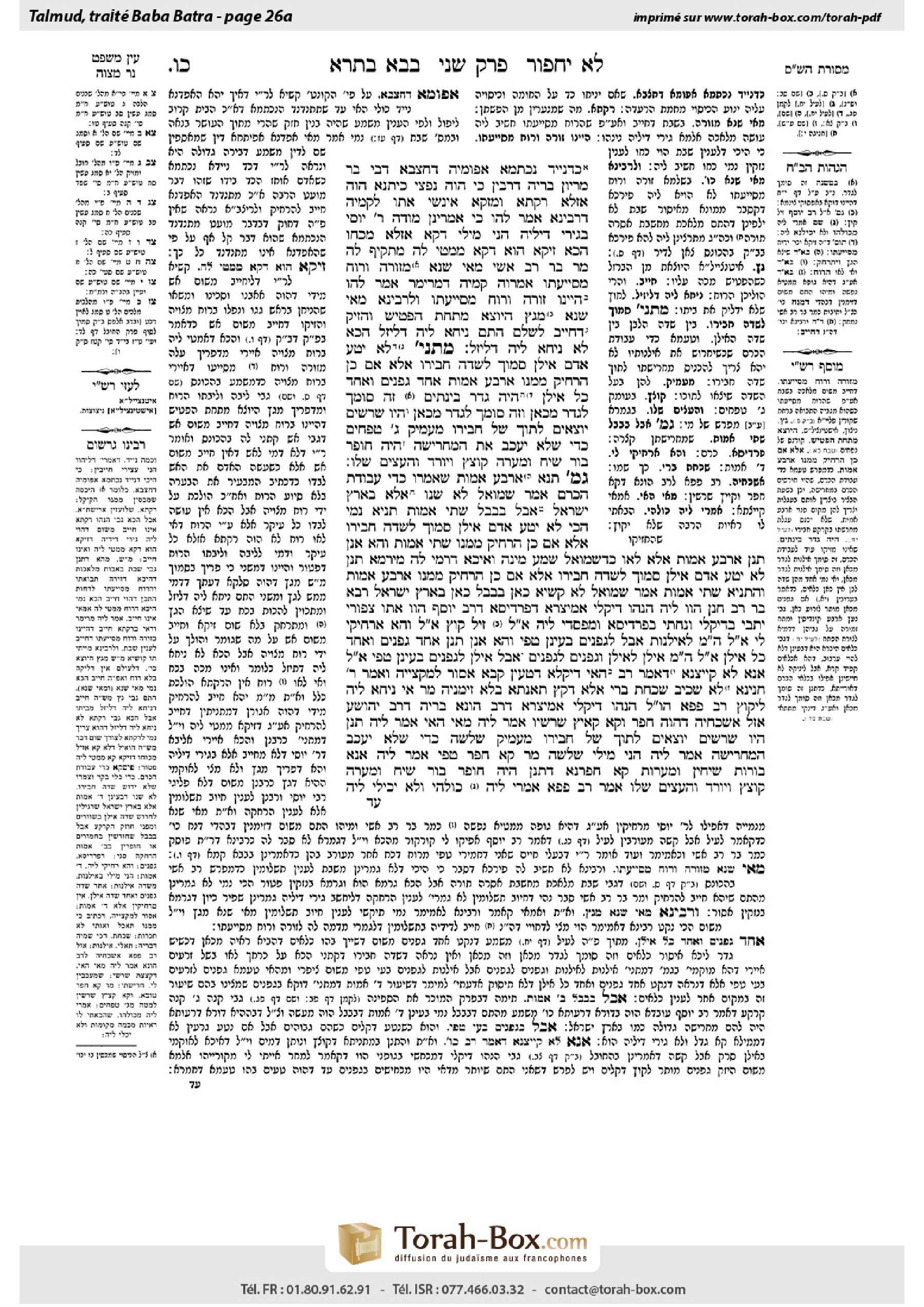
This page of Bava Batra includes the Aramaic text, an English translation and an AI-generated French translation, alongside the scan above.
בבא בתרא כ״ו א · Aramaic and Hebrew text
כִּדְנָיֵיד נִכְתְּמָא אַפּוּמֵּיהּ דְּחַצְבָּא.
דְּבֵי בַּר מָרִיּוֹן בְּרֵיהּ דְּרָבִין, כִּי הֲוָה נָפְצִי כִּיתָּנָא – הֲוָה אָזְלָא רַקְתָּא וּמַזְּקָא אִינָשֵׁי. אֲתוֹ לְקַמֵּיהּ דְּרָבִינָא, אֲמַר לְהוּ: כִּי אָמְרִינַן מוֹדֶה רַבִּי יוֹסֵי בְּגִירֵי דִּילֵיהּ – הָנֵי מִילֵּי דְּקָא אָזְלָא מִכֹּחוֹ, הָכָא – זִיקָא הוּא דְּקָא מַמְטֵי לַהּ.
מַתְקֵיף לַהּ מָר בַּר רַב אָשֵׁי: מַאי שְׁנָא מִזּוֹרֶה וְרוּחַ מְסַיַּיעְתּוֹ? אַמְרוּהָ קַמֵּיהּ דְּמָרִימָר, אֲמַר לְהוּ: הַיְינוּ זוֹרֶה וְרוּחַ מְסַיַּיעְתּוֹ.
וּלְרָבִינָא, מַאי שְׁנָא מִגֵּץ הַיּוֹצֵא מִתַּחַת הַפַּטִּישׁ וְהִזִּיק – דְּחַיָּיב לְשַׁלֵּם? הָתָם נִיחָא לֵיהּ דְּלֵיזִל, הָכָא לָא נִיחָא לֵיהּ דְּלֵיזִל.
מַתְנִי׳ לֹא יִטַּע אָדָם אִילָן סָמוּךְ לִשְׂדֵה חֲבֵירוֹ, אֶלָּא אִם כֵּן הִרְחִיק מִמֶּנּוּ אַרְבַּע אַמּוֹת – אֶחָד גְּפָנִים וְאֶחָד כׇּל אִילָן. הָיָה גָּדֵר בֵּינָתַיִם – זֶה סוֹמֵךְ לַגָּדֵר מִכָּאן, וְזֶה סוֹמֵךְ לַגָּדֵר מִכָּאן.
הָיוּ שׇׁרָשִׁים יוֹצְאִים לְתוֹךְ שֶׁל חֲבֵירוֹ – מַעֲמִיק שְׁלֹשָׁה טְפָחִים, כְּדֵי שֶׁלֹּא יְעַכֵּב אֶת הַמַּחֲרֵישָׁה. הָיָה חוֹפֵר בּוֹר, שִׁיחַ וּמְעָרָה – קוֹצֵץ וְיוֹרֵד, וְהָעֵצִים שֶׁלּוֹ.
גְּמָ׳ תָּנָא: אַרְבַּע אַמּוֹת שֶׁאָמְרוּ – כְּדֵי עֲבוֹדַת הַכֶּרֶם. אָמַר שְׁמוּאֵל: לֹא שָׁנוּ אֶלָּא בְּאֶרֶץ יִשְׂרָאֵל, אֲבָל בְּבָבֶל – שְׁתֵּי אַמּוֹת. תַּנְיָא נָמֵי הָכִי: לֹא יִטַּע אָדָם אִילָן סָמוּךְ לִשְׂדֵה חֲבֵירוֹ, אֶלָּא אִם כֵּן הִרְחִיק מִמֶּנּוּ שְׁתֵּי אַמּוֹת. וְהָא אֲנַן תְּנַן: אַרְבַּע אַמּוֹת! אֶלָּא לָאו כְּדִשְׁמוּאֵל? שְׁמַע מִינַּהּ.
וְאִיכָּא דְּרָמֵי לַהּ מִירְמֵא – תְּנַן: לֹא יִטַּע אָדָם אִילָן סָמוּךְ לִשְׂדֵה חֲבֵירוֹ, אֶלָּא אִם כֵּן הִרְחִיק מִמֶּנּוּ אַרְבַּע אַמּוֹת. וְהָתַנְיָא: שְׁתֵּי אַמּוֹת! אָמַר שְׁמוּאֵל: לָא קַשְׁיָא; כָּאן בְּבָבֶל, כָּאן בְּאֶרֶץ יִשְׂרָאֵל.
רָבָא בַּר רַב חָנָן הֲווֹ לֵיהּ הָנְהוּ דִּיקְלֵי, אַמִּיצְרָא דְּפַרְדֵּיסָא דְּרַב יוֹסֵף. הֲווֹ אָתוּ צִפּוֹרֵי יָתְבִי בְּדִיקְלֵי, וְנָחֲתִי בְּפַרְדֵּיסָא וּמַפְסְדִי לֵיהּ. אֲמַר לֵיהּ: זִיל קוֹץ. אֲמַר לֵיהּ: וְהָא אַרְחֵיקִי לִי! אֲמַר לֵיהּ: הָנֵי מִילֵּי לְאִילָנוֹת, אֲבָל לִגְפָנִים בָּעִינַן טְפֵי.
וְהָא אֲנַן תְּנַן: אֶחָד גְּפָנִים וְאֶחָד כׇּל אִילָן! אֲמַר לֵיהּ: הָנֵי מִילֵּי אִילָן לְאִילָן וּגְפָנִים לִגְפָנִים, אֲבָל אִילָן לִגְפָנִים בָּעִינַן טְפֵי.
אֲמַר לֵיהּ: אֲנָא לָא קָיֵיצְנָא, דְּאָמַר רַב: הַאי דִּיקְלָא דְּטָעֵין קַבָּא – אָסוּר לְמִקְצְיֵיהּ. וְאָמַר רַבִּי חֲנִינָא: לָא שְׁכֵיב שִׁכְחַת בְּרִי, אֶלָּא דְּקַץ תְּאֵנְתָּא בְּלָא זִימְנֵיהּ. מָר – אִי נִיחָא לֵיהּ, לִיקּוֹץ.
רַב פָּפָּא הֲווֹ לֵיהּ הָנְהוּ דִּיקְלֵי אַמִּיצְרָא דְּרַב הוּנָא בְּרֵיהּ דְּרַב יְהוֹשֻׁעַ. אֲזַל אַשְׁכְּחֵיהּ דַּהֲוָה חָפַר, וְקָא קָאֵיץ שׇׁרָשָׁיו. אֲמַר לֵיהּ: מַאי הַאי? אֲמַר לֵיהּ, תְּנַן: הָיוּ שׇׁרָשִׁים יוֹצְאִים לְתוֹךְ שֶׁל חֲבֵירוֹ – מַעֲמִיק שְׁלֹשָׁה, כְּדֵי שֶׁלֹּא יְעַכֵּב הַמַּחֲרֵישָׁה.
אֲמַר לֵיהּ: הָנֵי מִילֵּי שְׁלֹשָׁה, מָר קָא חָפַר טְפֵי! אֲמַר לֵיהּ: אֲנָא בּוֹרוֹת שִׁיחִין וּמְעָרוֹת קָא חָפַרְנָא – דִּתְנַן: הָיָה חוֹפֵר בּוֹר, שִׁיחַ וּמְעָרָה – קוֹצֵץ וְיוֹרֵד, וְהָעֵצִים שֶׁלּוֹ. אָמַר רַב פָּפָּא: אֲמַרִי לֵיהּ כּוּלְּהִי, וְלָא יְכֵילִי לֵיהּ;
Bava Batra 26a · English translation
It must shake enough that the lid [nakhtema] positioned at the mouth of a jug shakes if it is placed on a wall.
The Gemara relates: When the members of the household of bar Maryon, son of Ravin, would beat their flax, the chaff [rakta] would fly off and harm people. Those people came before Ravina to complain. Ravina said to them: When we say that Rabbi Yosei concedes with regard to his arrows, this statement applies only when the damaging item moves by his direct force. Here, by contrast, it is the wind that carries the chaff.
Mar bar Rav Ashi objects to this: In what way is this case different from one who winnows on Shabbat by throwing the grain into the wind so that the chaff is blown away and the wind assists him? That is considered a primary category of labor on Shabbat despite the fact that the act is performed partly with the aid of the wind. The Gemara relates that the Sages stated this objection with regard to beating flax before Mareimar. Mareimar said to them: This case is the same as one who winnows and the wind assists him. Just as this is considered his direct force for the purposes of the halakhot of Shabbat, it is likewise considered his direct force with regard to the halakhot of damages.
The Gemara asks: And according to the opinion of Ravina, who rejects this comparison and claims that flying chaff is not considered one’s arrow, in what way is this situation different from that of a spark that flies from a hammer and causes damage, in which case all agree that the one wielding the hammer is liable to pay? The Gemara answers: There, it is preferable for him that the spark go as far as possible, rather than staying nearby. Here it is not preferable for him, i.e., it is immaterial to him, that the chaff go some distance.
MISHNA: A person may not plant a tree near the field of another unless he distances it four cubits from the field. This is the case whether he is planting grapevines or any kind of tree. If there was a fence between them, this one may place, i.e., plant, his grapevines or trees close to the fence from here, and that one may place, i.e., plant, his produce close to the fence from there.
If the roots were spreading into the field of another, the owner of the field may dig to a depth of three handbreadths even if he severs those roots, so that they do not impede his plow. If he was digging a cistern in that spot, or a ditch, or a cave, and he came upon the roots of his neighbor’s tree, he may cut downward normally, and the wood from the roots is his.
GEMARA: A tanna taught: The four cubits that the Sages stated one must leave between a vineyard and a neighbor’s field are for the work of the vineyard, so that the owner of the vineyard does not take oxen and a plow into his neighbor’s field while working his vineyard. Shmuel says: They taught this halakha only with regard to Eretz Yisrael, but in Babylonia two cubits are sufficient, as their plows are shorter. This opinion is also taught in a baraita: A person may not plant a tree near the field of another unless he distances the tree two cubits from the field. But didn’t we learn in the mishna: Four cubits? Rather, is it not correct that there is a difference between Eretz Yisrael and Babylonia in this regard, as stated by Shmuel? The Gemara concludes: Indeed, learn from it that it is so.
And there are those who raise this matter in the form of a contradiction. We learned in the mishna that a person may not plant a tree near the field of another unless he distances it four cubits from the field. But isn’t it taught in a baraita that two cubits are sufficient? Shmuel said that this is not difficult: Here it is referring to Babylonia, whereas there it is referring to Eretz Yisrael.
The Gemara relates: Rava bar Rav Ḥanan had these palm trees that stood adjacent to the boundary of Rav Yosef’s vineyard. Birds would come and roost on the palm trees and would subsequently descend to the vineyard and damage it. Rav Yosef said to Rava bar Rav Ḥanan: Go and cut down your palm trees. Rava bar Rav Ḥanan said to him: But I distanced them the required amount. Rav Yosef said to him: This matter, i.e., this specific distance, applies only to trees, but a greater distance is required for vines.
Rava bar Rav Ḥanan protested: But didn’t we learn in the mishna that this is the halakha whether he is planting grapevines or any kind of tree? Rav Yosef said to him: This matter applies only to the distance between one tree and another tree, or the distance between one vine and other vines. But with regard to the space between a tree and vines, one requires a greater distance.
Rava bar Rav Ḥanan said to him: I myself will not cut them down, as Rav said: With regard to this palm tree that produces one kav of fruit, it is prohibited to cut it down, due to the verse: “You shall not destroy the trees” (Deuteronomy 20:19). And Rabbi Ḥanina says: My son Shikhḥat died only because he cut down a fig tree before its time. Rava bar Rav Ḥanan continued: If the Master is amenable to do so, he may cut them down, but I will not do it.
The Gemara further relates that Rav Pappa had these palm trees that stood adjacent to the boundary of the property of Rav Huna, son of Rav Yehoshua. He went and found Rav Huna digging and cutting his roots. Rav Pappa said to him: What is this? Rav Huna said to him that we learned in the mishna: If the roots were spreading into the field of another, the owner of the field may dig to a depth of three handbreadths even if he severs those roots, so that they do not impede his plow.
Rav Pappa said to him: This statement applies only up to three handbreadths, whereas the Master is digging and cutting more than three. Rav Huna said to him: I am digging cisterns, ditches, and caves, as we learned in the mishna: If he was digging a cistern, a ditch, or a cave, he may cut downward normally and the wood from the roots is his. Rav Pappa said: I told him all the proofs I could find, but I was unable to convince him that I was correct,
Bava Batra 26a · Traduction française (IA)
Il faut qu'il secoue suffisamment pour que le couvercle [nakhtema] placé à la bouche d'un récipient secoue s'il est posé contre un mur.
La Guemara rapporte : Lorsque les membres de la famille de bar Maryon, fils de Ravin, battaient leur lin, les débris [rakta] volaient et faisaient du mal aux gens. Ces gens se sont présentés devant Ravina pour se plaindre. Ravina a dit à ceux-ci : Lorsque nous disons que Rabbi Yosei concède concernant ses flèches, cette déclaration s'applique uniquement lorsque l'objet nuisible se déplace par sa force directe. Ici, par contraste, c'est le vent qui transporte les débris.
Mar bar Rav Ashi s'oppose à cela : Dans quelle mesure ce cas diffère-t-il de celui qui sépare sur le Shabbat en lançant le grain dans le vent afin que les débris soient emportés et que le vent l'assiste ? Cela est considéré comme une catégorie principale de travail sur le Shabbat, malgré le fait que l'acte est exécuté en partie avec l'aide du vent. La Guemara rapporte que les Sages ont formulé cette objection concernant le battage du lin avant Mareimar. Mareimar a dit à ceux-ci : Ce cas est le même que celui qui sépare et le vent l'assiste. Aussi bien que cela est considéré comme sa force directe pour les halakhot du Shabbat, il est également considéré comme sa force directe concernant les halakhot des dommages.
La Guemara pose la question : Et selon l'opinion de Ravina, qui rejette cette comparaison et affirme que les débris volants ne sont pas considérés comme ses flèches, dans quelle mesure ce cas diffère-t-il de celui d'une étincelle provenant d'un marteau et causant des dommages, dans lequel tous conviennent que celui qui tient le marteau est responsable de payer ? La Guemara répond : Là, il est préférable qu'il parte aussi loin que possible, plutôt que de rester près. Ici, il n'est pas préférable, c'est-à-dire cela n'a pas d'importance, que les débris aillent à une certaine distance.
MICHNA : Une personne ne peut pas planter un arbre près du champ d'autrui à moins qu'il le distante de quatre coudées du champ. Cela s'applique qu'il s'agisse de vigne ou d'un autre type d'arbre. Si un mur séparait les deux, celui-ci pourrait planter ses vigne ou ses arbres à proximité du mur d'ici, et celui-là pourrait planter ses produits à proximité du mur d'ailleurs.
Si les racines s'étendaient dans le champ d'autrui, l'propriétaire du champ peut creuser à une profondeur de trois tefachim même s'il coupe ces racines, afin qu'elles ne gêrent pas son charrue. Si il creusait un puits dans cet endroit, ou un canal, ou une grotte, et qu'il trouvait les racines d'un arbre de son voisin, il peut couper normalement en dessous, et le bois des racines est à lui.
GUEMARA : Un tanna a enseigné : Les quatre coudées que les Sages ont dit qu'on doit laisser entre un domaine de vigne et le champ d'un voisin sont pour le travail du domaine de vigne, afin que l'propriétaire du domaine de vigne ne prenne pas des bœufs et une charrue dans le champ de son voisin pendant qu'il travaille son domaine de vigne. Shmuel dit : Ils ont enseigné cette halakha uniquement concernant Eretz Yisrael, mais en Babylonie deux coudées suffisent, car leurs charrues sont plus courtes. Cette opinion est également enseignée dans une baraïta : Une personne ne peut pas planter un arbre près du champ d'autrui à moins qu'il distante l'arbre de deux coudées du champ. Mais n'avons-nous pas appris dans la mishna : Quatre coudées ? Plutôt, n'est-ce pas correct que cela diffère entre Eretz Yisrael et Babylonie à ce sujet, comme l'a dit Shmuel ? La Guemara conclut : En effet, apprenez-en que c'est ainsi.
Et il y a ceux qui soulevent cette question sous forme de contradiction. Nous avons appris dans la mishna que une personne ne peut pas planter un arbre près du champ d'autrui à moins qu'il le distante de quatre coudées du champ. Mais n'est-ce pas enseigné dans une baraïta que deux coudées suffisent ? Shmuel a dit que cela n'est pas difficile : Ici, il s'agit de Babylonie, tandis que là, il s'agit d'Eretz Yisrael.
La Guemara rapporte : Rava bar Rav Ḥanan avait ces palmiers qui se dressaient adjacent à la limite du domaine de Rav Yosef. Des oiseaux venaient y faire leur nid et descendaient ensuite dans le domaine de vigne et y causaient des dommages. Rav Yosef a dit à Rava bar Rav Ḥanan : Va et coupe tes palmiers. Rava bar Rav Ḥanan a dit à lui : Mais j'ai distancé les palmiers de la distance requise. Rav Yosef a dit à lui : Cette question, c'est-à-dire cette distance spécifique, s'applique uniquement aux arbres, mais une distance plus grande est requise pour les vigne.
Rava bar Rav Ḥanan s'est plaint : Mais n'avons-nous pas appris dans la mishna que c'est la halakha qu'il s'agisse de planter des vigne ou n'importe quel arbre ? Rav Yosef a dit à lui : Cette question s'applique uniquement à la distance entre un arbre et un autre arbre, ou entre une vigne et d'autres vignes. Mais concernant la distance entre un arbre et des vigne, on exige une distance plus grande.
Rava bar Rav Ḥanan a dit à lui : Je ne couperai pas moi-même ces arbres, car Rav a dit : Concernant ce palmier qui produit un kav de fruits, il est interdit de le couper, d'après la parole : « Vous ne détruirez pas les arbres » (Deutéronome 20:19). Et Rabbi Ḥanina dit : Mon fils Shikhḥat est mort uniquement parce qu'il a coupé un arbre de figue avant l'heure. Rava bar Rav Ḥanan a continué : Si le Maître est d'accord pour le faire, il peut les couper, mais je ne le ferai pas.
La Guemara rapporte davantage que Rav Pappa avait ces palmiers qui se dressaient adjacent à la limite de la propriété de Rav Huna, fils de Rav Yehoshua. Il est allé et a trouvé Rav Huna qui creusait et coupait ses racines. Rav Pappa a dit à lui : Qu'est-ce que c'est ? Rav Huna a dit à lui que nous avons appris dans la mishna : Si les racines s'étendaient dans le champ d'autrui, l'propriétaire du champ peut creuser à une profondeur de trois tefachim même s'il coupe ces racines, afin qu'elles ne gêrent pas sa charrue.
Rav Pappa dit à lui : Cette déclaration s'applique uniquement jusqu'à trois paumes, tandis que le Maître creuse et taille au-delà de trois paumes. Rav Huna dit à lui : Je creuse des puits, des canaux et des grottes, comme nous l'avons appris dans la mitsva : Si l'on creuse un puit, un canal ou une grotte, on peut tailler normalement vers le bas et le bois provenant des racines est à lui. Rav Pappa dit : J'ai présenté à lui toutes les preuves que je pouvais trouver, mais je n'ai pas réussi à le convaincre que j'avais raison,
Traduction française générée par IA à partir de l’édition anglaise de Sefaria. Vérifie toujours un passage avec le texte source.
Text from Sefaria: William Davidson Edition - Vocalized Aramaic (CC BY NC); William Davidson Edition - English (CC BY NC).