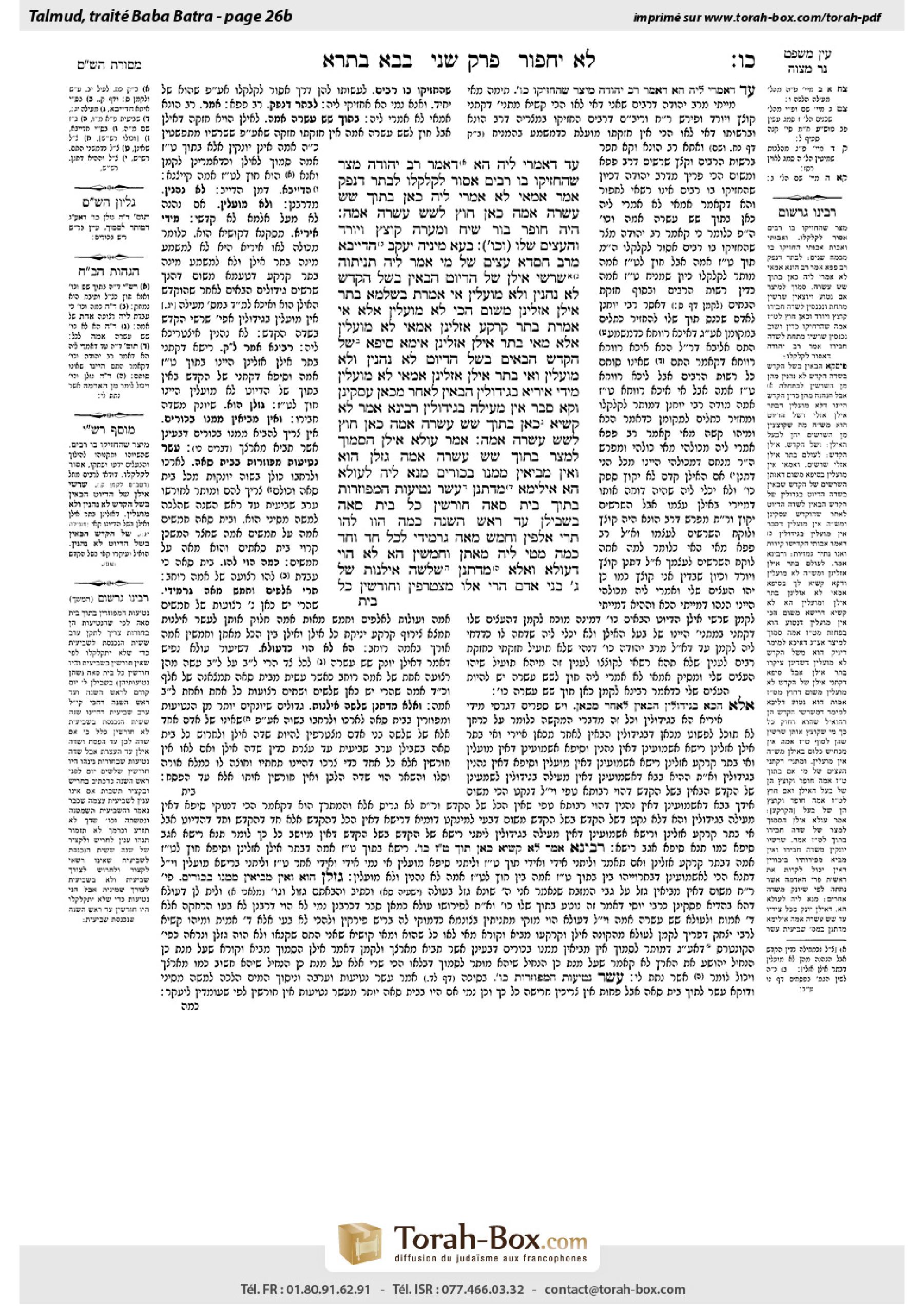
Bava Batra 26b: Talmud study for Daf Yomi
Study the Talmud for Daf Yomi with scanned pages, Hebrew text, English translations from Sefaria and AI-generated French translations.
Passage selection and English or AI-generated French translation are available where the scan has annotations. Daf Study is independent of Torah-Box and Sefaria.
Browse Bava Batra · בבא בתרא · All tractatesBava Batra 26b text and translations
This page of Bava Batra includes the Aramaic text, an English translation and an AI-generated French translation, alongside the scan above.
בבא בתרא כ״ו ב · Aramaic and Hebrew text
עַד דַּאֲמַרִי לֵיהּ הָא דְּאָמַר רַב יְהוּדָה: מֶצֶר שֶׁהֶחֱזִיקוּ בּוֹ רַבִּים – אָסוּר לְקַלְקְלוֹ. לְבָתַר דִּנְפַק, אֲמַר: אַמַּאי לָא אֲמַרִי לֵיהּ: כָּאן בְּתוֹךְ שֵׁשׁ עֶשְׂרֵה אַמָּה, כָּאן חוּץ לְשֵׁשׁ עֶשְׂרֵה אַמָּה.
הָיָה חוֹפֵר בּוֹר, שִׁיחַ וּמְעָרָה – קוֹצֵץ וְיוֹרֵד וְהָעֵצִים שֶׁלּוֹ (וְכוּ׳). בְּעָא מִינֵּיהּ יַעֲקֹב הַדְיָיבָא מֵרַב חִסְדָּא: עֵצִים שֶׁל מִי?
אֲמַר לֵיהּ, תְּנֵיתוּהָ: שׇׁרְשֵׁי אִילָן שֶׁל הֶדְיוֹט הַבָּאִין בְּשֶׁל הֶקְדֵּשׁ, לֹא נֶהֱנִין וְלֹא מוֹעֲלִין.
אִי אָמְרַתְּ בִּשְׁלָמָא: בָּתַר אִילָן אָזְלִינַן – מִשּׁוּם הָכִי לֹא מוֹעֲלִין; אֶלָּא אִי אָמְרַתְּ: בָּתַר קַרְקַע אָזְלִינַן, אַמַּאי לֹא מוֹעֲלִין?
אֶלָּא מַאי? בָּתַר אִילָן אָזְלִינַן?! אֵימָא סֵיפָא: שֶׁל הֶקְדֵּשׁ הַבָּאִים בְּשֶׁל הֶדְיוֹט, לֹא נֶהֱנִין וְלֹא מוֹעֲלִין. וְאִי בָּתַר אִילָן אָזְלִינַן, אַמַּאי לֹא מוֹעֲלִין?
מִידֵּי אִירְיָא?! בְּגִידּוּלִין הַבָּאִין לְאַחַר מִכָּאן עָסְקִינַן, וְקָא סָבַר: אֵין מְעִילָה בְּגִידּוּלִין.
רָבִינָא אָמַר: לָא קַשְׁיָא; כָּאן בְּתוֹךְ שֵׁשׁ עֶשְׂרֵה אַמָּה, כָּאן חוּץ לְשֵׁשׁ עֶשְׂרֵה אַמָּה.
אָמַר עוּלָּא: אִילָן הַסָּמוּךְ לַמֶּצֶר – בְּתוֹךְ שֵׁשׁ עֶשְׂרֵה אַמָּה, גַּזְלָן הוּא – וְאֵין מְבִיאִין מִמֶּנּוּ בִּכּוּרִים.
מְנָא לֵיהּ לְעוּלָּא הָא? אִילֵּימָא מִדִּתְנַן: עֶשֶׂר נְטִיעוֹת הַמְפוּזָּרוֹת בְּתוֹךְ בֵּית סְאָה, חוֹרְשִׁין כׇּל בֵּית סְאָה בִּשְׁבִילָן, עַד רֹאשׁ הַשָּׁנָה.
כַּמָּה הָווּ לְהוּ – תְּרֵי אַלְפִין וַחֲמֵשׁ מְאָה גַּרְמִידֵי; לְכׇל חַד וְחַד כַּמָּה מָטֵי לֵיהּ – מָאתַן וְחַמְשִׁין; הָא לָא הָוֵי דְּעוּלָּא!
וְאֶלָּא מִדִּתְנַן: שְׁלֹשָׁה אִילָנוֹת שֶׁל שְׁלֹשָׁה בְּנֵי אָדָם – הֲרֵי אֵלּוּ מִצְטָרְפִין, וְחוֹרְשִׁין כׇּל
Bava Batra 26b · English translation
until I told him that which Rav Yehuda says: With regard to a strip of land over which the public has an acquired privilege of use, one may not destroy it. Here too, since I have an acquired privilege of use of this land, you are not permitted to destroy that which I possess. After Rav Pappa left, Rav Huna, son of Rav Yehoshua, said: Why did I not say to him that there, an acquired privilege of use is effective when it is within sixteen cubits, as within that area the roots are considered part of the tree, whereas here I cut the roots of the palm trees beyond sixteen cubits.
§ The mishna teaches that if he was digging a cistern, a ditch, or a cave, he may cut downward and the wood is his. The Sage Ya’akov of Hadeyyav raised a dilemma before Rav Ḥisda: To whom does the wood belong? The mishna says that the wood is his, without specifying to which of the two individuals this refers, the owner of the tree or the owner of the land.
Rav Ḥisda said to him: You learned the answer in a mishna in tractate Me’ila (13b). If roots of a tree belonging to an ordinary person [hedyot] extend into a field belonging to the Temple treasury, one may not derive benefit from them, but if one derived benefit from them he is not liable for misuse of consecrated property. That is, even if one does transgress the prohibition and benefit from them, it is not considered misuse and he is not liable to bring an offering.
Granted, if you say that we follow the tree, and the roots are considered part of it, it is due to that reason that one is not liable for misuse, as the tree is not consecrated. But if you say we follow the land, i.e., the roots belong to the land’s owner, why is he not liable for misuse of consecrated property?
The Gemara asks: Rather, what will you say, that we follow the tree? If so, say the last clause of that mishna: If roots of a tree belonging to the Temple treasury extend into a field of an ordinary person, one may not derive benefit from them, but if one derived benefit from them he is not liable for misuse of consecrated property. But if we follow the tree, why is he not liable for misuse of consecrated property?
The Gemara responds: Are the cases comparable? In both clauses of the mishna we are dealing with growths that came thereafter, i.e., after the tree was consecrated, and the tanna of that mishna holds that with regard to growths that grew from a consecrated plant or tree, they are not subject to the halakhot of misuse of consecrated property. Only the original plant is. Consequently, there is no connection between that mishna and the question of whether roots are considered part of the tree or part of the land.
Ravina said that it is not difficult: Here, in the first clause of the mishna in Me’ila, it is referring to within sixteen cubits of the tree. In this case the roots are considered part of the tree. There, in the second clause, it is referring to roots beyond sixteen cubits, in which case the roots are considered part of the ground where they are found.
Ulla said: An individual who maintains a tree that is within sixteen cubits of a boundary is a robber, as it draws nourishment from the neighbor’s land, and one does not bring first fruits from it, since that would be a mitzva that is fulfilled by means of a transgression.
The Gemara asks: From where does Ulla derive that measurement? If we say it is from that which we learned in a mishna (Shevi’it 1:6), this is problematic. That mishna teaches: If there were ten saplings scattered in a beit se’a, one may plow the entire beit se’a for their sake until Rosh HaShana of the Sabbatical Year. Although it is prohibited to plow other land in the time leading into the Sabbatical Year, to avoid the appearance of preparing to work the ground in that year, it is permitted to do so for the purpose of sustaining these young trees.
The Gemara calculates: How much is the area of a beit se’a? It is 2,500 square cubits. And how much area is allocated for each and every one of the ten trees? It is 250 square cubits. This is not the distance that Ulla taught. An area of sixteen cubits to each side of the tree is a square of thirty-two by thirty-two cubits, or 1,024 square cubits, which is much larger than 250.
But rather, Ulla derived this measurement from that which we learned in the following mishna (Shevi’it 1:5): If there were three large trees belonging to three different people in one beit se’a, these trees combine, and one may plow the entire
Bava Batra 26b · Traduction française (IA)
jusqu'au moment où je lui ai dit ce que Rav Yehuda dit : Concernant un terrain sur lequel le public a acquis un droit d'usage, on ne peut pas le détruire. Ici aussi, puisque j'ai acquis un droit d'usage sur ce terrain, vous n'êtes pas autorisé à détruire ce que je possède. Après que Rav Pappa est parti, Rav Huna, fils de Rav Yehoshua, a dit : Pourquoi ne lui ai-je pas dit que là-bas, un droit d'usage est efficace à l'intérieur de seize coudées, car dans cette zone les racines sont considérées comme faisant partie de l'arbre, tandis qu'ici je coupe les racines des palmiers au-delà de seize coudées.
§ La Michna enseigne que si l'on creusait un puits, un fossé ou une grotte, on peut descendre et le bois est à lui. Le Sage Ya'akov d'Hadeyyav a posé un dilemme devant Rav Ḥisda : À qui appartient le bois ? La Michna dit que le bois est à lui, sans préciser à quel des deux individus cela se réfère, le propriétaire de l'arbre ou le propriétaire du terrain.
Rav Ḥisda a dit à lui : Vous avez appris la réponse dans une Michna du traité Me’ila (13b). Si les racines d'un arbre appartenant à un homme ordinaire [hedyot] s'étendent dans un champ appartenant au trésor du Temple, on ne peut pas en tirer profit, mais si l'on en a tiré profit, il n'est pas tenu responsable de l'usage illégal des biens consacrés. C'est-à-dire, même si l'on transgresse la prohibition et qu'on en tire profit, cela n'est pas considéré comme un usage illégal et il n'est pas tenu de présenter un sacrifice.
Admettons que vous disiez que nous suivons l'arbre, et que les racines sont considérées comme faisant partie de lui, c'est pour cette raison que l'on n'est pas tenu responsable d'usage illégal, car l'arbre n'est pas consacré. Mais si vous disiez que nous suivons le terrain, c'est-à-dire que les racines appartiennent au propriétaire du terrain, pourquoi n'est-il pas tenu responsable d'usage illégal des biens consacrés ?
La Guemara pose la question : Plutôt, que direz-vous, que nous suivons l'arbre ? Si c'est ainsi, dites la dernière partie de cette mitsva : Si les racines d'un arbre appartenant au trésor du Temple s'étendent dans un champ d'un homme ordinaire, on ne peut pas en tirer profit, mais si l'on en a tiré profit, il n'est pas tenu responsable d'usage illégal des biens consacrés. Mais si nous suivons l'arbre, pourquoi n'est-il pas tenu responsable d'usage illégal des biens consacrés ?
La Guemara répond : Les cas sont-ils comparables ? Dans les deux clauses de la mitsva, nous sommes en présence de pousses qui sont venues après, c'est-à-dire après que l'arbre a été consacré, et le tanna de cette mitsva considère que concernant les pousses qui sont nées d'une plante ou d'un arbre consacrés, elles ne sont pas soumises aux halakhot de l'usage illégal des biens consacrés. Seul l'arbre original est concerné. Ainsi, il n'y a pas de lien entre cette mitsva et la question de savoir si les racines sont considérées comme faisant partie de l'arbre ou du terrain.
Ravina a dit que cela n'est pas difficile : Ici, dans la première clause de la mitsna du traité Me’ila, il s'agit de l'intérieur de seize coudées de l'arbre. Dans ce cas, les racines sont considérées comme faisant partie de l'arbre. Là, dans la deuxième clause, il s'agit des racines au-delà de seize coudées, dans lesquelles cas les racines sont considérées comme faisant partie du terrain où elles sont trouvées.
Ulla a dit : Un individu qui maintient un arbre à seize coudées d'une limite est un voleur, car il tire sa nourriture du terrain du voisin, et on ne présente pas les premiers fruits à partir de lui, car cela serait une mitsva accomplie par un transgression.
La Guemara pose la question : D'où Ulla tire-t-il cette mesure ? Si nous disons qu'il s'agit de ce que nous avons appris dans une mitsna (Shevi’it 1:6), cela est problématique. Cette mitsna enseigne : Si dix jeunes arbres étaient dispersés dans un beit se’a, on peut labourer l'ensemble du beit se’a à leur sujet jusqu'à Rosh HaShana de l'année sabbatique. Bien que l'on interdise de labourer d'autres terres pendant la période précédant l'année sabbatique, afin d'éviter l'apparence de préparation à travailler la terre dans cette année, il est permis de le faire à l'effet de nourrir ces jeunes arbres.
La Guemara calcule : Combien mesure un beit se’a ? C'est 2 500 coudées carrées. Et combien d'espace est alloué à chaque arbre parmi les dix ? C'est 250 coudées carrées. Cela n'est pas la mesure que Ulla a enseignée. Une zone de seize coudées de chaque côté de l'arbre est un carré de trente-deux par trente-deux coudées, soit 1 024 coudées carrées, ce qui est bien plus grand que 250.
Mais plutôt, Ulla a tiré cette mesure de ce que nous avons appris dans la Michna suivante (Shevi’it 1:5) : Si trois grands arbres appartenant à trois personnes différentes étaient dans un beit se’a, ces arbres se combinent, et on peut labourer l'ensemble
Traduction française générée par IA à partir de l’édition anglaise de Sefaria. Vérifie toujours un passage avec le texte source.
Text from Sefaria: William Davidson Edition - Vocalized Aramaic (CC BY NC); William Davidson Edition - English (CC BY NC).