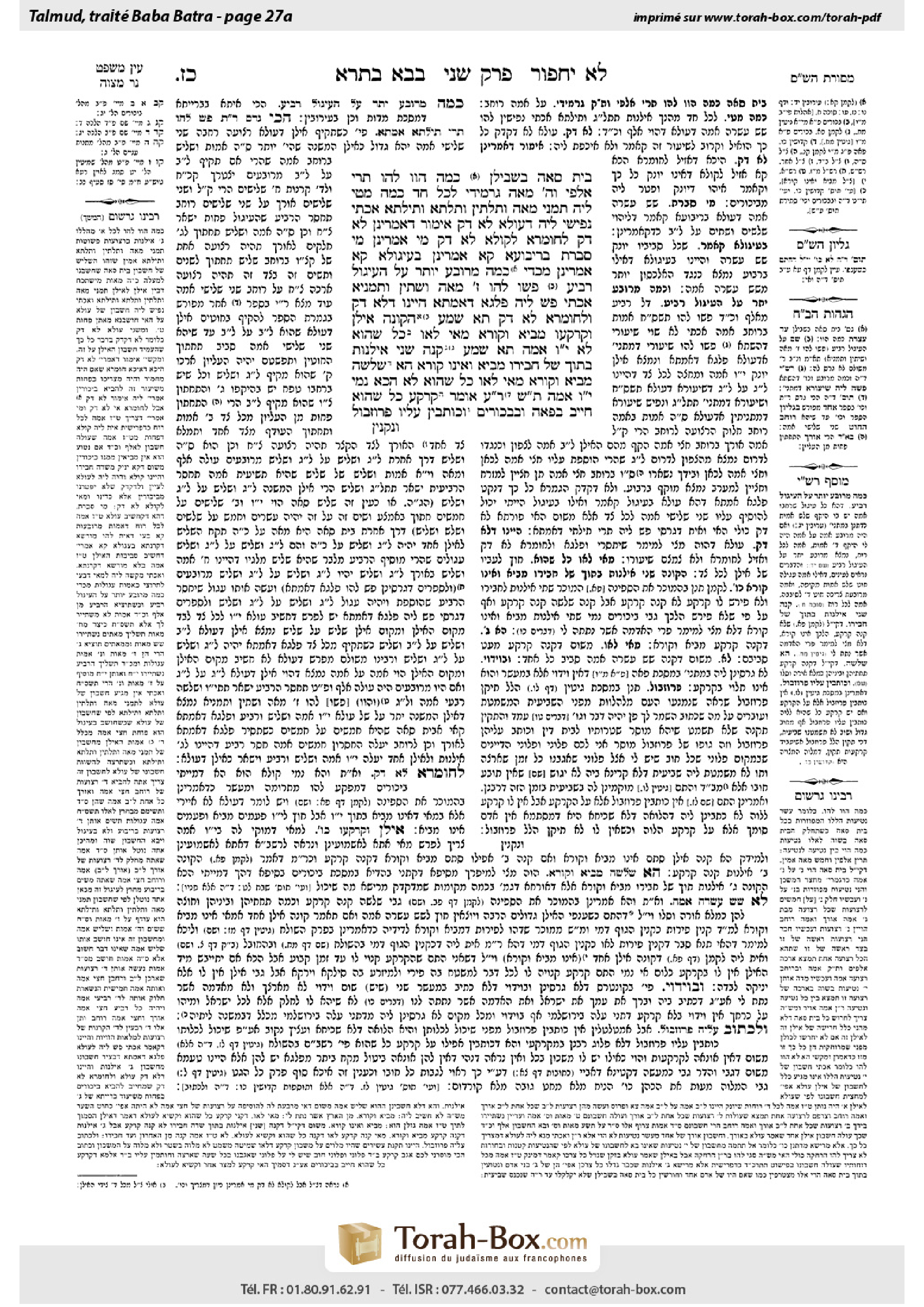
Bava Batra 27a: Talmud study for Daf Yomi
Study the Talmud for Daf Yomi with scanned pages, Hebrew text, English translations from Sefaria and AI-generated French translations.
Passage selection and English or AI-generated French translation are available where the scan has annotations. Daf Study is independent of Torah-Box and Sefaria.
Browse Bava Batra · בבא בתרא · All tractatesBava Batra 27a text and translations
This page of Bava Batra includes the Aramaic text, an English translation and an AI-generated French translation, alongside the scan above.
בבא בתרא כ״ז א · Aramaic and Hebrew text
בֵּית סְאָה בִּשְׁבִילָן. כַּמָּה הָווּ לְהוּ – תְּרֵי אַלְפֵי וַחֲמֵשׁ מְאָה גַּרְמִידֵי; לְכׇל חַד כַּמָּה מָטֵי לֵיהּ – תַּמְנֵי מְאָה וּתְלָתִין וּתְלָתָא וְתִילְתָּא; אַכַּתִּי נְפִישִׁי לֵיהּ דְּעוּלָּא! לָא דָּק.
אֵימוֹר דְּאָמְרִינַן לָא דָּק – לְחוּמְרָא; לְקוּלָּא – לָא דָּק מִי אָמְרִינַן?!
מִי סָבְרַתְּ בְּרִיבּוּעָא קָא אָמְרִינַן?! בְּעִיגּוּלָא קָא אָמְרִינַן!
מִכְּדֵי כַּמָּה מְרוּבָּע יוֹתֵר עַל הָעִיגּוּל – רְבִיעַ; פָּשׁוּ לְהוּ שְׁבַע מְאָה וְשִׁתִּין וּתְמָנְיָא; אַכַּתִּי פָּשׁ לֵיהּ פַּלְגָא דְאַמְּתָא! הַיְינוּ דְּלָא דָּק – וּלְחוּמְרָא לָא דָּק.
תָּא שְׁמַע: הַקּוֹנֶה אִילָן וְקַרְקָעוֹ – מֵבִיא וְקוֹרֵא. מַאי, לָאו כׇּל שֶׁהוּא? לֹא; שֵׁשׁ עֶשְׂרֵה אַמָּה.
תָּא שְׁמַע: קָנָה שְׁנֵי אִילָנוֹת בְּתוֹךְ שֶׁל חֲבֵירוֹ – מֵבִיא וְאֵינוֹ קוֹרֵא. הָא שְׁלֹשָׁה – מֵבִיא וְקוֹרֵא; מַאי, לָאו כׇּל שֶׁהוּא? לָא; הָכָא נָמֵי שֵׁשׁ עֶשְׂרֵה אַמָּה.
תָּא שְׁמַע, רַבִּי עֲקִיבָא אוֹמֵר: קַרְקַע כׇּל שֶׁהוּא – חַיָּיב בַּפֵּאָה וּבַבִּכּוּרִים, וְכוֹתְבִין עָלָיו פְּרוֹזְבּוּל,
Bava Batra 27a · English translation
beit se’a for their sake. How much is that area in cubits? It is 2,500 square cubits. And how much area is that for each of the trees? It is 833⅓. Still, Ulla's amount is greater than this. The Gemara answers: Ulla was not precise in this matter.
The Gemara asks: One can say that we say that a Sage was not precise in his measurements when his ruling leads to a stringency; but do we say that he was not precise if his measurements lead to a leniency? According to the previous explanation, Ulla exempts the owner of a tree from first fruits even in a case where his tree does not in fact draw nourishment from his neighbor’s field.
The Gemara answers: Do you maintain that we say the roots extend that far in a square, i.e., one measures sixteen cubits to each side of the tree? Not so; we say this with regard to a circle, that is, the roots extend in a circle surrounding the tree, as the area of a circle is smaller than that of the square circumscribing it.
The Gemara asks: Now, by how much is the area of a square greater than the area of a circle with a diameter the length of the side of that square? It is greater by one-quarter of the area of the circle. If so, 768 square cubits, three-quarters of 1,024, remain for each tree, but there still remains half a cubit more based on the mishna’s calculation. In other words, the measurement would be more accurate if a tree is considered to draw nourishment from a distance of sixteen and a half cubits on each side. The Gemara answers: This is why we said that Ulla was not precise, and he was not precise in a manner that leads to a stringency, as one brings first fruits even from a tree that stands just sixteen cubits from the boundary, rather than 16½.
The Gemara cites a proof against the opinion of Ulla. Come and hear the following mishna (Bikkurim 1:11): One who buys a tree and its land brings first fruits and recites the requisite Torah verses (Deuteronomy 26:5–11) over them. What, is it not referring to a case where one buys any amount of land with the tree? The Gemara rejects this claim: No; it is referring to a case where one buys sixteen cubits of land around the tree.
The Gemara suggests: Come and hear an additional proof from another mishna (Bikkurim 1:6): If one bought two trees in the field of another, he brings first fruits and does not recite the verses, because the land does not belong to him. It may be inferred from here that if he bought three trees he does bring first fruits and recite the verses. What, is it not referring to a case where one buys any amount of land with the trees? The Gemara rejects this claim as well: No; here too it is referring to a case where he acquires sixteen cubits of land around the trees.
The Gemara suggests: Come and hear a proof from a mishna (Pe’a 3:6). Rabbi Akiva says: The owner of land of any size is obligated in pe’a and in first fruits, and a lender can write a document that prevents the Sabbatical Year from abrogating an outstanding debt [prosbol] for this land, so that loans he provided will not be canceled at the close of the Sabbatical Year,
Bava Batra 27a · Traduction française (IA)
beit se’a pour leur compte. Quelle est la superficie de cette zone en cubits ? Elle est de 2 500 cubits carrés. Et quelle est la superficie par arbre ? Elle est de 833⅓. Cependant, la quantité d’Ulla est supérieure à cela. La Guemara répond : Ulla n’était pas précis dans cette affaire.
La Guemara pose la question : On peut dire que l’on considère qu’un Sage n’était pas précis dans ses mesures lorsque son jugement conduit à une stricte application de la loi ; mais est-ce que l’on considère qu’il n’était pas précis si ses mesures conduisent à une leniencé ? Selon l’explication précédente, Ulla exempt l’propriétaire d’un arbre des premiers fruits même dans le cas où cet arbre ne tire effectivement son alimentation du champ du voisin.
La Guemara répond : Vous maintenez-vous que nous disons que les racines s’étendent aussi loin dans un carré, c’est-à-dire qu’on mesure seize cubits de chaque côté de l’arbre ? Non, nous disons cela concernant un cercle, c’est-à-dire que les racines s’étendent en cercle autour de l’arbre, car la surface d’un cercle est plus petite que celle du carré qui le circonscrit.
La Guemara pose la question : Maintenant, de combien la surface d’un carré est-elle supérieure à celle d’un cercle dont le diamètre est égal à la longueur du côté de ce carré ? Elle est supérieure de un quart de la surface du cercle. Si tel est le cas, 768 cubits carrés, trois quarts de 1 024, restent par arbre, mais il reste encore demi-cubit supplémentaire selon le calcul de la Misha. En d’autres termes, la mesure serait plus précise si l’on considère que l’arbre tire son alimentation à une distance de seize et demi cubits de chaque côté. La Guemara répond : C’est pourquoi nous avons dit que Ulla n’était pas précis, et il n’était pas précis d’une manière qui conduit à une stricte application de la loi, car on apporte des premiers fruits même d’un arbre qui se trouve juste seize cubits de la limite, plutôt que seize et demi.
La Guemara cite une preuve contre l’opinion d’Ulla. Venez écouter la suivante Misha (Bikkurim 1:11) : Celui qui achète un arbre et son terrain apporte des premiers fruits et récite les versets nécessaires de la Torah (Deutéronome 26:5–11) sur eux. Qu’est-ce que cela ne signifie pas par le fait qu’il achète une quantité quelconque de terrain avec l’arbre ? La Guemara rejette cette affirmation : Non ; cela signifie un cas où l’on achète seize cubits de terrain autour de l’arbre.
La Guemara suggère : Venez écouter une preuve supplémentaire d’une autre Misha (Bikkurim 1:6) : Si l’on achète deux arbres dans le champ d’un autre, l’on apporte des premiers fruits et l’on ne récite pas les versets, car le terrain n’appartient pas à l’acheteur. On peut en déduire ici que si l’on achète trois arbres, l’on apporte des premiers fruits et l’on récite les versets. Qu’est-ce que cela ne signifie pas par le fait qu’il achète une quantité quelconque de terrain avec les arbres ? La Guemara rejette cette affirmation également : Non ; ici aussi, cela signifie un cas où l’on acquiert seize cubits de terrain autour des arbres.
La Guemara suggère : Venez écouter une preuve tirée d'une Misha (Pe’a 3:6). Rabbi Akiva dit : L'propriétaire d'un terrain, qu'il soit de toute taille, est tenu de pe’a et de premiers fruits, et un prêteur peut écrire un document qui empêche l'année sabbatique de révoquer une dette encaissée [prosbol] pour ce terrain, de sorte que les prêts qu'il a donnés ne soient pas annulés à la fin de l'année sabbatique,
Traduction française générée par IA à partir de l’édition anglaise de Sefaria. Vérifie toujours un passage avec le texte source.
Text from Sefaria: William Davidson Edition - Vocalized Aramaic (CC BY NC); William Davidson Edition - English (CC BY NC).