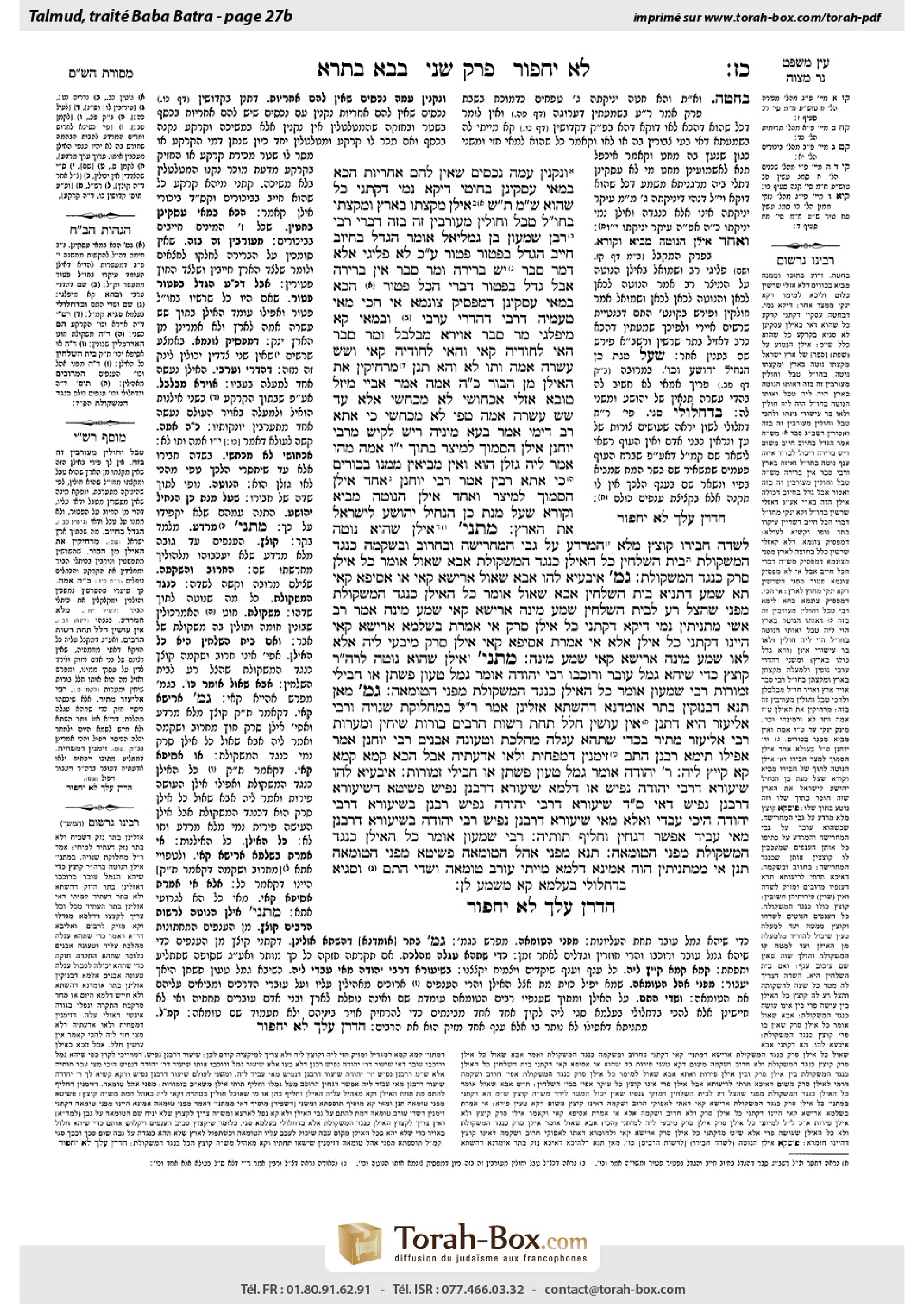
Bava Batra 27b: Talmud study for Daf Yomi
Study the Talmud for Daf Yomi with scanned pages, Hebrew text, English translations from Sefaria and AI-generated French translations.
Passage selection and English or AI-generated French translation are available where the scan has annotations. Daf Study is independent of Torah-Box and Sefaria.
Browse Bava Batra · בבא בתרא · All tractatesBava Batra 27b text and translations
This page of Bava Batra includes the Aramaic text, an English translation and an AI-generated French translation, alongside the scan above.
בבא בתרא כ״ז ב · Aramaic and Hebrew text
וְנִקְנִין עִמָּהּ נְכָסִים שֶׁאֵין לָהֶם אַחְרָיוּת! הָכָא בְּמַאי עָסְקִינַן – בְּחִיטֵּי.
דַּיְקָא נָמֵי, דְּקָתָנֵי: כׇּל שֶׁהוּא. שְׁמַע מִינַּהּ.
תָּא שְׁמַע: אִילָן – מִקְצָתוֹ בָּאָרֶץ וּמִקְצָתוֹ בְּחוּץ לָאָרֶץ – טֶבֶל וְחוּלִּין מְעוֹרָבִין זֶה בָּזֶה, דִּבְרֵי רַבִּי.
רַבָּן שִׁמְעוֹן בֶּן גַּמְלִיאֵל אוֹמֵר: הַגָּדֵל בְּחִיּוּב – חַיָּיב, הַגָּדֵל בִּפְטוּר – פָּטוּר.
עַד כָּאן לָא פְּלִיגִי, אֶלָּא דְּמָר סָבַר: יֵשׁ בְּרֵירָה, וּמַר סָבַר: אֵין בְּרֵירָה;
אֲבָל גָּדֵל בִּפְטוּר – דִּבְרֵי הַכֹּל פָּטוּר!
הָכָא בְּמַאי עָסְקִינַן – דְּמַפְסִיק צוּנְמָא. אִי הָכִי, מַאי טַעְמֵיהּ דְּרַבִּי? דְּהָדְרִי עׇרְבִי.
וּבְמַאי קָא מִיפַּלְגִי? מָר סָבַר: אַוֵּירָא מְבַלְבֵּל, וּמָר סָבַר: הַאי לְחוֹדֵיהּ קָאֵי וְהַאי לְחוֹדֵיהּ קָאֵי.
וְשֵׁשׁ עֶשְׂרֵה אַמָּה – וְתוּ לָא? וְהָא תְּנַן: מַרְחִיקִין אֶת הָאִילָן מִן הַבּוֹר, עֶשְׂרִים וְחָמֵשׁ אַמָּה! אָמַר אַבָּיֵי: מֵיזָל – טוּבָא אָזְלִי, אַכְחוֹשֵׁי לָא מַכְחֲשִׁי אֶלָּא עַד שֵׁשׁ עֶשְׂרֵה אַמָּה, טְפֵי לָא מַכְחֲשִׁי.
כִּי אֲתָא רַב דִּימִי אָמַר, בְּעָא מִינֵּיהּ רֵישׁ לָקִישׁ מֵרַבִּי יוֹחָנָן: אִילָן הַסָּמוּךְ לַמֶּיצֶר בְּתוֹךְ שֵׁשׁ עֶשְׂרֵה אַמָּה, מַהוּ? אֲמַר לֵיהּ: גַּזְלָן הוּא, וְאֵין מְבִיאִין מִמֶּנּוּ בִּכּוּרִים.
כִּי אֲתָא רָבִין אָמַר רַבִּי יוֹחָנָן: אֶחָד אִילָן הַסָּמוּךְ לַמֶּיצֶר, וְאֶחָד אִילָן הַנּוֹטֶה – מֵבִיא וְקוֹרֵא; שֶׁעַל מְנָת כֵּן הִנְחִיל יְהוֹשֻׁעַ לְיִשְׂרָאֵל אֶת הָאָרֶץ.
מַתְנִי׳ אִילָן שֶׁהוּא נוֹטֶה לִשְׂדֵה חֲבֵירוֹ – קוֹצֵץ מְלֹא הַמַּרְדֵּעַ, עַל גַּבֵּי הַמַּחֲרֵישָׁה. וּבֶחָרוּב וּבַשִּׁקְמָה – כְּנֶגֶד הַמִּשְׁקוֹלֶת. בֵּית הַשְּׁלָחִין – כׇּל הָאִילָן כְּנֶגֶד הַמִּשְׁקוֹלֶת. אַבָּא שָׁאוּל אוֹמֵר: כׇּל אִילַן סְרָק כְּנֶגֶד הַמִּשְׁקוֹלֶת.
גְּמָ׳ אִיבַּעְיָא לְהוּ: אַבָּא שָׁאוּל – אַרֵישָׁא קָאֵי, אוֹ אַסֵּיפָא קָאֵי?
תָּא שְׁמַע, דְּתַנְיָא: בֵּית הַשְּׁלָחִין – אַבָּא שָׁאוּל אוֹמֵר: כׇּל הָאִילָן כְּנֶגֶד הַמִּשְׁקוֹלֶת, מִפְּנֵי שֶׁהַצֵּל רַע לְבֵית הַשְּׁלָחִין. שְׁמַע מִינַּהּ: אַרֵישָׁא קָאֵי! שְׁמַע מִינַּהּ.
אָמַר רַב אָשֵׁי: מַתְנִיתִין נָמֵי דַּיְקָא, דְּקָתָנֵי: ״כׇּל אִילַן סְרָק״. אִי אָמְרַתְּ בִּשְׁלָמָא אַרֵישָׁא קָאֵי – הַיְינוּ דְּקָתָנֵי כׇּל אִילָן; אֶלָּא אִי אָמְרַתְּ אַסֵּיפָא קָאֵי, אִילַן סְרָק מִיבְּעֵי לֵיהּ?! אֶלָּא לָאו שְׁמַע מִינַּהּ אַרֵישָׁא קָאֵי? שְׁמַע מִינַּהּ.
מַתְנִי׳ אִילָן שֶׁהוּא נוֹטֶה לִרְשׁוּת הָרַבִּים, קוֹצֵץ כְּדֵי שֶׁיְּהֵא גָּמָל עוֹבֵר – וְרוֹכְבוֹ. רַבִּי יְהוּדָה אוֹמֵר: גָּמָל טָעוּן פִּשְׁתָּן אוֹ חֲבִילֵי זְמוֹרוֹת. רַבִּי שִׁמְעוֹן אוֹמֵר: כׇּל הָאִילָן כְּנֶגֶד הַמִּשְׁקוֹלֶת, מִפְּנֵי הַטּוּמְאָה.
גְּמָ׳ מַאן תְּנָא דְּבִנְזָקִין – בָּתַר אוּמְדָּנָא דְּהַשְׁתָּא אָזְלִינַן?
אָמַר רֵישׁ לָקִישׁ: בְּמַחֲלוֹקֶת שְׁנוּיָה, וְרַבִּי אֱלִיעֶזֶר הִיא – דִּתְנַן: אֵין עוֹשִׂין חָלָל תַּחַת רְשׁוּת הָרַבִּים – בּוֹרוֹת, שִׁיחִין וּמְעָרוֹת. רַבִּי אֱלִיעֶזֶר מַתִּיר, בִּכְדֵי שֶׁתְּהֵא עֲגָלָה מְהַלֶּכֶת – וּטְעוּנַהּ אֲבָנִים.
רַבִּי יוֹחָנָן אָמַר: אֲפִילּוּ תֵּימָא רַבָּנַן, הָתָם – זִימְנִין דְּמַפְחִית וְלָאו אַדַּעְתֵּיהּ, אֲבָל הָכָא – קַמָּא קַמָּא קָא קְיִיץ לֵיהּ.
רַבִּי יְהוּדָה אוֹמֵר: גָּמָל טָעוּן פִּשְׁתָּן אוֹ חֲבִילֵי זְמוֹרוֹת. אִיבַּעְיָא לְהוּ: שִׁיעוּרָא דְרַבִּי יְהוּדָה נְפִישׁ, אוֹ דִּלְמָא שִׁיעוּרָא דְרַבָּנַן נְפִישׁ?
פְּשִׁיטָא דְּשִׁיעוּרָא דְרַבָּנַן נְפִישׁ! דְּאִי סָלְקָא דַּעְתָּךְ שִׁיעוּרָא דְרַבִּי יְהוּדָה נְפִישׁ, רַבָּנַן – בְּשִׁיעוּרָא דְרַבִּי יְהוּדָה הֵיכִי עָבְדִי? וְאֶלָּא מַאי, שִׁיעוּרָא דְרַבָּנַן נְפִישׁ? רַבִּי יְהוּדָה – בְּשִׁיעוּרָא דְּרַבָּנַן מַאי עָבֵיד? אֶפְשָׁר דִּגְחִין וְחָלֵיף תּוּתֵיהּ.
רַבִּי שִׁמְעוֹן אוֹמֵר: כׇּל הָאִילָן כְּנֶגֶד הַמִּשְׁקוֹלֶת, מִפְּנֵי הַטּוּמְאָה. תָּנָא: מִפְּנֵי אֹהֶל הַטּוּמְאָה. פְּשִׁיטָא, ״מִפְּנֵי הַטּוּמְאָה״ תְּנַן!
אִי מִמַּתְנִיתִין, הֲוָה אָמֵינָא: דִּלְמָא מַיְיתֵי עוֹרֵב טוּמְאָה וְשָׁדֵי הָתָם, וְסַגְיָא בְּדַחְלוּלִי בְּעָלְמָא; קָא מַשְׁמַע לַן:
הַדְרָן עֲלָךְ לָא יַחְפּוֹר
Bava Batra 27b · English translation
and he can acquire property that does not serve as a guarantee, i.e., movable property, along with it. There are specific modes of acquisition for movable property, but if one is acquiring any amount of land at the same time as the movable property, the mode of acquisition employed to acquire the land suffices for the acquisition of the movable property as well. Apparently, any amount of land is subject to first fruits, whereas according to Ulla a tree acquired with less than sixteen cubits of land surrounding it draws nourishment from the land surrounding it and is exempt from first fruits. The Gemara rejects this: With what are we dealing here? We are dealing with wheat, which is subject to the halakhot of first fruits and requires very little land to nourish it.
The Gemara comments that the language of the mishna is also precise, as it teaches: Land of any size, which indicates even a miniscule amount, and all normal trees certainly require more land than that. The Gemara affirms: Learn from it that it is so.
The Gemara further suggests: Come and hear a proof from a baraita (Tosefta, Ma’asrot 2:22): If there is a tree, part of which is in Eretz Yisrael and part of which is outside of Eretz Yisrael, it is considered as though untithed produce, i.e., produce that is subject to the halakhot of terumot and tithes, and non-sacred produce, i.e., produce that is exempt from the halakhot of terumot and tithes, are mixed together in each one of this tree’s fruits. This is the statement of Rabbi Yehuda HaNasi.
Rabban Shimon ben Gamliel says: With regard to the fruits in the part of the tree that is growing in a place where there is an obligation to separate tithes, i.e., in Eretz Yisrael, the owner is obligated to separate tithes. With regard to the fruits that are growing in a place where there is an exemption from separating tithes, i.e., outside of Eretz Yisrael, the owner is exempt.
The Gemara comments: They disagree only in that one Sage, Rabban Shimon ben Gamliel, holds that there is retroactive designation, and therefore it is assumed that the nourishment drawn from Eretz Yisrael sustained the fruit that grew on that side of the tree, and the nourishment drawn from outside Eretz Yisrael sustained the fruit that grew there. And one Sage, Rabbi Yehuda HaNasi, holds that there is no retroactive designation, and the fruit is considered mixed.
But if the tree grew entirely in a place where there is an exemption from separating tithes, i.e., outside Eretz Yisrael, all agree that the owner is exempt, even though the tree might have roots within sixteen cubits of Eretz Yisrael and draw nourishment from there. This presents a difficulty for the opinion of Ulla, as he claims that the place from where a tree draws its nourishment is decisive with regard to first fruits.
The Gemara answers: With what are we dealing here? We are dealing with a case where a rock divides the roots up to the trunk, and therefore it is possible to distinguish between the parts of the tree that draw nutrients from Eretz Yisrael and the parts that draw nutrients from outside of Eretz Yisrael. The Gemara asks: If so, what is the reasoning of Rabbi Yehuda HaNasi? Why does he view the fruits as being a mixture? The Gemara answers: He holds that although there is a division between the roots, they cannot be distinguished from one another, as they then become mixed in the body of the tree.
The Gemara asks: And with regard to what principle do they disagree? The Gemara answers: One Sage, Rabbi Yehuda HaNasi, holds: The air above the ground mixes the nutrients, and one Sage, Rabban Shimon ben Gamliel, holds: This part of the tree stands alone and this part of the tree stands alone. From the roots up to the branches, it is as if the tree were cut along the line of the border.
The Gemara raises a difficulty against Ulla’s opinion from a different perspective: And do roots extend sixteen cubits and no more? Didn’t we learn in a mishna (25b): One must distance a tree twenty-five cubits from a cistern? This indicates that tree roots reach more than sixteen cubits. Abaye said: The roots extend farther, but they weaken the ground only up to sixteen cubits; with regard to an area any more distant than that, they do not weaken the ground.
Concerning this matter the Gemara relates that when Rav Dimi came from Eretz Yisrael he said: Reish Lakish raised a dilemma before Rabbi Yoḥanan: With regard to a tree that is within sixteen cubits of a boundary, what is the halakha? Rabbi Yoḥanan said to him: The owner is a robber, and one does not bring first fruits from it.
By contrast, when Ravin came from Eretz Yisrael, he related that Rabbi Yoḥanan says: Both in the case of a tree that is close to a boundary and a tree that leans into a neighbor’s yard, one brings first fruits and recites the verses, as it was on this condition that Joshua apportioned Eretz Yisrael to the Jewish people, i.e., that they would not be particular about such matters.
MISHNA: With regard to a tree that leans into the field of another, the neighbor may cut the branches to the height of an ox goad raised over the plow, in places where the land is to be plowed, so that the branches do not impede the use of the plow. And in the case of a carob tree and the case of a sycamore tree, whose abundance of branches cast shade that is harmful to plants, all the branches overhanging one’s property may be removed along the plumb line, i.e., along a line perpendicular to the boundary separating the fields. And if the neighbor’s field is an irrigated field, all branches of the tree are removed along the plumb line. Abba Shaul says: All barren trees are cut along the plumb line.
GEMARA: A dilemma was raised before them: Is Abba Shaul referring to the first clause of the mishna, which states that a tree extending into a neighbor’s field is cut only to the height of an ox goad, and Abba Shaul maintains that barren trees have the same halakha as carob and sycamore trees in that they are cut along the plumb line? Or is he referring to the latter clause, which discusses an irrigated field, and he permits cutting only barren trees along the plumb line, but not fruit trees?
The Gemara answers: Come and hear a resolution to this dilemma, as it is taught in a baraita: With regard to an irrigated field, Abba Shaul says: All types of trees are cut along the plumb line, because the shade is harmful to an irrigated field. This shows that he does not dispute the halakha of the latter clause. Learn from it that he is referring to the first clause of the mishna. The Gemara affirms: Learn from it that it is so.
Rav Ashi said that the wording of the mishna is also precise, as it teaches: All barren trees. Granted, if you say that Abba Shaul is referring to the first clause of the mishna, this is the reason that Abba Shaul teaches: All barren trees. But if you say that he is referring to the latter clause, he should have said simply: Barren trees, as the first tanna permits one to cut down any type of tree. Rather, isn’t it correct to conclude from it that he is referring to the first clause? The Gemara affirms: Learn from it that it is so.
MISHNA: With regard to a tree that extends into the public domain, one cuts its branches so that a camel can pass beneath the tree with its rider sitting on it. Rabbi Yehuda says: One cuts enough branches that a camel loaded with flax or bundles of branches can pass beneath it. Rabbi Shimon says: One cuts all branches of the tree that extend into the public domain along the plumb line, so that they do not hang over the public area at all, due to ritual impurity.
GEMARA: The Gemara asks: Who is the tanna who taught that with regard to damage one follows the current assessment, and future damage is not taken into account? The mishna states that the tree’s branches are cut to the height of a camel and its rider or load but no more, despite the fact that they will certainly grow again.
Reish Lakish says: This halakha is taught as a dispute, and it is the opinion of Rabbi Eliezer. As we learned in a mishna (60a): One may not make an empty space beneath the public domain by digging pits, ditches, or caves. Rabbi Eliezer permits one to dig a pit if it is subsequently covered with material strong enough that a wagon loaded with stones can travel on it without it collapsing. If the cover can withstand such weight when the pit is dug, it is permitted, despite the fact that the cover might eventually rot.
Rabbi Yoḥanan said: You may even say that the mishna here represents the opinion of the Rabbis, who prohibit one from digging beneath the public domain under any circumstances. The difference is that there, the cover will occasionally deteriorate, and as this matter is not on his mind it will cause damage. But here, as each branch grows he cuts it off. Since the potential cause of damage is visible, there is no concern that it might be neglected.
§ The mishna teaches that if the branches of a tree extend into the public domain, one may cut them to allow a camel and its rider to pass underneath; Rabbi Yehuda says: One cuts enough branches that a camel loaded with flax or bundles of branches can pass beneath it. A dilemma was raised before the Sages: Is Rabbi Yehuda’s measure greater, or is perhaps the Rabbis’ measure greater? Which reaches a greater height, a camel and rider or a camel loaded with flax?
The Gemara answers: It is obvious that the Rabbis’ measure is greater, as, if it enters your mind that Rabbi Yehuda’s measure is greater, how would the Rabbis act in the circumstance of Rabbi Yehuda’s measure? It is clear that a camel will have to pass beneath the tree with a burden, and it would not be able to do so. The Gemara expresses surprise at this claim: Rather, what then would you say? That the Rabbis’ measure is greater? If so, how would Rabbi Yehuda act in the circumstance of the Rabbis’ measure? It is also clear that a camel will have to pass there with its rider. The Gemara answers: It is possible for the rider to bend over and to pass underneath the branches.
§ The mishna teaches that Rabbi Shimon says: One cuts all branches of the tree that extend into the public domain along the plumb line, due to ritual impurity. The Gemara explains: A tanna taught in a baraita that this is due to ritual impurity imparted in a tent. Branches over a corpse might create a tent, thereby transferring impurity to whatever is beneath the branches, rendering impure those passing under the tree in the public domain. The Gemara expresses surprise at this statement: It is obvious that this is the reason. We already learned that it is due to ritual impurity. How else could ritual impurity be transferred through branches other than by means of a tent?
The Gemara answers: If this is learned from the mishna alone, I would say that the concern is that perhaps a crow might bring a source of impurity and perch on the tree’s branches and throw it there. And if that were the only concern, a mere scarecrow [bedaḥlulei] would be sufficient to frighten the crows away and prevent that type of impurity. Therefore, the tanna of the baraita teaches us that the concern is due to impurity imparted in a tent.
Bava Batra 27b · Traduction française (IA)
et il peut acquérir un bien qui ne sert pas de garantie, c'est-à-dire un bien mobilier, avec lui. Il existe des modes spécifiques d'acquisition pour les biens mobiliers, mais si l'on acquiert une quantité quelconque de terre en même temps que le bien mobilier, le mode d'acquisition utilisé pour acquérir la terre suffit également à l'acquisition du bien mobilier. Il semble que toute quantité de terre soit soumise aux premiers fruits, alors que selon Ulla, un arbre acquis avec moins de seize coudées de terre autour de lui tire sa nourriture de la terre environnante et est exempt des premiers fruits. La Guemara rejette cela : De quoi sommes-nous en train de parler ? Nous parlons du blé, qui est soumis aux halakhot des premiers fruits et qui nécessite peu de terre pour être nourri.
La Guemara commente que la formulation de la michna est aussi précise, car elle enseigne : Terre de toute taille, ce qui indique même une quantité minuscule, et tous les arbres normaux nécessitent certainement plus de terre que cela. La Guemara affirme : Apprends-en que c'est ainsi.
La Guemara suggère davantage : Viens écouter une preuve d'une baraïta (Tosefta, Ma'asrot 2:22) : Si un arbre a une partie en Eretz Yisrael et une partie en dehors d'Eretz Yisrael, il est considéré comme du produit non titré, c'est-à-dire du produit soumis aux halakhot de terouma et des dîmes, et du produit non sacré, c'est-à-dire du produit exempt des halakhot de terouma et des dîmes, sont mélangés dans chaque fruit de cet arbre. C'est la déclaration de Rabbi Yehuda HaNasi.
Rabban Shimon ben Gamliel dit : Concernant les fruits qui poussent dans un lieu où il y a une obligation de séparer les dîmes, c'est-à-dire en Eretz Yisrael, l'propriétaire est tenu de séparer les dîmes. Concernant les fruits qui poussent dans un lieu où il y a une exemption de séparation des dîmes, c'est-à-dire en dehors d'Eretz Yisrael, l'propriétaire est exempt.
La Guemara commente : Ils ne s'entendent que sur ce sage, Rabban Shimon ben Gamliel, qui considère qu'il y a une désignation rétroactive, et donc on suppose que la nourriture tirée d'Eretz Yisrael a nourri le fruit qui a poussé du côté de l'arbre, et la nourriture tirée en dehors d'Eretz Yisrael a nourri le fruit qui a poussé là. Et un sage, Rabbi Yehuda HaNasi, considère qu'il n'y a pas de désignation rétroactive, et le fruit est considéré comme mélangé.
Mais si l'arbre a entièrement poussé dans un lieu où il y a une exemption de séparation des dîmes, c'est-à-dire en dehors d'Eretz Yisrael, tous s'accordent sur le fait que l'propriétaire est exempt, même si l'arbre pourrait avoir des racines à seize coudées d'Eretz Yisrael et tirer sa nourriture d'ici. Cela présente une difficulté pour l'opinion d'Ulla, car il affirme que le lieu d'où un arbre tire sa nourriture est décisif concernant les premiers fruits.
La Guemara répond : De quoi sommes-nous en train de parler ? Nous parlons d'un cas où une roche divise les racines jusqu'au tronc, et donc il est possible de distinguer entre les parties de l'arbre qui tirent leur nourriture d'Eretz Yisrael et celles qui tirent leur nourriture en dehors d'Eretz Yisrael. La Guemara demande : Si c'est ainsi, quelle est la position de Rabbi Yehuda HaNasi ? Pourquoi considère-t-il les fruits comme mélangés ? La Guemara répond : Il considère que bien qu'il y ait une division entre les racines, elles ne peuvent pas être distinguées les unes des autres, car elles deviennent mélangées dans le corps de l'arbre.
La Guemara demande : Et sur quel principe s'entendent-ils ? La Guemara répond : Un sage, Rabbi Yehuda HaNasi, considère : L'air au-dessus du sol mélange les nutriments, et un sage, Rabban Shimon ben Gamliel, considère : Cette partie de l'arbre est seule et cette partie de l'arbre est seule. De la racine jusqu'aux branches, c'est comme si l'arbre avait été coupé le long de la ligne de la frontière.
La Guemara soulève une difficulté contre l'opinion d'Ulla d'un autre point de vue : Et les racines s'étendent seize coudées et pas plus ? N'avons-nous pas appris dans une michna (25b) : On doit distancer un arbre vingt-cinq coudées d'un puits ? Cela indique que les racines s'étendent plus de seize coudées. Abaye dit : Les racines s'étendent davantage, mais elles affaiblissent le sol seulement jusqu'à seize coudées ; concernant une zone plus éloignée, elles n'affaiblissent pas le sol.
Concernant cette affaire, la Guemara relate que lorsqu'Rav Dimi est venu d'Eretz Yisrael, il a dit : Reish Lakish a posé un dilemme devant Rabbi Yoḥanan : Concernant un arbre qui est à seize coudées d'une frontière, quelle est la halakha ? Rabbi Yoḥanan a dit à lui : L'owner est un voleur, et on ne présente pas les premiers fruits à partir de lui.
Par contraste, lorsqu'Ravin est venu d'Eretz Yisrael, il a rapporté que Rabbi Yoḥanan dit : À la fois dans le cas d'un arbre proche d'une frontière et d'un arbre penchait dans la propriété d'un voisin, on présente les premiers fruits et on récite les versets, car c'était sur cette condition que Josué a divisé Eretz Yisrael aux Juifs, c'est-à-dire qu'ils ne seraient pas exigeants à cet égard.
MICHNA : Concernant un arbre qui penche dans le champ d'un autre, le voisin peut couper les branches jusqu'à la hauteur d'une verge levée sur la charrue, dans les endroits où la terre est à labourer, afin que les branches ne gênent pas l'utilisation de la charrue. Et dans le cas d'un arbre de caroub, et dans le cas d'un arbre de sycamore, dont l'abondance de branches jette une ombre nuisible aux plantes, toutes les branches qui dépassent sur la propriété peuvent être coupées selon la ligne de plomb, c'est-à-dire selon une ligne perpendiculaire à la frontière séparant les champs. Et si le champ du voisin est un champ irrigué, toutes les branches de l'arbre sont coupées selon la ligne de plomb. Abba Shaul dit : Tous les arbres sans feuilles sont coupés selon la ligne de plomb.
GUEMARA : Un dilemme a été soulevé devant eux : Abba Shaul fait-il référence à la première clause de la mitsna, qui stipule qu’un arbre s’étendant dans le champ du voisin est coupé seulement jusqu’à la hauteur d’un bâton d’âne, et Abba Shaul affirme que les arbres sans feuilles ont la même halakha que les caroubes et les sycomores, car ils sont coupés selon la ligne plombale ? Ou fait-il référence à la seconde clause, qui discute d’un champ irrigué, et il permet de couper seulement les arbres sans feuilles selon la ligne plombale, mais pas les arbres fruitiers ?
La Guemara répond : Viens écouter une résolution à ce dilemme, comme il est enseigné dans une baraïta : Concernant un champ irrigué, Abba Shaul dit : Tous les types d’arbres sont coupés selon la ligne plombale, car l’ombre est nuisible pour un champ irrigué. Cela montre qu’il ne conteste pas la halakha de la seconde clause. Apprends-en que c’est ainsi. La Guemara confirme : Apprends-en que c’est ainsi.
Rav Ashi a dit que la formulation de la mitsna est aussi précise, car elle enseigne : Tous les arbres sans feuilles. Bien sûr, si tu dis que Abba Shaul fait référence à la première clause de la mitsna, c’est la raison pour laquelle Abba Shaul enseigne : Tous les arbres sans feuilles. Mais si tu dis qu’il fait référence à la seconde clause, il aurait dû simplement dire : Arbres sans feuilles, car le premier tanna permet de couper n’importe quel type d’arbre. N’est-ce pas correct de conclure ainsi ? La Guemara confirme : Apprends-en que c’est ainsi.
MICHNA: Concernant un arbre s’étendant dans le domaine public, on coupe ses branches afin qu’un chameau puisse passer sous l’arbre avec son cavalier assis dessus. Rabbi Yehuda dit : On coupe suffisamment de branches pour qu’un chameau chargé de lin ou de ballots de branches puisse passer sous lui. Rabbi Shimon dit : On coupe toutes les branches de l’arbre s’étendant dans le domaine public selon la ligne plombale, afin qu’elles ne pendent pas du tout sur le domaine public, en raison de l’impureté rituelle.
GUEMARA: La Guemara pose la question : Qui est le tanna qui a enseigné que concernant les dommages, on suit l’évaluation actuelle, et les dommages futurs ne sont pas pris en compte ? La Michna stipule que les branches de l’arbre sont coupées à la hauteur d’un chameau et de son cavalier, mais pas plus, malgré le fait qu’elles grandiront certainement à nouveau.
Reish Lakish dit : Cette halakha est enseignée comme un débat, et c’est l’opinion de Rabbi Eliezer. Comme nous avons appris dans une mitsva (60a) : On ne peut pas créer un espace vide sous le domaine public en creusant des puits, des fossés ou des grottes. Rabbi Eliezer permet de creuser un puits si celui-ci est ensuite recouvert de matériaux suffisamment solides pour que un chariot chargé de pierres puisse y circuler sans s’effondrer. Si le recouvrement peut supporter ce poids lorsqu’il est creusé, il est permis, malgré le fait que le recouvrement pourrait finir par se dégrader.
Rabbi Yoḥanan dit : On peut même dire que la mitsna ici représente l'opinion des Rabbins, qui interdisent de creuser sous le domaine public sous quelque circonstance que ce soit. La différence est que là, la couverture s'use occasionnellement, et comme cette question n'est pas sur l'esprit de l'homme, cela pourrait causer des dommages. Mais ici, comme chaque branche pousse, on la coupe. Puisque la cause potentielle de dommage est visible, il n'y a pas de crainte qu'elle soit négligée.
§ La mitsna enseigne que si les branches d'un arbre s'étendent dans le domaine public, on peut les couper pour permettre à un chameau et à son cavalier de passer dessous ; Rabbi Yehuda dit : On coupe suffisamment de branches pour que un chameau chargé de lin ou de ballots de branches puisse passer dessous. Un dilemme a été soulevé devant les Sages : L'unité de mesure de Rabbi Yehuda est-elle plus grande, ou est-ce peut-être l'unité de mesure des Rabbins ? Quelle hauteur est plus grande, un chameau et son cavalier ou un chameau chargé de lin ?
La Guemara répond : Il est évident que l'unité de mesure des Rabbins est plus grande, car, si l'idée te vient que l'unité de mesure de Rabbi Yehuda est plus grande, comment les Rabbins agiraient-ils dans le cas de l'unité de mesure de Rabbi Yehuda ? Il est clair qu'un chameau devra passer sous l'arbre avec un fardeau, et il ne pourrait pas le faire. La Guemara exprime une surprise à ce propos : Plutôt, que dirais-tu alors ? Que l'unité de mesure des Rabbins est plus grande ? Si c'est le cas, comment Rabbi Yehuda agirait-il dans le cas de l'unité de mesure des Rabbins ? Il est également clair qu'un chameau devra passer là avec son cavalier. La Guemara répond : Il est possible que le cavalier se penche et passe sous les branches.
§ La mitsna enseigne que Rabbi Shimon dit : On coupe toutes les branches de l’arbre s’étendant dans le domaine public selon la ligne plombale, en raison de l’impureté rituelle. La Guemara explique : Un tanna a enseigné dans une baraïta que cela est dû à l’impureté rituelle transmise dans une tente. Les branches au-dessus d’un cadavre pourraient former une tente, transférant ainsi l’impureté à tout ce qui est sous les branches, rendant impurs ceux qui passent sous l’arbre dans le domaine public. La Guemara exprime une surprise à ce propos : Il est évident que c’est la raison. Nous avons déjà appris que c’est dû à l’impureté rituelle. De quelle autre manière l’impureté rituelle pourrait-elle être transmise par des branches, à moins d’être par une tente ?
La Guemara répond : Si cela est appris uniquement à partir de la mitsna, je dirais que la préoccupation est que peut-être un corbeau pourrait apporter une source d’impureté et se percher sur les branches de l’arbre et y jeter la source d’impureté. Et si c’était la seule préoccupation, un simple effigie [bedaḥlulei] suffirait à effrayer les corbeaux et à empêcher ce type d’impureté. Par conséquent, le tanna de la baraïta nous enseigne que la préoccupation est dû à l’impureté transmise dans une tente.
Traduction française générée par IA à partir de l’édition anglaise de Sefaria. Vérifie toujours un passage avec le texte source.
Text from Sefaria: William Davidson Edition - Vocalized Aramaic (CC BY NC); William Davidson Edition - English (CC BY NC).