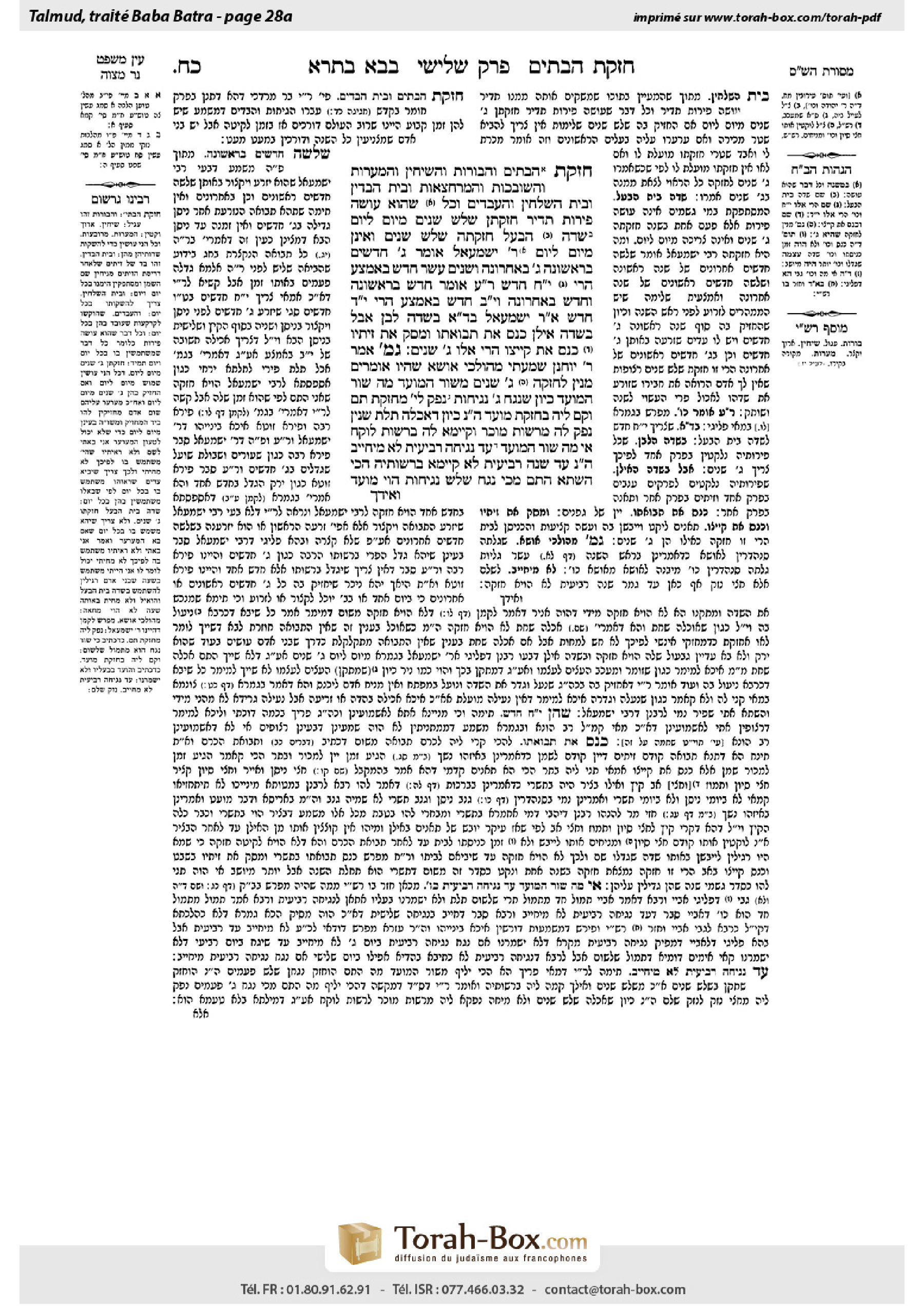
Bava Batra 28a: Talmud study for Daf Yomi
Study the Talmud for Daf Yomi with scanned pages, Hebrew text, English translations from Sefaria and AI-generated French translations.
Passage selection and English or AI-generated French translation are available where the scan has annotations. Daf Study is independent of Torah-Box and Sefaria.
Browse Bava Batra · בבא בתרא · All tractatesBava Batra 28a text and translations
This page of Bava Batra includes the Aramaic text, an English translation and an AI-generated French translation, alongside the scan above.
בבא בתרא כ״ח א · Aramaic and Hebrew text
חֶזְקַת הַבָּתִּים, וְהַבּוֹרוֹת, וְהַשִּׁיחִין, וְהַמְּעָרוֹת, וְהַשּׁוֹבָכוֹת, וְהַמֶּרְחֲצָאוֹת, וּבֵית הַבַּדִּין, וּבֵית הַשְּׁלָחִין, וְהָעֲבָדִים, וְכׇל שֶׁהוּא עוֹשֶׂה פֵּירוֹת תָּדִיר – חֶזְקָתָן שָׁלֹשׁ שָׁנִים מִיּוֹם לְיוֹם.
שְׂדֵה הַבַּעַל – חֶזְקָתָהּ שָׁלֹשׁ שָׁנִים, וְאֵינָן מִיּוֹם לְיוֹם.
רַבִּי יִשְׁמָעֵאל אוֹמֵר: שְׁלֹשָׁה חֳדָשִׁים בָּרִאשׁוֹנָה, שְׁלֹשָׁה בָּאַחֲרוֹנָה, וּשְׁנֵים עָשָׂר חֹדֶשׁ בָּאֶמְצַע; הֲרֵי שְׁמוֹנָה עָשָׂר חֹדֶשׁ.
רַבִּי עֲקִיבָא אוֹמֵר: חֹדֶשׁ בָּרִאשׁוֹנָה, וְחֹדֶשׁ בָּאַחֲרוֹנָה, וּשְׁנֵים עָשָׂר חֹדֶשׁ בָּאֶמְצַע; הֲרֵי אַרְבָּעָה עָשָׂר חֹדֶשׁ.
אָמַר רַבִּי יִשְׁמָעֵאל: בַּמֶּה דְּבָרִים אֲמוּרִים – בִּשְׂדֵה לָבָן, אֲבָל בִּשְׂדֵה אִילָן – כָּנַס אֶת תְּבוּאָתוֹ, וּמָסַק אֶת זֵיתָיו, כָּנַס אֶת קַיְיצוֹ – הֲרֵי אֵלּוּ שָׁלֹשׁ שָׁנִים.
גְּמָ׳ אָמַר רַבִּי יוֹחָנָן, שָׁמַעְתִּי מֵהוֹלְכֵי אוּשָׁא שֶׁהָיוּ אוֹמְרִים: מִנַּיִן לַחֲזָקָה שָׁלֹשׁ שָׁנִים? מִשּׁוֹר הַמּוּעָד – מָה שׁוֹר הַמּוּעָד, כֵּיוָן שֶׁנָּגַח שָׁלֹשׁ נְגִיחוֹת – נְפַק לֵיהּ מֵחֶזְקַת תָּם, וְקָם לֵיהּ בְּחֶזְקַת מוּעָד; הָכָא נָמֵי, כֵּיוָן דְּאַכְלַהּ תְּלָת שְׁנִין – נְפַק לַהּ מֵרְשׁוּת מוֹכֵר, וְקָיְימָא לַהּ בִּרְשׁוּת לוֹקֵחַ.
אִי – מָה שׁוֹר הַמּוּעָד עַד נְגִיחָה רְבִיעִית לָא מִיחַיַּיב, הָכָא נָמֵי, עַד שָׁנָה רְבִיעִית לָא קָיְימָא בִּרְשׁוּתֵיהּ! הָכִי הַשְׁתָּא?! הָתָם מִכִּי נְגַח שָׁלֹשׁ נְגִיחוֹת – הָוֵי מוּעָד,
Bava Batra 28a · English translation
MISHNA: With regard to the presumptive ownership of houses; and of pits; and of ditches; and of caves, which are used to collect water; and of dovecotes; and of bathhouses; and of olive presses; and of irrigated fields, which must be watered by people; and of slaves; and all similar property that constantly, i.e., throughout the year, generates profits, their presumptive ownership is established by working and profiting from them for a duration of three years from day to day. If the one in possession of the property can prove that he worked and profited from it for the previous three full years, there is a presumption that it belongs to him, and would remain in his possession if another were to claim that the property belonged to him or to his ancestors.
With regard to a non-irrigated field, i.e., one that is watered by rain, in which produce grows during certain seasons during the year, its presumption of ownership is established in three years, but they are not from day to day, since the fields are not worked and harvested continually throughout the three-year period.
Rabbi Yishmael says: Three months of possession in the first year, three months of possession in the last year, and twelve months of possession in the middle, which are eighteen months, suffice to establish the presumption of ownership with regard to a non-irrigated field.
Rabbi Akiva says: A month of possession in the first year, and a month of possession in the last year, and twelve months of possession in the middle, which are fourteen months, suffice to establish the presumption of ownership with regard to a non-irrigated field.
Rabbi Yishmael said: In what case is this statement, that eighteen months are required for a non-irrigated field, said? It is said with regard to a white field [bisdeh lavan], i.e., a grain field. But with regard to a field of trees, once he gathered his produce, and then harvested his olives, and then gathered his figs, these three harvests are the equivalent of three years. Since he harvested three types of produce, this is equivalent to having possessed the field for three years.
GEMARA: Rabbi Yoḥanan says: I heard from those who travel to Usha to study with the Sages there that they would say: From where is it derived that presumptive ownership is established in three years? From the forewarned ox: Just as in the case of a forewarned ox, once it has intentionally gored three gorings, it left the presumptive status of an innocuous ox and it is established as having the presumptive status of a forewarned ox, here too, once he has worked and profited from the land for three years, the land left the possession of the seller, and it is established as being in the possession of the buyer.
The Gemara questions this comparison: If so, say that just as with a forewarned ox, the owner is not liable to pay full damages until the fourth goring, here too, the land should not be established as being in his possession until the fourth year. The Gemara rejects this question: How can these cases be compared? There, once it has gored three times it is forewarned,
Bava Batra 28a · Traduction française (IA)
MICHNA : Concernant la propriété présumée des maisons ; des puits ; des canaux ; des grottes utilisées pour recueillir de l'eau ; des colombiers ; des bains ; des presses d'olive ; des champs irrigués, qui doivent être arrosés par les gens ; des esclaves ; et toutes les propriétés similaires qui génèrent constamment, c'est-à-dire toute l'année, des profits, leur propriété présumée est établie par le travail et le profit durant trois ans, jour après jour. Si celui qui possède la propriété peut prouver qu'il a travaillé et profité de celle-ci pendant les trois dernières années complètes, il y a une présomption qu'elle lui appartient, et restera en son possession si un autre affirme qu'elle lui appartenait ou appartenait à ses ancêtres.
Concernant un champ non irrigué, c'est-à-dire un champ arrosé par la pluie, dans lequel les récoltes poussent durant certaines saisons de l'année, la présomption de propriété est établie en trois ans, mais ces trois ans ne sont pas jour après jour, car les champs ne sont pas travaillés et récoltés continuellement durant la période de trois ans.
Rabbi Yishmael dit : Trois mois de possession dans la première année, trois mois de possession dans la dernière année, et douze mois de possession dans la période intermédiaire, ce qui fait dix-huit mois, suffisent à établir la présomption de propriété concernant un champ non irrigué.
Rabbi Akiva dit : Un mois de possession dans la première année, et un mois de possession dans la dernière année, et douze mois de possession dans la période intermédiaire, ce qui fait quatorze mois, suffisent à établir la présomption de propriété concernant un champ non irrigué.
Rabbi Yishmael dit : Dans quel cas cette déclaration, selon laquelle dix-huit mois sont requis pour un champ non irrigué, est-elle émise ? Elle est émise concernant un champ blanc [bisdeh lavan], c'est-à-dire un champ de céréales. Mais concernant un champ d'arbres, une fois qu'il a récolté ses produits, puis récolté ses olives, puis récolté ses figues, ces trois récoltes équivalent à trois ans. Puisque trois types de produits ont été récoltés, cela équivaut à avoir possédé le champ pendant trois ans.
GUEMARA : Rabbi Yoḥanan dit : J'ai entendu de ceux qui voyagent vers Usha pour étudier avec les Sages là-bas qu'ils disaient : D'où est tiré le fait que la propriété présumée est établie en trois ans ? De l'ox prévenu : Tout comme dans le cas d'un ox prévenu, une fois qu'il a délibérément tourné trois fois, il quitte le statut présumé d'un ox innocent et est établi comme ayant le statut présumé d'un ox prévenu, ici aussi, une fois qu'on a travaillé et profité du terrain pendant trois ans, le terrain quitte la possession du vendeur et est établi comme étant en possession de l'acheteur.
La Guemara soulève une question sur cette comparaison : Si c'est ainsi, disons que tout comme dans le cas d'un bœuf prévenu, l'propriétaire n'est pas tenu de payer les dommages complets jusqu'au quatrième aiguisage, ici aussi, le terrain ne devrait pas être établi comme étant en possession de la personne jusqu'au quatrième an. La Guemara rejette cette question : Comment peuvent ces cas être comparés ? Là-bas, une fois qu'il a tourné trois fois, il est prévenu,
Traduction française générée par IA à partir de l’édition anglaise de Sefaria. Vérifie toujours un passage avec le texte source.
Text from Sefaria: William Davidson Edition - Vocalized Aramaic (CC BY NC); William Davidson Edition - English (CC BY NC).