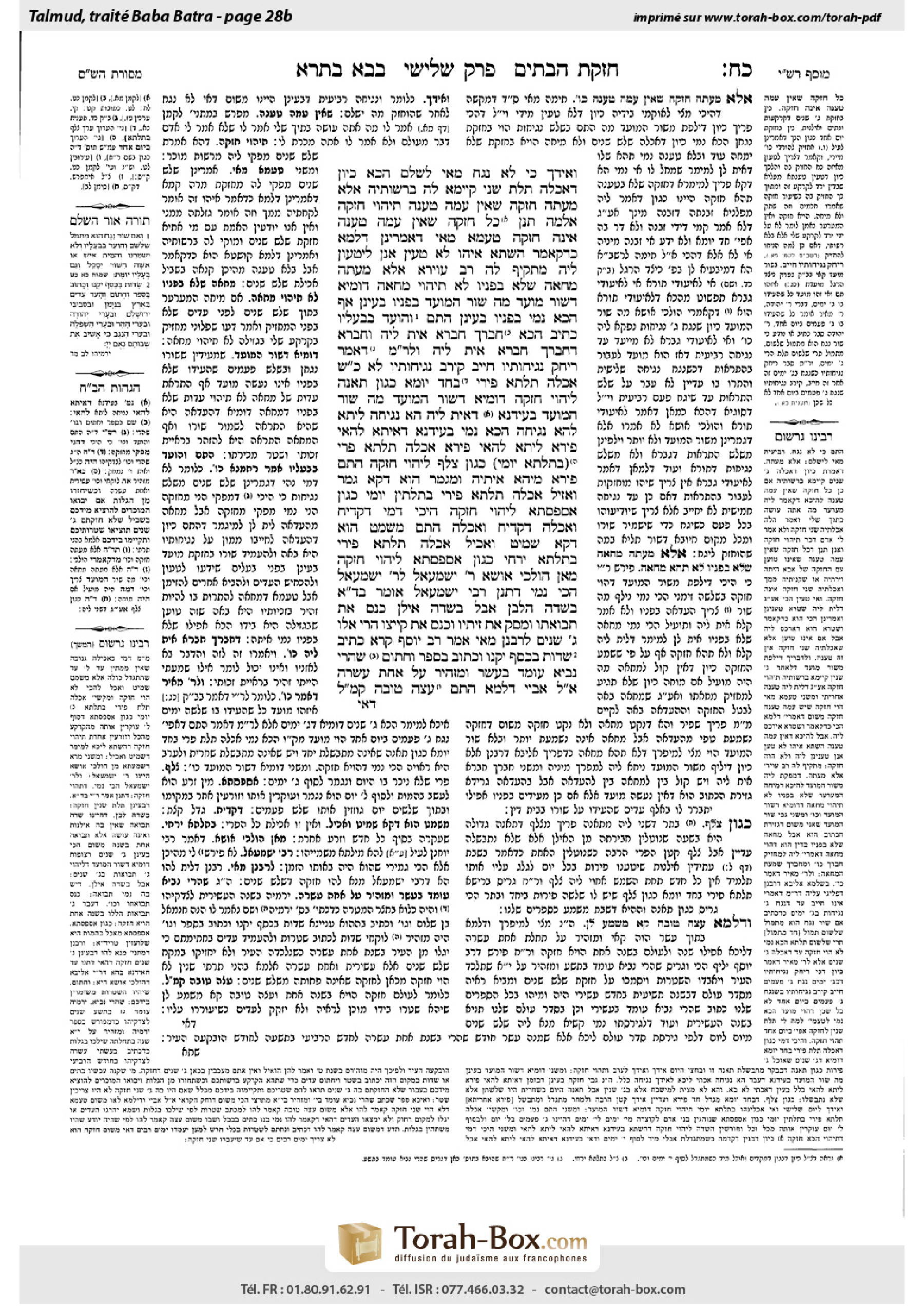
Bava Batra 28b: Talmud study for Daf Yomi
Study the Talmud for Daf Yomi with scanned pages, Hebrew text, English translations from Sefaria and AI-generated French translations.
Passage selection and English or AI-generated French translation are available where the scan has annotations. Daf Study is independent of Torah-Box and Sefaria.
Browse Bava Batra · בבא בתרא · All tractatesBava Batra 28b text and translations
This page of Bava Batra includes the Aramaic text, an English translation and an AI-generated French translation, alongside the scan above.
בבא בתרא כ״ח ב · Aramaic and Hebrew text
וְאִידַּךְ, כִּי לָא נְגַח – מַאי לְשַׁלֵּם? הָכָא, כֵּיוָן דְּאַכְלַהּ תְּלָת שְׁנֵי – קָיְימָא לַהּ בִּרְשׁוּתֵיהּ.
אֶלָּא מֵעַתָּה, חֲזָקָה שֶׁאֵין עִמָּהּ טַעֲנָה תֶּיהְוֵי חֲזָקָה! אַלְּמָה תְּנַן: כׇּל חֲזָקָה שֶׁאֵין עִמָּהּ טַעֲנָה, אֵינָהּ חֲזָקָה?
טַעְמָא מַאי – דְּאָמְרִינַן: דִּלְמָא כִּדְקָאָמַר, הַשְׁתָּא אִיהוּ לָא טָעֵין, אֲנַן לִיטְעוֹן לֵיהּ?!
מַתְקֵיף לַהּ רַב עַוִּירָא: אֶלָּא מֵעַתָּה, מֶחָאָה שֶׁלֹּא בְּפָנָיו לָא תֶּיהְוֵי מֶחָאָה – דּוּמְיָא דְּשׁוֹר מוּעָד; מָה שׁוֹר הַמּוּעָד בְּפָנָיו בָּעֵינַן, אַף הָכָא נָמֵי בְּפָנָיו בָּעֵינַן!
הָתָם – ״וְהוּעַד בִּבְעָלָיו״ כְּתִיב; הָכָא – חַבְרָךְ חַבְרָא אִית לֵיהּ, וְחַבְרָא דְּחַבְרָךְ – חַבְרָא אִית לֵיהּ.
וּלְרַבִּי מֵאִיר, דְּאָמַר: רִיחֵק נְגִיחוֹתָיו חַיָּיב, קֵירַב נְגִיחוֹתָיו לֹא כׇּל שֶׁכֵּן; אַכְלַהּ תְּלָתָא פֵּירֵי בְּחַד יוֹמָא – כְּגוֹן תְּאֵנָה, לֶיהֱוֵי חֲזָקָה!
דּוּמְיָא דְּשׁוֹר הַמּוּעָד, מָה שׁוֹר הַמּוּעָד בְּעִידָּנָא דְּאִית לֵיהּ הָא נְגִיחָה לֵיתָא לְהָא נְגִיחָה, הָכָא נָמֵי בְּעִידָּנָא דְּאִיתָא לְהַאי פֵּירָא לֵיתָא לְהַאי פֵּירָא.
אַכְלַהּ תְּלָתָא פֵּרֵי בִּתְלָתָא יוֹמֵי – כְּגוֹן צָלָף, לֶיהֱוֵי חֲזָקָה! הָתָם פֵּירָא מִיהָא אִיתֵיהּ, וּמִגְמָר הוּא דְּקָא גָמַר וְאָזֵיל.
אַכְלַהּ תְּלָתָא פֵּירֵי בִּתְלָתִין יוֹמֵי – כְּגוֹן אַסְפַּסְתָּא, לֶיהֱוֵי חֲזָקָה! הֵיכִי דָּמֵי – דְּקָדַיח וְאָכְלָה דְּקָדַיח וְאָכְלָה; הָתָם מִשְׁמָט הוּא דְּקָא שָׁמֵיט וְאָכֵיל.
אַכְלַהּ תְּלָתָא פֵּירֵי בִּתְלָתָא יַרְחֵי – כְּגוֹן אַסְפַּסְתָּא, לֶיהֱוֵי חֲזָקָה! מַאן הוֹלְכֵי אוּשָׁא – רַבִּי יִשְׁמָעֵאל; לְרַבִּי יִשְׁמָעֵאל הָכִי נָמֵי –
דִּתְנַן, רַבִּי יִשְׁמָעֵאל אוֹמֵר: בַּמֶּה דְּבָרִים אֲמוּרִים – בִּשְׂדֵה הַלָּבָן, אֲבָל בִּשְׂדֵה אִילָן – כָּנַס אֶת תְּבוּאָתוֹ, וּמָסַק אֶת זֵיתָיו, וְכָנַס אֶת קַיְיצוֹ – הֲרֵי אֵלּוּ שָׁלֹשׁ שָׁנִים.
לְרַבָּנַן, מַאי?
אָמַר רַב יוֹסֵף, קְרָא כְּתִיב: ״שָׂדוֹת בַּכֶּסֶף יִקְנוּ וְכָתוֹב בַּסֵּפֶר וְחָתוֹם״ – שֶׁהֲרֵי נָבִיא עוֹמֵד בְּעֶשֶׂר, וּמַזְהִיר עַל אַחַת עֶשְׂרֵה.
אֲמַר לֵיהּ אַבָּיֵי: דִּלְמָא הָתָם עֵצָה טוֹבָה קָא מַשְׁמַע לַן!
Bava Batra 28b · English translation
and the requirement for there to be another, fourth, incident for the owner to be liable to pay full damages exists because before it gores after having become a forewarned ox, what is there for the owner to pay? Here, once he has worked and profited from the land for three years, the land is established as being in his possession.
The Gemara asks: If that is so, according to the explanation that the forewarned ox is the source for the presumption of ownership with regard to land, even possession that is not accompanied by a claim, i.e., where the possessor has no explanation as to how he acquired it, should be sufficient to establish the presumption of ownership, just as goring three times automatically establishes its having the status of a forewarned ox. Why did we learn in a mishna (41a): Any possession that is not accompanied by a claim explaining how the possessor became the owner is not sufficient to establish the presumption of ownership?
The Gemara answers: What is the reason that possession that is not accompanied by a claim is not sufficient to establish the presumption of ownership? Because in a standard case where one has presumptive ownership, we say that even if the claimant proves that the field was once his, since the other is in possession of the land, perhaps the truth is as he says, that he purchased it from the previous owner. But now that he himself does not claim that he purchased it, will we claim this for him?
Rav Avira objects to the explanation that the presumption with regard to land is derived from the halakha of a forewarned ox: If that is so, a protest that the claimant lodges during the three years not in the presence of the possessor should not be considered a protest, because it must be similar to the halakha of a forewarned ox: Just as we require that the testimony concerning a forewarned ox be in its owner’s presence, so too here, we should also require that a protest be lodged in the possessor’s presence.
The Gemara answers: This is not difficult. There, with regard to a forewarned ox, it is written: “And warning has been given to its owner” (Exodus 21:29), indicating that the warning must be issued in the presence of the owner. Here, with regard to the protest, your friend has a friend, and the friend of your friend has a friend, so that the protest will become known even if lodged not in the presence of the possessor, as word of it will spread. There is no Torah edict mandating that the protest be lodged in his presence, and it is sufficient that he hears of it, even secondhand.
The Gemara further asks: And according to Rabbi Meir, who says: When the ox performs its gorings at intervals its owner is liable, if it performs its gorings successively, is it not all the more so the case that its owner is liable? According to his opinion, the animal must gore only three times to become forewarned, and it is not required that the gorings occur on three separate days; they can all occur on the same day. Similarly, one could say that if he profited from the field by consuming three fruits of, for example, a fig tree, within one day, that should be sufficient to establish the presumption of ownership.
The Gemara answers: This would not be a valid comparison, as presumptive ownership with regard to land must be similar to the halakha of a forewarned ox: Just as with a forewarned ox, at the time when the animal has this goring, it does not have that goring, as each act of goring occurs at a separate time, here too, in order for the consumption of the produce to establish the presumption of ownership, it must be that at the time when this fruit is here, that fruit is not here. When all the produce of the field is extant concurrently, consumption of this produce does not establish the presumption of ownership, even if the produce is consumed at three different times.
The Gemara asks: Based on this, if he profited from the field by consuming three fruits within three consecutive days, for example, the fruits of a caper bush, whose fruits ripen day after day, that should be sufficient to establish the presumption of ownership, as all three fruits were not ripe concurrently. The Gemara answers: There, with regard to the caper bush, at least the fruit is here and it is in the process of finishing its ripening during the three days. This is not similar to the goring ox, where each goring is fully independent of the others.
The Gemara challenges: Based on this, if he profited from the field by consuming three fruits within thirty days, for example, alfalfa [aspasta], which quickly regrows when cut, and which is repeatedly cut over a short period of time, that should be sufficient to establish the presumption of ownership. The Gemara explains: What are the circumstances where it could regrow three times within thirty days? Where it grows a little and he cuts and consumes it, where it grows a little more and he consumes it, such that he cuts it three times within thirty days. There, he is seizing and consuming the alfalfa, which is not the normal way of farming it, and consequently he does not establish the presumption of ownership, which is established only through standard use of the land.
The Gemara challenges: Based on this, if he profited from the field by consuming three fruits within three months, for example, alfalfa, where he did employ the standard method of harvesting it, that should be sufficient to establish the presumption of ownership. The Gemara explains: Who are they who travel to Usha whose opinion is under discussion? It is Rabbi Yishmael. Indeed, according to Rabbi Yishmael, this would establish the presumption of ownership.
This is as we learned in the mishna that Rabbi Yishmael says: In what case is this statement, that eighteen months are required for a non-irrigated field, said? With regard to a white field, i.e., a grain field. But with regard to a field of trees, once he gathered his produce, and then harvested his olives, and then gathered his figs, these three harvests are the equivalent of three years. Rabbi Yishmael is of the opinion that three harvests are sufficient.
The Gemara asks: According to the Rabbis, who hold that three years, and not three harvests, are required to establish the presumption of ownership, what is the source for the concept of this type of presumptive ownership?
Rav Yosef said that it is written in the verse detailing the purchase of a field from Hanamel by Jeremiah, his cousin, during the time of the siege of Eretz Yisrael: “Men shall buy fields for money, and subscribe the deeds, and seal them” (Jeremiah 32:44). This describes the writing of a bill of sale to serve as proof of ownership of the field, since he was unable to remain living there for three years to establish the presumption of ownership. As the prophet Jeremiah stood in the tenth year of King Zedekiah’s reign and warned people to write bills of sale for the eleventh year, when Eretz Yisrael would be overrun. Consequently, despite the fact that one purchasing a field there would be able to live on the land for two years, this would not be sufficient to establish the presumption of ownership, which is why he said that they should have bills of sale written.
Abaye said to him: Perhaps there he merely teaches us good advice, that it is advisable to have documents to preclude the need to present witnesses that can attest that one had been living on the land. This is not a proof that the presumption of ownership cannot be established in less than three years.
Bava Batra 28b · Traduction française (IA)
et la nécessité qu'il y ait un quatrième incident pour que le propriétaire soit tenu pleinement responsable existe car avant qu'il ne blesse après avoir été un bœuf averti, que peut-il payer ? Ici, une fois qu'il a travaillé et profité du terrain pendant trois ans, le terrain est considéré comme étant en son possession.
La Guemara pose la question : Si c'est ainsi, selon l'explication selon laquelle le bœuf averti est la source de l'assomption de la propriété concernant le terrain, même une possession non accompagnée d'une revendication, c'est-à-dire où le possesseur n'a pas d'explication sur la manière dont il est devenu propriétaire, devrait suffire à établir l'assomption de la propriété, tout comme l'attaque trois fois établit automatiquement le statut de bœuf averti. Pourquoi avons-nous appris dans une mitsva (41a) : Toute possession non accompagnée d'une revendication expliquant comment le possesseur est devenu propriétaire n'est pas suffisante pour établir l'assomption de la propriété ?
La Guemara répond : Quelle est la raison pour laquelle une possession non accompagnée d'une revendication n'est pas suffisante pour établir l'assomption de la propriété ? Parce que dans un cas normal où l'on a une assomption de propriété, on dit que même si le réclamant prouve que le champ était à lui, puisque l'autre est en possession du terrain, peut-être la vérité est-elle comme il le dit, qu'il l'a acheté auprès du précédent propriétaire. Mais maintenant qu'il ne réclame pas lui-même qu'il l'a acheté, voulons-nous le prétendre pour lui ?
Rav Avira s'oppose à l'explication selon laquelle l'assomption concernant la terre est tirée de la halakha du bœuf averti : Si c'est ainsi, une protestation que le réclamant dépose pendant les trois ans, sans la présence du possesseur, ne devrait pas être considérée comme une protestation, car elle doit être semblable à la halakha du bœuf averti : Tout comme nous exigeons que le témoignage concernant un bœuf averti soit en présence de son propriétaire, de même ici, nous devrions exiger que la protestation soit déposée en présence du possesseur.
La Guemara répond : Ce n'est pas difficile. Là, concernant le bœuf averti, il est écrit : « Et un avertissement a été donné à son propriétaire » (Exode 21:29), indiquant que l'avertissement doit être donné en présence du propriétaire. Ici, concernant la protestation, votre ami a un ami, et l'ami de votre ami a un ami, de sorte que la protestation deviendra connue même si elle est déposée sans la présence du possesseur, car la nouvelle se répandra. Il n'y a pas un décret de la Torah exigeant que la protestation soit déposée en sa présence, et il suffit qu'il l'entende, même de manière indirecte.
La Guemara pose une autre question : Et selon Rabbi Meïr, qui dit : Lorsque l'animal effectue ses attaques à intervalles réguliers, son propriétaire est responsable, si l'animal effectue ses attaques successivement, n'est-ce pas encore plus le cas que son propriétaire est responsable ? Selon son opinion, l'animal doit attaquer trois fois pour devenir un bœuf averti, et il n'est pas requis que les attaques aient lieu sur trois jours différents ; elles peuvent toutes avoir lieu le même jour. De même, on pourrait dire que si l'on a profité du champ en consommant trois fruits, par exemple, d'un arbre à figues, dans la même journée, cela devrait suffire à établir l'assomption de la propriété.
La Guemara répond : Ce ne serait pas une comparaison valable, car l'assomption de propriété concernant la terre doit être semblable à la halakha du bœuf averti : tout comme avec un bœuf averti, au moment où l'animal a cette attaque, il n'a pas cette attaque, car chaque attaque a lieu à un moment séparé, ici aussi, afin que la consommation des produits établisse l'assomption de la propriété, il faut que, au moment où ce fruit est là, ce fruit ne soit pas là. Lorsque tous les produits du champ sont présents en même temps, la consommation de ces produits ne permet pas d'établir l'assomption de la propriété, même si les produits sont consommés à trois moments différents.
La Guemara pose la question : Selon cela, si l'on a profité du champ en consommant trois fruits pendant trois jours consécutifs, par exemple, les fruits d'un buis, dont les fruits mûrissent un par un, cela devrait suffire à établir l'assomption de la propriété, car les trois fruits n'étaient pas mûrs en même temps. La Guemara répond : Là, concernant le buis, au moins le fruit est là et il est en train de finir de mûrir pendant les trois jours. Cela n'est pas semblable à l'attaque du bœuf, où chaque attaque est totalement indépendante des autres.
La Guemara conteste : Selon cela, si l'on a profité du champ en consommant trois fruits dans trente jours, par exemple, l'alfalfa [aspasta], qui repousse rapidement lorsqu'il est coupé et qui est répétamment coupé sur une courte période, cela devrait suffire à établir la présomption de propriété. La Guemara explique : Quelles sont les circonstances où il pourrait repousser trois fois dans trente jours ? Là où il pousse un peu et il le coupe et le consomme, où il pousse un peu plus et il le consomme, de sorte qu'il le coupe trois fois dans trente jours. Là, il s'empare et consomme l'alfalfa, ce qui n'est pas la manière normale de le cultiver, et par conséquent il ne peut pas établir la présomption de propriété, qui est établie uniquement par l'utilisation normale du terrain.
La Guemara conteste : Selon cela, si l'on a profité du champ en consommant trois fruits dans trois mois, par exemple, l'alfalfa, où l'on a employé la méthode normale de récolte, cela devrait suffire à établir la présomption de propriété. La Guemara explique : Qui sont ceux qui voyagent vers Usha dont l'opinion est en débat ? C'est Rabbi Yishmael. En effet, selon Rabbi Yishmael, cela établirait la présomption de propriété.
C’est ce que nous avons appris dans la Michna, que Rabbi Yishmael dit : Dans quel cas cette déclaration, selon laquelle dix-huit mois sont requis pour un champ non arrosé, est-elle émise ? Concernant un champ blanc, c’est-à-dire un champ de céréales. Mais concernant un champ d’arbres, une fois qu’il a récolté ses produits, puis récolté ses olives, puis récolté ses figues, ces trois récoltes équivalent à trois ans. Rabbi Yishmael estime que trois récoltes suffisent.
Le Guemara demande : Selon les Rabbins, qui considèrent que trois ans, et non trois récoltes, sont requis pour établir la présomption d’ownership, quelle est la source de la notion de cette présomption d’ownership ?
Rav Yosef a dit qu’il est écrit dans la versette décrivant l’achat d’un champ par Hanamel par Jérémie, son cousin, pendant la siege d’Eretz Yisrael : « Les hommes achèteront des champs avec de l’argent, et signeront les actes, et les scelleront » (Jérémie 32:44). Cela décrit l’écriture d’un acte de vente pour servir de preuve d’ownership du champ, puisqu’il n’était pas possible de rester vivant là-bas pendant trois ans pour établir la présomption d’ownership. Comme le prophète Jérémie se tenait en dixième année du règne du roi Zédéquias et avertissait les gens d’écrire des actes de vente pour l’année onze, lorsque Eretz Yisrael serait envahie. Ainsi, malgré le fait qu’un acheteur d’un champ y puisse vivre deux ans, cela ne serait pas suffisant pour établir la présomption d’ownership, ce pourquoi il a dit qu’ils devaient écrire des actes de vente.
Abaye a dit à lui : Peut-être qu’il nous enseigne simplement un bon conseil, à savoir qu’il est conseillé d’avoir des documents pour éviter de présenter des témoins qui pourraient attester qu’on avait vécu sur le terrain. Ce n’est pas une preuve que la présomption d’ownership ne peut pas être établie en moins de trois ans.
Traduction française générée par IA à partir de l’édition anglaise de Sefaria. Vérifie toujours un passage avec le texte source.
Text from Sefaria: William Davidson Edition - Vocalized Aramaic (CC BY NC); William Davidson Edition - English (CC BY NC).