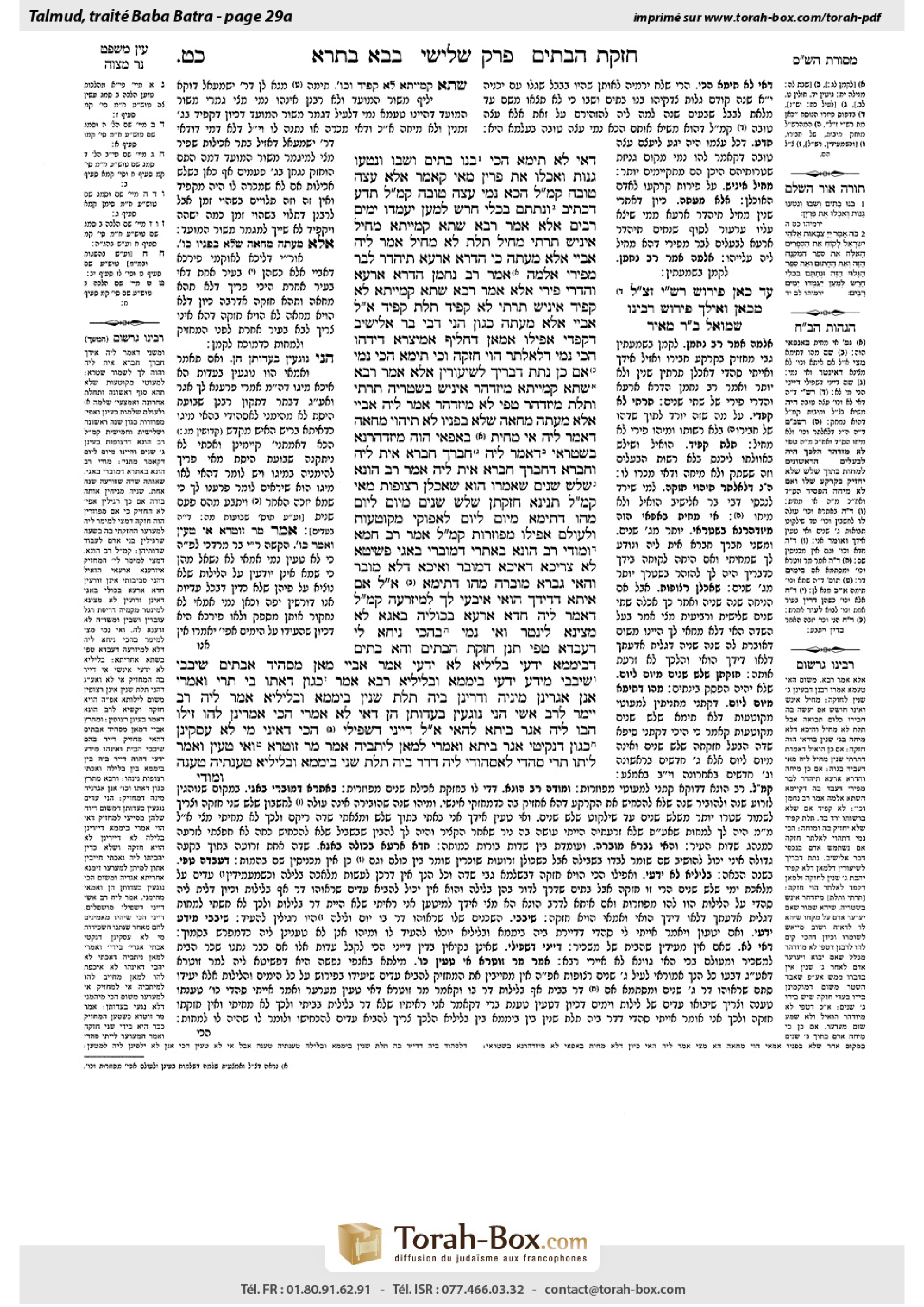
Bava Batra 29a: Talmud study for Daf Yomi
Study the Talmud for Daf Yomi with scanned pages, Hebrew text, English translations from Sefaria and AI-generated French translations.
Passage selection and English or AI-generated French translation are available where the scan has annotations. Daf Study is independent of Torah-Box and Sefaria.
Browse Bava Batra · בבא בתרא · All tractatesBava Batra 29a text and translations
This page of Bava Batra includes the Aramaic text, an English translation and an AI-generated French translation, alongside the scan above.
בבא בתרא כ״ט א · Aramaic and Hebrew text
דְּאִי לָא תֵּימָא הָכִי, ״בְּנוּ בָתִּים וְשֵׁבוּ, וְנִטְעוּ גַנּוֹת וְאִכְלוּ אֶת פִּרְיָן״ – מַאי קָאָמַר? אֶלָּא עֵצָה טוֹבָה קָא מַשְׁמַע לַן; הָכָא נָמֵי – עֵצָה טוֹבָה קָא מַשְׁמַע לַן. תִּדַּע, דִּכְתִיב: ״וּנְתַתָּם בִּכְלִי חָרֶשׂ, לְמַעַן יַעַמְדוּ יָמִים רַבִּים״.
אֶלָּא אָמַר רָבָא: שַׁתָּא קַמַּיְיתָא מָחֵיל אִינִישׁ, תַּרְתֵּי מָחֵיל, תְּלָת לָא מָחֵיל.
אֲמַר לֵיהּ אַבָּיֵי: אֶלָּא מֵעַתָּה, כִּי הָדְרָא אַרְעָא, תִּיהְדַּר לְבַר מִפֵּירֵי! אַלְּמָה אָמַר רַב נַחְמָן: הָדְרָא אַרְעָא וְהָדְרִי פֵּירֵי?
אֶלָּא, אָמַר רָבָא: שַׁתָּא קַמַּיְיתָא לָא קָפֵיד אִינִישׁ, תַּרְתֵּי לָא קָפֵיד, תְּלָת קָפֵיד.
אֲמַר לֵיהּ אַבָּיֵי: אֶלָּא מֵעַתָּה, כְּגוֹן הָנֵי דְּבֵי בַּר אֶלְיָשִׁיב – דְּקָפְדִי אֲפִילּוּ אַמַּאן דְּחָלֵיף אַמִּיצְרָא דִידְהוּ, הָכִי נָמֵי דִּלְאַלְתַּר הָוֵי חֲזָקָה? וְכִי תֵּימָא הָכִי נָמֵי, אִם כֵּן נָתַתָּ דְּבָרֶיךָ לְשִׁיעוּרִין!
אֶלָּא אָמַר רָבָא: שַׁתָּא קַמַּיְיתָא מִיזְדְּהַר אִינִישׁ בִּשְׁטָרֵיהּ, תַּרְתֵּי וּתְלָת מִיזְדְּהַר, טְפֵי לָא מִיזְדְּהַר.
אֲמַר לֵיהּ אַבָּיֵי: אֶלָּא מֵעַתָּה, מֶחָאָה שֶׁלֹּא בְּפָנָיו – לָא תִּיהְוֵי מֶחָאָה, דַּאֲמַר לֵיהּ: אִי מַחֵית בְּאַפַּאי, הֲוָה מִיזְדְהַרְנָא בִּשְׁטָרַאי!
דְּאָמַר לֵיהּ: חַבְרָךְ חַבְרָא אִית לֵיהּ, וְחַבְרָא דְחַבְרָךְ – חַבְרָא אִית לֵיהּ.
אָמַר רַב הוּנָא: שָׁלֹשׁ שָׁנִים שֶׁאָמְרוּ, הוּא שֶׁאֲכָלָן רְצוּפוֹת. מַאי קָמַשְׁמַע לַן? תְּנֵינָא: חֶזְקָתָן שָׁלֹשׁ שָׁנִים מִיּוֹם לְיוֹם! מַהוּ דְּתֵימָא, ״מִיּוֹם לְיוֹם״ לְאַפּוֹקֵי מְקוּטָּעוֹת – וּלְעוֹלָם אֲפִילּוּ מְפוּזָּרוֹת; קָא מַשְׁמַע לַן.
אָמַר רַב חָמָא: וּמוֹדֵי רַב הוּנָא בְּאַתְרֵי דְּמוֹבְרִי בָּאגֵי.
פְּשִׁיטָא! לָא צְרִיכָא, דְּאִיכָּא דְּמוֹבַר וְאִיכָּא דְּלָא מוֹבַר – וְהַאי גַּבְרָא מוֹבְרַהּ; מַהוּ דְּתֵימָא, אֲמַר לֵיהּ: אִם אִיתָא דְּדִידָךְ הֲוַאי, אִיבְּעִי לָךְ לְמִיזְרְעַהּ; קָא מַשְׁמַע לַן דַּאֲמַר לֵיהּ: חֲדָא אַרְעָא בְּכוּלֵּיהּ בָּאגָא – לָא מָצֵינָא לִינְטַר.
וְאִי נָמֵי, בְּהָכִי נִיחָא לִי – דְּעָבְדָא טְפֵי.
תְּנַן: חֶזְקַת הַבָּתִּים. וְהָא בָּתִּים – דְּבִימָמָא יָדְעִי, בְּלֵילְיָא לָא יָדְעִי!
אָמַר אַבָּיֵי: מַאן מַסְהֵיד אַבָּתִּים – שִׁיבָבֵי; שִׁיבָבֵי מִידָּע יָדְעִי בִּימָמָא וּבְלֵילְיָא.
רָבָא אָמַר: כְּגוֹן דְּאָתוּ בֵּי תְרֵי, וְאָמְרִי: אֲנַן אָגְרִינַן מִינֵּיהּ, וְדָרֵינַן בֵּיהּ תְּלָת שְׁנִין בִּימָמָא וּבְלֵילְיָא.
אֲמַר לֵיהּ רַב יֵימַר לְרַב אָשֵׁי: הָנֵי נוֹגְעִין בְּעֵדוּתָן הֵן – דְּאִי לָא אָמְרִי הָכִי, אָמְרִינַן לְהוּ: זִילוּ הַבוּ לֵיהּ אֲגַר בֵּיתָא לְהַאי!
אֲמַר לֵיהּ: דַּיָּינֵי דִּשְׁפִילִי הָכִי דָּאיָנִי. מִי לָא עָסְקִינַן כְּגוֹן דִּנְקִיטִי אֲגַר בֵּיתָא וְאָמְרִי: לְמַאן לִיתְּבֵיהּ?
אָמַר מָר זוּטְרָא, וְאִי טָעֵין וְאָמַר: לֵיתוֹ תְּרֵי סָהֲדִי לְאַסְהוֹדֵי לֵיהּ דְּדָר בֵּיהּ תְּלָת שְׁנֵי בִּימָמָא וּבְלֵילְיָא – טַעְנְתֵיהּ טַעֲנָה.
Bava Batra 29a · English translation
Because if you do not say so, then when he states: “Build houses, and dwell in them, and plant gardens, and eat the fruit of them” (Jeremiah 29:5), what halakhic statement was he saying? Rather, he teaches us good advice, and here too he teaches us good advice. The Gemara comments: Know that this was mere advice, as it is written: “And put them in an earthen vessel; that they may continue many days” (Jeremiah 32:14). This is obviously good advice to preserve the items properly, and is not a halakhic statement. Therefore, this is not a proof that the presumption of ownership cannot be established in under three years.
Rather, Rava said a different reason: A person who sees another profiting from his field might waive his rights during the first year, and he might waive his rights for two years, but he will not waive his rights for three years. Therefore, if one does not lodge a protest by the end of the third year, it is tantamount to a concession that the land is not his.
Abaye said to him: If that is so, when it becomes clear that the land is in fact owned by another and it is returned to its owner, it should be returned, save for the produce that the possessor consumed during the first two years, as the owner waived his rights to it. Why did Rav Naḥman say: The land is returned and the produce is returned?
Rather, Rava said a different reason: A person is not particular the first year to lodge a protest, and he is not particular for two years, even though he does not waive his rights to the produce. He is particular to lodge a protest when he sees another profiting from his field for three years. Therefore, if one does not lodge a protest by the end of the third year, it is tantamount to a concession that the land is not his.
Abaye said to him: If that is so, for people such as those of the bar Elyashiv household, who are particular even with regard to one who goes on the boundary of their field, here too, will you say that presumptive ownership is established immediately, as soon as one makes use of their property without their lodging a protest? And if you would say that is indeed the halakha, if so, you have subjected your statement to the varying circumstances of each case, as there will be a different length of time needed to establish the presumption of ownership depending on who the prior owner is. This is untenable.
Rather, Rava said a different reason: A person is careful with his document detailing his purchase of land for the first year after the purchase, and he is also careful for two and three years. For more time than that, he is not careful and might discard the document if no one has lodged a protest concerning his possession of the land. Therefore, the Sages ruled that after three years have passed, he can prove his ownership by means of presumptive ownership.
Abaye said to him: If that is so, a protest that is lodged not in his presence should not be a valid protest, and if three years pass with no protest in his presence, presumptive ownership should be established even if there was a protest lodged before other people. This is because the one possessing the land can say to the claimant: If you had protested in my presence, I would have been careful with my document and would not have discarded it.
The Gemara explains that this claim would not be accepted, because the claimant can say to him: Your friend has a friend, and your friend’s friend has a friend, and the assumption is that word of the protest reached you.
§ Rav Huna says: The three years that the Sages said are required to establish the presumption of ownership is referring to when he worked and profited from the field in consecutive years. The Gemara asks: What is Rav Huna teaching us with this statement? We learned this in the mishna: Their presumption of ownership is established by use for a duration of three years from day to day. The Gemara answers: Lest you say that the phrase: From day to day, serves to exclude partial years and to teach that each of the three years must be full, and actually even scattered, i.e., non-consecutive, years are sufficient, therefore, Rav Huna teaches us that the years must be consecutive.
Rav Ḥama says: And Rav Huna concedes with regard to locations where they leave fields [bagei] to lie fallow by planting in alternate years, that the three years combine despite not being consecutive, as that is the manner in which owners profit from the land.
The Gemara asks: Isn’t it obvious that this is the halakha? The Gemara answers: No, it is necessary to state this with regard to locations where there are some people who leave the fields to lie fallow and there are some people who do not leave the fields to lie fallow, and this man left the field to lie fallow. Lest you say that the claimant can say to him: If it is so that the land is yours, you should have sown it, therefore, Rav Ḥama teaches us that the possessor can say to the claimant: I am not able to hire someone to guard one parcel of land within an entire field, and I acted like those who own other land in this location and let the field lie fallow.
And alternatively, the possessor can say to the claimant: In this manner of farming it is beneficial for me to farm, because the land produces more later, and I do not wish to plant year after year and weaken the soil.
The Gemara clarifies Rav Huna’s statement that the presumption of ownership can be established only by consecutive use. We learned in the mishna about the presumptive ownership of houses. But with regard to the use of houses, where the witnesses attesting to its use know who uses the house only in the day, but they do not know who uses the house in the night, how then can one establish the presumption of ownership in the case of a house? The possessor’s use is not consecutive, as it is continually interrupted by the nights.
Abaye said: Who testifies about houses? Neighbors, and neighbors know who is inside in the day and in the night.
Rava said that there is another scenario in which one can bring witnesses with regard to the use of a house. This is such as when two people come and say: We rented the house from him and we lived in it for three years, in the day and in the night. This testimony substantiates that the house was used under the authority of the one who is attempting to prove that he has established the presumption of ownership.
Rav Yeimar said to Rav Ashi: How can their testimony be relied upon? These witnesses are biased in their testimony, because if they do not say this testimony, that they rented the house from the possessor for three consecutive years, we say to them: Go and give payment for the rental of the house to that one who is claiming ownership, as the one you paid has not established that he is the true owner.
Rav Ashi said to him: Low-level judges rule this way. In other words, only a court composed of ignorant judges would accept the testimony of the renters of the house in a case where they are biased in their testimony. Nevertheless, Rava’s scenario is still possible, as, are we not dealing with a case where they are holding the money for the payment for the rental of the house, and they are saying to the court: To whom shall we give it? Therefore, they are not biased in their testimony, because they will pay the same amount, regardless of who the actual owner is.
The Gemara quotes a related statement. Mar Zutra said: And if the claimant claims and says: Let two witnesses come to testify for the possessor that he lived in the house three years in the day and in the night, his claim is a legitimate claim.
Bava Batra 29a · Traduction française (IA)
Parce que si vous ne dites pas cela, alors quand il dit : « Construisez des maisons, et demeurez-y, et plantez des jardins, et mangez leurs fruits » (Jérémie 29:5), quelle déclaration halakhique faisait-il ? Plutôt, il nous enseigne un bon conseil, et ici aussi il nous enseigne un bon conseil. La Guemara commente : Sachez que cela n'était qu'un conseil, car il est écrit : « Et mettez-les dans un récipient en terre ; afin qu'ils durent de nombreux jours » (Jérémie 32:14). Cela est clairement un bon conseil pour conserver les objets correctement, et n'est pas une déclaration halakhique. Par conséquent, cela ne constitue pas une preuve que l'assomption de propriété ne peut être établie en moins de trois ans.
Plutôt, Rava a dit une autre raison : Une personne qui voit une autre profiter de son champ pourrait renoncer à ses droits pendant la première année, et il pourrait renoncer à ses droits pendant deux ans, mais il ne renoncerait pas à ses droits pendant trois ans. Par conséquent, si l'on ne dépose pas une protestation à la fin de la troisième année, cela équivaut à une concession que le champ n'est pas à lui.
Abaye a dit à lui : Si c'est ainsi, quand il devient clair que le champ est en réalité possédé par un autre et qu'il est rendu à son propriétaire, il devrait être rendu, sauf pour les produits que le possesseur a consommés pendant les deux premières années, car le propriétaire a renoncé à ses droits sur ceux-ci. Pourquoi Rav Naḥman a-t-il dit : Le champ est rendu et les produits sont rendus ?
Plutôt, Rava a dit une autre raison : Une personne n'est pas particulièrement attentive la première année à déposer une protestation, et elle n'est pas particulièrement attentive pendant deux ans, même s'il ne renonce pas à ses droits sur les produits. Elle est particulièrement attentive à déposer une protestation quand elle voit une autre profiter de son champ pendant trois ans. Par conséquent, si l'on ne dépose pas une protestation à la fin de la troisième année, cela équivaut à une concession que le champ n'est pas à lui.
Abaye a dit à lui : Si c'est ainsi, pour des gens comme ceux de la famille de bar Elyashiv, qui sont particuliers même envers celui qui marche sur la limite de leur champ, ici aussi, diriez-vous que l'assomption de propriété est établie immédiatement, dès que l'on utilise leur propriété sans qu'ils n'aient déposé de protestation ? Et si vous dites que c'est effectivement la halakha, alors vous avez soumis votre déclaration aux circonstances variables de chaque cas, car il y aura un temps différent nécessaire pour établir l'assomption de propriété selon qui est le propriétaire précédent. Cela n'est pas tenable.
Plutôt, Rava a dit une autre raison : Une personne est attentive à son document détaillant l'achat de terrain pendant la première année après l'achat, et elle est aussi attentive pendant deux et trois ans. Pour un temps plus long, elle n'est pas attentive et pourrait jeter le document si personne n'a déposé de protestation concernant sa possession du terrain. Par conséquent, les Sages ont décidé que, après trois ans, il peut prouver sa propriété par l'assomption de propriété.
Abaye dit à lui : Si c'est ainsi, une protestation déposée devant lui ne devrait pas être une protestation valide, et si trois ans passent sans protestation devant lui, l'assomption de propriété devrait être établie même s'il y a eu une protestation déposée devant d'autres personnes. Cela est parce que le possesseur peut dire au réclamant : Si vous aviez protesté devant moi, je serais resté attentif à mon document et ne l'aurais pas jeté.
La Guemara explique que cette revendication ne serait pas acceptée, car le réclamant peut lui dire : Votre ami a un ami, et votre ami a un ami qui a un ami, et on suppose que le bruit de la protestation vous a atteint.
§ Rav Huna dit : Les trois ans que les Sages ont dit être nécessaires pour établir l'assomption de propriété font référence à quand il a travaillé et a profité du champ pendant des années consécutives. La Guemara pose la question : Qu'est-ce que Rav Huna nous enseigne avec cette déclaration ? Nous avons appris cela dans la Michna : Leur assomption de propriété est établie par l'utilisation pendant une durée de trois ans, jour après jour. La Guemara répond : Afin de ne pas dire que la phrase : Jour après jour, sert à exclure les années partielles et pour enseigner que chaque des trois ans doit être complet, et en réalité même des années dispersées, c'est-à-dire non consécutives, sont suffisantes, donc Rav Huna nous enseigne que les années doivent être consécutives.
Rav Ḥama dit : Et Rav Huna reconnaît, concernant les lieux où ils laissent les champs [bagei] en friche en plantant alternativement, que les trois ans s'additionnent même s'ils ne sont pas consécutifs, car c'est la manière dont les propriétaires profitent du terrain.
La Guemara pose la question : N'est-ce pas évident que c'est la halakha ? La Guemara répond : Non, il est nécessaire d'exprimer cela concernant les lieux où il y a des gens qui laissent les champs en friche et des gens qui n'en laissent pas, et cet homme a laissé le champ en friche. Afin de ne pas dire que le réclamant peut lui dire : Si c'est ainsi que le terrain est à toi, tu devrais avoir semé, donc Rav Ḥama nous enseigne que le possesseur peut dire au réclamant : Je n'ai pas la capacité de faire garder une parcelle de terrain dans un tout le champ, et j'ai agi comme ceux qui possèdent d'autres terres ici et ont laissé le champ en friche.
Et de manière alternative, le possesseur peut dire au réclamant : Ainsi de la culture, il est bénéfique pour moi de cultiver, car le terrain produit plus tard, et je ne veux pas planter année après année et affaiblir le sol.
La Guemara clarifie la déclaration de Rav Huna selon laquelle la présomption d'ownership peut être établie uniquement par une utilisation consécutive. Nous avons appris dans la Michna concernant la présomption d'ownership des maisons. Mais concernant l'utilisation des maisons, où les témoins attestant de leur utilisation connaissent qui utilise la maison seulement pendant la journée, mais ne connaissent pas qui utilise la maison pendant la nuit, comment alors peut-on établir la présomption d'ownership dans le cas d'une maison ? L'utilisation du possesseur n'est pas consécutive, car elle est constamment interrompue par les nuits.
Abaye a dit : Qui peut témoigner sur les maisons ? Les voisins, et les voisins savent qui est à l'intérieur le jour et la nuit.
Rava a dit qu'il existe un autre cas où l'on peut admettre des témoins concernant l'usage d'une maison. C'est le cas où deux personnes viennent et disent : Nous avons loué la maison à lui et nous y avons vécu trois ans, le jour et la nuit. Ce témoignage permet d'établir que la maison a été utilisée sous l'autorité de celui qui tente de prouver qu'il a établi la présomption d'ownership.
Rav Yeimar a dit à Rav Ashi : Comment peut-on avoir confiance en leur témoignage ? Ces témoins sont biaisés, car si ils ne disent pas ce témoignage, c'est-à-dire qu'ils ont loué la maison à l'occupant pendant trois ans consécutifs, on dit à eux : Allez payer la location à celui qui revendique la propriété, car celui à qui vous avez payé n'a pas établi qu'il est le propriétaire véritable.
Rav Ashi dit à lui : Les juges de bas niveau jugent ainsi. En d'autres termes, seul un tribunal composé de juges ignorants accepterait le témoignage des locataires dans un cas où ils sont biaisés. Cependant, la situation de Rava est toujours possible, car ne sommes-nous pas dans un cas où ils tiennent l'argent de la location, et ils disent au tribunal : À qui devons-nous le donner ? Ainsi, ils ne sont pas biaisés dans leur témoignage, car ils paieront la même somme, quels que soit le propriétaire réel.
La Guemara cite une déclaration liée. Mar Zutra a dit : Et si le plaignant affirme et dit : Faisons venir deux témoins pour témoigner en faveur du possesseur qu'il a vécu dans la maison trois ans, jour et nuit, sa revendication est une revendication légitime.
Traduction française générée par IA à partir de l’édition anglaise de Sefaria. Vérifie toujours un passage avec le texte source.
Text from Sefaria: William Davidson Edition - Vocalized Aramaic (CC BY NC); William Davidson Edition - English (CC BY NC).