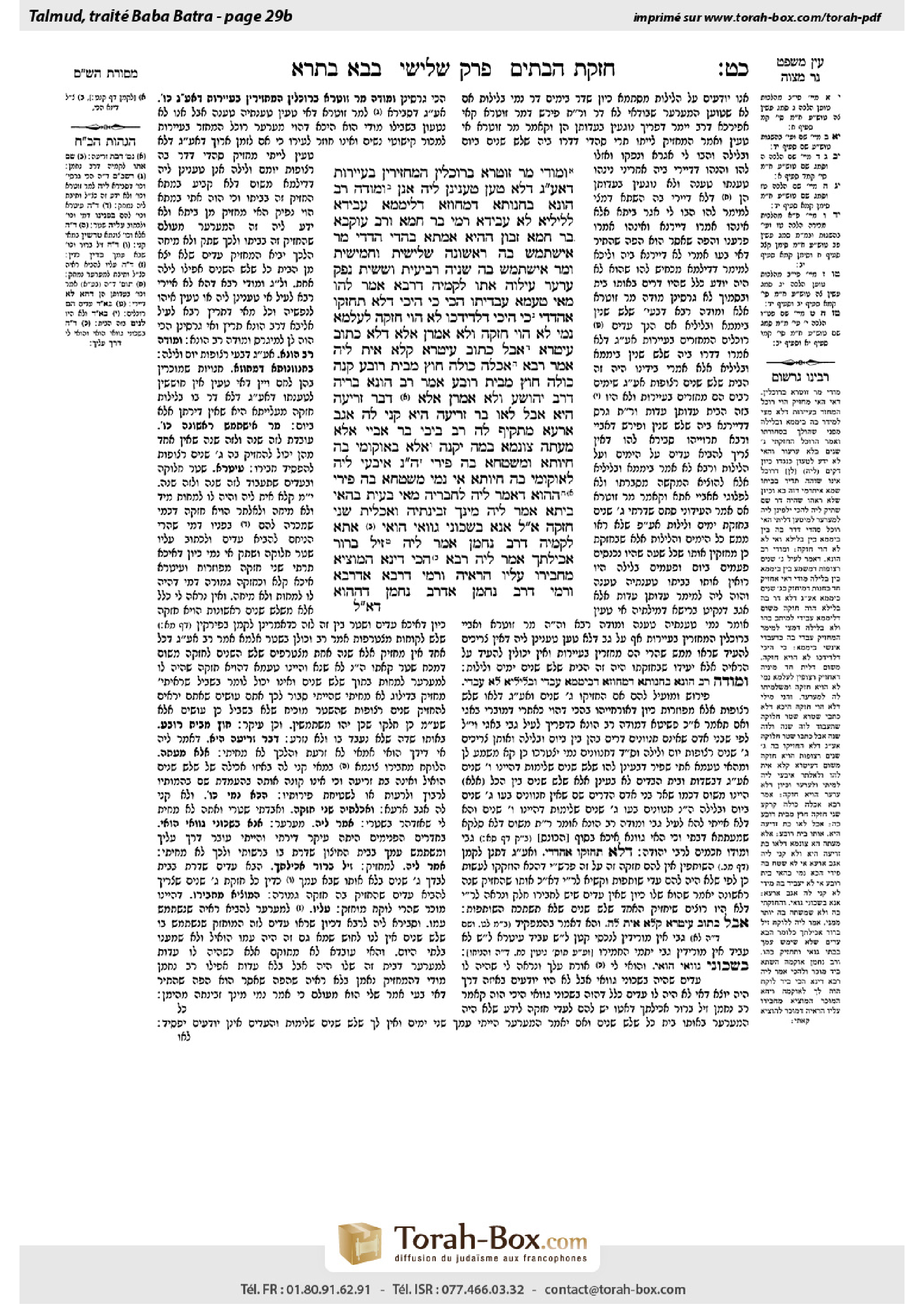
Bava Batra 29b: Talmud study for Daf Yomi
Study the Talmud for Daf Yomi with scanned pages, Hebrew text, English translations from Sefaria and AI-generated French translations.
Passage selection and English or AI-generated French translation are available where the scan has annotations. Daf Study is independent of Torah-Box and Sefaria.
Browse Bava Batra · בבא בתרא · All tractatesBava Batra 29b text and translations
This page of Bava Batra includes the Aramaic text, an English translation and an AI-generated French translation, alongside the scan above.
בבא בתרא כ״ט ב · Aramaic and Hebrew text
וּמוֹדֵי מָר זוּטְרָא בְּרוֹכְלִין הַמַּחֲזִירִין בָּעֲיָירוֹת, דְּאַף עַל גַּב דְּלָא טָעַן – טָעֲנִינַן לֵיהּ אֲנַן.
וּמוֹדֶה רַב הוּנָא בְּחַנְוָתָא דְמָחוֹזָא – דְּלִימָמָא עֲבִידָא, לְלֵילְיָא לָא עֲבִידָא.
רָמֵי בַּר חָמָא וְרַב עוּקְבָא בַּר חָמָא זְבוּן הָהִיא אַמְּתָא בַּהֲדֵי הֲדָדֵי. מָר אִישְׁתַּמַּשׁ בָּהּ רִאשׁוֹנָה שְׁלִישִׁית וַחֲמִישִׁית, וּמָר אִישְׁתַּמַּשׁ בָּהּ שְׁנִיָּה רְבִיעִית וְשִׁשִּׁית. נְפַק עַרְעָר עִילָּוַהּ,
אֲתוֹ לְקַמֵּיהּ דְּרָבָא, אֲמַר לְהוּ: מַאי טַעְמָא עָבְדִיתוּ הָכִי – כִּי הֵיכִי דְּלָא תַּחְזְקוּ אַהֲדָדֵי; כִּי הֵיכִי דִּלְדִידְכוּ לָא הָוֵי חֲזָקָה, לְעָלְמָא נָמֵי לָא הָוֵי חֲזָקָה.
וְלָא אֲמַרַן אֶלָּא דְּלָא כְּתוּב עִיטְרָא, אֲבָל כְּתוּב עִיטְרָא – קָלָא אִית לֵיהּ.
אָמַר רָבָא: אֲכָלָהּ כּוּלָּהּ, חוּץ מִבֵּית רוֹבַע – קָנָה כּוּלָּהּ, חוּץ מִבֵּית רוֹבַע.
אָמַר רַב הוּנָא בְּרֵיהּ דְּרַב יְהוֹשֻׁעַ: וְלָא אֲמַרַן אֶלָּא דְּבַר זְרִיעָה הִיא, אֲבָל לָאו בַּר זְרִיעָה הִיא – קָנֵי לַהּ אַגַּב אַרְעָא.
מַתְקֵיף לַהּ רַב בִּיבִי בַּר אַבָּיֵי: אֶלָּא מֵעַתָּה, צוּנְמָא – בַּמֶּה יִקְנֶה? אֶלָּא בְּאוֹקוֹמֵי בָּהּ חֵיוָתָא וּמִשְׁטְחָא בַּהּ פֵּירֵי; הָכָא נָמֵי – אִיבְּעִי לֵיהּ לְאוֹקוֹמֵי בָּהּ חֵיוָתָא, אִי נָמֵי מִשְׁטְחָא בַּהּ פֵּירֵי.
הָהוּא דַּאֲמַר לֵיהּ לְחַבְרֵיהּ: מַאי בָּעֵית בְּהַאי בֵּיתָא? אֲמַר לֵיהּ: מִינָּךְ זְבֵינְתֵּיהּ, וַאֲכַלִית שְׁנֵי חֲזָקָה. אֲמַר לֵיהּ: אֲנָא בִּשְׁכוּנֵי גַּוּוֹאֵי הֲוַאי.
אֲתָא לְקַמֵּיהּ דְּרַב נַחְמָן, אֲמַר לֵיהּ: זִיל בְּרוֹר אֲכִילְתָךְ. אֲמַר לֵיהּ רָבָא: הָכִי דִּינָא?! הַמּוֹצִיא מֵחֲבֵירוֹ עָלָיו הָרְאָיָה!
וְרָמֵי דְּרָבָא אַדְּרָבָא, וְרָמֵי דְּרַב נַחְמָן אַדְּרַב נַחְמָן – דְּהָהוּא
Bava Batra 29b · English translation
And Mar Zutra concedes with regard to peddlers who travel through cities, during which time others might live in their houses, that even though the claimant does not claim that he insists on testimony that there was continuous use, day and night, over three years, we the court claim this for him. Since people know they are traveling salesmen, it is more likely that people lived in their houses without permission and without their knowledge.
With regard to the requirement for continuous day and night use to establish the presumption of ownership, the Gemara comments: And Rav Huna concedes with regard to a store in the town of Meḥoza, which is generally used in the day and is not generally used in the night, that one is not required to use it in the night to establish the presumption of ownership.
With regard to the requirement of continuous use to establish the presumption of ownership, the Gemara relates that Rami bar Ḥama and Rav Ukva bar Ḥama purchased a maidservant together. One Sage made use of her during the first, third, and fifth years, and one Sage made use of her during the second, fourth, and sixth years. One individual who contested their ownership of the maidservant emerged and claimed that he was the owner.
They came before Rava for a judgment. He said to them: What is the reason you acted like this, making use of her in alternate years, so that each of you would not establish the presumption of ownership concerning each other by making use of her for three consecutive years? Just as this usage does not establish the presumption of ownership with regard to you, it does not establish the presumption of ownership with regard to others, i.e., the claimant in this case, as well.
The Gemara adds: And we said this only in a case where it was not written in a document that they are partners and are dividing the use, but if it was written in a document, the document generates publicity that they own the maidservant as partners rather than individually, and they can jointly establish the presumption of ownership.
§ The Gemara continues its discussion of the requirement for full use of land to establish the presumption of ownership. Rava says: If one worked and profited, for three years, from all of the land except for the area required for sowing a quarter-kav of seed [beit rova], which he did not use, he acquires all of the field based on presumptive ownership except for that beit rova.
Rav Huna, son of Rav Yehoshua, says: And we said this ruling only where that beit rova is suitable for planting, but if it is not suitable for planting, he acquires it by means of the acquisition of the rest of the land.
Rav Beivai bar Abaye objects to this: If that is so, how could one acquire an area that is only rock by establishing the presump-tion of ownership, as one does not plant rocky land? Rather, the presumption of ownership can be established by standing animals on it or spreading produce on it. Here too, he should be required to stand animals on the beit rova or to spread produce on it. If he did not profit from this small piece of land at all, he has not established the presumption of ownership with regard to it, and acquires only the rest of the field.
§ The Gemara relates that there was a certain person who said to another: What do you want, i.e., what are you doing, with this house of mine? The other said to him: I purchased it from you and I worked and profited from it for the years necessary for establishing the presumption of ownership. The claimant said to him: I was among the distant settlements, and was unaware that you were residing in my house, which is why I did not lodge a protest.
The one residing in the house came before Rav Naḥman for a judgment. Rav Naḥman said to him: Go clarify your profiting, i.e., prove that you really resided there for three years, and then the case can be judged. Rava said to Rav Naḥman: Is this the correct judgment? The halakha is that the burden of proof rests upon the claimant. Therefore, the one who is attempting to take the house from the possessor should have to prove that the other did not reside in the house.
And the Gemara raises a contradiction between this statement of Rava and another statement of Rava, and it raises a contradiction between this statement of Rav Naḥman and another statement of Rav Naḥman. As there was a certain person
Bava Batra 29b · Traduction française (IA)
Et Mar Zutra admet, concernant les vendeurs ambulants qui traversent les villes, pendant laquelle période d'autres pourraient habiter leurs maisons, que même si le plaignant ne prétend pas qu'il exige un témoignage selon lequel l'usage a été continu, jour et nuit, pendant trois ans, nous, la cour, affirmons cela pour lui. Puisque les gens savent qu'ils sont des vendeurs ambulants, il est plus probable que des personnes aient habité dans leurs maisons sans permission et sans leur connaissance.
Concernant la nécessité d'un usage continu jour et nuit pour établir la présomption de propriété, la Guemara commente : Et Rav Huna admet, concernant un magasin dans la ville de Meḥoza, qui est généralement utilisé pendant la journée et non pendant la nuit, que l'on n'est pas tenu d'en faire usage pendant la nuit pour établir la présomption de propriété.
Concernant la nécessité d'un usage continu pour établir la présomption de propriété, la Guemara rapporte que Rami bar Ḥama et Rav Ukva bar Ḥama ont acheté ensemble une servante. Un sage l'a utilisée pendant la première, la troisième et la cinquième année, et un autre sage l'a utilisée pendant la deuxième, la quatrième et la sixième année. Un individu qui contestait leur propriété de la servante est apparu et a affirmé être le propriétaire.
Ils se sont présentés devant Rava pour un jugement. Il leur a dit : Quel est le motif que vous avez agi ainsi, en utilisant la servante alternativement chaque année, afin que chacun de vous ne puisse pas établir la présomption de propriété concernant l'autre en l'utilisant pendant trois années consécutives ? Tout comme cette utilisation ne permet pas d'établir la présomption de propriété concernant vous, elle ne permet pas non plus d'établir la présomption de propriété concernant les autres, c'est-à-dire le plaignant dans ce cas.
La Guemara ajoute : Et nous avons dit cela uniquement dans un cas où il n'était pas écrit dans un document qu'ils sont associés et divisent l'utilisation, mais si cela était écrit dans un document, le document génère une publicité selon laquelle ils possèdent la servante en tant qu'associés plutôt que de manière individuelle, et ils peuvent ensemble établir la présomption de propriété.
§ La Guemara continue sa discussion sur la nécessité d'un usage complet du terrain pour établir la présomption de propriété. Rava dit : Si l'on a travaillé et réalisé des bénéfices pendant trois ans, à partir de tout le terrain sauf la zone nécessaire pour semer un quart de kav de grain [beit rova], que l'on n'a pas utilisé, l'on acquiert tout le champ selon la présomption de propriété, sauf ce beit rova.
Rav Huna, fils de Rav Yehoshua, dit : Et nous avons dit cette décision uniquement dans le cas où ce beit rova est adapté à la plantation, mais si ce n'est pas adapté à la plantation, il acquiert cela par l'acquisition du reste du terrain.
Rav Beivai bar Abaye s'oppose à cela : Si c'est ainsi, comment peut-on acquérir une zone qui est seulement rocheuse en établissant la présomption de propriété, puisque l'on ne plante pas de terrain rocheux ? Plutôt, la présomption de propriété peut être établie en faisant stationner des animaux sur elle ou en répandant des produits sur elle. Ici aussi, il devrait être tenu de faire stationner des animaux sur le beit rova ou de répandre des produits sur lui. Si l'on n'a pas réalisé aucun bénéfice de cette petite portion de terrain, l'on n'a pas établi la présomption de propriété concernant elle, et l'on acquiert seulement le reste du champ.
§ La Guemara rapporte qu'il y avait un certain homme qui a dit à un autre : Que veux-tu, c'est-à-dire que fais-tu, avec cette maison à moi ? L'autre a répondu à lui : J'ai acheté cela de toi et j'ai travaillé et réalisé des bénéfices de cela pendant les années nécessaires pour établir la présomption de propriété. Le plaignant a dit à lui : J'étais parmi les villes éloignées, et je ne savais pas que tu habitais dans ma maison, ce qui est pourquoi je n'ai pas porté plainte.
Celui qui habitait dans la maison s'est présenté devant Rav Naḥman pour un jugement. Rav Naḥman a dit à lui : Va clarifier ton bénéfice, c'est-à-dire prouve que tu as vraiment habité là pendant trois ans, et alors le cas pourra être jugé. Rava a dit à Rav Naḥman : Est-ce que ce jugement est correct ? La halakha est que la charge de la preuve repose sur le plaignant. Ainsi, celui qui tente de prendre la maison du possesseur doit prouver que l'autre n'a pas habité dans la maison.
Et la Guemara soulève une contradiction entre cette déclaration de Rava et une autre déclaration de Rava, et elle soulève une contradiction entre cette déclaration de Rav Naḥman et une autre déclaration de Rav Naḥman. Comme il y avait un certain homme
Traduction française générée par IA à partir de l’édition anglaise de Sefaria. Vérifie toujours un passage avec le texte source.
Text from Sefaria: William Davidson Edition - Vocalized Aramaic (CC BY NC); William Davidson Edition - English (CC BY NC).