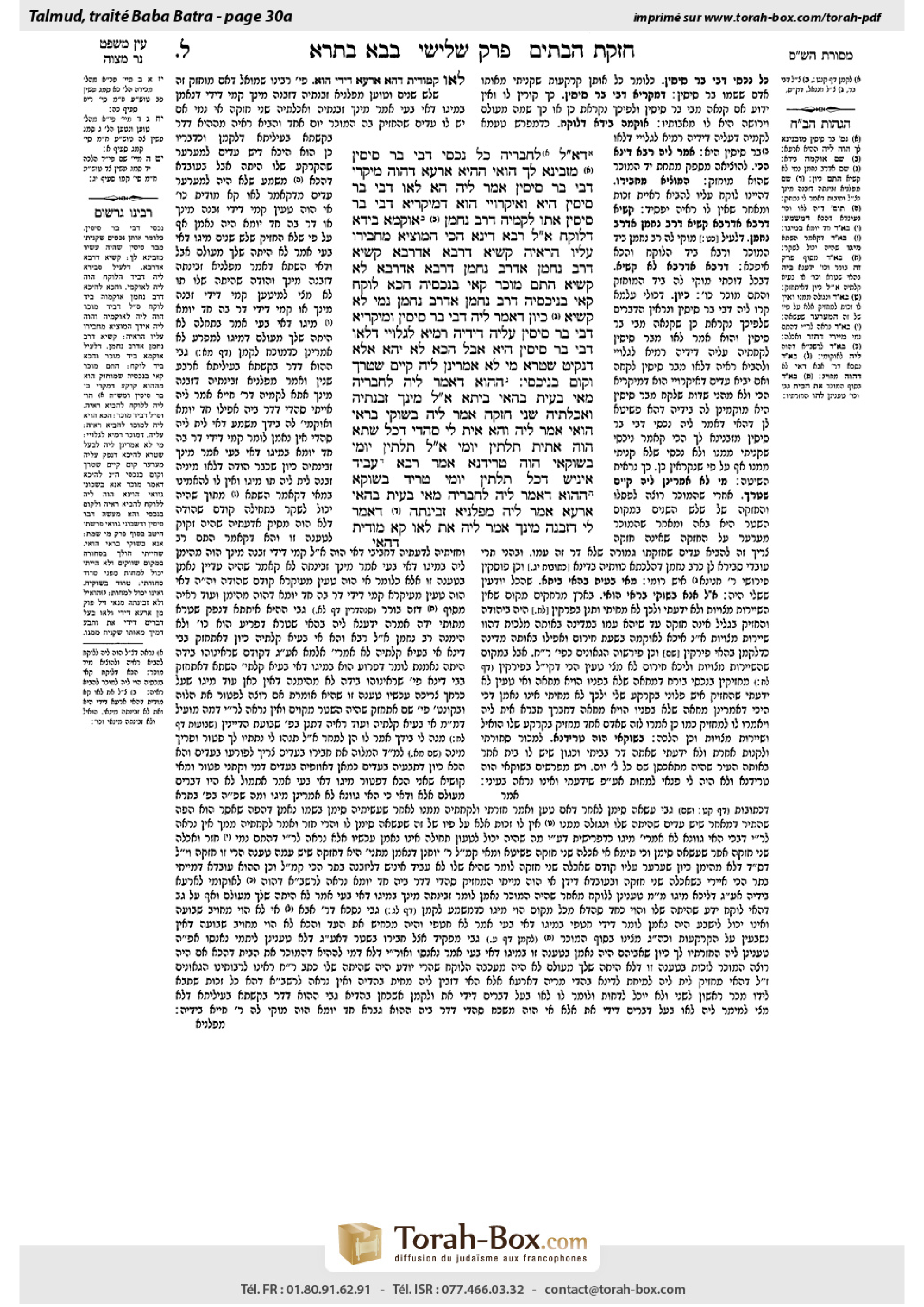
Bava Batra 30a: Talmud study for Daf Yomi
Study the Talmud for Daf Yomi with scanned pages, Hebrew text, English translations from Sefaria and AI-generated French translations.
Passage selection and English or AI-generated French translation are available where the scan has annotations. Daf Study is independent of Torah-Box and Sefaria.
Browse Bava Batra · בבא בתרא · All tractatesBava Batra 30a text and translations
This page of Bava Batra includes the Aramaic text, an English translation and an AI-generated French translation, alongside the scan above.
בבא בתרא ל׳ א · Aramaic and Hebrew text
דַּאֲמַר לֵיהּ לְחַבְרֵיהּ: כׇּל נִכְסֵי דְּבֵי בַּר סִיסִין – מְזַבֵּינָא לָךְ. הֲוַאי הָהִיא אַרְעָא דַּהֲוָה מִיקְּרֵי ״דְּבֵי בַּר סִיסִין״. אֲמַר לֵיהּ: הָא לָאו דְּבֵי בַּר סִיסִין הִיא, וְאִיקְּרוֹיֵי הוּא דְּמִיקַּרְיָא ״דְּבֵי בַּר סִיסִין״. אֲתוֹ לְקַמֵּיהּ דְּרַב נַחְמָן, אוֹקְמָא בִּידָא דְלוֹקֵחַ. אֲמַר לֵיהּ רָבָא: דִּינָא הָכִי?! הַמּוֹצִיא מֵחֲבֵירוֹ עָלָיו הָרְאָיָה!
קַשְׁיָא דְּרָבָא אַדְּרָבָא, קַשְׁיָא דְּרַב נַחְמָן אַדְּרַב נַחְמָן.
דְּרָבָא אַדְּרָבָא לָא קַשְׁיָא – הָתָם מוֹכֵר קָאֵי בְּנִכְסֵיהּ, הָכָא לוֹקֵחַ קָאֵי בְּנִיכְסֵיהּ.
דְּרַב נַחְמָן אַדְּרַב נַחְמָן נָמֵי לָא קַשְׁיָא – כֵּיוָן דַּאֲמַר לֵיהּ: דְּבֵי בַּר סִיסִין, וּמִיקַּרְיָא ״דְּבֵי בַּר סִיסִין״, עֲלֵיהּ דִּידֵיהּ רַמְיָא לְגַלּוֹיֵי דְּלָאו דְּבֵי בַּר סִיסִין הִיא; אֲבָל הָכָא, לֹא יְהֵא אֶלָּא דְּנָקֵיט שְׁטָרָא – מִי לָא אָמְרִינַן לֵיהּ: קַיֵּים שְׁטָרָךְ וְקוּם בְּנִיכְסֵי?
הָהוּא דַּאֲמַר לֵיהּ לְחַבְרֵיהּ: מַאי בָּעֵית בְּהַאי בֵּיתָא? אֲמַר לֵיהּ: מִינָּךְ זְבֵנְתֵּיהּ, וַאֲכַלְתֵּיהּ שְׁנֵי חֲזָקָה. אֲמַר לֵיהּ: בְּשׁוּקֵי בָּרָאֵי הֲוַאי. אֲמַר לֵיהּ: וְהָא אִית לִי סָהֲדִי דְּכֹל שַׁתָּא הֲוָה אָתֵית תְּלָתִין יוֹמֵי! אֲמַר לֵיהּ: תְּלָתִין יוֹמֵי – בְּשׁוּקַאי הֲוָה טְרִידְנָא. אָמַר רָבָא: עֲבִיד אִינִישׁ דְּכֹל תְּלָתִין יוֹמֵי טְרִיד בְּשׁוּקָא.
הָהוּא דְּאָמַר לֵיהּ לְחַבְרֵיהּ: מַאי בָּעֵית בְּהַאי אַרְעָא? אֲמַר לֵיהּ: מִפְּלָנְיָא זְבֵינְתַּהּ, דְּאָמַר לִי דְּזַבְנַהּ מִינָּךְ. אֲמַר לֵיהּ: אַתְּ לָאו קָא מוֹדֵית
Bava Batra 30a · English translation
who said to another: I am hereby selling to you all of the property that I own of the house of bar Sisin. There was a certain parcel of land that was called: Of the house of bar Sisin. The seller said to the buyer: This parcel of land that I own is not actually of the house of bar Sisin, and it is merely called: Of the house of bar Sisin, and it is not included in the sale. They came before Rav Naḥman for judgment, and he established the land in the possession of the buyer. Rava said to Rav Naḥman: Is this the halakha? Isn’t the halakha that the burden of proof rests upon the claimant, and the land should remain in the possession of the seller?
The Gemara continues: There is a difficulty from one statement of Rava to another statement of Rava, and there is also a difficulty from one statement of Rav Naḥman to another statement of Rav Naḥman, as in the first case, where the claimant states that he had been in a distant location, Rav Naḥman ruled in favor of the claimant, and Rava ruled in favor of the possessor; while in the second case, that of the property of bar Sisin, their opinions were reversed.
The Gemara answers: The contradiction between one statement of Rava and another statement of Rava is not difficult, because there, in the case of the property of bar Sisin, the seller had been established as having the land in his property, which is why Rava rules in his favor. But here, in the case where the claimant states that he had been in a distant location, the buyer is established as having the house in his property.
The contradiction between one statement of Rav Naḥman and the other statement of Rav Naḥman is not difficult as well, because there, since the seller said to him: I am hereby selling you all of the property that I own of the house of bar Sisin, and this parcel of land is called: Of the house of bar Sisin, it is incumbent on him to reveal that the parcel under dispute is not of the house of bar Sisin. But here, in the case where the claimant states that he had been in a distant location, it should not be any different from a case where the possessor is holding a document as evidence that he purchased the house. Wouldn’t we then say to him: First ratify your document, and only then be established in the property? In this case as well, since his presumptive ownership is in place of a document, he needs to clarify the matter by means of witnesses.
There was a certain person who said to another: What do you want with this house of mine? The possessor said to him: I purchased it from you and I worked and profited from it for the years necessary for establishing the presumption of ownership. The claimant said to him: I was in the outer marketplaces, and was unaware that you were residing in my house, and therefore did not lodge a protest, so your profiting does not establish the presumption of ownership. The possessor said to him: But I have witnesses that every year you would come here for thirty days and had an opportunity to know that I was residing in your house and to lodge a protest. The claimant said to him: I was occupied with my business in the marketplaces for those thirty days. Rava said: A person is apt to be occupied with business in the marketplace for all of thirty days, and accepted his claim.
There was a certain person who said to another: What do you want with this land of mine? The possessor said to him: I purchased it from so-and-so, who told me that he purchased it from you. The claimant said to him: Don’t you concede
Bava Batra 30a · Traduction française (IA)
qui dit à un autre : Je vends ici tout le bien que j'possède de la maison de bar Sisin. Il y avait un certain terrain qui était appelé : De la maison de bar Sisin. Le vendeur dit à l'acheteur : Ce terrain que j'possède n'est pas effectivement de la maison de bar Sisin, et il est simplement appelé : De la maison de bar Sisin, et il n'est pas inclus dans la vente. Ils se sont présentés devant Rav Naḥman pour un jugement, et il a établi le terrain en possession de l'acheteur. Rava a dit à Rav Naḥman : C'est-ce qui est la halakha ? N'est-ce pas la halakha que la charge de la preuve repose sur le plaignant, et le terrain devrait rester en possession du vendeur ?
La Guemara continue : Il y a une difficulté entre une déclaration de Rava et une autre déclaration de Rava, et il y a aussi une difficulté entre une déclaration de Rav Naḥman et une autre déclaration de Rav Naḥman, comme dans le premier cas, où le plaignant déclare qu'il était dans une localité éloignée, Rav Naḥman a rendu un jugement en faveur du plaignant, et Rava a rendu un jugement en faveur du possesseur ; tandis que dans le second cas, celui du terrain de bar Sisin, leurs opinions étaient inversées.
La Guemara répond : La contradiction entre une déclaration de Rava et une autre déclaration de Rava n'est pas difficile, car là, dans le cas du terrain de bar Sisin, le vendeur avait été établi comme possédant le terrain, ce qui est pourquoi Rava rend un jugement en son faveur. Mais ici, dans le cas où le plaignant déclare qu'il était dans une localité éloignée, l'acheteur est établi comme possédant la maison.
La contradiction entre une déclaration de Rav Naḥman et l'autre déclaration de Rav Naḥman n'est pas difficile non plus, car là, puisque le vendeur dit à lui : Je vends ici tout le bien que j'possède de la maison de bar Sisin, et ce terrain est appelé : De la maison de bar Sisin, il est incumbent sur lui de révéler que le terrain en litige n'est pas de la maison de bar Sisin. Mais ici, dans le cas où le plaignant déclare qu'il était dans une localité éloignée, il ne devrait pas être différent d'un cas où le possesseur tient un document comme preuve qu'il a acheté la maison. Ne dirions-nous pas alors à lui : Vérifie d'abord ton document, et seulement alors établis-toi en possession du bien ? Dans ce cas également, puisque sa possession présumée est équivalente à un document, il a besoin de clarifier la question par l'intermédiaire de témoins.
Il y avait un certain homme qui dit à un autre : Que veux-tu avec cette maison à moi ? Le possesseur dit à lui : J'ai acheté cela de toi et j'ai travaillé et profité de cela pendant les années nécessaires pour établir la présomption de possession. Le plaignant dit à lui : J'étais dans les marchés extérieurs, et je n'étais pas conscient que tu habitais dans ma maison, et par conséquent n'ai pas porté plainte, donc ton profit ne constitue pas la présomption de possession. Le possesseur dit à lui : Mais j'ai des témoins qui disent que chaque année tu venais ici pendant trente jours et avais l'occasion de savoir que j'habitais dans ta maison et de porter plainte. Le plaignant dit à lui : J'étais occupé avec mon affaire dans les marchés pendant ces trente jours. Rava dit : Une personne est susceptible d'être occupée avec son affaire dans les marchés pendant toute la durée de trente jours, et a accepté sa déclaration.
Il y avait un certain homme qui dit à un autre : Que veux-tu avec cette terre à moi ? Le possesseur dit à lui : J'ai acheté cela de tel et tel, qui m'a dit qu'il l'avait acheté de toi. Le plaignant dit à lui : N'admettes-tu pas
Traduction française générée par IA à partir de l’édition anglaise de Sefaria. Vérifie toujours un passage avec le texte source.
Text from Sefaria: William Davidson Edition - Vocalized Aramaic (CC BY NC); William Davidson Edition - English (CC BY NC).