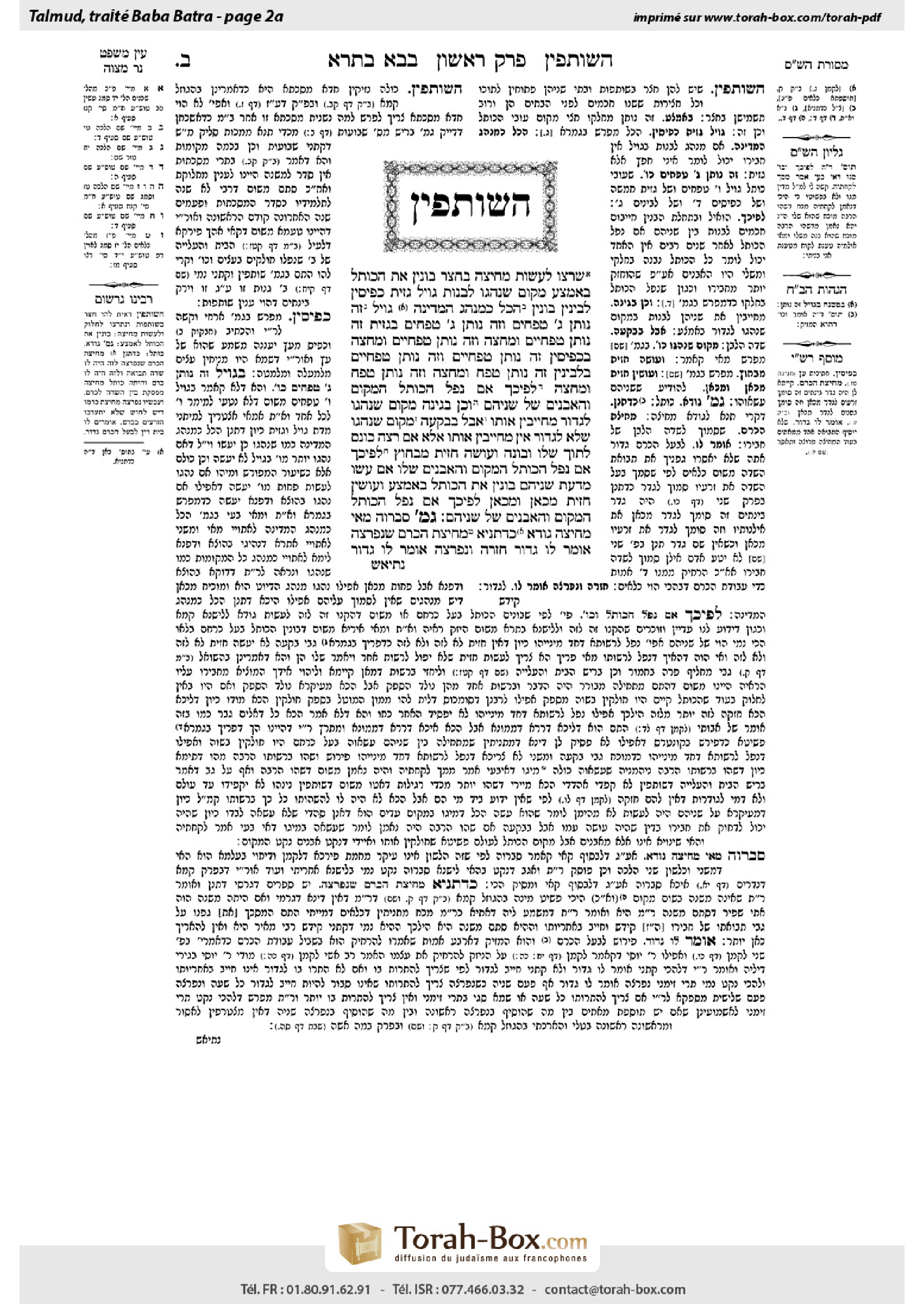
Bava Batra 2a: Talmud study for Daf Yomi
Study the Talmud for Daf Yomi with scanned pages, Hebrew text, English translations from Sefaria and AI-generated French translations.
Passage selection and English or AI-generated French translation are available where the scan has annotations. Daf Study is independent of Torah-Box and Sefaria.
Browse Bava Batra · בבא בתרא · All tractatesBava Batra 2a text and translations
This page of Bava Batra includes the Aramaic text, an English translation and an AI-generated French translation, alongside the scan above.
בבא בתרא ב׳ א · Aramaic and Hebrew text
הַשּׁוּתָּפִין שֶׁרָצוּ לַעֲשׂוֹת מְחִיצָה בְּחָצֵר – בּוֹנִין אֶת הַכּוֹתֶל בְּאֶמְצַע. מָקוֹם שֶׁנָּהֲגוּ לִבְנוֹת גְּוִיל, גָּזִית, כְּפִיסִין, לְבֵינִין – בּוֹנִין; הַכֹּל כְּמִנְהַג הַמְּדִינָה.
גְּוִיל – זֶה נוֹתֵן שְׁלֹשָׁה טְפָחִים, וְזֶה נוֹתֵן שְׁלֹשָׁה טְפָחִים. בַּגָּזִית – זֶה נוֹתֵן טִפְחַיִים וּמֶחֱצָה וְזֶה נוֹתֵן טִפְחַיִים וּמֶחֱצָה. בַּכְּפִיסִין – זֶה נוֹתֵן טִפְחַיִים וְזֶה נוֹתֵן טִפְחַיִים. בִּלְבֵינִין – זֶה נוֹתֵן טֶפַח וּמֶחֱצָה וְזֶה נוֹתֵן טֶפַח וּמֶחֱצָה. לְפִיכָךְ, אִם נָפַל הַכּוֹתֶל – הַמָּקוֹם וְהָאֲבָנִים שֶׁל שְׁנֵיהֶם.
וְכֵן בַּגִּינָּה – מְקוֹם שֶׁנָּהֲגוּ לִגְדּוֹר – מְחַיְּיבִין אוֹתוֹ. אֲבָל בַּבִּקְעָה – מְקוֹם שֶׁנָּהֲגוּ שֶׁלֹּא לִגְדּוֹר – אֵין מְחַיְּיבִין אוֹתוֹ,
אֶלָּא אִם רָצָה, כּוֹנֵס לְתוֹךְ שֶׁלּוֹ וּבוֹנֶה, וְעוֹשֶׂה חֲזִית מִבַּחוּץ. לְפִיכָךְ, אִם נָפַל הַכּוֹתֶל – הַמָּקוֹם וְהָאֲבָנִים שֶׁלּוֹ.
אִם עָשׂוּ מִדַּעַת שְׁנֵיהֶם – בּוֹנִין אֶת הַכּוֹתֶל בָּאֶמְצַע, וְעוֹשִׂין חֲזִית מִכָּאן וּמִכָּאן. לְפִיכָךְ, אִם נָפַל הַכּוֹתֶל – הַמָּקוֹם וְהָאֲבָנִים שֶׁל שְׁנֵיהֶם.
גְּמָ׳ סַבְרוּהָ מַאי ״מְחִיצָה״ – גּוּדָּא; כִּדְתַנְיָא: מְחִיצַת הַכֶּרֶם שֶׁנִּפְרְצָה, אוֹמֵר לוֹ: ״גְּדוֹר״. חָזְרָה וְנִפְרְצָה – אוֹמֵר לוֹ: ״גְּדוֹר״.
Bava Batra 2a · English translation
MISHNA: Partners who wished to make a partition [meḥitza] in a jointly owned courtyard build the wall for the partition in the middle of the courtyard. What is this wall fashioned from? In a place where it is customary to build such a wall with non-chiseled stone [gevil], or chiseled stone [gazit], or small bricks [kefisin], or large bricks [leveinim], they must build the wall with that material. Everything is in accordance with the regional custom.
If they build the wall with non-chiseled stone, this partner provides three handbreadths of his portion of the courtyard and that partner provides three handbreadths, since the thickness of such a wall is six handbreadths. If they build the wall with chiseled stone, this partner provides two and a half handbreadths and that partner provides two and a half handbreadths, since such a wall is five handbreadths thick. If they build the wall with small bricks, this one provides two handbreadths and that one provides two handbreadths, since the thickness of such a wall is four handbreadths. If they build with large bricks, this one provides one and a half handbreadths and that one provides one and a half handbreadths, since the thickness of such a wall is three handbreadths. Therefore, if the wall later falls, the assumption is that the space where the wall stood and the stones belong to both of them, to be divided equally.
And similarly with regard to a garden, in a place where it is customary to build a partition in the middle of a garden jointly owned by two people, and one of them wishes to build such a partition, the court obligates his neighbor to join in building the partition. But with regard to an expanse of fields [babbika], in a place where it is customary not to build a partition between two people’s fields, and one person wishes to build a partition between his field and that of his neighbor, the court does not obligate his neighbor to build such a partition.
Rather, if one person wishes to erect a partition, he must withdraw into his own field and build the partition there. And he makes a border mark on the outer side of the barrier facing his neighbor’s property, indicating that he built the entire structure of his own materials and on his own land. Therefore, if the wall later falls, the assumption is that the space where the wall stood and the stones belong only to him, as is indicated by the mark on the wall.
Nevertheless, in a place where it is not customary to build a partition between two people’s fields, if they made such a partition with the agreement of the two of them, they build it in the middle, i.e., on the property line, and make a border mark on the one side and on the other side. Therefore, if the wall later falls, the assumption is that the space where the wall stood and the stones belong to both of them, to be divided equally.
GEMARA: The Sages initially assumed: What is the meaning of the term meḥitza mentioned in the mishna? It means a partition, as it is taught in a baraita: Consider the case where a partition of [meḥitzat] a vineyard which separates the vineyard from a field of grain was breached, resulting, if the situation is not rectified, in the grain and grapes becoming items from which deriving benefit is prohibited due to the prohibition of diverse kinds planted in a vineyard. The owner of the field of grain may say to the owner of the vineyard: Build a partition between the vineyard and the field of grain. If the owner of the vineyard did so, and the partition was breached again, the owner of the field of grain may say to him again: Build a partition.
Bava Batra 2a · Traduction française (IA)
MICHNA : Les partenaires qui souhaitaient établir une séparation [meḥitza] dans un cour d'habitation partagé construisent le mur de séparation au milieu du cour. De quel matériau ce mur est-il fait ? Dans un lieu où il est coutumier de construire ce genre de mur avec des pierres non taillées [gevil], ou des pierres taillées [gazit], ou des petits briques [kefisin], ou des grandes briques [leveinim], ils doivent construire le mur avec ce matériau. Tout est selon la coutume locale.
Si ils construisent le mur avec des pierres non taillées, ce partenaire fournit trois tefachim de sa part du cour et l'autre partenaire fournit trois tefachim, car l'épaisseur de tel mur est de six tefachim. Si ils construisent le mur avec des pierres taillées, ce partenaire fournit deux et demi tefachim et l'autre partenaire fournit deux et demi tefachim, car l'épaisseur de tel mur est de cinq tefachim. Si ils construisent le mur avec des petits briques, ce partenaire fournit deux tefachim et l'autre partenaire fournit deux tefachim, car l'épaisseur de tel mur est de quatre tefachim. Si ils construisent avec des grandes briques, ce partenaire fournit un et demi tefachim et l'autre partenaire fournit un et demi tefachim, car l'épaisseur de tel mur est de trois tefachim. Ainsi, si le mur tombe plus tard, on suppose que l'espace où le mur était et les pierres appartiennent aux deux, à être divisé équitablement.
Et de même concernant un jardin, dans un lieu où il est coutumier de construire une séparation au milieu d'un jardin partagé par deux personnes, et l'une d'entre elles souhaite construire une telle séparation, la cour oblige son voisin à participer à la construction de la séparation. Mais concernant une étendue de champs [babbika], dans un lieu où il est coutumier de ne pas construire de séparation entre les champs de deux personnes, et l'une d'entre elles souhaite construire une séparation entre son champ et celui de son voisin, la cour ne charge pas son voisin de construire une telle séparation.
Au contraire, si une personne souhaite ériger une séparation, elle doit se retirer dans son propre champ et construire la séparation là. Et elle fait un marquage de frontière sur le côté extérieur de la barrière face à la propriété de son voisin, indiquant qu'elle a construit l'ensemble de la structure avec ses propres matériaux et sur son propre terrain. Ainsi, si la mur tombe plus tard, on suppose que l'espace où le mur était et les pierres appartiennent uniquement à lui, comme indiqué par le marquage sur le mur.
Cependant, dans un lieu où il n'est pas coutumier de construire une séparation entre les champs de deux personnes, si ils ont construit une telle séparation avec l'accord des deux, ils la construisent au milieu, c'est-à-dire sur la limite des propriétés, et font un marquage de frontière sur chaque côté. Ainsi, si la mur tombe plus tard, on suppose que l'espace où le mur était et les pierres appartiennent aux deux, à être divisé équitablement.
GUEMARA : Les Sages ont d'abord pensé : Quelle est la signification du terme meḥitza mentionné dans la mishna ? Cela signifie une séparation, comme il est enseigné dans une baraïta : Considérons le cas où une séparation [meḥitzat] d'un domaine de vigne qui sépare le domaine de vigne d'un champ de céréales a été rompue, entraînant, si la situation n'est pas réparée, que les céréales et les raisins deviennent des objets dont l'usage est interdit en raison de l'interdiction de cultiver diverses espèces dans un domaine de vigne. L'propriétaire du champ de céréales peut dire à l'propriétaire du domaine de vigne : Construis une séparation entre le domaine de vigne et le champ de céréales. Si l'propriétaire du domaine de vigne l'a fait, et que la séparation a été rompue à nouveau, l'propriétaire du champ de céréales peut lui dire à nouveau : Construis une séparation.
Traduction française générée par IA à partir de l’édition anglaise de Sefaria. Vérifie toujours un passage avec le texte source.
Text from Sefaria: William Davidson Edition - Vocalized Aramaic (CC BY NC); William Davidson Edition - English (CC BY NC).