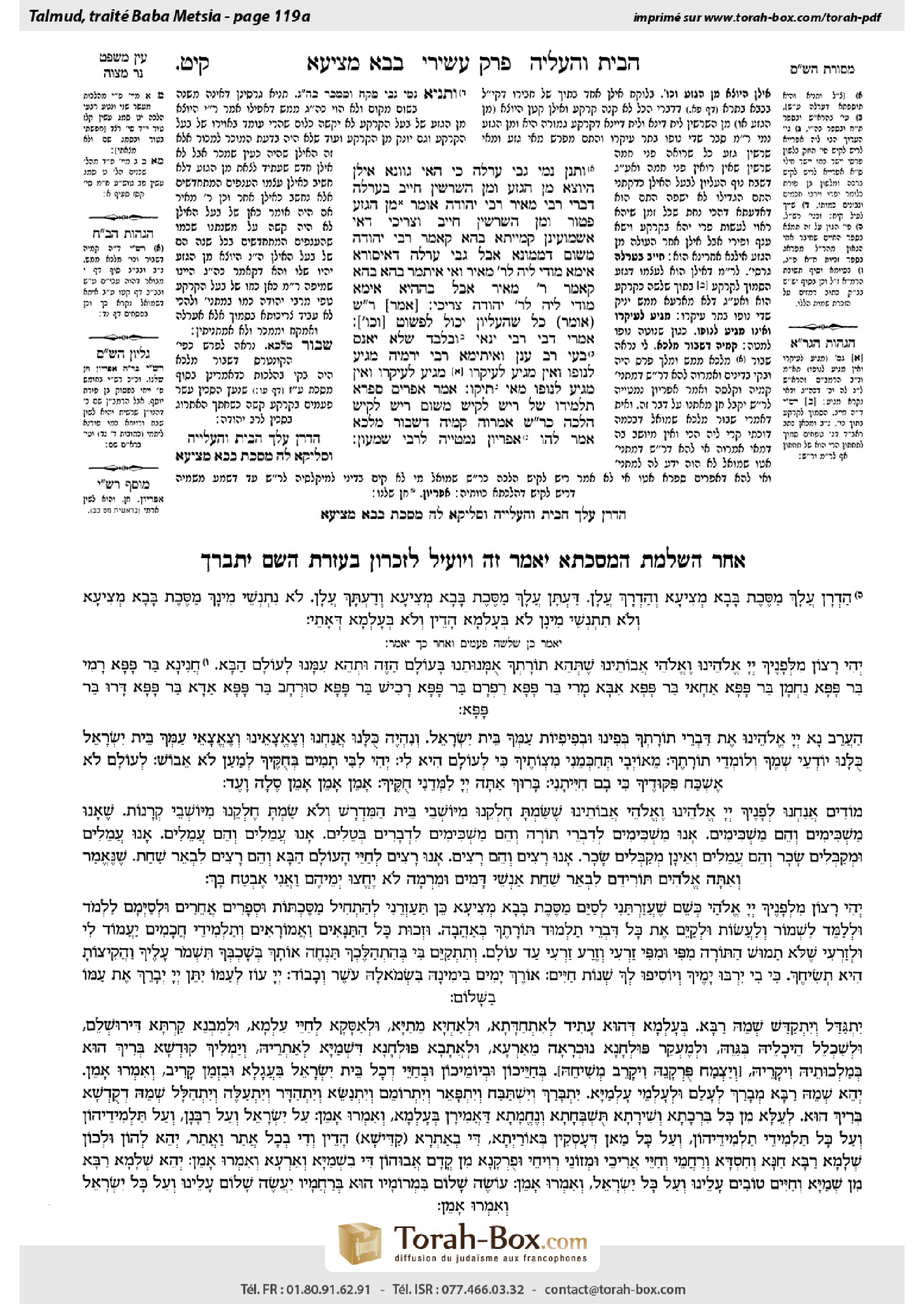
Bava Metzia 119a: Talmud study for Daf Yomi
Study the Talmud for Daf Yomi with scanned pages, Hebrew text, English translations from Sefaria and AI-generated French translations.
Passage selection and English or AI-generated French translation are available where the scan has annotations. Daf Study is independent of Torah-Box and Sefaria.
Browse Bava Metzia · בבא מציעא · All tractatesBava Metzia 119a text and translations
This page of Bava Metzia includes the Aramaic text, an English translation and an AI-generated French translation, alongside the scan above.
בבא מציעא קי״ט א · Aramaic and Hebrew text
וּתְנַן נָמֵי גַּבֵּי עָרְלָה כִּי הַאי גַוְונָא: אִילָן הַיּוֹצֵא מִן הַגֶּזַע וּמִן הַשָּׁרָשִׁין – חַיָּיב בְּעָרְלָה, דִּבְרֵי רַבִּי מֵאִיר. רַבִּי יְהוּדָה אוֹמֵר: מִן הַגֶּזַע – פָּטוּר, מִן הַשָּׁרָשִׁין – חַיָּיב.
וּצְרִיכִי, דְּאִי אַשְׁמוֹעִינַן קַמַּיְיתָא: בְּהָא קָאָמַר רַבִּי יְהוּדָה מִשּׁוּם דְּמָמוֹנָא, אֲבָל גַּבֵּי עָרְלָה דְּאִיסּוּרָא – אֵימָא מוֹדֵי לֵיהּ לְרַבִּי מֵאִיר. וְאִי אִיתְּמַר בְּהָא: בְּהָא קָאָמַר רַבִּי מֵאִיר, אֲבָל בְּהַהִיא – אֵימָא מוֹדֵי לֵיהּ לְרַבִּי יְהוּדָה, צְרִיכִי.
אָמַר רַבִּי שִׁמְעוֹן: כֹּל שֶׁהָעֶלְיוֹן יָכוֹל לִפְשׁוֹט [וְכוּ׳]. אָמְרִי דְּבֵי רַבִּי יַנַּאי: וּבִלְבַד שֶׁלֹּא יֵאָנֵס.
בָּעֵי רַב עָנָן, וְאִיתֵּימָא רַבִּי יִרְמְיָה: מַגִּיעַ לְנוֹפוֹ וְאֵין מַגִּיעַ לְעִיקָּרוֹ, מַגִּיעַ לְעִיקָּרוֹ וְאֵין מַגִּיעַ לְנוֹפוֹ, מַאי? תֵּיקוּ.
אָמַר אֶפְרַיִם סָפְרָא תַּלְמִידוֹ שֶׁל רֵישׁ לָקִישׁ מִשּׁוּם רֵישׁ לָקִישׁ: הֲלָכָה כְּרַבִּי שִׁמְעוֹן. אַמְרוּהָ קַמֵּיהּ דְּשַׁבּוּר מַלְכָּא, אֲמַר לְהוּ: אָפְרִין נִמְטְיֵיהּ לְרַבִּי שִׁמְעוֹן.
הֲדַרַן עֲלָךְ הַבַּיִת וְהָעֲלִיָּיה וּסְלִיקָא לַהּ מַסֶּכֶת בָּבָא מְצִיעָא
Bava Metzia 119a · English translation
And we also learned a case like this in a baraita (Tosefta, Orla 1:4), with regard to the prohibition against eating the fruit of a tree during the first three years after its planting [orla]: In the case of a tree that sprouts from the trunk and from the roots of an old tree, its owner is obligated in orla, since it is considered like a new tree, and the orla years must be counted anew. This is the statement of Rabbi Meir. Rabbi Yehuda says: If it sprouts from the trunk, the owner is exempt, since it is considered like a branch of the old tree, but if it grows from the roots, the owner is obligated.
The Gemara comments: And both cases are necessary to be stated although they are both based on the same principle. As had it taught us only the first halakha, that of ownership, one could say that it is only with regard to this case that Rabbi Yehuda said his ruling, due to the fact that it pertains to monetary matters, but with regard to orla, which is a matter of a prohibition, one could say that he concedes to Rabbi Meir. And if it was stated only with regard to this case of orla, one could say that it is only with regard to this case that Rabbi Meir said his stringent ruling, but with regard to that case, one could say that he concedes to Rabbi Yehuda. It is therefore necessary to state both disputes.
§ The mishna teaches: Rabbi Shimon said: Any vegetables that the owner of the upper garden can stretch out his hand and take, those vegetables are his, and the rest belong to the owner of the lower garden. In the school of Rabbi Yannai they say: And this is only so provided that he does not force himself, but simply stretches out his hand in the usual manner.
Rav Anan, and some say it was Rabbi Yirmeya, raised a dilemma: If the owner of the upper garden can reach its leaves, but he cannot reach its roots, or if he can reach its roots but he cannot reach its leaves, what is the halakha? Is the plant considered to be within his reach or not? No answer was found for this question, and the Gemara concludes: The dilemma shall stand unresolved.
Efrayim the scribe, a student of Reish Lakish, says in the name of Reish Lakish: The halakha is in accordance with the opinion of Rabbi Shimon. They stated this case before the Persian King Shapur, who expressed an interest in this legal issue, and he said to them: Let us offer praise [apiryon] to Rabbi Shimon. He too felt that this was the best resolution.
Bava Metzia 119a · Traduction française (IA)
Et nous avons également appris un cas semblable dans une baraïta (Tosefta, Orla 1:4), concernant l'interdiction de manger les fruits d'un arbre durant les trois premières années après son plantation [orla] : dans le cas d'un arbre qui pousse à partir du tronc et des racines d'un arbre ancien, son propriétaire est tenu de l'orla, car il est considéré comme un arbre nouveau, et les années d'orla doivent être recomptées. C'est la déclaration de Rabbi Meir. Rabbi Yéhuda dit : Si l'arbre pousse à partir du tronc, le propriétaire est exempt, car il est considéré comme une branche de l'arbre ancien, mais si l'arbre pousse à partir des racines, le propriétaire est tenu.
La Guemara commente : Et les deux cas sont nécessaires à énoncer, même s'ils reposent sur le même principe. Car si on avait enseigné seulement la première halakha, celle de la propriété, on pourrait dire que c'est uniquement concernant ce cas que Rabbi Yéhuda a exprimé son avis, en raison du fait qu'il s'agit d'une question de propriété, mais concernant l'orla, qui est une question d'interdiction, on pourrait dire qu'il concède à Rabbi Meir. Et si on avait énoncé seulement ce cas d'orla, on pourrait dire que c'est uniquement concernant ce cas que Rabbi Meir a exprimé son avis strict, mais concernant ce cas-là, on pourrait dire qu'il concède à Rabbi Yéhuda. Il est donc nécessaire d'énoncer les deux divergences.
§ La mitsna enseigne : Rabbi Shim'on dit : Toute plante que le propriétaire du jardin supérieur peut tendre la main et prendre, ces plantes sont à lui, et le reste appartient au propriétaire du jardin inférieur. Dans l'école de Rabbi Yannai, ils disent : Et cela est vrai uniquement à condition qu'il ne force pas, mais simplement tende la main de la manière habituelle.
Rav Anan, et certains disent que c'était Rabbi Yirméya, a posé un dilemme : Si le propriétaire du jardin supérieur peut atteindre ses feuilles, mais pas ses racines, ou s'il peut atteindre ses racines mais pas ses feuilles, quelle est la halakha ? Le plant est-il considéré comme étant à portée de main ou non ? Aucune réponse n'a été trouvée à cette question, et la Guemara conclut : Ce dilemme restera sans réponse.
Efrayim le scribe, un disciple de Reïsh Lakish, dit en nom de Reïsh Lakish : La halakha suit l'opinion de Rabbi Shim'on. Ils ont posé ce cas devant le roi perse Shapur, qui s'intéressait à cette question juridique, et il a dit à eux : Louons Rabbi Shim'on. Il aussi pensait que c'était la meilleure solution.
Traduction française générée par IA à partir de l’édition anglaise de Sefaria. Vérifie toujours un passage avec le texte source.
Text from Sefaria: William Davidson Edition - Vocalized Aramaic (CC BY NC); William Davidson Edition - English (CC BY NC).