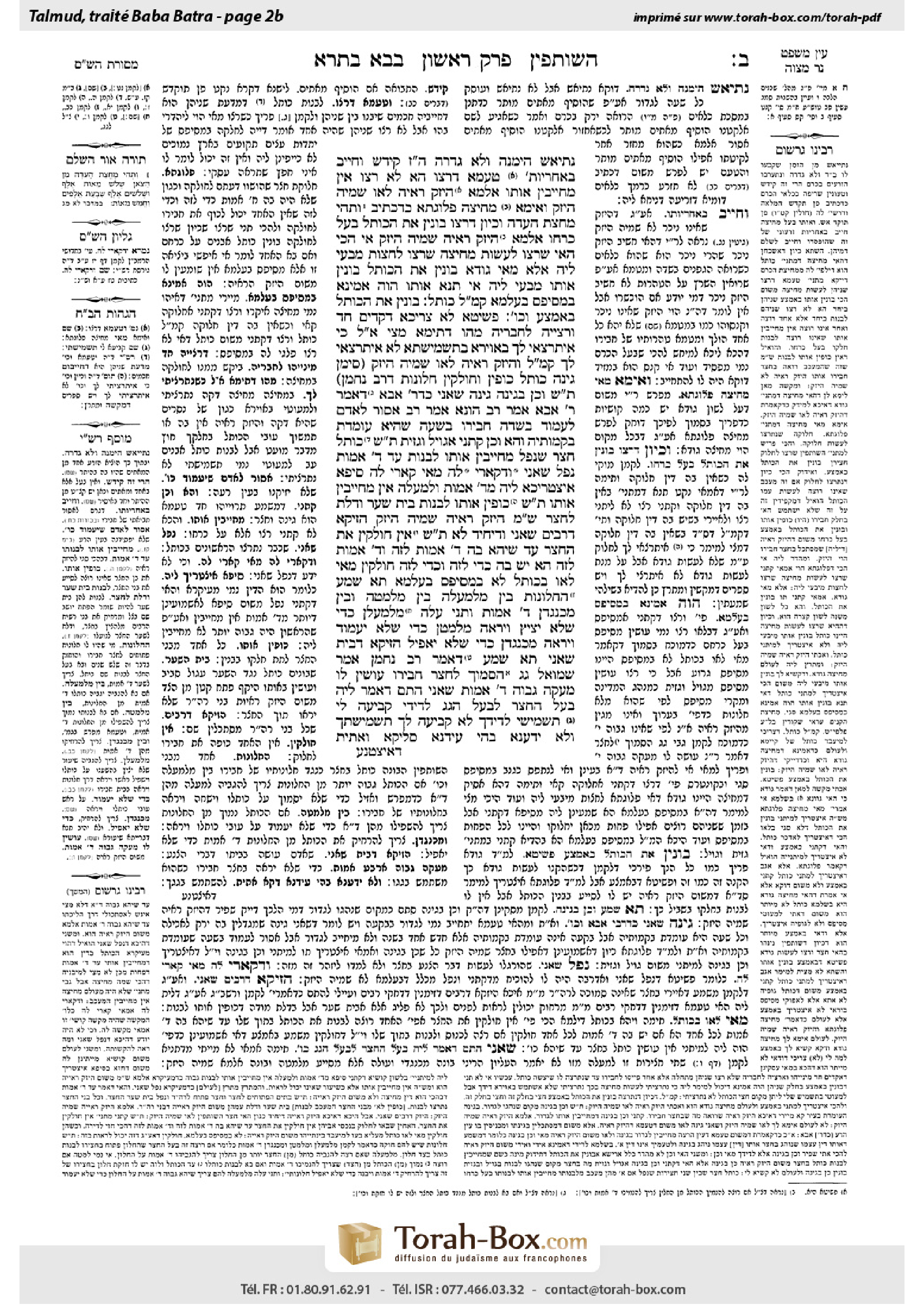
Bava Batra 2b: Talmud study for Daf Yomi
Study the Talmud for Daf Yomi with scanned pages, Hebrew text, English translations from Sefaria and AI-generated French translations.
Passage selection and English or AI-generated French translation are available where the scan has annotations. Daf Study is independent of Torah-Box and Sefaria.
Browse Bava Batra · בבא בתרא · All tractatesBava Batra 2b text and translations
This page of Bava Batra includes the Aramaic text, an English translation and an AI-generated French translation, alongside the scan above.
בבא בתרא ב׳ ב · Aramaic and Hebrew text
נִתְיָאֵשׁ הֵימֶנָּה וְלֹא גְּדָרָהּ – הֲרֵי זֶה קִידֵּשׁ, וְחַיָּיב בְּאַחְרָיוּתָהּ.
טַעְמָא דְּרָצוּ, הָא לֹא רָצוּ – אֵין מְחַיְּיבִין אוֹתוֹ; אַלְמָא הֶיזֵּק רְאִיָּה לָאו שְׁמֵיהּ הֶיזֵּק.
וְאֵימָא ״מְחִיצָה״ – פְּלוּגְתָּא, כְּדִכְתִיב: ״וַתְּהִי מֶחֱצַת הָעֵדָה״; וְכֵיוָן דְּרָצוּ – בּוֹנִין אֶת הַכּוֹתֶל בְּעַל כׇּרְחוֹ, אַלְמָא הֶיזֵּק רְאִיָּה שְׁמֵיהּ הֶיזֵּק!
אִי הָכִי, הַאי ״שֶׁרָצוּ לַעֲשׂוֹת מְחִיצָה״?! ״שֶׁרָצוּ לַחֲצוֹת״ מִבְּעֵי לֵיהּ! אֶלָּא מַאי – גּוּדָּא? ״בּוֹנִין אֶת הַכּוֹתֶל״?! ״בּוֹנִין אוֹתוֹ״ מִבְּעֵי לֵיהּ! אִי תְּנָא ״אוֹתוֹ״, הֲוָה אָמֵינָא בִּמְסִיפָס בְּעָלְמָא, קָא מַשְׁמַע לַן כּוֹתֶל.
בּוֹנִין אֶת הַכּוֹתֶל בָּאֶמְצַע וְכוּ׳. פְּשִׁיטָא!
לָא צְרִיכָא – דִּקְדֵים חַד וְרַצְּיֵּיהּ לְחַבְרֵיהּ; מַהוּ דְּתֵימָא, מָצֵי אָמַר לֵיהּ: כִּי אִיתְרְצַאי לָךְ – בְּאַוֵּירָא, בְּתַשְׁמִישְׁתָּא – לָא אִיתְרְצַאי לָךְ; קָא מַשְׁמַע לַן.
וְהֶיזֵּק רְאִיָּה לָאו שְׁמֵיהּ הֶיזֵּק?! (סִימָן: גִּינָּה, כּוֹתֶל, כּוֹפִין, וְחוֹלְקִין, חַלּוֹנוֹת, דְּרַב נַחְמָן).
תָּא שְׁמַע: ״וְכֵן בְּגִינָּה״!
גִּינָּה שָׁאנֵי, כִּדְרַבִּי אַבָּא – דְּאָמַר רַבִּי אַבָּא אָמַר רַב הוּנָא אָמַר רַב: אָסוּר לָאָדָם לַעֲמוֹד בִּשְׂדֵה חֲבֵירוֹ בְּשָׁעָה שֶׁהִיא עוֹמֶדֶת בְּקָמוֹתֶיהָ.
וְהָא ״וְכֵן״ קָתָנֵי! אַגְּוִיל וְגָזִית.
תָּא שְׁמַע: כּוֹתֶל חָצֵר שֶׁנָּפַל – מְחַיְּיבִין אוֹתוֹ לִבְנוֹת עַד אַרְבַּע אַמּוֹת! נָפַל שָׁאנֵי.
וּדְקָאָרֵי לַהּ מַאי קָאָרֵי לַהּ? סֵיפָא אִיצְטְרִיכָא לֵיהּ – מֵאַרְבַּע אַמּוֹת וּלְמַעְלָה אֵין מְחַיְּיבִין אוֹתוֹ.
תָּא שְׁמַע: כּוֹפִין אוֹתוֹ לִבְנוֹת בֵּית שַׁעַר וְדֶלֶת לֶחָצֵר. שְׁמַע מִינַּהּ, הֶיזֵּק רְאִיָּה שְׁמֵיהּ הֶיזֵּק! הַזִּיקָא דְרַבִּים שָׁאנֵי.
וּדְיָחִיד לָא? תָּא שְׁמַע: אֵין חוֹלְקִין אֶת הֶחָצֵר, עַד שֶׁיְּהֵא בָּהּ אַרְבַּע אַמּוֹת לָזֶה וְאַרְבַּע אַמּוֹת לָזֶה. הָא יֵשׁ בָּהּ כְּדֵי לָזֶה וּכְדֵי לָזֶה – חוֹלְקִין; מַאי, לָאו בְּכוֹתֶל? לָא, בִּמְסִיפָס בְּעָלְמָא.
תָּא שְׁמַע: הַחַלּוֹנוֹת, בֵּין מִלְּמַעְלָה בֵּין מִלְּמַטָּה וּבֵין מִכְּנֶגְדָּן – אַרְבַּע אַמּוֹת. וְתָנֵי עֲלַהּ: מִלְּמַעְלָן – כְּדֵי שֶׁלֹּא יָצִיץ וְיִרְאֶה; מִלְּמַטָּן – כְּדֵי שֶׁלֹּא יַעֲמוֹד וְיִרְאֶה; מִכְּנֶגְדָּן – כְּדֵי שֶׁלֹּא יַאֲפִיל!
הֶזֵּיקָא דְבַיִת שָׁאנֵי.
תָּא שְׁמַע, דְּאָמַר רַב נַחְמָן אָמַר שְׁמוּאֵל: גַּג הַסָּמוּךְ לַחֲצַר חֲבֵירוֹ – עוֹשִׂין לוֹ מַעֲקֶה גָּבוֹהַּ אַרְבַּע אַמּוֹת! שָׁאנֵי הָתָם, דְּאָמַר לֵיהּ בַּעַל הֶחָצֵר לְבַעַל הַגָּג: לְדִידִי קְבִיעָה לִי תַּשְׁמִישִׁי, לְדִידָךְ לָא קְבִיעָה לָךְ תַּשְׁמִישְׁתָּךְ; וְלָא יָדַעְנָא בְּהֵי עִידָּנָא סְלִיקָא וְאָתֵית –
Bava Batra 2b · English translation
If the owner of the vineyard neglected to make the necessary repairs and did not properly build a partition between the fields, the grain and grapes are rendered forbidden due to the prohibition of diverse kinds planted in a vineyard, and he is liable for the monetary loss. He must compensate the owner of the grain for the damage suffered, as it is the vineyard owner’s fault that deriving benefit from the grain is now prohibited.
According to the understanding that the term meḥitza means a partition, one can infer: The reason that they build a wall is that they both wished to make a partition in their jointly owned courtyard. But if they did not both wish to do so, the court does not obligate the reluctant partner to build such a wall, although his neighbor objects to the fact that the partner can see what he is doing in his courtyard. Apparently, it may be concluded that damage caused by sight, that is, the discomfort suffered by someone because he is exposed to the gaze of others while he is in his own private domain, is not called damage.
The Gemara objects to this conclusion: But say that the term meḥitza used in the mishna means a division, as it is written: “And the division of [meḥetzat] the congregation was” (Numbers 31:43), referring to the half of the spoil that belonged to the entire congregation. According to this interpretation the mishna means: Since they wished to divide the jointly owned courtyard, they build a proper wall in the center even against the will of one of the partners. Apparently, it may be concluded that damage caused by sight is called damage.
The Gemara rejects this line of reasoning: If it is so that the term meḥitza means a division, the words: Who wished to make a division, are imprecise, as the tanna should have said: Who wished to divide. Rather, what is the meaning of the term meḥitza? A partition. The Gemara retorts: If so, the words: They build the wall, are imprecise, as the tanna should have said: They build it, since the wall and the partition are one and the same. The Gemara responds: Had the tanna taught: They build it, I would say that a mere partition of pegs [bimseifas] would suffice. He therefore teaches us that they build an actual wall, all in accordance with the regional custom.
The mishna teaches: Partners who wished to make a partition in a jointly owned courtyard build the wall for the partition in the middle of the courtyard. The Gemara asks: Isn’t it obvious that if they agree to build a wall it should be built in the middle? Why should one of them contribute more than the other?
The Gemara answers: No, it is necessary to state this halakha in a case where one of the partners went ahead and convinced the other that they should build a partition. Lest you say that the second can later say to the first when the latter comes to begin construction: When I was persuaded by you to build a partition, it was with regard to the airspace. I agreed to the erection of a minimal barrier that would result in a loss of open space in the courtyard. But I was not persuaded by you with regard to the use of the courtyard. I did not agree to forfeit any usable space on the ground in my share of the courtyard for the building of a wall. To counter this, the mishna teaches us that since they agreed to make a partition, they must each contribute a part of the courtyard for the building of the wall.
§ After having determined that the wording of the mishna is unproblematic only if the term meḥitza means a wall, it follows that damage caused by sight is not called damage. The Gemara asks: And is damage caused by sight in fact not called damage? The Gemara provides a mnemonic for the proofs, which follow, that challenge this assumption: Garden, wall, compels, and they divide, windows, as Rav Naḥman.
The Gemara suggests: Come and hear that which the mishna teaches: And similarly with regard to a garden, in a place where it is customary to build a partition in the middle of a garden jointly owned by two people, and one of them wishes to build such a partition, the court obligates his neighbor to join in building the partition. This indicates that invading one’s privacy by looking at him while he is in his private domain is called damage.
The Gemara answers: A garden is different with regard to the halakha governing invasion of privacy, in accordance with the statement of Rabbi Abba, as Rabbi Abba says that Rav Huna says that Rav says: It is prohibited for a person to stand in another’s field and look at his crop while the grain is standing, because he casts an evil eye upon it and thereby causes him damage, and the same is true for a garden. Since the issue in this case is damage resulting from the evil eye, no proof can be brought with regard to the matter of damage caused by sight.
The Gemara objects: But the mishna teaches: And similarly with regard to a garden, which suggests that a garden and a courtyard are governed by the same rationale. The Gemara answers: The term: And similarly, is stated not with regard to the reason for the obligation to construct a wall, but with regard to the halakha concerning non-chiseled and chiseled stones. A partition in a garden is built with the same materials used for the building of a wall in a courtyard, in accordance with regional custom.
The Gemara suggests: Come and hear a proof from a mishna (5a): In the case of a dividing wall in a jointly owned courtyard that fell, if one of the owners wishes to rebuild the wall, the court obligates the other owner to build the wall with him again up to a height of four cubits. This indicates that damage caused by sight is called damage. The Gemara rejects this proof: The case of a wall that fell is different; since a wall had already stood there, the court compels the owners to rebuild it as it was.
The Gemara expresses its astonishment: And he who asked the question, why did he ask it at all? The mishna is clearly referring to a wall that has fallen, which means that the joint owners have already agreed in the past to build a partition between their respective portions. The Gemara answers: He who asked the question maintains that the joint owners can be compelled to build a wall even in a case where a wall had not stood there before, to prevent any invasion of privacy. And the mishna does not address the case of a wall that fell to teach that only in such a case is there an obligation to build a wall. Rather, it was necessary to teach the latter clause, which states that even in a case where there had previously been a high wall the court does not obligate him to rebuild it higher than four cubits, because once there is a wall of four cubits there is no further invasion of privacy.
The Gemara suggests: Come and hear an additional proof that damage caused by sight is called damage, from what is taught in a mishna (7b): The residents of a courtyard can compel each inhabitant of that courtyard to financially participate in the building of a gatehouse and a door to the jointly owned courtyard, so that the courtyard not be open to the eyes of those standing in the public domain. Learn from it that damage caused by sight is called damage. The Gemara answers: This is not a proof to the halakha in the case of two neighbors, as the damage of being exposed to the gaze of the general public, which has unimpeded sight of what is happening in the courtyard, is different and certainly called damage.
The Gemara asks: And is exposure to the sight of an individual not considered damage? Come and hear a proof that it is called damage from what is taught in a mishna (11a): One divides a courtyard at the request of one of the co-owners only if its area is sufficient so that there will be in it four by four cubits for this one and four by four cubits for that one, that is, the same minimal dimensions for each of the co-owners. This means that if there is enough for this one and enough for that one, they do divide the courtyard at the request of one of the owners. What, is it not so that the courtyard must be divided with a wall that will prevent one neighbor from seeing the other? The Gemara answers: No, perhaps it is divided with a mere partition of pegs through which one can still see.
The Gemara further suggests: Come and hear another proof that damage caused by sight is called damage from what is taught in a mishna (22a): One who desires to build a wall opposite the windows of a neighbor’s house must distance the wall four cubits from the windows, whether above, below, or opposite. And a baraita is taught with regard to that mishna: Concerning the requirement of a distance above, the wall must be high enough so that one cannot peer into the window and see into the window; concerning the requirement of a distance below, the wall must be low so that he will not be able to stand on top of it and see into the window; and concerning the requirement of a distance opposite, one must distance the wall from the windows so that it will not darken his neighbor’s house by blocking the light that enters the house through the window. This indicates that there is a concern about the damage caused by exposure to the gaze of others.
The Gemara rejects this argument: The damage of being exposed to the sight of others while in one’s own house is different, as people engage in activities in their homes that they do not want others to see. By contrast, a courtyard is out in the open and it is possible that the residents are indifferent to being observed.
The Gemara challenges this distinction: Come and hear a proof, as Rav Naḥman says that Shmuel says: If one’s roof is adjacent to another’s courtyard, he must make a parapet around the roof four cubits high so that he will not be able to see into his neighbor’s courtyard. This indicates that the damage of being exposed to the eyes of others even in a courtyard is called damage. The Gemara refutes this proof: The situation is different there, as the owner of the courtyard can say to the owner of the roof: I make use of my courtyard on a regular basis. You, by contrast, do not make use of your roof on a regular basis, but only infrequently. Consequently, I do not know when you will go up to the roof,
Bava Batra 2b · Traduction française (IA)
Si l'propriétaire du domaine de vigne négligeait de faire les réparations nécessaires et n'avait pas correctement construit une séparation entre les champs, les céréales et les raisins deviennent interdits en raison de l'interdiction de semer diverses espèces dans un domaine de vigne, et il est responsable de la perte monétaire. Il doit indemniser le propriétaire des céréales pour les dommages subis, car c'est la faute de l'exploitant du domaine de vigne que l'exploitation des céréales est désormais interdite.
Selon la compréhension que le terme meḥitza signifie une séparation, on peut en déduire : La raison pour laquelle ils construisent un mur est qu'ils souhaitaient tous deux établir une séparation dans leur cour partagée. Mais si ils n'avaient pas tous deux souhaité le faire, la cour ne s'oblige pas le partenaire réticent à construire un tel mur, même si son voisin s'offusque du fait que le partenaire puisse voir ce qu'il fait dans sa cour. Apparemment, on peut conclure que les dommages causés par la vue, c'est-à-dire l'inconfort subi par quelqu'un qui est exposé au regard des autres alors qu'il est dans son domaine privé, ne sont pas appelés dommages.
La Guemara s'oppose à cette conclusion : Mais disons que le terme meḥitza utilisé dans la mitsna signifie une division, comme il est écrit : « Et la division de [meḥetzat] la congrégation fut » (Nombres 31:43), faisant référence à la moitié des butins appartenant à toute la congrégation. Selon cette interprétation, la mitsna signifie : Puisqu'ils souhaitaient diviser la cour partagée, ils construisent un mur correct dans le centre même contre la volonté d'un des partenaires. Apparemment, on peut conclure que les dommages causés par la vue sont appelés dommages.
La Guemara rejette cette ligne de raisonnement : Si c'est ainsi que le terme meḥitza signifie une division, les mots : Qui souhaitait faire une division, sont imprecises, car le tanna aurait dû dire : Qui souhaitait diviser. Plutôt, quelle est la signification du terme meḥitza ? Une partition. La Guemara rétorque : Si c'est ainsi, les mots : Ils construisent le mur, sont imprecises, car le tanna aurait dû dire : Ils le construisent, puisque le mur et la partition sont une seule et même chose. La Guemara répond : Si le tanna avait enseigné : Ils le construisent, je dirais qu'une simple partition de clous [bimseifas] suffirait. Il enseigne donc que l'on construit un mur réel, conformément à la coutume locale.
La mitsva enseigne : Les partenaires qui souhaitaient établir une séparation dans une cour partagée construisent le mur pour la séparation au milieu de la cour. La Guemara demande : N'est-ce pas évident que si ils s'accordent à construire un mur, il devrait être construit au milieu ? Pourquoi l'un d'eux devrait-il contribuer davantage que l'autre ?
La Guemara répond : Non, il est nécessaire d'énoncer cette halakha dans un cas où l'un des partenaires a convaincu l'autre qu'ils devaient établir une séparation. Afin de ne pas dire que le second peut plus tard dire au premier, lorsqu'il commence la construction, : Quand j'ai été convaincu par toi de construire une séparation, c'était concernant l'espace aérien. J'ai accepté l'érection d'une barrière minimale qui entraînerait une perte d'espace ouvert dans la cour. Mais je n'ai pas été convaincu par toi concernant l'utilisation de la cour. Je n'ai pas accepté de perdre tout espace utilisable sur ma part de la cour pour la construction d'un mur. Pour contrecarrer cela, la mitsva nous enseigne que puisqu'ils s'accordent à établir une séparation, ils doivent chacun contribuer une part de la cour à la construction du mur.
§ Après avoir déterminé que la formulation de la Michna est sans problème uniquement si le terme meḥitza signifie un mur, il en suit que les dommages causés par la vue ne sont pas appelés dommages. La Guemara demande : Et les dommages causés par la vue ne sont-ils pas en effet appelés dommages ? La Guemara fournit un mnémonique pour les preuves qui suivent, qui remettent en question cette hypothèse : Jardin, mur, compelle, et ils divisent, fenêtres, comme Rav Naḥman.
La Guemara suggère : Viens écouter ce que la Michna enseigne : De même concernant un jardin, dans un lieu où il est coutumier de construire une séparation au milieu d'un jardin partagé par deux personnes, et que l'un d'eux souhaite construire une telle séparation, la cour oblige son voisin à participer à la construction de la séparation. Cela indique que l'invasion de la vie privée en regardant quelqu'un alors qu'il est dans son domaine privé est appelée dommage.
La Guemara répond : Le jardin est différent concernant la halakha concernant l'invasion de la vie privée, conformément à la déclaration de Rabbi Abba, car Rabbi Abba dit que Rav Huna dit que Rav dit : Il est interdit à une personne de se tenir dans le champ d'un autre et de le regarder lorsqu'il est en train de croître, car il jette un œil mauvais sur lui et cause ainsi un dommage, et c'est pareil pour un jardin. Puisque la question ici est un dommage résultant de l'œil mauvais, aucune preuve ne peut être apportée concernant la question du dommage causé par la vue.
La Guemara s'oppose : Mais la Michna enseigne : De même concernant un jardin, ce qui suggère que le jardin et la cour sont régis par le même raisonnement. La Guemara répond : Le terme : De même, est dit non en référence à la raison de l'obligation de construire un mur, mais en référence à la halakha concernant les pierres non taillées et taillées. Une séparation dans un jardin est construite avec les mêmes matériaux utilisés pour la construction d'un mur dans une cour, conformément à la coutume locale.
La Guemara suggère : Viens écouter une preuve tirée d'une Michna (5a) : Dans le cas d'un mur de séparation dans une cour partagée qui s'est effondré, si l'un des propriétaires souhaite reconstruire le mur, la cour oblige l'autre propriétaire à reconstruire le mur avec lui jusqu'à une hauteur de quatre coudées. Cela indique que les dommages causés par la vue sont appelés dommages. La Guemara rejette cette preuve : Le cas d'un mur qui s'est effondré est différent ; puisque un mur avait déjà été là, la cour impose aux propriétaires de le reconstruire tel qu'il était.
La Guemara exprime son étonnement : Et celui qui a posé la question, pourquoi a-t-il posé cette question ? La mitsna est clairement relative à un mur qui est tombé, ce qui signifie que les propriétaires communs ont déjà convenu par le passé de construire une clôture entre leurs portions respectives. La Guemara répond : Celui qui a posé la question maintient que les propriétaires communs peuvent être contraints de construire un mur même dans le cas où un mur n'avait pas été là avant, afin d'empêcher toute violation de la vie privée. Et la mitsna ne traite pas du cas d'un mur tombé pour enseigner que seule dans ce cas-là il y a une obligation de construire un mur. Au contraire, il était nécessaire d'enseigner cette dernière clause, qui stipule que même dans le cas où il y avait précédemment un mur élevé, la cour ne s'oblige pas à le reconstruire plus haut que quatre coudées, car une fois qu'il y a un mur de quatre coudées, il n'y a plus de violation de la vie privée.
La Guemara suggère : Viens écouter une preuve supplémentaire que les dommages causés par la vue sont appelés dommages, d'après ce qui est enseigné dans une mitsna (7b) : Les habitants d'un cour d'habitation peuvent obliger chaque habitant de ce cour à participer financièrement à la construction d'une porte et d'une porte d'entrée au cour partagé, afin que le cour ne soit pas ouvert aux yeux de ceux qui sont dans le domaine public. Apprends-en que les dommages causés par la vue sont appelés dommages. La Guemara répond : Ce n'est pas une preuve pour la halakha dans le cas de deux voisins, car le dommage d'être exposé aux regards du public, qui a une vue libre sur ce qui se passe dans le cour, est différent et est certainement appelé dommage.
La Guemara pose la question : Et l'exposition à la vue d'un individu n'est-elle pas considérée comme un dommage ? Viens écouter une preuve que cela est appelé dommage, d'après ce qui est enseigné dans une mitsna (11a) : On divise un cour à la demande d'un des co-propriétaires uniquement si sa surface est suffisante pour qu'il y ait quatre par quatre coudées pour celui-ci et quatre par quatre coudées pour celui-là, c'est-à-dire les mêmes dimensions minimales pour chaque co-propriétaire. Cela signifie que si il y a assez pour celui-ci et assez pour celui-là, ils divisent le cour à la demande d'un des propriétaires. Qu'est-ce que cela ne signifie pas que le cour doit être divisé avec un mur qui empêche un voisin de voir l'autre ? La Guemara répond : Non, peut-être qu'il est divisé avec une simple clôture de clous par laquelle on peut encore voir.
La Guemara suggère davantage : Viens écouter une autre preuve que les dommages causés par la vue sont appelés dommages, d'après ce qui est enseigné dans une mitsna (22a) : Celui qui veut construire un mur en face des fenêtres d'une maison d'un voisin doit distancer le mur de quatre coudées des fenêtres, que ce soit au-dessus, en dessous ou en face. Et une baraïta est enseignée concernant cette mitsna : En ce qui concerne la distance au-dessus, le mur doit être suffisamment haut pour que l'on ne puisse pas regarder dans la fenêtre et voir à l'intérieur de la fenêtre ; en ce qui concerne la distance en dessous, le mur doit être bas pour que l'on ne puisse pas s'y tenir et voir dans la fenêtre ; et en ce qui concerne la distance en face, il faut distancer le mur des fenêtres de sorte qu'il ne bloque pas la lumière qui entre dans la maison à travers la fenêtre. Cela indique qu'il y a une préoccupation concernant les dommages causés par l'exposition aux regards des autres.
La Guemara rejette cet argument : Le dommage d'être exposé aux regards d'autrui dans sa propre maison est différent, car les gens effectuent des activités dans leurs maisons qu'ils ne veulent pas que les autres voient. En revanche, un cour est en plein air et il est possible que les habitants soient indifférents à être observés.
La Guemara conteste cette distinction : Viens écouter une preuve, car Rav Naḥman dit que Shmuel dit : Si le toit d'une personne est adjacent à un cour d'un autre, il doit faire un parapet autour du toit de quatre coudées de haut afin qu'il ne puisse pas voir dans le cour de son voisin. Cela indique que le dommage d'être exposé aux yeux d'autrui même dans un cour est appelé dommage. La Guemara réfute cette preuve : La situation est différente là, car le propriétaire du cour peut dire au propriétaire du toit : J'utilise mon cour régulièrement. Toi, en revanche, tu n'utilises pas ton toit régulièrement, mais seulement occasionnellement. Ainsi, je ne sais pas quand tu monteras sur le toit,
Traduction française générée par IA à partir de l’édition anglaise de Sefaria. Vérifie toujours un passage avec le texte source.
Text from Sefaria: William Davidson Edition - Vocalized Aramaic (CC BY NC); William Davidson Edition - English (CC BY NC).