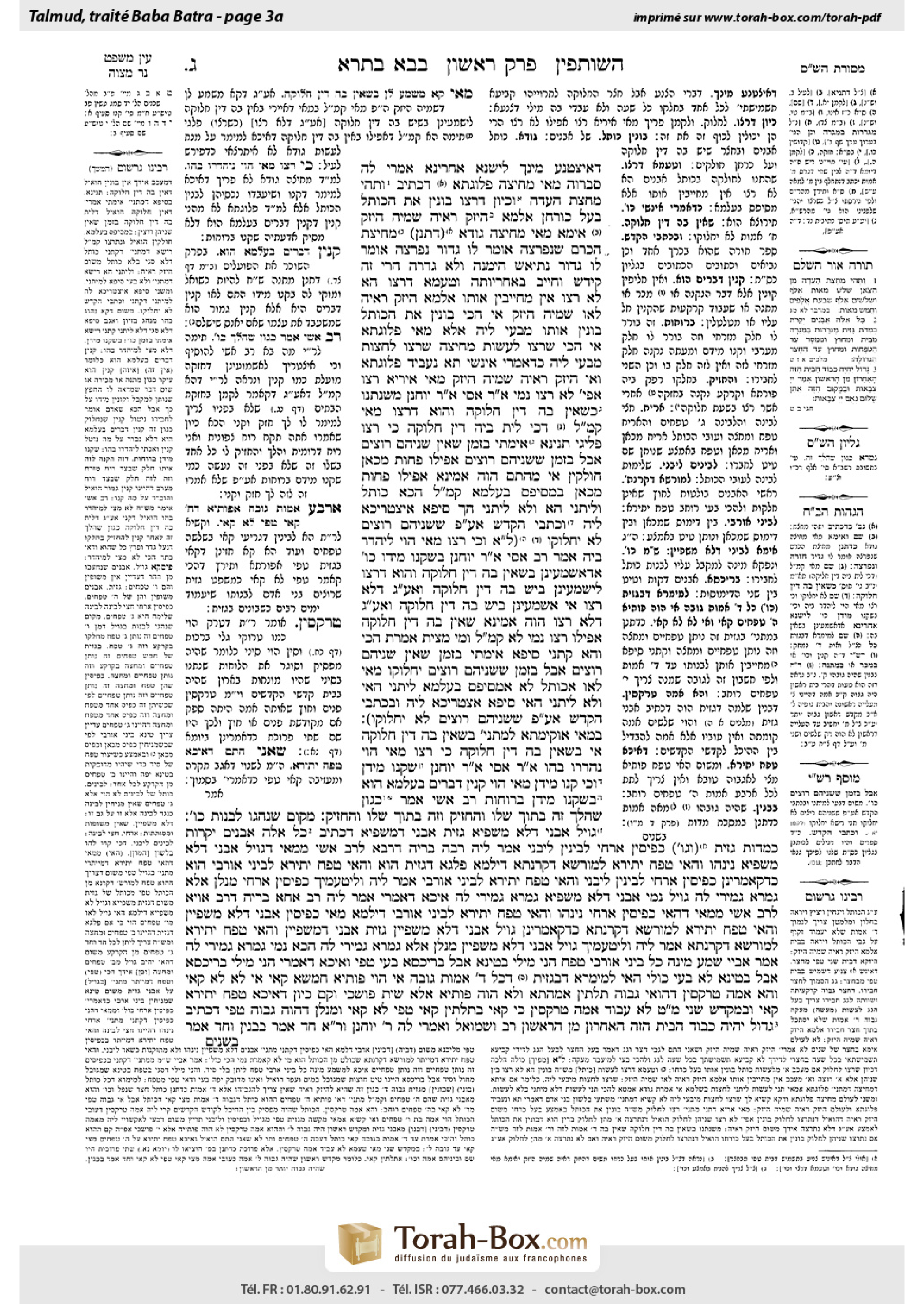
Bava Batra 3a: Talmud study for Daf Yomi
Study the Talmud for Daf Yomi with scanned pages, Hebrew text, English translations from Sefaria and AI-generated French translations.
Passage selection and English or AI-generated French translation are available where the scan has annotations. Daf Study is independent of Torah-Box and Sefaria.
Browse Bava Batra · בבא בתרא · All tractatesBava Batra 3a text and translations
This page of Bava Batra includes the Aramaic text, an English translation and an AI-generated French translation, alongside the scan above.
בבא בתרא ג׳ א · Aramaic and Hebrew text
דְּאִיצְטַנַּע מִינָּךְ.
לִישָּׁנָא אַחֲרִינָא אָמְרִי לַהּ: סַבְרוּהָ, מַאי ״מְחִיצָה״ – פְּלוּגְתָּא, דִּכְתִיב: ״וַתְּהִי מֶחֱצַת הָעֵדָה״; וְכֵיוָן דְּרָצוּ – בּוֹנִין אֶת הַכּוֹתֶל בְּעַל כּוֹרְחָן, אַלְמָא הֶיזֵּק רְאִיָּה שְׁמֵיהּ הֶיזֵּק.
אֵימָא: מַאי ״מְחִיצָה״ – גּוּדָּא; דִּתְנַן: מְחִיצַת הַכֶּרֶם שֶׁנִּפְרְצָה – אוֹמֵר לוֹ: ״גְּדוֹר״. נִפְרְצָה – אוֹמֵר לוֹ: ״גְּדוֹר״. נִתְיָאֵשׁ הֵימֶנָּה וְלֹא גְּדָרָהּ – הֲרֵי זֶה קִידֵּשׁ, וְחַיָּיב בְּאַחְרָיוּתָהּ.
וְטַעְמָא דְּרָצוּ, הָא לֹא רָצוּ – אֵין מְחַיְּיבִין אוֹתוֹ, אַלְמָא הֶיזֵּק רְאִיָּה לָאו שְׁמֵיהּ הֶיזֵּק!
אִי הָכִי, ״בּוֹנִין אֶת הַכּוֹתֶל״?! ״בּוֹנִין אוֹתוֹ״ מִבְּעֵי לֵיהּ! אֶלָּא מַאי – פְּלוּגְתָּא? אִי הָכִי, ״שֶׁרָצוּ לַעֲשׂוֹת מְחִיצָה״?! ״שֶׁרָצוּ לַחֲצוֹת״ מִבְּעֵי לֵיהּ! כִּדְאָמְרִי אִינָשֵׁי: תָּא נַעֲבֵיד פְּלוּגְתָּא.
וְאִי הֶיזֵּק רְאִיָּה שְׁמֵיהּ הֶיזֵּק – מַאי אִירְיָא רָצוּ? אֲפִילּוּ לֹא רָצוּ נָמֵי! אָמַר רַבִּי אַסִּי אָמַר רַבִּי יוֹחָנָן: מִשְׁנָתֵנוּ – כְּשֶׁאֵין בָּהּ דִּין חֲלוּקָהּ, וְהוּא דְּרָצוּ.
מַאי קָא מַשְׁמַע לַן – דְּכִי לֵית בֵּיהּ דִּין חֲלוּקָהּ, כִּי רָצוּ – פְּלִיגִי?! תְּנֵינָא: אֵימָתַי – בִּזְמַן שֶׁאֵין שְׁנֵיהֶם רוֹצִים, אֲבָל בִּזְמַן שֶׁשְּׁנֵיהֶם רוֹצִים – אֲפִילּוּ פָּחוֹת מִכָּאן חוֹלְקִין! אִי מֵהָתָם, הֲוָה אָמֵינָא אֲפִילּוּ פָּחוֹת מִכָּאן – בִּמְסִיפָס בְּעָלְמָא; קָא מַשְׁמַע לַן הָכָא, כּוֹתֶל.
וְלִיתְנֵי הָא וְלָא לִיתְנֵי הָךְ! סֵיפָא אִיצְטְרִיכָא לֵיהּ – וְכִתְבֵי הַקֹּדֶשׁ, אַף עַל פִּי שֶׁשְּׁנֵיהֶם רוֹצִים – לֹא יַחְלוֹקוּ.
(לִישָּׁנָא אַחֲרִינָא: וְכִי רָצוּ מַאי הָוֵי? לִיהְדַּר בֵּיהּ! אָמַר רַב אַסִּי אָמַר רַבִּי יוֹחָנָן: בְּשֶׁקָּנוּ מִיָּדוֹ כּוּ׳.
אַדְּאַשְׁמְעִינַן בְּשֶׁאֵין בָּהּ דִּין חֲלוּקָהּ – וְהוּא דְּרָצוּ, לַישְׁמְעִינַן בְּיֵשׁ בָּהּ דִּין חֲלוּקָהּ – וְאַף עַל גַּב דְּלֹא רָצוּ! אִי אַשְׁמְעִינַן בְּיֵשׁ בָּהּ דִּין חֲלוּקָהּ – וְאַף עַל גַּב דְּלֹא רָצוּ, הֲוָה אָמֵינָא: שֶׁאֵין בָּהּ דִּין חֲלוּקָהּ – אֲפִילּוּ רָצוּ נָמֵי לָא; קָא מַשְׁמַע לַן.
וּמִי מָצֵית אָמְרַתְּ הָכִי?! וְהָא קָתָנֵי סֵיפָא: אֵימָתַי – בִּזְמַן שֶׁאֵין שְׁנֵיהֶם רוֹצִים, אֲבָל בִּזְמַן שֶׁשְּׁנֵיהֶם רוֹצִים – יַחְלוֹקוּ. מַאי, לָאו אַכּוֹתֶל? לָא, אַמְּסִיפָס בְּעָלְמָא.
לִיתְנֵי הַאי וְלָא לִיתְנֵי הַאי! סֵיפָא אִצְטְרִיכָא לֵיהּ – וּבְכִתְבֵי הַקֹּדֶשׁ, אַף עַל פִּי שֶׁשְּׁנֵיהֶם רוֹצִים – לֹא יַחְלוֹקוּ).
בְּמַאי אוֹקֵימְתָּא לְמַתְנִיתִין – בְּשֶׁאֵין בָּהּ דִּין חֲלוּקָהּ; אִי בְּשֶׁאֵין בָּהּ דִּין חֲלוּקָהּ, כִּי רָצוּ מַאי הָוֵי? נֶהְדְּרוּ בְּהוּ! אָמַר רַבִּי אַסִּי אָמַר רַבִּי יוֹחָנָן: שֶׁקָּנוּ מִיָּדָן.
וְכִי קָנוּ מִיָּדָן מַאי הָוֵי? קִנְיַן דְּבָרִים בְּעָלְמָא הוּא! בְּשֶׁקָּנוּ מִיָּדָן בְּרוּחוֹת. רַב אָשֵׁי אָמַר: כְּגוֹן שֶׁהָלַךְ זֶה בְּתוֹךְ שֶׁלּוֹ וְהֶחֱזִיק, וְזֶה בְּתוֹךְ שֶׁלּוֹ וְהֶחֱזִיק.
מָקוֹם שֶׁנָּהֲגוּ לִבְנוֹת כּוּ׳. גְּוִיל – אַבְנֵי דְּלָא מְשַׁפְּיָא. גָּזִית – אַבְנֵי דִּמְשַׁפְּיָא, דִּכְתִיב: ״כָּל אֵלֶּה אֲבָנִים יְקָרוֹת כְּמִדּוֹת גָּזִית (וְגוֹ׳)״ כְּפִיסִין – אַרְחֵי. לְבֵינִין – לִיבְנֵי.
אֲמַר לֵיהּ רַבָּה בְּרֵיהּ דְּרָבָא לְרַב אָשֵׁי: מִמַּאי דִּגְוִיל אַבְנֵי דְּלָא מְשַׁפְּיָא נִינְהוּ, וְהַאי טֶפַח יַתִּירָא – לְמוּרְשָׁא דְקַרְנָתָא? דִּילְמָא פַּלְגָא דְגָזִית הוּא, וְהַאי טֶפַח יַתִּירָא – לְבֵינֵי אוּרְבֵי הוּא;
כִּדְקָאָמְרִינַן: כְּפִיסִין – אַרְחֵי, לְבֵינִין – לִיבְנֵי, וְהַאי טֶפַח יַתִּירָא – לְבֵינֵי אוּרְבֵי!
אֲמַר לֵיהּ: וְלִיטַעְמָיךְ, כְּפִיסִין – אַרְחֵי, מְנָלַן? אֶלָּא גְּמָרָא גְּמִירִי לַהּ, גְּוִיל נָמֵי – אַבְנֵי דְּלָא מְשַׁפְּיָא, גְּמָרָא גְּמִירִי לַהּ.
אִיכָּא דְאָמְרִי, אֲמַר לֵיהּ רַב אַחָא בְּרֵיהּ דְּרַב אַוְיָא לְרַב אָשֵׁי: מִמַּאי דְּהַאי כְּפִיסִין – אַרְחֵי נִינְהוּ, וְהַאי טֶפַח יַתִּירָא – לְבֵינֵי אוּרְבֵי? דִּילְמָא מַאי כְּפִיסִין – אַבְנֵי דְּלָא מְשַׁפְּיָין, וְהַאי טֶפַח יַתִּירָא – לְמוּרְשָׁא דְקַרְנָתָא; כִּדְקָאָמְרִינַן: גְּוִיל – אַבְנֵי דְּלָא מְשַׁפְּיָין, גָּזִית – אַבְנֵי דִּמְשַׁפְּיָין, וְהַאי טֶפַח יַתִּירָא – לְמוּרְשָׁא דְקַרְנָתָא!
אֲמַר לֵיהּ: וְלִיטַעְמָיךְ, גְּוִיל – אַבְנֵי דְּלָא מְשַׁפְּיָין, מְנָלַן? אֶלָּא גְּמָרָא גְּמִירִי לַהּ, הָכָא נָמֵי – גְּמָרָא גְּמִירִי לַהּ.
אָמַר אַבָּיֵי, שְׁמַע מִינַּהּ: כָּל בֵּינֵי אוּרְבֵי – טֶפַח; הָנֵי מִילֵּי בְּטִינָא, אֲבָל בְּרִיכְסָא בָּעֵי טְפֵי. וְאִיכָּא דְּאָמְרִי: הָנֵי מִילֵּי בְּרִיכְסָא, אֲבָל בְּטִינָא לָא בָּעֵי כּוּלֵּי הַאי.
לְמֵימְרָא דִּבְגָזִית; דְּכֹל אַרְבַּע אַמּוֹת גּוֹבַהּ, אִי הָוֵי פּוּתְיָא חַמְשָׁא – קָאֵי, אִי לָא – לָא קָאֵי?! וְהָא אַמָּה טְרַקְסִין; דַּהֲוַאי גָּבוֹהַּ תְּלָתִין אַמְּהָתָא, וְלָא הֲוָה פּוּתְיָא אֶלָּא שֵׁית פּוּשְׁכֵי; וְקָם! כֵּיוָן דְּאִיכָּא טֶפַח יַתִּירָא – קָאֵי.
וּבְמִקְדָּשׁ שֵׁנִי מַאי טַעְמָא לָא עֲבוּד אַמָּה טְרַקְסִין? כִּי קָאֵי – בִּתְלָתִין קָאֵי, טְפֵי לָא קָאֵי.
וּמְנָלַן דַּהֲוָה גָּבוֹהַּ טְפֵי? דִּכְתִיב: ״גָּדוֹל יִהְיֶה כְּבוֹד הַבַּיִת הַזֶּה הָאַחֲרוֹן מִן הָרִאשׁוֹן״ – רַב וּשְׁמוּאֵל; וְאָמְרִי לַהּ רַבִּי יוֹחָנָן וְרַבִּי אֶלְעָזָר; חַד אָמַר: בְּבִנְיָן, וְחַד אָמַר:
Bava Batra 3a · English translation
so that I can hide from you at that time and avoid coming under your gaze.
§ The Gemara has so far presented one version of the discussion of the mishna. A different version relates the discussion as follows: The Sages initially assumed: What is the meaning of the term meḥitza mentioned in the mishna? A division, not a partition, as it is written: “And the division of [meḥetzat] the congregation was” (Numbers 31:43). According to this interpretation, the mishna means to say: Since they wished to divide the jointly owned courtyard, they build a proper wall in the center even against the will of one of the partners. Apparently, it may be concluded that damage caused by sight is called damage.
The Gemara objects to this conclusion: But why not say: What is the meaning of the term meḥitza mentioned in the mishna? It means a partition. This usage would be as we learned in a baraita: Consider the case where a partition of [meḥitzat] a vineyard which separates the vineyard from a field of grain was breached, resulting, if the situation is not rectified, in the grain and grapes becoming items from which deriving benefit is prohibited. The owner of the field of grain may say to the owner of the vineyard: Build a partition between the vineyard and the field of grain. If the owner of the vineyard did so, and the partition was breached again, the owner of the field of grain may say to him again: Build a partition. If the owner of the vineyard neglected to make the necessary repairs and did not properly build a partition between the fields, the grain and grapes are rendered forbidden due to the prohibition of diverse kinds planted in a vineyard, and he is liable for the monetary loss.
The Gemara concludes stating the objection: And according to the understanding that the term meḥitza means a partition, one can infer: The reason that they build a wall is that they both wished to make a partition in their jointly owned courtyard. But if they did not both wish to do so, the court does not obligate the reluctant partner to build such a wall, although his neighbor objects to the fact that the partner can see what he is doing in his courtyard. Apparently, it may be concluded that damage caused by sight is not called damage.
The Gemara rejects this argument: If so, the words: They build the wall, are imprecise, as the tanna should have said: They build it, since the wall and the partition are one and the same. The Gemara retorts: Rather, what is the meaning of the term meḥitza? A division. If it is so that the term meḥitza means a division, the words: Who wished to make a division, are imprecise, as the tanna should have said: Who wished to divide. The Gemara answers: The phrasing of the mishna is as people commonly say: Come, let us make a division. Consequently, the mishna can also be understood as referring to two people who wished to divide a jointly owned area.
The Gemara asks, according to the understanding that meḥitza means division: But if damage caused by sight is called damage, why does the tanna specifically teach that if they wish, they build a wall? Even if they did not both wish to do so, it should also be possible to compel the reluctant party to build a wall between them. Rabbi Asi said that Rabbi Yoḥanan said: Our mishna is referring to a courtyard that is not subject to the halakha of division. Joint owners of a courtyard cannot be compelled to divide the courtyard unless each party will receive at least four square cubits of the courtyard. And therefore, this ruling of the mishna applies only in the case where they both wished to divide the courtyard.
The Gemara asks: According to this understanding, what is the tanna teaching us? Is he teaching us that when a courtyard is not subject to the halakha of division, if they nevertheless wished to do so, they divide it? But we already learned this in the latter clause of a different mishna (11a): When do they not divide the courtyard because it is not large enough to compel division? When the joint owners do not both wish to divide it. But when both of them wish to divide it, they divide it even if it is smaller than this, i.e., smaller than four square cubits for each party. The Gemara answers: If we had learned this halakha only from there, I would say that they divide the courtyard even if it is smaller than this by constructing a mere partition of pegs, which does not prevent invasion of privacy. Therefore, the tanna teaches us here in this mishna that if they wish to divide the courtyard they can be compelled to build a proper wall.
The Gemara asks: If so, let the tanna teach this mishna and not teach that other mishna, as this mishna teaches more details than the later one. The Gemara answers: It was necessary for the tanna to teach the other mishna to introduce the last clause of that mishna, which states: And jointly owned sacred writings that are contained in a single scroll should not be divided even if both owners wish to do so.
The Gemara brings a different version of the previous discussion: And if they wished to divide the courtyard, what of it? What forces them to build the wall? If one of the parties does not wish to build a wall, let him retract. Rav Asi said that Rabbi Yoḥanan said that the mishna is not discussing a case where they merely reached a verbal agreement to divide the courtyard, but rather with a case where each party performed an act of acquisition with the other, confirming their respective commitments. Therefore, neither side can retract.
The Gemara asks: Rather than teaching us a case where the courtyard is not subject to the halakha of division, but nevertheless they wished to divide it, let the mishna teach us a case where the courtyard is subject to the halakha of division, even if they did not both wish to divide it. The Gemara answers: Had it taught us only a case where the courtyard is subject to the halakha of division that applies even if they did not both wish to divide it, I would say that in a case where the courtyard is not subject to the halakha of division then even if they both wished to divide it, if one of the parties does not wish to build a proper wall he cannot be compelled to do so. Therefore, the mishna teaches us that he is compelled to participate.
The Gemara asks: But how can you say this? Doesn’t the latter clause of the mishna (11a) teach: When do they not divide the courtyard because it is not large enough to compel division? When the joint owners do not both wish to divide it. But when both of them wish to divide it, they divide it even if it is smaller than this. What, is this clause of the mishna not referring to the fact that either one can force the other to build a proper wall? The Gemara answers: No, it is referring to a mere partition of pegs and not to an actual wall.
The Gemara asks: If so, let the tanna teach this mishna and not teach that other mishna, as this mishna teaches more details than the later one. The Gemara answers: It was necessary to teach the other mishna for the last clause of that mishna, which states: And jointly owned sacred writings that are contained in a single scroll should not be divided even if both owners wish to do so. This concludes the alternative version of the discussion.
The Gemara continues its analysis of the mishna: To what case did you interpret the mishna to be referring? To a case where the courtyard is not subject to the halakha of division. But if there is no halakha of division, then if they wished to divide the courtyard, what of it; how can either one force the other to build a wall? If the parties no longer want to build a wall, let them retract. Rabbi Asi said that Rabbi Yoḥanan said: It is referring to a case where each party performed an act of acquisition with the other, confirming their respective commitments. Therefore, neither party can retract.
The Gemara asks: But even if each party performed an act of acquisition with the other, what of it? It is merely a verbal acquisition, meaning there was no actual transfer of property, but only a verbal agreement to act in a certain manner in the future and not a true act of acquisition. The Gemara answers: They performed an act of acquisition with the other with regard to directions, i.e., not only did they verbally agree to divide the courtyard, they also determined which of them would get which part of the courtyard. Consequently, the acquisition related to actual property, a particular plot of land. Rav Ashi said: For example, this one walked through his designated portion and performed an act demonstrating ownership there, and that one walked through his designated portion and performed an act demonstrating ownership there.
§ The mishna teaches: In a place where it is customary to build such a wall with non-chiseled stone [gevil], or chiseled stone [gazit], or small bricks [kefisin], or large bricks [leveinim], they must build the wall with that material. The Gemara identifies the various building materials: Gevil refers to stones that are not planed. Gazit means stones that are planed, as it is written: “All these were of costly stones, according to the measures of chiseled stones [gazit], sawed with saws, within and without” (I Kings 7:9). This teaches that chiseled stones are those that have been planed and smoothened. Kefisin refers to small bricks. Leveinim means large bricks.
Rabba, the son of Rava, said to Rav Ashi: From where do you know that gevil refers to stones that are not planed, and this extra handbreadth that a wall of gevil has compared to what a wall of gazit has is for the protruding edges? That is, a wall of gevil is six handbreadths thick because the stones have not been planed and smoothened, and therefore protrude somewhat outward. Perhaps gevil refers to planed stones that are half the thickness of gazit, namely, just two and a half handbreadths, as compared to gazit, which is five handbreadths thick; and this extra handbreadth in a wall of gevil is for the space between the two rows [urbei]. That is, a wall of gevil is actually two walls of planed stones that are each two and a half handbreadths thick; and the two walls are separated by one handbreadth, which is later filled in with mortar for added strength.
A proof for this explanation can be brought from what we say, i.e., that kefisin are small bricks, whereas leveinim are large bricks, twice the thickness of small bricks. And this extra handbreadth of thickness that a wall of kefisin has compared to what a wall of levinim has is for the space between the two rows of small bricks.
Rav Ashi said to him: And according to your reasoning, from where do we derive that kefisin are small bricks? Rather, the Sages learned this as a tradition. And so too, they learned as a tradition that gevil refers to non-planed stones.
The Gemara presents a different version of the discussion. There are those who say that Rav Aḥa, son of Rav Avya, said to Rav Ashi: From where do you know that kefisin are small bricks, one-half the width of large bricks, and this extra handbreadth of thickness that a wall of kefisin has compared to what a wall of leveinim has covers the space between the two rows of kefisin? Perhaps you should say what are kefisin? Stones that are not planed, and this extra handbreadth of thickness that a wall of kefisin has in comparison to what a wall of leveinim has is for the protruding edges. And proof for this explanation can be brought from what we say, i.e., that gevil refers to stones that are not planed, whereas gazit means planed stones, and this extra handbreadth of thickness that a wall of gevil has compared to what a wall of gazit has is for the protruding edges.
Rav Ashi said to him: And according to your reasoning, from where do we derive that gevil are stones that are not planed? Rather, the Sages learned this as a tradition. Here too, they learned as a tradition that kefisin are small bricks.
Abaye said: Learn from it that the space left between the two rows of a wall is always a handbreadth. The Gemara comments: This matter applies only when the two rows of the wall are filled in with mortar. But when they are filled in with gravel [berikhsa], more space is required. And there are those who say that this matter applies only when the two rows of the wall are filled in with gravel. But when mortar is used to fill in the space, not as much space is required, and less than a handbreadth suffices.
§ The Gemara asks: Is this to say that in the case of a wall of chiseled stone, if for every four cubits of height there are five handbreadths of thickness the wall will stand, and if not it will not stand, as this is the required ratio between a wall’s height and its thickness? But wasn’t there the one-cubit-thick wall separating the Holy of Holies from the Sanctuary of the Temple [amah teraksin] separating the Holy of Holies from the Sanctuary, which was thirty cubits high and its thickness was only six handbreadths and nevertheless stood? The Gemara answers: Since there was an extra handbreadth of thickness, it was able to stand even to such a great height.
The Gemara asks: And what is the reason that in the Second Temple they did not fashion an amah teraksin to separate between the Holy of Holies and the Sanctuary, as they had done in the First Temple? The Gemara answers: When a partition stands even though it is only six handbreadths thick, it is able to remain standing up to thirty cubits in height. But it will not be able to stand if it is more than that height. The Second Temple was taller than the First Temple, and therefore the partition separating the Holy of Holies from the Sanctuary also had to be higher.
The Gemara comments: And from where do we derive that the Second Temple was taller than the First Temple? As it is written: “The glory of this latter house shall be greater than that of the former” (Haggai 2:9). Rav and Shmuel disagree about the meaning of this verse, and some say it was Rabbi Yoḥanan and Rabbi Elazar who disagreed as to its meaning. One of them said that it means that the Second Temple will be greater in the size of its structure, i.e., taller. And one of them said
Bava Batra 3a · Traduction française (IA)
afin que je puisse me cacher de vous à ce moment-là et éviter de tomber sous votre regard.
§ La Guemara a jusqu'à présent présenté une version de la discussion de la Michna. Une autre version rapporte la discussion comme suit : Les Sages ont d'abord supposé : Quelle est la signification du terme meḥitza mentionné dans la Michna ? Une division, pas une partition, comme il est écrit : « Et la division de [meḥetzat] la congrégation fut » (Nombres 31:43). Selon cette interprétation, la Michna veut dire : Puisque ils souhaitaient diviser le jardin partagé, ils construisent un mur approprié au milieu même contre la volonté d'un des partenaires. Apparemment, on peut conclure que les dommages causés par la vue sont appelés dommages.
La Guemara s'oppose à cette conclusion : Mais pourquoi ne pas dire : Quelle est la signification du terme meḥitza mentionné dans la Michna ? Il signifie une partition. Cette utilisation serait celle que nous avons apprise dans une baraïta : Considérons le cas où une partition de [meḥitzat] un vignoble qui sépare le vignoble d'un champ de céréales est percée, entraînant, si la situation n'est pas corrigée, que les céréales et les raisins deviennent des objets dont l'usage est interdit. L'propriétaire du champ de céréales peut dire à l'propriétaire du vignoble : Construisez une partition entre le vignoble et le champ de céréales. Si l'propriétaire du vignoble l'a fait, et que la partition a été percée à nouveau, l'propriétaire du champ de céréales peut lui dire à nouveau : Construisez une partition. Si l'propriétaire du vignoble néglige de faire les réparations nécessaires et n'a pas correctement construit une partition entre les champs, les céréales et les raisins deviennent interdits en raison de la prohibition des espèces diverses plantées dans un vignoble, et il est responsable du préjudice matériel.
La Guemara conclut en indiquant l'objection : Et selon l'interprétation qui considère que le terme meḥitza signifie une partition, on peut inférer : La raison pour laquelle ils construisent un mur est qu'ils souhaitaient tous deux faire une partition dans leur jardin partagé. Mais si ils n'ont pas tous deux souhaité le faire, la cour ne s'oblige pas le partenaire réticent à construire un tel mur, même si son voisin s'oppose au fait que le partenaire puisse voir ce qu'il fait dans son jardin. Apparemment, on peut conclure que les dommages causés par la vue ne sont pas appelés dommages.
La Guemara rejette cet argument : Si c'est ainsi, les mots : Ils construisent le mur, sont imprecises, car le tanna aurait dû dire : Ils le construisent, puisque le mur et la partition sont une seule et même chose. La Guemara rétorque : Plutôt, quelle est la signification du terme meḥitza ? Une division. Si c'est ainsi que le terme meḥitza signifie une division, les mots : Qui souhaitait faire une division, sont imprecises, car le tanna aurait dû dire : Qui souhaitait diviser. La Guemara répond : La formulation de la Michna est telle que les gens l'emploient couramment : Viens, faisons une division. Ainsi, la Michna peut également être interprétée comme faisant référence à deux personnes qui souhaitaient diviser une zone partagée.
La Guemara pose une question, selon cette interprétation : Mais si les dommages causés par la vue sont appelés dommages, pourquoi le tanna enseigne spécifiquement que si ils souhaitent, ils construisent un mur ? Même s'ils n'ont pas tous deux souhaité le faire, il devrait être possible de contraindre la partie réticente à construire un mur entre eux. Rabbi Asi dit que Rabbi Yoḥanan dit : Notre Michna fait référence à un jardin qui n'est pas soumis à la halakha de division. Les propriétaires partagés d'un jardin ne peuvent être contraints de le diviser que si chaque partie reçoit au moins quatre cubits carrés du jardin. Et donc, cette décision de la Michna s'applique uniquement dans le cas où ils souhaitaient tous deux diviser le jardin.
La Guemara pose une question : Selon cette interprétation, que nous enseigne le tanna ? Est-ce qu'il nous enseigne que lorsque le jardin n'est pas soumis à la halakha de division, si les propriétaires souhaitent le faire, ils le divisent ? Mais nous avons déjà appris cela dans la dernière clause d'une autre Michna (11a) : Quand ne divisent-ils pas le jardin car il n'est pas assez grand pour imposer la division ? Lorsque les propriétaires partagés ne souhaitent pas tous deux le faire. Mais lorsque les deux souhaitent le faire, ils le divisent même s'il est plus petit que cela, c'est-à-dire plus petit que quatre cubits carrés pour chaque partie. La Guemara répond : Si nous avions appris cette halakha uniquement là, je dirais qu'ils divisent le jardin même s'il est plus petit que cela en construisant une simple partition de clous, qui ne prévient pas l'invasion de la vie privée. Ainsi, le tanna nous enseigne ici dans cette Michna que si les propriétaires souhaitent diviser le jardin, ils peuvent être contraints de construire un mur approprié.
La Guemara pose une question : Si c'est ainsi, laissez le tanna enseigner cette Michna et non celle-ci, car cette Michna enseigne plus de détails que la suivante. La Guemara répond : Il était nécessaire que le tanna enseigne cette autre Michna pour introduire la dernière clause de celle-ci, qui stipule : Et les écritures sacrées partagées qui sont contenues dans un seul rouleau ne doivent pas être divisées même si les deux propriétaires souhaitent le faire.
La Guemara rapporte une autre version de la discussion précédente : Et si ils souhaitaient diviser le jardin, qu'est-ce que cela change ? Quelles sont les forces qui les poussent à construire le mur ? Si l'un des propriétaires ne souhaite pas construire un mur, laissez-le rétracter. Rav Asi dit que Rabbi Yoḥanan dit que la Michna ne parle pas d'un cas où ils ont simplement atteint un accord verbal pour diviser le jardin, mais plutôt d'un cas où chaque partie a accompli un acte d'acquisition avec l'autre, confirmant leurs engagements respectifs. Ainsi, aucun des deux côtés ne peut rétracter.
La Guemara pose la question : Plutôt que d'enseigner un cas où le cour d'entrée n'est pas soumis à la halakha de division, mais qu'ils souhaitaient quand même le diviser, la Michna devrait nous enseigner un cas où le cour d'entrée est soumis à la halakha de division, même s'ils n'avaient pas tous deux souhaité le diviser. La Guemara répond : Si elle nous avait enseigné seulement un cas où le cour d'entrée est soumis à la halakha de division qui s'applique même s'ils n'avaient pas tous deux souhaité le diviser, je dirais que dans un cas où le cour d'entrée n'est pas soumis à la halakha de division, même s'ils souhaitaient tous deux le diviser, si l'un des parties ne souhaitait pas construire un mur approprié, il ne pourrait pas être contraint de le faire. Ainsi, la Michna nous enseigne qu'il est contraint de participer.
La Guemara pose la question : Mais comment pouvez-vous dire cela ? N'est-ce pas que la clause ultérieure de la Michna (11a) enseigne : Dans quel cas ne divisent-ils pas le cour d'entrée parce qu'il n'est pas assez grand pour imposer la division ? Lorsque les propriétaires communs ne souhaitent pas tous deux le diviser. Mais lorsqu'ils souhaitent tous deux le diviser, ils le divisent même s'il est plus petit que cela. Qu'est-ce que cette clause de la Michna ne fait pas référence au fait que l'un peut forcer l'autre à construire un mur approprié ? La Guemara répond : Non, elle fait référence à une simple division de clous et non à un mur réel.
La Guemara pose la question : Si c'est ainsi, laissa la tanna enseigner cette Michna et non celle-ci, car cette Michna enseigne plus de détails que celle qui suit. La Guemara répond : Il était nécessaire d'enseigner cette autre Michna pour la dernière clause de celle-ci, qui stipule : Et les écritures sacrées partagées qui sont contenues dans un seul rouleau ne doivent pas être divisées même si les propriétaires souhaitent le faire. Cela conclut la version alternative de la discussion.
La Guemara continue son analyse de la Michna : À quel cas avez-vous interprété la Michna ? À un cas où le cour d'entrée n'est pas soumis à la halakha de division. Mais si la halakha de division n'existe pas, alors même s'ils souhaitaient diviser le cour d'entrée, qu'est-ce que cela change ; comment l'un peut-il forcer l'autre à construire un mur ? Si les parties ne souhaitent plus construire un mur, qu'ils rétractent. Rabbi Asi a dit que Rabbi Yoḥanan a dit : Il s'agit d'un cas où chaque partie a accompli un acte d'acquisition avec l'autre, confirmant leurs engagements respectifs. Ainsi, aucune des parties ne peut rétracter.
La Guemara pose la question : Mais même si chaque partie a accompli un acte d'acquisition avec l'autre, qu'est-ce que cela change ? C'est simplement une acquisition verbale, c'est-à-dire qu'il n'y avait pas de transfert réel de propriété, mais seulement un accord verbal pour agir de manière déterminée à l'avenir et non un acte réel d'acquisition. La Guemara répond : Ils ont accompli un acte d'acquisition avec l'autre concernant les directions, c'est-à-dire qu'ils n'ont pas seulement convenu verbalement de diviser le cour d'entrée, mais ils ont également déterminé qui obtiendrait quelle partie du cour d'entrée. Ainsi, l'acquisition concernait une propriété réelle, une parcelle de terre spécifique. Rav Ashi a dit : Par exemple, celui-ci a marché dans sa portion désignée et a accompli un acte démontrant son appartenance, et celui-là a marché dans sa portion désignée et a accompli un acte démontrant son appartenance.
§ La Michna enseigne : Dans un lieu où il est coutumier de construire un tel mur avec des pierres non taillées [gevil], ou des pierres taillées [gazit], ou des petits briques [kefisin], ou des grandes briques [leveinim], ils doivent construire le mur avec ce matériau. La Guemara identifie les divers matériaux de construction : Gevil désigne des pierres non polies. Gazit signifie des pierres polies, comme il est écrit : « Tous ces matériaux étaient de pierres précieuses, selon les mesures des pierres taillées [gazit], taillées avec des scies, à l'intérieur et à l'extérieur » (I Rois 7:9). Cela enseigne que les pierres taillées sont celles qui ont été polies et lissées. Kefisin désigne des petits briques. Leveinim signifie des grandes briques.
Rabba, fils de Rava, a dit à Rav Ashi : D'où savez-vous que gevil désigne des pierres non polies, et que ce supplément de coudée que possède un mur de gevil par rapport à un mur de gazit est pour les bords émergents ? C'est-à-dire que le mur de gevil est épais de six coudées car les pierres n'ont pas été polies et lissées, et donc émergent légèrement. Peut-être que gevil désigne des pierres polies qui sont la moitié de l'épaisseur de gazit, c'est-à-dire deux et demi coudées, par rapport à gazit, qui est épais de cinq coudées. Et ce supplément de coudée dans un mur de gevil est pour l'espace entre les deux rangées [urbei]. C'est-à-dire que le mur de gevil est en réalité deux murs de pierres polies, chacun épais de deux et demi coudées, et les deux murs sont séparés par une coudée, qui est plus tard comblée avec du mortier pour plus de solidité.
Une preuve pour cette explication peut être apportée à partir de ce que nous disons, c'est-à-dire que kefisin sont des petits briques, tandis que leveinim sont des grandes briques, deux fois plus épaisses que les petits briques. Et ce supplément de coudée d'épaisseur que possède un mur de kefisin par rapport à un mur de leveinim est pour l'espace entre les deux rangées de petits briques.
Rav Ashi a dit à lui : Et selon votre raisonnement, d'où savons-nous que les kefisin sont des petits briques ? Plutôt, les Sages ont appris cela comme une tradition. Et de même, ils ont appris comme une tradition que gevil désigne des pierres non polies.
La Guemara présente une autre version de la discussion. Il y a ceux qui disent que Rav Aḥa, fils de Rav Avya, a dit à Rav Ashi : D'où savez-vous que les kefisin sont des petits briques, la moitié de la largeur des grandes briques, et ce supplément de coudée d'épaisseur que possède un mur de kefisin par rapport à un mur de leveinim couvre l'espace entre les deux rangées de kefisin ? Peut-être devriez-vous dire ce que sont les kefisin ? Des pierres non polies, et ce supplément de coudée d'épaisseur que possède un mur de kefisin par rapport à un mur de leveinim est pour les bords émergents. Et une preuve pour cette explication peut être apportée à partir de ce que nous disons, c'est-à-dire que gevil désigne des pierres non polies, tandis que gazit signifie des pierres polies, et ce supplément de coudée d'épaisseur que possède un mur de gevil par rapport à un mur de gazit est pour les bords émergents.
Rav Ashi dit à lui : Et selon votre raisonnement, d'où tirons-nous que les gevil sont des pierres non polies ? Plutôt, les Sages ont appris cela comme une tradition. Ici aussi, ils ont appris cela comme une tradition, à savoir que les kefisin sont des petits briques.
Abaye dit : Apprenez-en que l'espace laissé entre les deux rangées d'une muraille est toujours un tefach. La Guemara commente : Cette question s'applique uniquement lorsque les deux rangées de la muraille sont remplies de mortier. Mais lorsqu'elles sont remplies de gravier [berikhsa], un espace plus grand est requis. Et certains disent que cette question s'applique uniquement lorsque les deux rangées de la muraille sont remplies de gravier. Mais lorsqu'on utilise du mortier pour remplir l'espace, on n'a pas besoin d'un espace aussi grand, et moins d'un tefach suffit.
§ La Guemara pose la question : Voulait-on dire que dans le cas d'une muraille de pierres taillées, si pour chaque quatre coudées de hauteur il y a cinq tefachim d'épaisseur la muraille tiendra, et si ce n'est pas le cas, elle ne tiendra pas, comme c'est le rapport requis entre la hauteur d'une muraille et son épaisseur ? Mais n'y avait-il pas une muraille d'une coudée d'épaisseur séparant le Saint des Saints du Saint des Saints du Temple [amah teraksin], qui était trente coudées de hauteur et dont l'épaisseur était seulement six tefachim, et pourtant elle tenait ? La Guemara répond : Puisque l'épaisseur était d'un tefach de plus, elle a pu tenir même à une hauteur aussi grande.
La Guemara pose la question : Et quelle est la raison que dans le Second Temple ils n'ont pas façonné un amah teraksin pour séparer le Saint des Saints du Saint des Saints, comme ils l'avaient fait dans le Premier Temple ? La Guemara répond : Lorsqu'une cloison tient même si elle est seulement six tefachim d'épaisseur, elle peut rester debout jusqu'à trente coudées de hauteur. Mais elle ne tiendra pas si elle est plus haute que cela. Le Second Temple était plus haut que le Premier Temple, et par conséquent la cloison séparant le Saint des Saints du Saint des Saints devait aussi être plus haute.
La Guemara commente : Et d'où tirons-nous que le Temple Second était plus haut que le Temple Premier ? Comme il est écrit : « La gloire de cette maison ultérieure sera plus grande que celle de la première » (Haggaï 2:9). Rav et Shmuel s'opposent sur la signification de cette verset, et certains disent que c'était Rabbi Yoḥanan et Rabbi Elazar qui s'opposaient sur sa signification. L'un d'eux a dit que cela signifie que le Temple Second sera plus grand en termes de taille de sa structure, c'est-à-dire plus haut. Et l'un d'eux a dit
Traduction française générée par IA à partir de l’édition anglaise de Sefaria. Vérifie toujours un passage avec le texte source.
Text from Sefaria: William Davidson Edition - Vocalized Aramaic (CC BY NC); William Davidson Edition - English (CC BY NC).