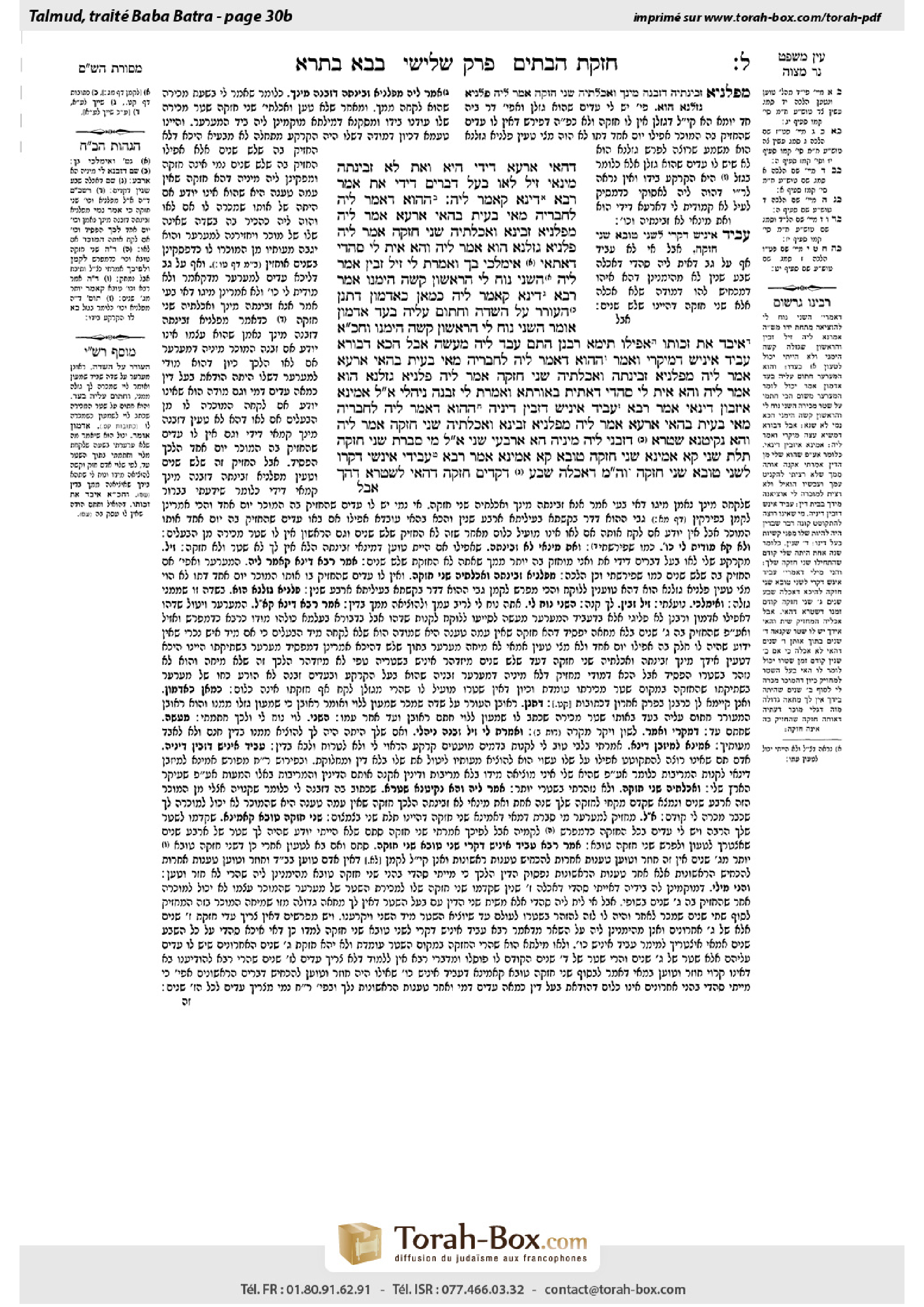
Bava Batra 30b: Talmud study for Daf Yomi
Study the Talmud for Daf Yomi with scanned pages, Hebrew text, English translations from Sefaria and AI-generated French translations.
Passage selection and English or AI-generated French translation are available where the scan has annotations. Daf Study is independent of Torah-Box and Sefaria.
Browse Bava Batra · בבא בתרא · All tractatesBava Batra 30b text and translations
This page of Bava Batra includes the Aramaic text, an English translation and an AI-generated French translation, alongside the scan above.
בבא בתרא ל׳ ב · Aramaic and Hebrew text
דְּהַאי אַרְעָא דִּידִי הִיא, וְאַתְּ לָא זְבֵינְתַּהּ מִינַּאי? זִיל, לָאו בַּעַל דְּבָרִים דִּידִי אַתְּ. אָמַר רָבָא: דִּינָא קָאָמַר לֵיהּ.
הָהוּא דְּאָמַר לֵיהּ לְחַבְרֵיהּ: מַאי בָּעֵית בְּהַאי אַרְעָא? אֲמַר לֵיהּ: מִפְּלָנְיָא זְבֵינְתַּהּ, וַאֲכַלְתִּיהָ שְׁנֵי חֲזָקָה. אֲמַר לֵיהּ: פְּלָנְיָא גַּזְלָנָא הוּא.
אֲמַר לֵיהּ: וְהָא אִית לִי סָהֲדִי דַּאֲתַאי אִימְּלַכִי בָּךְ, וַאֲמַרְתְּ לִי: ״זִיל זְבֹין״! אֲמַר לֵיהּ: הַשֵּׁנִי נוֹחַ לִי; הָרִאשׁוֹן קָשֶׁה הֵימֶנּוּ. אָמַר רָבָא: דִּינָא קָאָמַר לֵיהּ.
כְּמַאן, כְּאַדְמוֹן? דִּתְנַן: הָעוֹרֵר עַל הַשָּׂדֶה וְחָתוּם עָלֶיהָ בְּעֵד – אַדְמוֹן אוֹמֵר: הַשֵּׁנִי נוֹחַ לִי; הָרִאשׁוֹן קָשֶׁה הֵימֶנּוּ. וַחֲכָמִים אוֹמְרִים: אִיבֵּד אֶת זְכוּתוֹ.
אֲפִילּוּ תֵּימָא רַבָּנַן – הָתָם עֲבַד לֵיהּ מַעֲשֶׂה; אֲבָל הָכָא דִּבּוּרָא – עֲבִיד אִינִישׁ דְּמִיקְּרֵי וְאָמַר.
הָהוּא דְּאָמַר לֵיהּ לְחַבְרֵיהּ: מַאי בָּעֵית בְּהַאי אַרְעָא? אֲמַר לֵיהּ: מִפְּלָנְיָא זְבֵינְתַּהּ, וַאֲכַלְתִּיהָ שְׁנֵי חֲזָקָה. אֲמַר לֵיהּ: פְּלָנְיָא גַּזְלָנָא הוּא! אֲמַר לֵיהּ: וְהָא אִית לִי סָהֲדִי דַּאֲתֵית בְּאוּרְתָּא, וַאֲמַרְתְּ לִי: זַבְנַהּ נִיהֲלִי! אֲמַר לֵיהּ: אָמֵינָא אֶיזְבּוֹן דִּינַאי. אָמַר רָבָא: עֲבִיד אִינִישׁ דְּזָבֵין דִּינֵיהּ.
הָהוּא דַּאֲמַר לֵיהּ לְחַבְרֵיהּ: מַאי בָּעֵית בְּהַאי אַרְעָא? אֲמַר לֵיהּ: מִפְּלָנְיָא זְבֵינְתַּהּ, וַאֲכַלְתִּיהָ שְׁנֵי חֲזָקָה. אֲמַר לֵיהּ: וְהָא נְקִיטְנָא שְׁטָרָא דִּזְבַנִי לַיהּ מִינֵּיהּ הָא אַרְבְּעִי שְׁנֵי!
אֲמַר לֵיהּ: מִי סָבְרַתְּ ״שְׁנֵי חֲזָקָה״ – תְּלָת שְׁנֵי קָא אָמֵינָא?! שְׁנֵי חֲזָקָה טוּבָא קָא אָמֵינָא. אָמַר רָבָא: עֲבִידִי אִינָשֵׁי דְּקָרוּ לִשְׁנֵי טוּבָא ״שְׁנֵי חֲזָקָה״.
וְהָנֵי מִילֵּי דְּאַכְלַהּ שְׁבַע – דִּקְדֵים חֲזָקָה דְהַאי לִשְׁטָרָא דְהָךְ;
Bava Batra 30b · English translation
that this land is formerly mine, and that you did not purchase it from me? Go away; I am not legally answerable to you. Rava said: The claimant stated the halakha to the possessor, as this is a legitimate claim, and Rava accepted his claim.
There was a certain person who said to another: What do you want with this land of mine? The possessor said to him: I purchased it from so-and-so and then I worked and profited from it for the years necessary for establishing the presumption of ownership. The claimant said to him: So-and-so is a robber who robbed me of the field, and he did not have the authority to sell it to you.
The possessor said to him: But I have witnesses that I came and consulted with you, and you said to me: Go purchase the land, indicating that you conceded that he had the authority to sell it. The claimant said to him: The reason that I advised you to purchase it was because the second person, i.e., you, the possessor, is amenable to me, while the first, i.e., the purported thief, is more difficult than he, i.e., I prefer to litigate with you rather than with him. Rava said: The claimant stated the halakha to the possessor, as this is a legitimate claim, and Rava accepted his claim.
The Gemara asks: In accordance with whose opinion is Rava’s statement? Is it in accordance with the opinion of Admon? As we learned in a mishna (Ketubot 109a): With regard to one who contests ownership of a field, claiming that a field possessed by someone else actually belongs to him, and the claimant himself is signed as a witness on the bill of sale of the field to that other person, Admon says: His signature does not disprove his claim of ownership of the property, as it is possible that the claimant said to himself: The second person is amenable to me to deal with, as I can reason with him, while the first owner, who sold the field to the current possessor, is more difficult to deal with than he. And the Rabbis say: He lost his right to contest, as he signed a bill of sale that states that the field belongs to the possessor. Rava’s ruling appears to be in accordance with the individual opinion of Admon, and not with the opinion of the Rabbis.
The Gemara explains: You may even say that Rava’s ruling is in accordance with the opinion of the Rabbis. There, in the case of the mishna in tractate Ketubot, by signing the bill of sale the claimant performed an action indicating that the field was not his for the benefit of the possessor of the field, but here, in Rava’s case, there was no action, only speech, and a person is apt to casually say statements, and he does not lose his right by virtue of this.
There was a certain person who said to another: What do you want with this land of mine? The possessor said to him: I purchased it from so-and-so and then I worked and profited from it for the years necessary for establishing the presumption of ownership. The claimant said to him: So-and-so is a robber who robbed me of the field, and he did not have the authority to sell it to you. The possessor said to him: But I have witnesses that you came to me at night and you said to me: Sell it to me, indicating that it is not your land, as if it were yours, you would have demanded that I return it without your paying for it. The claimant said to him: I said to myself: Let me purchase the benefit of avoiding my litigation in order to reclaim my land. Rava said: A person is apt to pay money to purchase the benefit of avoiding his litigation.
There was a certain person who said to another: What do you want with this land of mine? The possessor said to him: I purchased it from so-and-so and then I worked and profited from it for the years necessary for establishing the presumption of ownership, indicating that he possessed it for three years, as this is the minimum number of years required for establishing the presumption of ownership. The claimant said to him: But I am holding a document stating that I purchased it from that seller four years ago. Therefore, if it was sold to you three years ago, as you claim, he did not have the authority to sell it at that time.
The possessor said to him: Do you maintain that when I said: I profited from the land for the years necessary for establishing the presumption of ownership, that I was saying I worked and profited from the land for precisely three years? What I actually was saying was that I worked and profited from the land for many years and thereby established the presumption of ownership. Since my purchase predated yours, it was effective. Rava said: It is common for people to refer to many years as: Years necessary for establishing the presumption of ownership, and his claim is accepted.
The Gemara comments: And this matter applies only if he profited from the land for seven years, so that presumptive ownership of this possessor preceded the document of that claimant.
Bava Batra 30b · Traduction française (IA)
Ce pays est à moi, et vous ne l'avez pas acheté de moi ? Retirez-vous ; je ne suis pas tenu légalement envers vous. Rava a dit : Le plaignant a déclaré la halakha au possesseur, car c'est une revendication légitime, et Rava a accepté sa revendication.
Il y avait un certain homme qui dit à un autre : À quoi bon ce terrain de la part de mon terrain ? Le possesseur dit à lui : J'ai acheté ce terrain à tel et ensuite j'ai travaillé et profité de lui pendant les années nécessaires pour établir la présomption d'ownership. Le plaignant dit à lui : Tel est un voleur qui a volé mon terrain, et il n'avait pas le pouvoir de le vendre à vous.
Le possesseur dit à lui : Mais j'ai des témoins qui m'ont dit que j'étais venu vous consulter, et vous avez dit à moi : Acheté ce terrain, ce qui indique que vous avez admis qu'il avait le pouvoir de le vendre. Le plaignant dit à lui : La raison pour laquelle j'ai conseillé d'acheter ce terrain est parce que le second, c'est-à-dire vous, le possesseur, est plus facile à moi, tandis que le premier, c'est-à-dire le prétendu voleur, est plus difficile que lui, et je préfère me battre avec vous plutôt qu'avec lui. Rava a dit : Le plaignant a déclaré la halakha au possesseur, car c'est une revendication légitime, et Rava a accepté sa revendication.
Le Guemara demande : Selon l'opinion de qui est l'affirmation de Rava ? Est-ce selon l'opinion d'Admon ? Comme nous avons appris dans une mitsva (Ketubot 109a) : En ce qui concerne celui qui conteste la propriété d'un terrain, affirmant que le terrain possédé par quelqu'un d'autre appartient en réalité à lui, et le plaignant lui-même est signataire comme témoin sur le contrat de vente du terrain à cette autre personne, Admon dit : Son signature ne contredit pas sa revendication de propriété, car il est possible que le plaignant ait pensé à lui-même : La deuxième personne est plus facile à moi pour traiter, car je peux raisonner avec lui, tandis que le premier propriétaire, qui a vendu le terrain au possesseur actuel, est plus difficile à traiter que lui. Et les Rabbins disent : Il a perdu son droit de contestation, car il a signé un contrat de vente indiquant que le terrain appartient au possesseur. L'arrêt de Rava semble être selon l'opinion individuelle d'Admon, et non selon l'opinion des Rabbins.
Le Guemara explique : On peut même dire que l'arrêt de Rava est selon l'opinion des Rabbins. Là, dans le cas de la mitsva dans le traité Ketubot, en signant le contrat de vente, le plaignant a accompli une action indiquant que le terrain n'était pas à lui pour le bénéfice du possesseur du terrain, mais ici, dans le cas de Rava, il n'y avait pas d'action, seulement un discours, et une personne est enclined à dire des paroles à la légère, et il ne perd pas son droit à cause de cela.
Il y avait un certain homme qui dit à un autre : À quoi bon ce terrain de la part de ton terrain ? Le possesseur dit à lui : J'ai acheté ce terrain à tel et ensuite j'ai travaillé et profité de lui pendant les années nécessaires pour établir la présomption d'ownership. Le plaignant dit à lui : Tel est un voleur qui a volé mon terrain, et il n'avait pas le pouvoir de le vendre à vous. Le possesseur dit à lui : Mais j'ai des témoins qui m'ont dit que vous êtes venu à moi la nuit et que vous avez dit à moi : Vends-le-moi, ce qui indique que ce n'est pas ton terrain, comme si c'était à toi, tu aurais demandé que je te le rende sans que tu ne payes pour cela. Le plaignant dit à lui : J'ai pensé à moi-même : Laisse-moi acheter le bénéfice d'éviter ma procédure pour récupérer mon terrain. Rava a dit : Une personne est enclined à payer de l'argent pour acheter le bénéfice d'éviter sa procédure.
Il y avait un certain homme qui dit à un autre : À quoi bon ce terrain de la part de ton terrain ? Le possesseur dit à lui : J'ai acheté ce terrain à tel et ensuite j'ai travaillé et profité de lui pendant les années nécessaires pour établir la présomption d'ownership, ce qui indique qu'il l'avait possédé pendant trois ans, car c'est le nombre minimum d'années requis pour établir la présomption d'ownership. Le plaignant dit à lui : Mais j'ai un document indiquant que j'ai acheté ce terrain à ce vendeur il y a quatre ans. Donc, si ce terrain a été vendu à vous il y a trois ans, comme vous le dites, ce vendeur n'avait pas le pouvoir de le vendre à ce moment-là.
Le possesseur lui dit : Vous affirmez-vous que lorsque j'ai dit : J'ai profité du terrain pendant les années nécessaires pour établir la présomption d'ownership, j'ai voulu dire que j'ai travaillé et profité du terrain pendant exactement trois ans ? Ce que j'ai vraiment dit, c'est que j'ai travaillé et profité du terrain pendant de nombreuses années et que c'est ainsi que j'ai établi la présomption d'ownership. Puisque mon achat a précédé le vôtre, il était valide. Rava dit : Il est courant que les gens fassent référence à de nombreuses années comme : Les années nécessaires pour établir la présomption d'ownership, et sa revendication est acceptée.
Le Guemara commente : Et cette affaire s'applique uniquement si l'on a profité du terrain pendant sept ans, de sorte que la présomption d'ownership de ce possesseur a précédé le document du plaignant.
Traduction française générée par IA à partir de l’édition anglaise de Sefaria. Vérifie toujours un passage avec le texte source.
Text from Sefaria: William Davidson Edition - Vocalized Aramaic (CC BY NC); William Davidson Edition - English (CC BY NC).