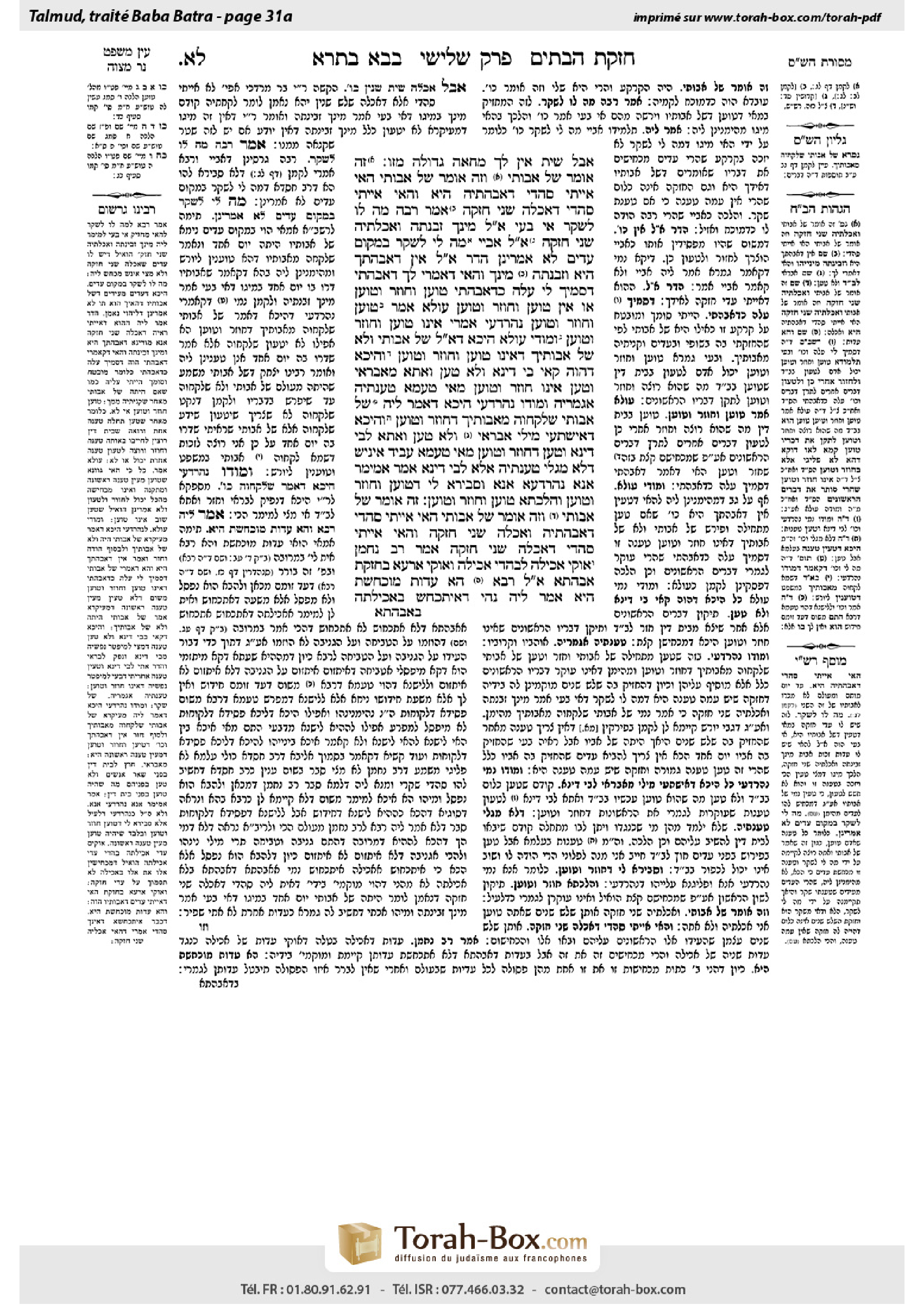
Bava Batra 31a: Talmud study for Daf Yomi
Study the Talmud for Daf Yomi with scanned pages, Hebrew text, English translations from Sefaria and AI-generated French translations.
Passage selection and English or AI-generated French translation are available where the scan has annotations. Daf Study is independent of Torah-Box and Sefaria.
Browse Bava Batra · בבא בתרא · All tractatesBava Batra 31a text and translations
This page of Bava Batra includes the Aramaic text, an English translation and an AI-generated French translation, alongside the scan above.
בבא בתרא ל״א א · Aramaic and Hebrew text
אֲבָל שֵׁית – אֵין לְךָ מֶחָאָה גְּדוֹלָה מִזּוֹ.
זֶה אוֹמֵר: ״שֶׁל אֲבוֹתַי״, וְזֶה אוֹמֵר: ״שֶׁל אֲבוֹתַי״; הַאי אַיְיתִי סָהֲדֵי דַּאֲבָהָתֵיהּ הִיא, וְהַאי אַיְיתִי סָהֲדֵי דְּאַכְלַהּ שְׁנֵי חֲזָקָה –
אָמַר רַבָּה: מָה לוֹ לְשַׁקֵּר? אִי בָּעֵי אֲמַר לֵיהּ: מִינָּךְ זְבֵנְתַּהּ וַאֲכַלְתִּיהָ שְׁנֵי חֲזָקָה. אֲמַר לֵיהּ אַבָּיֵי: ״מָה לִי לְשַׁקֵּר״ בִּמְקוֹם עֵדִים – לָא אָמְרִינַן.
הֲדַר אֲמַר לֵיהּ: אִין, דַּאֲבָהָתָךְ הִיא – וּזְבֵנְתַּהּ מִינָּךְ; וְהַאי דַּאֲמַרִי לָךְ דַּאֲבָהָתִי, דִּסְמִיךְ לִי עֲלַהּ כְּדַאֲבָהָתִי.
טוֹעֵן וְחוֹזֵר וְטוֹעֵן, אוֹ אֵין טוֹעֵן וְחוֹזֵר וְטוֹעֵן? עוּלָּא אָמַר: טוֹעֵן וְחוֹזֵר וְטוֹעֵן. נְהַרְדָּעֵי אָמְרִי: אֵינוֹ טוֹעֵן וְחוֹזֵר וְטוֹעֵן.
וּמוֹדֵי עוּלָּא הֵיכָא דַּאֲמַר לֵיהּ: שֶׁל אֲבוֹתַי וְלֹא שֶׁל אֲבוֹתֶיךָ – דְּאֵינוֹ טוֹעֵן וְחוֹזֵר וְטוֹעֵן. וְהֵיכָא דַּהֲוָה קָאֵי בֵּי דִינָא וְלָא טְעַן, וַאֲתָא מֵאַבָּרַאי וּטְעַן – אֵינוֹ חוֹזֵר וְטוֹעֵן. מַאי טַעְמָא? טַעְנְתֵיהּ אַגְמְרֵיהּ.
וּמוֹדוּ נְהַרְדָּעֵי הֵיכָא דַּאֲמַר לֵיהּ: שֶׁל אֲבוֹתַי שֶׁלְּקָחוּהָ מֵאֲבוֹתֶיךָ – דְּחוֹזֵר וְטוֹעֵן. וְהֵיכָא דְּאִישְׁתַּעִי מִילֵּי אַבָּרַאי וְלָא טְעַן, וַאֲתָא לְבֵי דִינָא וּטְעַן – דְּחוֹזֵר וְטוֹעֵן. מַאי טַעְמָא? עֲבִיד אִינִישׁ דְּלָא מְגַלֵּי טַעְנְתֵיהּ אֶלָּא לְבֵי דִינָא.
אָמַר אַמֵּימָר: אֲנָא נְהַרְדָּעָא אֲנָא, וּסְבִירָא לִי דְּטוֹעֵן וְחוֹזֵר וְטוֹעֵן. וְהִלְכְתָא: טוֹעֵן וְחוֹזֵר וְטוֹעֵן.
זֶה אוֹמֵר: שֶׁל אֲבוֹתַי, וְזֶה אוֹמֵר: שֶׁל אֲבוֹתַי; הַאי אַיְיתִי סָהֲדֵי דַּאֲבָהָתֵיהּ וְאַכְלַהּ שְׁנֵי חֲזָקָה, וְהַאי אַיְיתִי סָהֲדֵי דְּאַכְלַהּ שְׁנֵי חֲזָקָה.
אָמַר רַב נַחְמָן: אוֹקִי אֲכִילָה לְבַהֲדֵי אֲכִילָה, וְאוֹקִי אַרְעָא בְּחֶזְקַת אֲבָהָתָא. אֲמַר לֵיהּ רָבָא: הָא עֵדוּת מוּכְחֶשֶׁת הִיא! אֲמַר לֵיהּ: נְהִי דְּאִיתַּכְחַשׁ בַּאֲכִילְתָה,
Bava Batra 31a · English translation
But if he profited from the land for only six years, so that the sale to the claimant took place before the years necessary for establishing the presumption of ownership were completed, you can have no greater protest than this, that the purported seller then sold the land to another. By doing so he indicated that he does not concede that the possessor was the rightful owner, and the possessor should have been careful to hold on to his bill of sale for even longer than three years.
There was an incident where two people disputed the ownership of land. This one says: The land belonged to my ancestors and I inherited it from them, and that one says: The land belonged to my ancestors and I inherited it from them. This one brings witnesses that the land belonged to his ancestors, and that one brings witnesses that he currently possesses the land and that he worked and profited from the land for the years necessary for establishing the presumption of ownership.
Rabba said: The judgment is in favor of the possessor, due to the legal principle that if the judgment would have been decided in one’s favor had he advanced a certain claim, and he instead advanced a different claim that leads to the same ruling, he has credibility, as why would he lie and state this claim? If the possessor wanted to lie, he could have said to the claimant: I purchased the land from you and I worked and profited from it for the years necessary for establishing the presumption of ownership, in which case he would have been awarded the land. Abaye said to Rabba: We do not say the principle of: Why would I lie, in a case where there are witnesses contradicting his current claim, as they testify that the land belonged to the ancestors of the claimant. Therefore, he should not be awarded the land.
The possessor then said to the claimant: Yes, it is true that it had belonged to your ancestors, but I purchased it from you, and by stating that which I said to you: It belonged to my ancestors, I merely meant that I rely upon my ownership of it as if it belonged to my ancestors, as I purchased it and then profited from it for the years necessary for establishing the presumption of ownership.
The Gemara asks: Can he state a claim and return and state a modified version of his claim, or can he not state a claim and return and state a modified version of his claim? Ulla said: He can state a claim and return and state a modified version of his claim. The Sages of Neharde’a say: He cannot state a claim and return and state a modified version of his claim.
The Gemara clarifies their respective opinions: And Ulla concedes that in a case where he had initially said to him: The land belonged to my ancestors and did not belong to your ancestors, that he cannot state a claim and return and state a modified version of his claim, as Ulla allows the litigant only to reinterpret his initial claim, not to replace it with a contradictory claim. And Ulla also concedes that in a case where he was standing in court and did not state a particular claim, and he later came in from outside and back into the court and he stated that claim, that he cannot return and state that claim. What is the reason for this? It is because it is apparent that these claims of his were taught to him by someone after he left the court.
And the Sages of Neharde’a concede that in a case where the litigant who changed his claim said to the other litigant that when he had initially claimed: The land belonged to my ancestors, he had actually meant: It belonged to my ancestors, who purchased it from your ancestors, that he can state a claim and return and state a modified version of his claim, as this serves only to clarify, and not negate, his initial claim. And the Sages of Neharde’a also concede that in a case where he discussed the matter outside of the court and did not state a particular claim, and then he came in to the court and stated that claim, that he can return and state that claim. What is the reason for this? Because a person is apt not to reveal his claims except to the court.
Ameimar said: I am from Neharde’a, but I nevertheless hold that a litigant can state a claim and return and state a modified version of his claim. The Gemara concludes: And the halakha is that a litigant can state a claim and return and state a modified version of his claim.
In an incident where two people dispute the ownership of land, this one says: The land belonged to my ancestors and I inherited it from them, and that one says: The land belonged to my ancestors and I inherited it from them. The first one brings witnesses that the land belonged to his ancestors, and that he worked and profited from the land for the years necessary for establishing the presumption of ownership. And the second one brings witnesses only that he worked and profited from the land for the years necessary for establishing the presumption of ownership.
Rav Naḥman said: Establish the testimony with regard to the profiting by the first litigant alongside the testimony with regard to the profiting by the second, and the two testimonies cancel each other out, leaving the testimony with regard to ownership by the ancestors of the first litigant. And therefore, establish the land in the presumptive ownership of the litigant who brought witnesses that it belonged to his ancestors. Rava objected and said to him: This testimony cannot be relied on, as it is contradicted by the other testimony. Rav Naḥman responded and said to him: Although it is so that the testimony was contradicted with regard to profiting from the land,
Bava Batra 31a · Traduction française (IA)
Mais si l'homme a tiré profit du terrain pendant seulement six ans, de sorte que la vente au prétendant s'est produite avant les années nécessaires pour établir la présomption d'ownership, vous ne pouvez avoir qu'une protestation aussi forte que celle-ci, à savoir que le vendeur prétendu a alors vendu le terrain à un autre. En le faisant, il a indiqué qu'il ne reconnaît pas que le possesseur était le propriétaire légitime, et le possesseur aurait dû être vigilant pour conserver son acte de vente pendant plus de trois ans.
Il y avait un incident où deux personnes disputaient la propriété d'un terrain. L'une disait : Ce terrain appartenait à mes ancêtres et j'ai hérité de lui, et l'autre disait : Ce terrain appartenait à mes ancêtres et j'ai hérité de lui. L'une présente des témoins selon lesquels le terrain appartenait à ses ancêtres, et l'autre présente des témoins selon lesquels il possède actuellement le terrain et qu'il a travaillé et tiré profit du terrain pendant les années nécessaires pour établir la présomption d'ownership.
Rabba dit : La décision est en faveur du possesseur, en vertu du principe juridique selon lequel si la décision aurait été rendue en son faveur s'il avait formulé une certaine revendication, et qu'il a au contraire formulé une autre revendication qui mène à la même décision, il a de la crédibilité, car pourquoi ment-il en affirmant cette revendication ? Si le possesseur voulait mentir, il aurait pu dire au prétendant : J'ai acheté le terrain de vous et j'ai travaillé et tiré profit de lui pendant les années nécessaires pour établir la présomption d'ownership, dans ce cas il aurait été récompensé du terrain. Abaye dit à Rabba : Nous ne disons pas le principe de : Pourquoi ment-il, dans un cas où il y a des témoins qui contredisent sa revendication actuelle, car ils témoignent que le terrain appartenait aux ancêtres du prétendant. Ainsi, il ne devrait pas être récompensé du terrain.
Le possesseur dit alors au prétendant : Oui, c'est vrai qu'il appartenait à vos ancêtres, mais j'ai acheté le terrain de vous, et en disant ce que j'ai dit à vous : Il appartenait à mes ancêtres, j'entends simplement dire que je fais confiance à ma propriété comme si elle appartenait à mes ancêtres, car j'ai acheté le terrain et j'ai ensuite profité de lui pendant les années nécessaires pour établir la présomption d'appartenance.
La Guemara pose la question : Peut-il présenter une revendication, puis revenir et présenter une version modifiée de sa revendication, ou ne peut-il pas présenter une revendication, puis revenir et présenter une version modifiée de sa revendication ? Ulla dit : Il peut présenter une revendication, puis revenir et présenter une version modifiée de sa revendication. Les Sages de Neharde’a disent : Il ne peut pas présenter une revendication, puis revenir et présenter une version modifiée de sa revendication.
La Guemara clarifie leurs opinions respectives : Et Ulla reconnaît que dans un cas où il avait initialement dit à lui : Le terrain appartenait à mes ancêtres et n'appartenait pas à vos ancêtres, il ne peut pas présenter une revendication, puis revenir et présenter une version modifiée de sa revendication, car Ulla permet au litigeur de modifier seulement sa revendication initiale, pas de la remplacer par une revendication contradictoire. Et Ulla reconnaît également que dans un cas où il était en cour et n'avait pas formulé une certaine revendication, et qu'il est ensuite revenu de l'extérieur et est entré à nouveau en cour et a formulé cette revendication, il ne peut pas revenir et formuler cette revendication. Quelle est la raison de cela ? C'est parce que ces revendications de lui ont été apprises par quelqu'un après qu'il ait quitté la cour.
Et les Sages de Neharde’a reconnaissent que dans un cas où le litigeur qui a modifié sa revendication a dit à l'autre litigeur que lorsqu'il avait initialement revendiqué : Le terrain appartenait à mes ancêtres, il avait en réalité voulu dire : Il appartenait à mes ancêtres, qui l'ont acheté de vos ancêtres, il peut présenter une revendication, puis revenir et présenter une version modifiée de sa revendication, car cela sert seulement à clarifier, et non à annuler, sa revendication initiale. Et les Sages de Neharde’a reconnaissent également que dans un cas où il a discuté de la question en dehors de la cour et n'a pas formulé une certaine revendication, et qu'il est ensuite entré en cour et a formulé cette revendication, il peut revenir et formuler cette revendication. Quelle est la raison de cela ? Parce qu'une personne n'est pas enclined à révéler ses revendications qu'à la cour.
Ameimar dit : Je suis de Neharde’a, mais je maintiens toutefois que le litigeur peut présenter une revendication, puis revenir et présenter une version modifiée de sa revendication. La Guemara conclut : Et la halakha est que le litigeur peut présenter une revendication, puis revenir et présenter une version modifiée de sa revendication.
Dans un incident où deux personnes disputent la propriété d'un terrain, l'une dit : Le terrain appartenait à mes ancêtres et j'ai hérité de lui, et l'autre dit : Le terrain appartenait à mes ancêtres et j'ai hérité de lui. Le premier présente des témoins selon lesquels le terrain appartenait à ses ancêtres, et qu'il a travaillé et tiré profit du terrain pendant les années nécessaires pour établir la présomption de propriété. Et le second présente des témoins seulement selon lesquels il a travaillé et tiré profit du terrain pendant les années nécessaires pour établir la présomption de propriété.
Rav Naḥman dit : Établir le témoignage concernant le profit du premier litigeur en parallèle avec le témoignage concernant le profit du second, et les deux témoignages s'annulent mutuellement, laissant le témoignage concernant la propriété par les ancêtres du premier litigeur. Ainsi, établir le terrain en faveur de la présomption de propriété du litigeur qui a présenté des témoins selon lesquels il appartenait à ses ancêtres. Rava s'est opposé et a dit à lui : Ce témoignage ne peut pas être considéré comme fiable, car il est contredit par l'autre témoignage. Rav Naḥman a répondu et a dit à lui : Bien que ce soit vrai que le témoignage ait été contredit concernant le profit du terrain,
Traduction française générée par IA à partir de l’édition anglaise de Sefaria. Vérifie toujours un passage avec le texte source.
Text from Sefaria: William Davidson Edition - Vocalized Aramaic (CC BY NC); William Davidson Edition - English (CC BY NC).