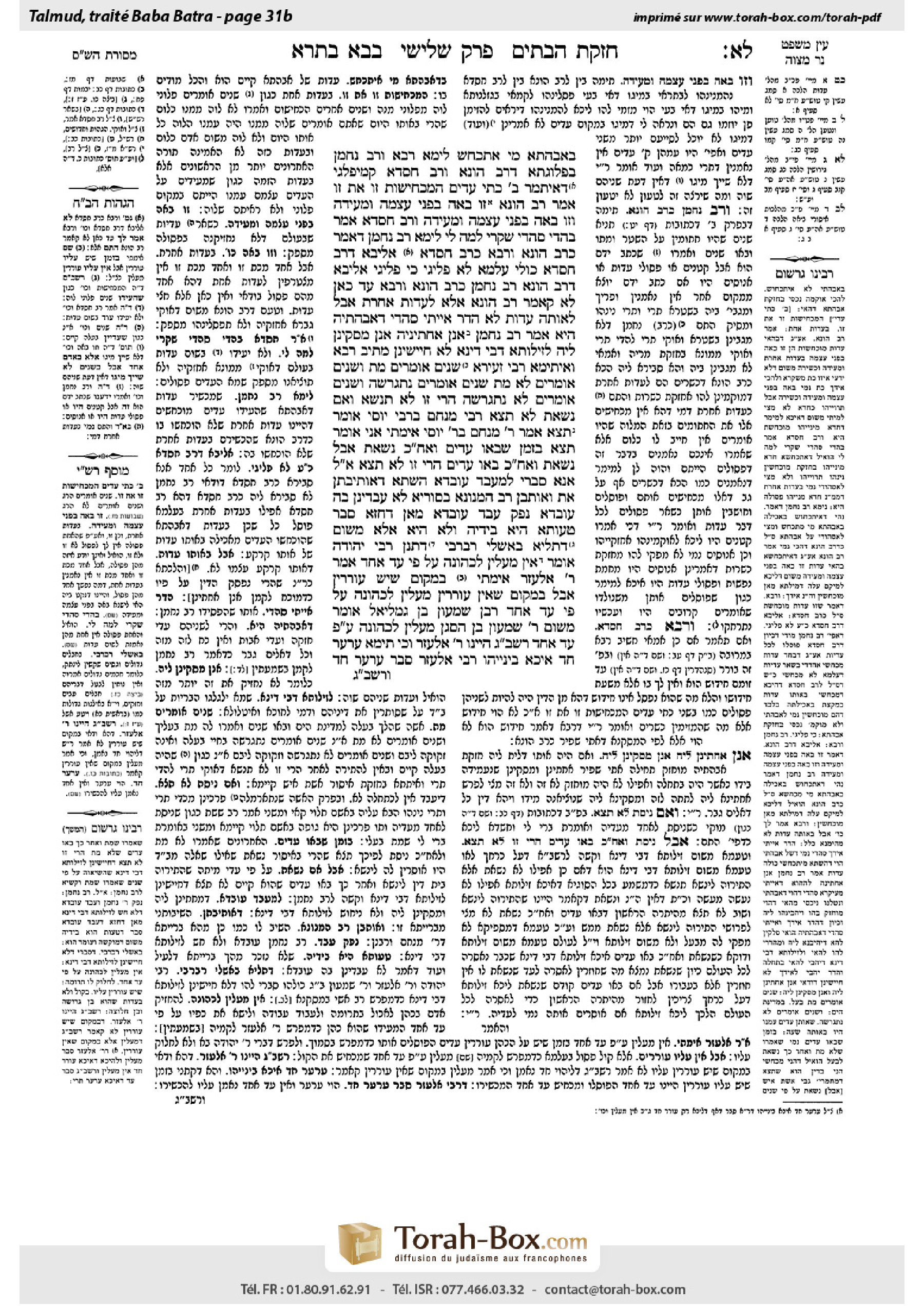
Bava Batra 31b: Talmud study for Daf Yomi
Study the Talmud for Daf Yomi with scanned pages, Hebrew text, English translations from Sefaria and AI-generated French translations.
Passage selection and English or AI-generated French translation are available where the scan has annotations. Daf Study is independent of Torah-Box and Sefaria.
Browse Bava Batra · בבא בתרא · All tractatesBava Batra 31b text and translations
This page of Bava Batra includes the Aramaic text, an English translation and an AI-generated French translation, alongside the scan above.
בבא בתרא ל״א ב · Aramaic and Hebrew text
בַּאֲבָהָתָא מִי אִתַּכְחַשׁ?!
לֵימָא רָבָא וְרַב נַחְמָן – בִּפְלוּגְתָּא דְּרַב הוּנָא וְרַב חִסְדָּא קָמִיפַּלְגִי?
דְּאִיתְּמַר: שְׁתֵּי כִּתֵּי עֵדִים הַמַּכְחִישׁוֹת זוֹ אֶת זוֹ – אָמַר רַב הוּנָא: זוֹ בָּאָה בִּפְנֵי עַצְמָהּ וּמְעִידָה, וְזוֹ בָּאָה בִּפְנֵי עַצְמָהּ וּמְעִידָה. וְרַב חִסְדָּא אָמַר: בַּהֲדֵי סָהֲדֵי שַׁקָּרֵי לְמָה לִי? לֵימָא רַב נַחְמָן – דְּאָמַר כְּרַב הוּנָא, וְרָבָא כְּרַב חִסְדָּא?
אַלִּיבָּא דְּרַב חִסְדָּא – כּוּלֵּי עָלְמָא לָא פְלִיגִי, כִּי פְּלִיגִי – אַלִּיבָּא דְרַב הוּנָא. רַב נַחְמָן – כְּרַב הוּנָא. וְרָבָא – עַד כָּאן לָא קָאָמַר רַב הוּנָא אֶלָּא לְעֵדוּת אַחֶרֶת, אֲבָל לְאוֹתָהּ עֵדוּת – לָא.
הֲדַר אַיְיתִי סָהֲדֵי דַּאֲבָהָתֵיהּ הִיא. אָמַר רַב נַחְמָן: אֲנַן אַחֲתִינֵּיהּ, אֲנַן מַסְּקִינַן לֵיהּ; לְזִילוּתָא דְבֵי דִינָא לָא חָיְישִׁינַן.
מֵתִיב רָבָא, וְאִיתֵּימָא רַבִּי זְעֵירָא: שְׁנַיִם אוֹמְרִים מֵת, וּשְׁנַיִם אוֹמְרִים לָא מֵת; שְׁנַיִם אוֹמְרִים נִתְגָּרְשָׁה, וּשְׁנַיִם אוֹמְרִים לֹא נִתְגָּרְשָׁה – הֲרֵי זוֹ לֹא תִּנָּשֵׂא, וְאִם נִשֵּׂאת לֹא תֵּצֵא. רַבִּי מְנַחֵם בְּרַבִּי יוֹסֵי אוֹמֵר: תֵּצֵא.
אָמַר רַבִּי מְנַחֵם בְּרַבִּי יוֹסֵי: אֵימָתַי אֲנִי אוֹמֵר תֵּצֵא – בִּזְמַן שֶׁבָּאוּ עֵדִים וְאַחַר כָּךְ נִשֵּׂאת; אֲבָל נִשֵּׂאת וְאַחַר כָּךְ בָּאוּ עֵדִים – הֲרֵי זוֹ לֹא תֵּצֵא.
אֲמַר לֵיהּ: אֲנָא סְבַרִי לְמֶעְבַּד עוֹבָדָא; הַשְׁתָּא דְּאוֹתֵיבְתַּן אַתְּ, וְאוֹתְבַן רַב הַמְנוּנָא בְּסוּרְיָא – לָא עָבֵידְנָא בַּהּ עוֹבָדָא.
נְפַק עֲבַד עוֹבָדָא. מַאן דַּחֲזָא, סָבַר: טָעוּתָא הִיא בִּידֵיהּ; וְלָא הִיא, אֶלָּא מִשּׁוּם דְּתַלְיָא בְּאַשְׁלֵי רַבְרְבֵי –
דִּתְנַן, רַבִּי יְהוּדָה אוֹמֵר: אֵין מַעֲלִין לַכְּהוּנָּה עַל פִּי עֵד אֶחָד. אָמַר רַבִּי אֶלְעָזָר: אֵימָתַי – בִּמְקוֹם שֶׁיֵּשׁ עוֹרְרִין, אֲבָל בִּמְקוֹם שֶׁאֵין עוֹרְרִין – מַעֲלִין לַכְּהוּנָּה עַל פִּי עֵד אֶחָד. רַבָּן שִׁמְעוֹן בֶּן גַּמְלִיאֵל אוֹמֵר מִשּׁוּם רַבִּי שִׁמְעוֹן בֶּן הַסְּגָן: מַעֲלִין לַכְּהוּנָּה עַל פִּי עֵד אֶחָד.
רַבָּן שִׁמְעוֹן בֶּן גַּמְלִיאֵל הַיְינוּ רַבִּי אֶלְעָזָר! וְכִי תֵּימָא: עַרְעָר חַד אִיכָּא בֵּינַיְיהוּ – רַבִּי אֶלְעָזָר סָבַר: עַרְעָר חַד,
Bava Batra 31b · English translation
was the testimony contradicted with regard to ownership of the ancestors?
The Gemara asks: Shall we say that Rava and Rav Naḥman disagree in the dispute between Rav Huna and Rav Ḥisda?
As it was stated concerning two groups of witnesses that contradict each other, that Rav Huna says: This one comes to court on its own and testifies, and that one comes to court on its own and testifies. Despite the fact that one group certainly testified falsely, which should serve to disqualify one of the groups, each group is able to testify in another case. And Rav Ḥisda says: Why do I need these lying witnesses? In other words, they are all disqualified to testify in another case until it is clarified which of them had testified falsely. The Gemara asks: Shall we say that Rav Naḥman is the one who says his ruling in accordance with the opinion of Rav Huna, and Rava says his ruling in accordance with the opinion of Rav Ḥisda?
The Gemara explains: According to the opinion of Rav Ḥisda, who holds that the witnesses are disqualified, everyone agrees that the testimony concerning ancestral ownership is not accepted, as the witnesses were contradicted concerning their testimony of usage of the land, and Rav Naḥman’s ruling cannot accord with his opinion. When Rav Naḥman and Rava disagree it is according to the opinion of Rav Huna, who does not disqualify the witnesses. The ruling of Rav Naḥman is in accordance with the opinion of Rav Huna, and he therefore accepts the testimony with regard to ancestral ownership, and Rava would say: Rav Huna says that the witnesses are accepted only for another testimony, i.e., in a different case. But they are not accepted for the same testimony, as in this incident, where both testimonies concerned ownership of the same land.
The Gemara relates the continuation of the case above. The one who had brought witnesses only to his having profited from the land then brought witnesses that it had belonged to his ancestors, thereby balancing the evidence for the two litigants. Therefore, Rav Naḥman said: We previously brought down to the land the one who initially had evidence of ancestral ownership to take possession of it, and we now bring him up from it, removing him from the land. And we are not concerned about the possible contempt of court that might result from perceived indecisiveness.
Rava, and some say it is Rabbi Zeira, raises an objection from a baraita. If there was a married man whose fate was unknown, and two witnesses say: This married man died, and two witnesses say: He did not die; or if two witnesses say: This woman was divorced, and two witnesses say: She was not divorced, this woman may not marry, as there is not unequivocal testimony that she is no longer married, but if she marries, the marriage is valid and she need not leave her husband. Rabbi Menaḥem, son of Rabbi Yosei, says: She must leave her husband.
Rabbi Menaḥem, son of Rabbi Yosei, said: When do I say that she must leave her husband? She must leave him in a case where witnesses came to testify that she is still married and she then married despite their testimony. But if she married and the witnesses then came to testify that she is still married, this woman is not required to leave her husband based on the uncertainty created by contradictory witnesses. The fact that she is not required to leave her marriage in light of the new testimony seems to indicate an unwillingness to reverse the court’s ruling that she may marry, contrary to the ruling of Rav Naḥman.
Rav Naḥman said to him: I had thought to perform an action and reverse the court’s ruling, but now that you raised an objection against me, and Rav Hamnuna also raised a similar objection against me in Syria, I will not perform an action in this matter.
The Gemara relates that Rav Naḥman then went out and performed an action, taking away the land from the litigant in whose favor he had previously ruled. One who saw what he did thought that he made a mistake, but that is not so. Rather, he performed an action despite the objections that had been raised because the matter depends on great authorities [ashlei ravrevei]. Since, as the Gemara will demonstrate, this issue is subject to dispute between great authorities, he relied on those that supported his opinion.
As we learned in a mishna (Ketubot 23b): Rabbi Yehuda says: One is not elevated to the presumptive status of priesthood on the basis of the testimony of one witness. Two witnesses are required for that purpose. Rabbi Elazar says: When is that the halakha? In a case where there are challengers to his claim that he is a priest. But in a case where there are no challengers, one is elevated to the presumptive status of priesthood on the basis of the testimony of one witness. Rabban Shimon Ben Gamliel says in the name of Rabbi Shimon, son of the deputy High Priest: One is elevated to the presumptive status of priesthood on the basis of the testimony of one witness.
The Gemara asks: The opinion of Rabban Shimon Ben Gamliel is identical to the opinion of Rabbi Elazar, as they agree that one is elevated to the presumptive status of priesthood on the basis of one witness when there are no challengers. What is their dispute? And if you would say that there is a practical difference between them in a case where there is a challenge posed by one person, as Rabbi Elazar holds: A challenge posed by one person is sufficient to undermine one’s presumptive status of priesthood, and two witnesses are required to overcome that challenge;
Bava Batra 31b · Traduction française (IA)
Le témoignage a-t-il été contredit concernant l'appartenance aux ancêtres ?
Le Guemara demande : devons-nous dire que Rava et Rav Naḥman sont en désaccord dans le débat entre Rav Huna et Rav Ḥisda ?
Comme il a été dit concernant deux groupes de témoins qui s'opposent, Rav Huna dit : celui-ci vient devant le tribunal seul et témoigne, et celui-là vient devant le tribunal seul et témoigne. Malgré le fait qu'un groupe a certainement témoigné faussement, ce qui devrait servir à disqualifier l'un des groupes, chaque groupe peut témoigner dans un autre cas. Et Rav Ḥisda dit : pourquoi ai-je besoin de ces témoins menteurs ? Autrement dit, ils sont tous disqualifiés pour témoigner dans un autre cas jusqu'à ce qu'il soit clarifié lequel d'entre eux a témoigné faussement. Le Guemara demande : devons-nous dire que Rav Naḥman est celui qui dit son jugement selon l'opinion de Rav Huna, et Rava dit son jugement selon l'opinion de Rav Ḥisda ?
Le Guemara explique : selon l'opinion de Rav Ḥisda, qui considère que les témoins sont disqualifiés, tout le monde convient que le témoignage concernant la propriété des ancêtres n'est pas accepté, car les témoins ont été contredits concernant leur témoignage sur l'utilisation de la terre, et la décision de Rav Naḥman ne peut pas correspondre à son opinion. Lorsque Rav Naḥman et Rava sont en désaccord, c'est selon l'opinion de Rav Huna, qui ne disqualifie pas les témoins. La décision de Rav Naḥman est selon l'opinion de Rav Huna, et il accepte donc le témoignage concernant la propriété des ancêtres, et Rava dirait : Rav Huna dit que les témoins sont acceptés uniquement pour un autre témoignage, c'est-à-dire dans un autre cas. Mais ils ne sont pas acceptés pour le même témoignage, comme dans ce cas-ci, où les deux témoignages concernaient la propriété de la même terre.
Le Guemara rapporte la continuation du cas ci-dessus. Celui qui avait apporté des témoins uniquement pour son profit sur la terre a ensuite apporté des témoins selon la propriété de ses ancêtres, équilibrant ainsi les preuves pour les deux parties en litige. Par conséquent, Rav Naḥman a dit : nous avions précédemment fait descendre la terre à celui qui avait initialement des preuves de propriété des ancêtres pour qu'il prenne possession, et nous faisons maintenant monter celui-ci de la terre, le retirant de la terre. Et nous ne nous inquiétons pas de la possible contenance du tribunal qui pourrait résulter d'une indécision perçue.
Rava, et certains disent que c'est Rabbi Zeira, émet un objet contre une baraïta. Si un homme marié dont le sort était inconnu, et deux témoins disent : cet homme marié est mort, et deux témoins disent : il n'est pas mort ; ou si deux témoins disent : cette femme a été divorcée, et deux témoins disent : elle n'a pas été divorcée, cette femme ne peut pas se marier, car il n'y a pas de témoignage indubitable qu'elle n'est plus mariée, mais si elle se marie, le mariage est valide et elle n'a pas besoin de quitter son mari. Rabbi Menaḥem, fils de Rabbi Yosei, dit : elle doit quitter son mari.
Rabbi Menaḥem, fils de Rabbi Yosei, a dit : quand dis-je qu'elle doit quitter son mari ? Elle doit le quitter dans le cas où des témoins sont venus témoigner qu'elle est encore mariée et elle s'est mariée malgré leur témoignage. Mais si elle s'est mariée et les témoins sont ensuite venus témoigner qu'elle est encore mariée, cette femme n'est pas tenue de quitter son mari en raison de l'incertitude créée par les témoins contradictoires. Le fait qu'elle ne soit pas tenue de quitter son mariage en raison du nouveau témoignage semble indiquer une réticence à inverser le jugement du tribunal selon lequel elle peut se marier, contraire au jugement de Rav Naḥman.
Rav Naḥman a dit à lui : j'avais pensé agir et inverser le jugement du tribunal, mais maintenant que vous avez soulevé une objection contre moi, et Rav Hamnuna a également soulevé une objection similaire contre moi en Syrie, je ne vais pas agir dans cette affaire.
Le Guemara rapporte que Rav Naḥman est ensuite sorti et a agi, enlevant la terre à la partie en litige dont il avait précédemment rendu un jugement. Celui qui a vu ce qu'il a fait a pensé qu'il avait fait une erreur, mais ce n'est pas le cas. Plutôt, il a agi malgré les objections soulevées, car l'affaire dépend de grands maîtres [ashlei ravrevei]. Comme le Guemara le montrera, cette question est sujette à débat entre des grands maîtres, il s'est appuyé sur ceux qui soutenaient son opinion.
Comme nous avons appris dans une mitsva (Ketubot 23b) : Rabbi Yehuda dit : on n'est pas élevé au statut présomptif de prêtrise sur la base du témoignage d'un seul témoin. Deux témoins sont requis à cet effet. Rabbi Elazar dit : quand est-ce que cette halakha s'applique ? Dans un cas où il y a des contestataires à son affirmation qu'il est un prêtre. Mais dans un cas où il n'y a pas de contestataires, on est élevé au statut présomptif de prêtrise sur la base du témoignage d'un seul témoin. Rabban Shimon Ben Gamliel dit en nom de Rabbi Shimon, fils du sous-prêtre principal : on est élevé au statut présomptif de prêtrise sur la base du témoignage d'un seul témoin.
Le Guemara demande : l'opinion de Rabban Shimon Ben Gamliel est identique à l'opinion de Rabbi Elazar, car ils s'accordent sur le fait qu'on est élevé au statut présomptif de prêtrise sur la base d'un seul témoin lorsqu'il n'y a pas de contestataires. Quel est leur débat ? Et si vous dites qu'il y a une différence pratique entre eux dans un cas où il y a une contestation d'un seul individu, comme Rabbi Elazar dit : une contestation d'un seul individu est suffisante pour discréditer le statut présomptif de prêtrise, et deux témoins sont requis pour surmonter cette contestation ;
Traduction française générée par IA à partir de l’édition anglaise de Sefaria. Vérifie toujours un passage avec le texte source.
Text from Sefaria: William Davidson Edition - Vocalized Aramaic (CC BY NC); William Davidson Edition - English (CC BY NC).