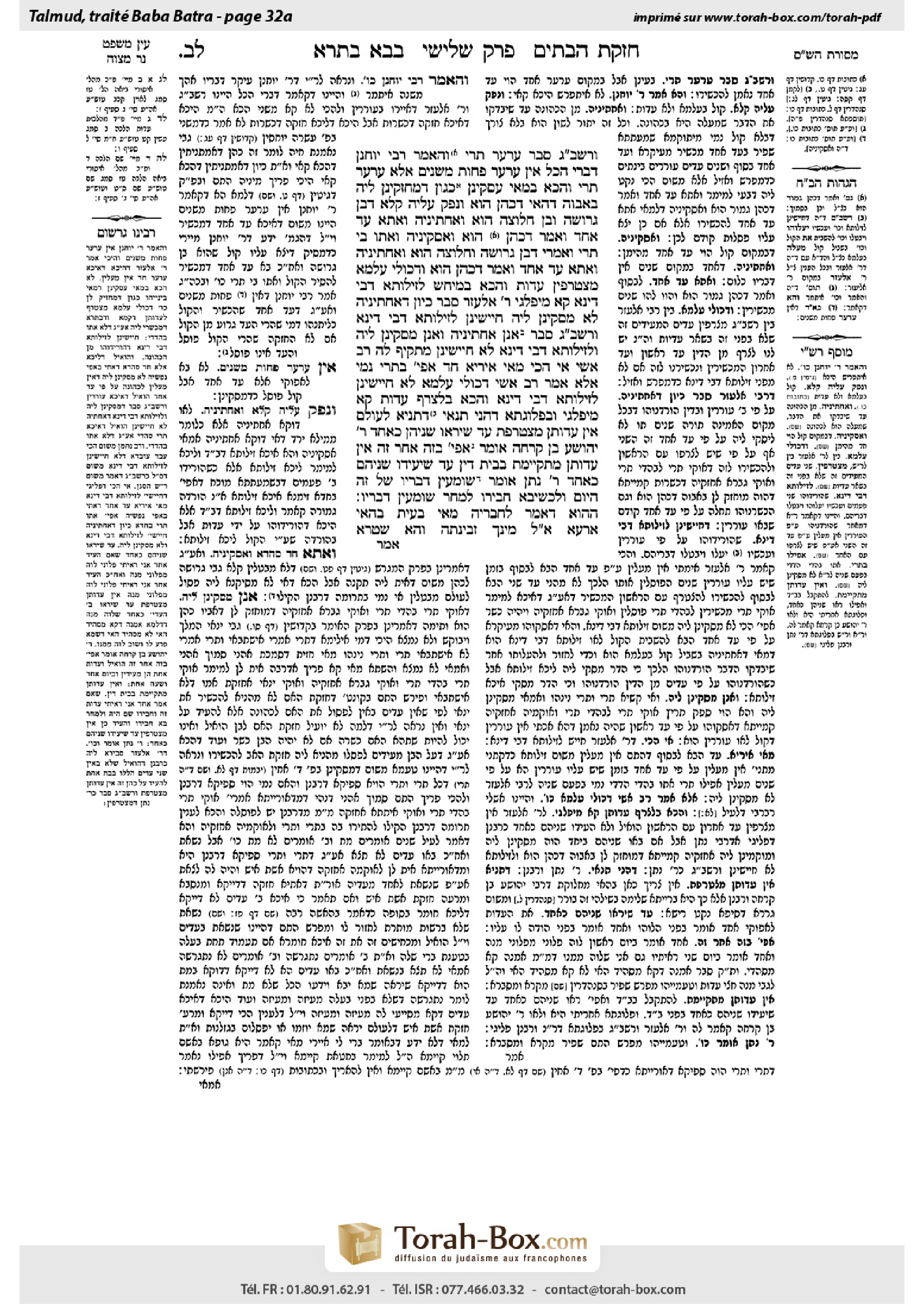
Bava Batra 32a: Talmud study for Daf Yomi
Study the Talmud for Daf Yomi with scanned pages, Hebrew text, English translations from Sefaria and AI-generated French translations.
Passage selection and English or AI-generated French translation are available where the scan has annotations. Daf Study is independent of Torah-Box and Sefaria.
Browse Bava Batra · בבא בתרא · All tractatesBava Batra 32a text and translations
This page of Bava Batra includes the Aramaic text, an English translation and an AI-generated French translation, alongside the scan above.
בבא בתרא ל״ב א · Aramaic and Hebrew text
וְרַבָּן שִׁמְעוֹן בֶּן גַּמְלִיאֵל סָבַר: עַרְעָר – תְּרֵי; וְהָאָמַר רַבִּי יוֹחָנָן: דִּבְרֵי הַכֹּל אֵין עַרְעָר פָּחוֹת מִשְּׁנַיִם!
אֶלָּא עַרְעָר תְּרֵי; וְהָכָא בְּמַאי עָסְקִינַן – כְּגוֹן דְּמַחְזְקִינַן לֵיהּ בַּאֲבוּהּ דְּהַאי – דְּכֹהֵן הוּא; וּנְפַק עֲלֵיהּ קָלָא דְּבֶן גְּרוּשָׁה וּבֶן חֲלוּצָה הוּא, וְאַחֲתִינֵּיהּ; וַאֲתָא עֵד אֶחָד וְאָמַר דְּכֹהֵן הוּא, וְאַסְּקִינֵּיהּ;
וַאֲתוֹ בֵּי תְרֵי וְאָמְרִי דְּבֶן גְּרוּשָׁה וַחֲלוּצָה הוּא, וְאַחֲתִינֵּיהּ; וַאֲתָא עֵד אֶחָד וְאָמַר דְּכֹהֵן הוּא. וּדְכוּלֵּי עָלְמָא – מִצְטָרְפִין עֵדוּת,
וְהָכָא בְּמֵיחַשׁ לְזִילוּתָא דְבֵי דִינָא קָא מִיפַּלְגִי – רַבִּי אֶלְעָזָר סָבַר: כֵּיוָן דְאַחֲתִינֵּיהּ – לָא מַסְּקִינַן לֵיהּ, חָיְישִׁינַן לְזִילוּתָא דְבֵי דִינָא. וְרַבָּן שִׁמְעוֹן בֶּן גַּמְלִיאֵל סָבַר: אֲנַן אַחֲתִינֵּיהּ, וַאֲנַן מַסְּקִינַן לֵיהּ; וּלְזִילוּתָא דְבֵי דִּינָא לָא חָיְישִׁינַן.
מַתְקֵיף לַהּ רַב אָשֵׁי: אִי הָכִי, מַאי אִירְיָא חַד? אֲפִילּוּ בִּתְרֵי נָמֵי! אֶלָּא אָמַר רַב אָשֵׁי: דְּכוּלֵּי עָלְמָא לָא חָיְישִׁינַן לְזִילוּתָא דְבֵי דִינָא; וְהָכָא – בִּלְצָרֵף עֵדוּת קָא מִיפַּלְגִי. וּבִפְלוּגְתָּא דְהָנֵי תַנָּאֵי –
דְּתַנְיָא: לְעוֹלָם אֵין עֵדוּתָן מִצְטָרֶפֶת, עַד שֶׁיִּרְאוּ שְׁנֵיהֶן כְּאֶחָד. רַבִּי יְהוֹשֻׁעַ בֶּן קָרְחָה אוֹמֵר: אֲפִילּוּ בְּזֶה אַחַר זֶה. אֵין עֵדוּתָן מִתְקַיֶּימֶת בְּבֵית דִּין, עַד שֶׁיָּעִידוּ שְׁנֵיהֶם כְּאֶחָד. רַבִּי נָתָן אוֹמֵר: שׁוֹמְעִין דְּבָרָיו שֶׁל זֶה הַיּוֹם, וּלִכְשֶׁיָּבֹא חֲבֵירוֹ לְמָחָר – שׁוֹמְעִין דְּבָרָיו.
הָהוּא דַּאֲמַר לְחַבְרֵיהּ: מַאי בָּעֵית בְּהַאי אַרְעָא? אֲמַר לֵיהּ: מִינָּךְ זְבֵינְתַּהּ, וְהָא שְׁטָרָא.
Bava Batra 32a · English translation
and Rabban Shimon Ben Gamliel holds that an effective challenge requires two witnesses, one could then ask: But doesn’t Rabbi Yoḥanan say: Everyone agrees that there is no effective challenge with fewer than two witnesses?
Rather, the challenge was established by two witnesses. And with what are we dealing here? We are dealing with a case where we presume with regard to the father of that man that he is a priest, and a rumor emerged about the son that he is the son of a priest and a divorced woman, or the son of a priest and a ḥalutza, and we downgraded him from the presumptive status of priesthood based on that rumor, and one witness came and said that the man in question is a priest of unflawed lineage, and we elevated him back to the priesthood, as one witness is sufficient to negate a rumor.
The Gemara continues the case: And then two witnesses came and said that he is the son of a divorced woman or the son of a ḥalutza, and we downgraded him from the priesthood based on their testimony. Then one witness came and said that he is a priest of unflawed lineage, resulting in two witnesses testifying that his lineage is unflawed, and two testifying that it is flawed. And everyone agrees that the testimony of the two single witnesses combine to produce testimony that he is a priest of unflawed lineage, and his presumptive status of priesthood should be restored.
The Gemara explains the dispute: And here it is with regard to concern about contempt of court that they disagree. Rabbi Elazar holds: Once we downgraded him from the presumptive status of priesthood based on the testimony of two witnesses, we do not then elevate him, as we are concerned about contempt of court, as a reversal in the court’s decision creates the impression that the court operates indecisively. And Rabban Shimon Ben Gamliel holds: We downgraded him from the presumptive status of priesthood and we then elevate him, and we are not concerned about contempt of court. The primary concern is that the matter should be determined based on the relevant testimonies.
Rav Ashi objects to the analysis that they disagree with regard to concern about contempt of court: If so, why specifically is it necessary to establish the dispute in a case where first one witness testified as to his unflawed lineage, and then another testified later? The same would hold true even in a case where two witnesses testified together that he is unfit for the priesthood and the court downgraded him, and two witnesses testified together that he is fit for the priesthood and the court elevated him. The tanna’im would also disagree, as the same concern applies. Rather, Rav Ashi said: Everyone agrees that we are not concerned about contempt of court. And here, it is with regard to whether the court is able to combine the testimony of two single witnesses that they disagree, and it is with regard to the issue that is the subject of the following dispute between these tanna’im.
As it is taught in a baraita (Tosefta, Sanhedrin 5:5): The testimony of individual witnesses never combines unless it is so that the two of them see the incident transpire together as one. Rabbi Yehoshua ben Korḥa says: Their testimony combines even in a case where they witnessed the event one after the other, but their testimony is established in court only if it is so that the two of them testify together as one. Rabbi Natan says: They are not required to testify together. Their testimony is combined even if the court hears the statement of this witness today and when the other witness arrives tomorrow the court hears his statement. Rabbi Elazar and Rabban Shimon ben Gamliel disagree in the dispute between Rabbi Natan and the Rabbis, whether the separate testimonies can be combined.
§ The Gemara relates an incident where two people disputed the ownership of land. There was a certain person who said to another: What do you want with this land of mine? The possessor said to him: I purchased it from you, and this is the bill of sale.
Bava Batra 32a · Traduction française (IA)
et Rabban Shimon ben Gamliel affirme que pour qu'un défi soit efficace, il faut deux témoins, on pourrait alors demander : Mais n'est-ce pas que Rabbi Yoḥanan dit : Tout le monde convient qu'il n'y a pas de défi efficace avec moins de deux témoins ?
En réalité, le défi a été établi par deux témoins. Et de quoi est-on en train de parler ici ? On parle d'un cas où l'on suppose, concernant le père de cette personne, qu'il est un prêtre, et une rumeur s'est répandue concernant le fils, disant qu'il est le fils d'un prêtre et d'une femme divorcée, ou le fils d'un prêtre et d'une ḥalutza, et on a abaissé son statut présomptif de prêtrise en raison de cette rumeur, et un témoin est venu dire que la personne en question est un prêtre de lignage irréprochable, et on l'a rétabli dans la prêtrise, car un seul témoin suffit pour annuler une rumeur.
La Guemara continue le cas : Et ensuite deux témoins sont venus dire qu'il est le fils d'une femme divorcée ou le fils d'une ḥalutza, et on l'a abaissé de la prêtrise en raison de leur témoignage. Puis un témoin est venu dire qu'il est un prêtre de lignage irréprochable, ce qui a entraîné deux témoins à témoigner qu'il a un lignage irréprochable et deux témoins à témoigner qu'il en a un défaut. Et tout le monde convient que le témoignage des deux témoins individuels combinés produit un témoignage selon lequel il est un prêtre de lignage irréprochable, et son statut présomptif de prêtrise devrait être rétabli.
La Guemara explique le désaccord : Il s'agit ici de l'inquiétude concernant le mépris du tribunal. Rabbi Elazar affirme : Une fois qu'on a abaissé son statut présomptif de prêtrise en raison du témoignage de deux témoins, on ne l'élève pas ensuite, car on craint le mépris du tribunal, car un renversement de la décision du tribunal crée l'impression que le tribunal est indécis. Et Rabban Shimon ben Gamliel affirme : On a abaissé son statut présomptif de prêtrise et on l'a ensuite élevé, et on n'a pas peur du mépris du tribunal. L'inquiétude principale est que la question devrait être décidée sur la base des témoignages pertinents.
Rav Ashi s'oppose à l'analyse selon laquelle ils diffèrent concernant la crainte du mépris du tribunal : Si c'est ainsi, pourquoi est-il nécessaire de fixer le désaccord dans un cas où d'abord un témoin a témoigné concernant son lignage irréprochable, et ensuite un autre témoin a témoigné plus tard ? La même chose serait vraie même dans un cas où deux témoins ont témoigné ensemble qu'il n'est pas digne de la prêtrise et le tribunal l'a abaissé, et deux témoins ont témoigné ensemble qu'il est digne de la prêtrise et le tribunal l'a élevé. Les tannaïm seraient également en désaccord, car la même crainte s'applique. En réalité, Rav Ashi a dit : Tout le monde convient que nous ne craignons pas le mépris du tribunal. Et ici, il s'agit de savoir si le tribunal est capable de combiner les témoignages de deux témoins individuels, et il s'agit de la question qui est au centre du désaccord entre ces tannaïm.
Comme il est enseigné dans une baraïta (Tosefta, Sanhedrin 5:5) : Le témoignage des témoins individuels ne se combine jamais à moins qu'ils n'aient vu l'incident se produire ensemble. Rabbi Yéhoshua ben Korkha dit : Leur témoignage se combine même dans un cas où ils ont témoin de l'événement l'un après l'autre, mais leur témoignage est établi en cour uniquement si c'est ainsi qu'ils témoignent ensemble. Rabbi Natan dit : Ils n'ont pas besoin de témoigner ensemble. Leur témoignage se combine même si la cour entend la déclaration de ce témoin aujourd'hui et que lorsqu'arrive l'autre témoin demain, la cour entend sa déclaration. Rabbi Elazar et Rabban Shimon ben Gamliel diffèrent dans le débat entre Rabbi Natan et les Rabbins, concernant si les témoignages séparés peuvent être combinés.
§ La Guemara rapporte un incident où deux personnes disputaient la propriété d'une terre. Il y avait un certain homme qui a dit à un autre : À quoi bon cette terre à moi ? Le possesseur a dit à lui : J'ai acheté cela de toi, et voici le contrat de vente.
Traduction française générée par IA à partir de l’édition anglaise de Sefaria. Vérifie toujours un passage avec le texte source.
Text from Sefaria: William Davidson Edition - Vocalized Aramaic (CC BY NC); William Davidson Edition - English (CC BY NC).