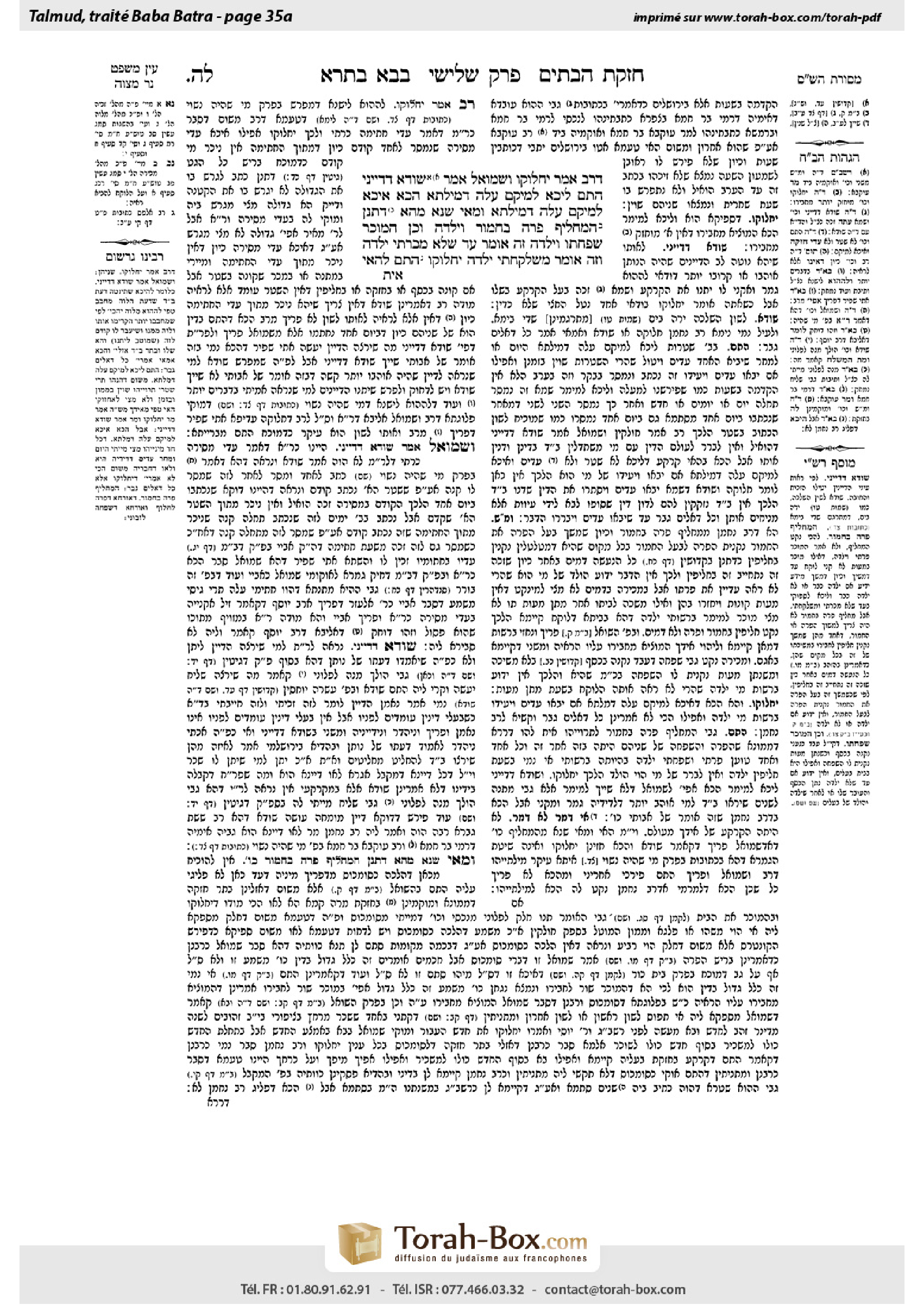
Bava Batra 35a: Talmud study for Daf Yomi
Study the Talmud for Daf Yomi with scanned pages, Hebrew text, English translations from Sefaria and AI-generated French translations.
Passage selection and English or AI-generated French translation are available where the scan has annotations. Daf Study is independent of Torah-Box and Sefaria.
Browse Bava Batra · בבא בתרא · All tractatesBava Batra 35a text and translations
This page of Bava Batra includes the Aramaic text, an English translation and an AI-generated French translation, alongside the scan above.
בבא בתרא ל״ה א · Aramaic and Hebrew text
דְּרַב אָמַר: יַחְלוֹקוּ, וּשְׁמוּאֵל אָמַר: שׁוּדָא דְּדַיָּינֵי? הָתָם, לֵיכָּא לְמֵיקַם עֲלַהּ דְּמִילְּתָא; הָכָא, אִיכָּא לְמֵיקַם עֲלַהּ דְּמִילְּתָא.
וּמַאי שְׁנָא מֵהָא דִּתְנַן: הַמַּחֲלִיף פָּרָה בַּחֲמוֹר, וְיָלְדָה; וְכֵן הַמּוֹכֵר שִׁפְחָתוֹ, וְיָלְדָה – זֶה אוֹמֵר: ״עַד שֶׁלֹּא מָכַרְתִּי יָלְדָה״, וְזֶה אוֹמֵר: ״מִשֶּׁלָּקַחְתִּי יָלְדָה״ – יַחְלוֹקוּ?
הָתָם, לְהַאי
Bava Batra 35a · English translation
as Rav said: In that case, they should divide the property between them, and Shmuel said: It is decided based on the discretion [shudda] of the judges. Why in the seemingly equivalent case of a dispute where there is no evidence for either litigant did Rav Naḥman rule that whoever is stronger prevails? The Gemara answers: There, in the case of the two deeds, it will not be possible for the court to clarify the matter in the future, and therefore, the court issues a ruling according to the information they currently have. Here, in the case of Rav Naḥman, it may be possible for the court to clarify the matter in the future, if one of the litigants was to bring witnesses supporting his claim.
The Gemara asks: And in what way is this case different from that which we learned in a mishna (Bava Metzia 100a): With regard to one who exchanges a cow for a donkey and the cow calved, and similarly one who sells his Canaanite maidservant and she gave birth, and this one, i.e., the seller, says: She gave birth before I sold either the cow or maidservant, and the offspring belongs to me; and that one, i.e., the buyer, says: She gave birth after I purchased her and the offspring belongs to me, the ruling is that they should divide the value of the newborn. In that case, the court is not able to clarify the matter, so they should rule that whoever is stronger prevails.
The Gemara answers: There, in the case of the exchange, for this one, i.e., the buyer,
Bava Batra 35a · Traduction française (IA)
comme Rav a dit : dans ce cas, ils devraient diviser les biens entre eux, et Shmuel a dit : la décision est prise selon le jugement [shudda] des juges. Pourquoi, dans le cas semblablement équivalent de litige où il n'y a pas de preuve pour l'un ou l'autre des parties, Rav Naḥman a-t-il décidé que celui qui est le plus fort l'emporte ? La Guemara répond : là, dans le cas des deux actes, il ne sera pas possible au tribunal de clarifier la question à l'avenir, et par conséquent, le tribunal rend un jugement selon les informations qu'ils ont actuellement. Ici, dans le cas de Rav Naḥman, il pourrait être possible au tribunal de clarifier la question à l'avenir, si l'une des parties apportait des témoins en faveur de sa revendication.
La Guemara demande : Et dans quelle mesure ce cas diffère-t-il de celui que nous avons appris dans une mitsna (Bava Metzia 100a) : concernant celui qui échange une vache contre un âne et la vache a donné naissance, et de même celui qui vend sa servante cananite et elle a donné naissance, et celui-ci, c'est-à-dire le vendeur, dit : elle a donné naissance avant que je ne vende soit la vache soit la servante, et l'offspring appartient à moi ; et celui-là, c'est-à-dire l'acheteur, dit : elle a donné naissance après que j'ai acheté elle, et l'offspring appartient à moi, la décision est que l'on doive diviser la valeur du nouveau-né. Dans ce cas, le tribunal n'est pas en mesure de clarifier la question, donc ils doivent décider que celui qui est le plus fort l'emporte.
La Guemara répond : là, dans le cas de l'échange, pour celui-ci, c'est-à-dire l'acheteur,
Traduction française générée par IA à partir de l’édition anglaise de Sefaria. Vérifie toujours un passage avec le texte source.
Text from Sefaria: William Davidson Edition - Vocalized Aramaic (CC BY NC); William Davidson Edition - English (CC BY NC).