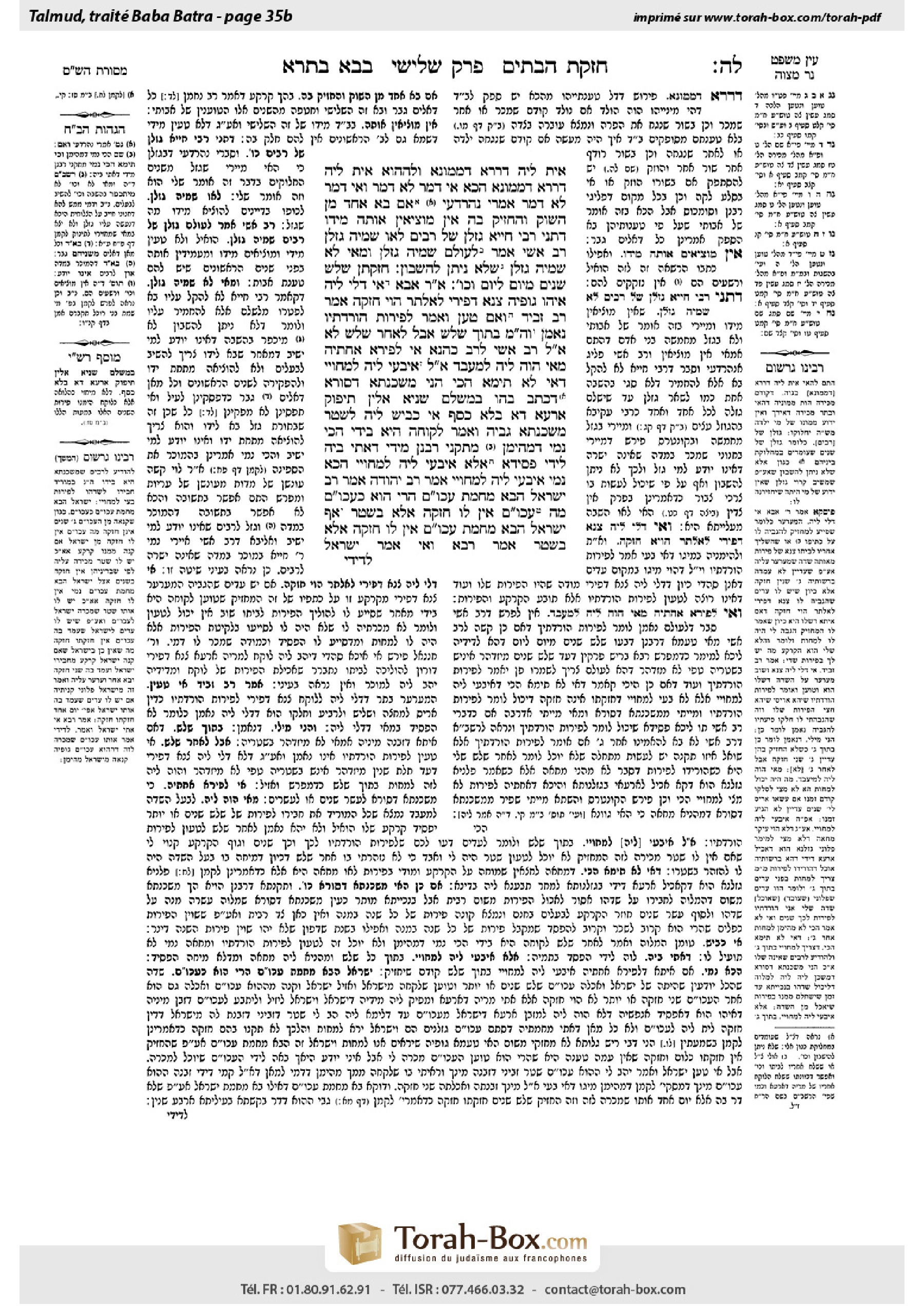
Bava Batra 35b: Talmud study for Daf Yomi
Study the Talmud for Daf Yomi with scanned pages, Hebrew text, English translations from Sefaria and AI-generated French translations.
Passage selection and English or AI-generated French translation are available where the scan has annotations. Daf Study is independent of Torah-Box and Sefaria.
Browse Bava Batra · בבא בתרא · All tractatesBava Batra 35b text and translations
This page of Bava Batra includes the Aramaic text, an English translation and an AI-generated French translation, alongside the scan above.
בבא בתרא ל״ה ב · Aramaic and Hebrew text
אִית לֵיהּ דְּרָרָא דְמָמוֹנָא, וּלְהָהוּא אִית לֵיהּ דְּרָרָא דְמָמוֹנָא; הָכָא, אִי דְּמָר – לָא דְּמָר, וְאִי דְּמָר – לָא דְּמָר.
אָמְרִי נְהַרְדָּעֵי: אִם בָּא אֶחָד מִן הַשּׁוּק, וְהֶחְזִיק בָּהּ – אֵין מוֹצִיאִין אוֹתָהּ מִיָּדוֹ. דְּתָנֵי רַבִּי חִיָּיא: גַּזְלָן שֶׁל רַבִּים לָאו שְׁמֵיהּ גַּזְלָן.
רַב אָשֵׁי אָמַר: לְעוֹלָם שְׁמֵיהּ גַּזְלָן, וּמַאי ״לָא שְׁמֵיהּ גַּזְלָן״? שֶׁלֹּא נִיתַּן לְהִשָּׁבוֹן.
חׇזְקָתָן שָׁלֹשׁ שָׁנִים מִיּוֹם לְיוֹם וְכוּ׳. אָמַר רַבִּי אַבָּא: אִי דָּלֵי לֵיהּ אִיהוּ גּוּפֵיהּ צַנָּא דְפֵירֵי, לְאַלְתַּר הָוֵי חֲזָקָה. אָמַר רַב זְבִיד, וְאִם טָעַן וְאָמַר: ״לְפֵירוֹת הוֹרַדְתִּיו״ – נֶאֱמָן. וְהָנֵי מִילֵּי בְּתוֹךְ שָׁלֹשׁ, אֲבָל לְאַחַר שָׁלֹשׁ – לָא.
אֲמַר לֵיהּ רַב אָשֵׁי לְרַב כָּהֲנָא: אִי לְפִירָא אַחֲתֵיהּ, מַאי הֲוָה לֵיהּ לְמֶעְבַּד? אֲמַר לֵיהּ: אִיבְּעִי לֵיהּ לְמַחוֹיֵי.
דְּאִי לָא תֵּימָא הָכִי, הָנֵי מַשְׁכְּנָתָא דְסוּרָא, דִּכְתִב בְּהוּ: ״בְּמִשְׁלַם שְׁנַיָּא אִלֵּין תִּיפּוֹק אַרְעָא דָּא בְּלָא כְּסַף״; אִי כָּבֵישׁ לֵיהּ לִשְׁטַר מַשְׁכַּנְתָּא גַּבֵּיהּ, וְאָמַר: לְקוּחָה הִיא בְּיָדִי, הָכִי נָמֵי דִּמְהֵימַן? מְתַקְּנִי רַבָּנַן מִידֵּי דְּאָתֵי בֵּיהּ לִידֵי פְּסֵידָא?! אֶלָּא אִיבְּעִי לֵיהּ לְמַחוֹיֵי; הָכָא נָמֵי, אִיבְּעִי לֵיהּ לְמַחוֹיֵי.
אָמַר רַב יְהוּדָה אָמַר רַב: יִשְׂרָאֵל הַבָּא מֵחֲמַת גּוֹי – הֲרֵי הוּא כְּגוֹי; מָה גּוֹי – אֵין לוֹ חֲזָקָה אֶלָּא בִּשְׁטָר, אַף יִשְׂרָאֵל הַבָּא מֵחֲמַת גּוֹי – אֵין לוֹ חֲזָקָה אֶלָּא בִּשְׁטָר. אָמַר רָבָא, וְאִי אָמַר יִשְׂרָאֵל:
Bava Batra 35b · English translation
he has financial involvement [derara], and for that one, i.e., the seller, he has financial involvement. Since each of them has a definite claim to owning the offspring, as each of them owned the cow or maidservant at one point, it is reasonable for the court to divide the offspring between the two parties. By contrast, here, in the case of Rav Naḥman, if it belongs to this Master it does not belong to that Master, and if it belongs to that Master it does not belong to this Master. Only one of the two litigants has any claim to the property, as it belonged either to the ancestors of this one or of that one. Therefore, a ruling to divide it would not be appropriate.
The Sages of Neharde’a say: In a case where two parties disputed the ownership of a certain property and the court ruled that whoever is stronger prevails, if one from the marketplace who had no claim came and took possession of it, the court does not remove it from his possession, as Rabbi Ḥiyya teaches (Tosefta, Bava Kamma 10:14): A robber of the public, meaning a robber whose victim is unknown, is not called a robber. Since it is unclear whom he robbed, no one is able to demand payment. Here too, since it is unclear whose property it is, neither can demand that it be taken from the robber.
Rav Ashi said in disagreement: Actually, he is called a robber, and the property is taken from him, and what is meant by: He is not called a robber? It means that the stolen item is not subject to being returned, and consequently he is unable to fully atone, as he does not know whom to repay.
§ The mishna teaches with regard to certain types of property that their presumptive ownership is established by use of a duration of three years from day to day. The Gemara comments: Rabbi Abba says: Nevertheless, there are cases where presumptive ownership is established immediately. For example, if the prior owner himself lifted a basket of fruit from that field for the possessor, that immediately is sufficient to establish the presumption of ownership, and the prior owner can no longer lodge a protest. Rav Zevid says: But if the prior owner stated a claim and said: I brought him down into my field solely to consume the produce, e.g., as a sharecropper, he is deemed credible. And that halakha, that the prior owner is deemed credible were he to state such a claim, applies only if he stated it within three years of when the other took possession, but after three years he is not deemed credible.
Rav Ashi said to Rav Kahana: If in fact he did bring him down into the field solely to consume the produce, what was there for him to do to prevent the possessor from establishing the presumption of ownership? Rav Kahana said to him: He should have protested during the first three years and publicized that he had granted the possessor rights to the produce alone.
The assumption that lodging a protest would be effective must be correct, since if you do not say so, then in the case of this mortgage according to the custom in Sura, a city in Babylonia, in which is written: At the completion of these years this land will be released to its prior owner without any need for the prior owner to give money, if the creditor were to hide the mortgage document in his possession and say: This land is purchased and that is why it is in my possession, here is it also the case that he would be deemed credible? That cannot be, as is it reasonable that the Sages would institute a matter, such as this type of arrangement, that people can be led by it to suffer a loss? Rather, in the case of the mortgage the debtor should have protested, and by not protesting, he causes his own loss. Here, too, in the case of the field, the owner should have protested.
§ Rav Yehuda says that Rav says: With regard to a Jew who comes to claim land due to having received it from a gentile, he is like a gentile in terms of which legal claims are available to him. Therefore, just as a gentile has the ability to establish the presumption of ownership only by means of a document, so too, a Jew who comes to claim land due to having received it from a gentile has the ability to establish the presumption of ownership only by means of a document. Rava said: And if the Jew said to a prior owner, who claims to still own the land:
Bava Batra 35b · Traduction française (IA)
Il a une implication financière [derara], et pour celui-ci, c'est-à-dire le vendeur, il a une implication financière. Puisque chacun d'eux a un droit clair à la propriété des rejetons, car chacun d'eux possédait la vache ou la servante à un moment donné, il est raisonnable que la cour divise les rejetons entre les deux parties. En revanche, ici, dans le cas de Rav Naḥman, si cela appartient à ce maître, cela n'appartient pas à celui-là, et si cela appartient à celui-là, cela n'appartient pas à ce maître. Seul l'un des deux litigants a un droit à la propriété, car cela appartenait soit aux ancêtres de celui-ci, soit aux ancêtres de celui-là. Par conséquent, une décision de diviser ne serait pas appropriée.
Les Sages de Neharde’a disent : Dans un cas où deux parties disputent la propriété d'un bien et la cour décide que celui qui est le plus fort l'emporte, si l'un des marchands qui n'avait aucun droit vient prendre possession de ce bien, la cour ne retire pas ce bien de sa possession, comme enseigne Rabbi Ḥiyya (Tosefta, Bava Kamma 10:14) : Un voleur du public, c'est-à-dire un voleur dont la victime est inconnue, n'est pas appelé voleur. Puisque c'est indéterminé à qui il a volé, personne ne peut exiger un paiement. De même, ici, puisque c'est indéterminé à qui appartient ce bien, personne ne peut exiger qu'il soit retiré du voleur.
Rav Ashi a dit en désaccord : En réalité, il est appelé voleur, et la propriété est retirée de lui, et que signifie : Il n'est pas appelé voleur ? Cela signifie que l'objet volé n'est pas soumis à un retour, et par conséquent il ne peut pas pleinement s'atténuer, puisqu'il ne sait à qui rembourser.
§ La mitsna enseigne concernant certains types de biens que leur propriété présumée est établie par l'usage d'une durée de trois ans, jour après jour. La Guemara commente : Rabbi Abba dit : Cependant, il y a des cas où la propriété présumée est établie immédiatement. Par exemple, si l'ancien propriétaire lui-même a ramassé un panier de fruits de ce champ pour le possesseur, cela suffit immédiatement à établir la présomption de propriété, et l'ancien propriétaire ne peut plus protester. Rav Zevid dit : Mais si l'ancien propriétaire a déclaré un droit et a dit : J'ai amené celui-ci dans mon champ uniquement pour consommer les produits, c'est-à-dire en tant que fermier partageant, il est considéré comme crédible. Et cette halakha, que l'ancien propriétaire est considéré comme crédible s'il déclare une telle revendication, s'applique uniquement s'il l'a déclaré dans les trois ans suivant la prise de possession par l'autre, mais après trois ans il n'est pas considéré comme crédible.
Rav Ashi a dit à Rav Kahana : Si en effet il a amené celui-ci dans le champ uniquement pour consommer les produits, que devait-il faire pour empêcher le possesseur d'établir la présomption de propriété ? Rav Kahana a dit à lui : Il aurait dû protester durant les trois premières années et faire savoir qu'il avait octroyé au possesseur le droit exclusif aux produits.
L'hypothèse que le recours à une protestation serait efficace doit être correcte, puisque si vous ne dites pas cela, alors dans le cas de ce prêt hypothécaire selon la coutume de Sura, une ville en Babylone, où il est écrit : À la fin de ces années, cette terre sera rendue à son ancien propriétaire sans qu'il n'ait besoin de l'ancien propriétaire de donner de l'argent, si le créancier cache le document hypothécaire dans sa possession et dit : Cette terre est achetée et c'est pourquoi elle est en ma possession, ici aussi, est-ce que cela serait considéré comme crédible ? Cela ne peut pas être, puisque c'est raisonnable que les Sages aient institué une affaire, comme celle-ci, qui pourrait conduire les gens à subir une perte ? Plutôt, dans le cas de l'hypothèque, le débiteur aurait dû protester, et en ne protestant pas, il cause sa propre perte. Ici aussi, dans le cas du champ, le propriétaire aurait dû protester.
§ Rav Yehuda dit que Rav dit : Concernant un Juif qui vient réclamer une terre en raison d'avoir reçu celle-ci d'un non-Juif, il est comme un non-Juif en ce qui concerne les recours juridiques disponibles. Par conséquent, tout comme un non-Juif peut établir la présomption de propriété uniquement par un document, de même un Juif qui vient réclamer une terre en raison d'avoir reçu celle-ci d'un non-Juif peut établir la présomption de propriété uniquement par un document. Rava a dit : Et si le Juif a dit à un ancien propriétaire, qui réclame encore la terre :
Traduction française générée par IA à partir de l’édition anglaise de Sefaria. Vérifie toujours un passage avec le texte source.
Text from Sefaria: William Davidson Edition - Vocalized Aramaic (CC BY NC); William Davidson Edition - English (CC BY NC).