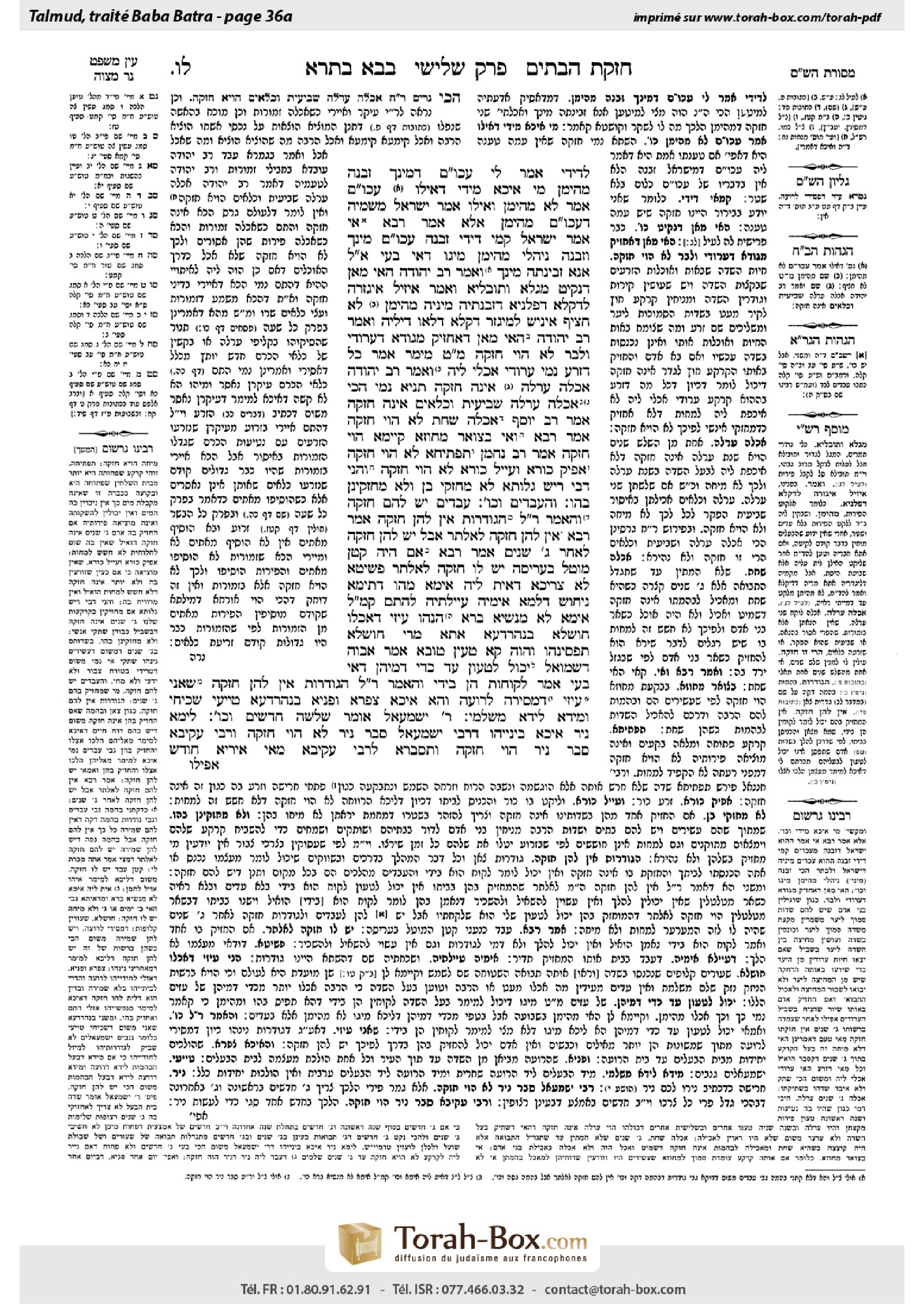
Bava Batra 36a: Talmud study for Daf Yomi
Study the Talmud for Daf Yomi with scanned pages, Hebrew text, English translations from Sefaria and AI-generated French translations.
Passage selection and English or AI-generated French translation are available where the scan has annotations. Daf Study is independent of Torah-Box and Sefaria.
Browse Bava Batra · בבא בתרא · All tractatesBava Batra 36a text and translations
This page of Bava Batra includes the Aramaic text, an English translation and an AI-generated French translation, alongside the scan above.
בבא בתרא ל״ו א · Aramaic and Hebrew text
״לְדִידִי אֲמַר לִי גּוֹי, דְּמִינָּךְ זַבְנַהּ״ – מְהֵימַן. מִי אִיכָּא מִידֵּי דְּאִילּוּ גּוֹי אָמַר – לָא מְהֵימַן, וְאִילּוּ אָמַר יִשְׂרָאֵל מִשְּׁמֵיהּ דְּגוֹי – מְהֵימַן?!
אֶלָּא אָמַר רָבָא, אִי אָמַר יִשְׂרָאֵל: ״קַמֵּי דִּידִי זַבְנַהּ גּוֹי מִינָּךְ, וְזַבְּנַהּ נִיהֲלִי״ – מְהֵימַן, מִיגּוֹ דְּאִי בָּעֵי אֲמַר לֵיהּ: אֲנָא זְבֵינְתַּהּ מִינָּךְ.
וְאָמַר רַב יְהוּדָה: הַאי מַאן דְּנָקֵיט מַגָּלָא וְתוּבַלְיָא, וְאָמַר: ״אֵיזִיל אֶיגְזְרֵהּ לְדִקְלָא דִפְלָנְיָא, דִּזְבֵנְתֵּיהּ מִינֵּיהּ״ – מְהֵימַן, לָא חֲצִיף אִינִישׁ לְמִיגְזַר דִּקְלָא דְּלָאו דִּילֵיהּ.
וְאָמַר רַב יְהוּדָה: הַאי מַאן דְּאַחְזֵיק מִגּוּדָא דַעֲרוֹדֵי וּלְבַר, לָא הָוֵי חֲזָקָה. מַאי טַעְמָא? מֵימָר אָמַר: כֹּל דְּזָרַע נָמֵי עֲרוֹדֵי אָכְלִי לֵיהּ.
וְאָמַר רַב יְהוּדָה: אֲכָלָהּ עׇרְלָה – אֵינָהּ חֲזָקָה. תַּנְיָא נָמֵי הָכִי: אֲכָלָהּ עׇרְלָה, שְׁבִיעִית וְכִלְאַיִם – אֵינָהּ חֲזָקָה.
אָמַר רַב יוֹסֵף: אַכְלַהּ שַׁחַת – לָא הָוֵי חֲזָקָה. אָמַר רָבָא: וְאִי בְּצַוַּאר מָחוֹזָא קָיְימָא – הָוֵי חֲזָקָה.
אָמַר רַב נַחְמָן: תַּפְתִּיחָא – לָא הָוֵי חֲזָקָה. אַפֵּיק כּוֹרָא וְעַיֵּיל כּוֹרָא – לָא הָוֵי חֲזָקָה.
וְהָנֵי דְּבֵי רֵישׁ גָּלוּתָא – לָא מַחְזְקִי בַּן, וְלָא מַחְזְקִינַן בְּהוּ.
וְהָעֲבָדִים וְכוּ׳. עֲבָדִים יֵשׁ לָהֶם חֲזָקָה?! וְהָאָמַר רֵישׁ לָקִישׁ: הַגּוֹדְרוֹת – אֵין לָהֶן חֲזָקָה! אָמַר רָבָא: אֵין לָהֶן חֲזָקָה לְאַלְתַּר, אֲבָל יֵשׁ לָהֶן חֲזָקָה לְאַחַר שָׁלֹשׁ שָׁנִים.
אָמַר רָבָא: אִם הָיָה קָטָן מוּטָּל בַּעֲרִיסָה – יֵשׁ לוֹ חֲזָקָה לְאַלְתַּר. פְּשִׁיטָא! לָא צְרִיכָא, דְּאִית לֵיהּ אִימָּא; מַהוּ דְּתֵימָא: נֵיחוּשׁ דִּלְמָא אִימֵּיהּ עַיֵּילְתֵּיהּ לְהָתָם; קָמַשְׁמַע לַן – אִימָּא לָא מְנַשְּׁיָא בְּרָא.
הָנְהוּ עִיזֵּי דַּאֲכַלוּ חוּשְׁלָא בִּנְהַרְדְּעָא. אֲתָא מָרֵי חוּשְׁלָא, תַּפְסִינְהוּ, וַהֲוָה קָא טָעֵין טוּבָא. אֲמַר אֲבוּהּ דִּשְׁמוּאֵל: יָכוֹל לִטְעוֹן עַד כְּדֵי דְּמֵיהֶן – דְּאִי בָּעֵי, אָמַר: לְקוּחוֹת הֵן בְּיָדִי. וְהָאָמַר רֵישׁ לָקִישׁ: הַגּוֹדְרוֹת – אֵין לָהֶן חֲזָקָה! שָׁאנֵי עִיזֵּי, דִּמְסִירָה לְרוֹעֶה.
וְהָא אִיכָּא צַפְרָא וּפַנְיָא! בִּנְהַרְדְּעָא טַיָּיעִי שְׁכִיחִי, וּמִיְּדָא לִידָא מְשַׁלְּמִי.
רַבִּי יִשְׁמָעֵאל אוֹמֵר: שְׁלֹשָׁה חֳדָשִׁים וְכוּ׳. לֵימָא נִיר אִיכָּא בֵּינַיְיהוּ – דְּרַבִּי יִשְׁמָעֵאל סָבַר: נִיר לָא הָוֵי חֲזָקָה, וְרַבִּי עֲקִיבָא סָבַר: נִיר הָוֵי חֲזָקָה?
וְתִסְבְּרָא?! לְרַבִּי עֲקִיבָא – מַאי אִירְיָא חוֹדֶשׁ?
Bava Batra 36a · English translation
The gentile told me that he purchased a field from you, this claim is deemed credible. The Gemara asks: Is there any case where if a gentile says it he is not deemed credible, but if a Jew said it in the gentile’s name he would be deemed credible?
Rather, Rava said: If a Jew said to the prior owner: A gentile purchased a field from you in my presence, and then he sold it to me, this claim is deemed credible, since if he wanted to, he could have said to the prior owner of the land: I purchased it from you.
The Gemara records a series of halakhot pertaining to presumptive ownership. And Rav Yehuda says: This one who is holding a sickle and rope and says: I will go cull the dates from the date tree of so-and-so, from whom I purchased it, is deemed credible. The reason for this is that a person is not so brazen that he would cull the dates from a date tree that is not his.
And Rav Yehuda says: With regard to this one, who possesses a field only from the fence built to prevent the entry of the wild donkeys and outward toward the public property, this conduct is not sufficient to establish the presumption of ownership. What is the reason? The owner says to himself: Everything that he sows, the wild donkeys will eat as well, and cannot establish the presumption of ownership for him, as he is not profiting from the land as an owner would.
And Rav Yehuda says: With regard to one who profited from the land by consuming produce from the first three years after it was planted [orla], during which time one is prohibited from deriving benefit from the produce, this conduct is not sufficient to establish the presumption of ownership. This is also taught in a baraita: With regard to one who profited from the land by consuming orla produce, or profited from the land by consuming produce of the Sabbatical Year, or consumed produce that was prohibited as it was of diverse kinds, this conduct is not sufficient to establish the presumption of ownership.
Rav Yosef says: With regard to one who profited from the land by consuming fodder, i.e., produce that has grown stalks but is not yet ripe, this conduct is not sufficient to establish the presumption of ownership. Rava said: But if the land was located in the neck of Meḥoza, a valley where it was common to harvest unripe produce to feed animals, this conduct is sufficient to establish the presumption of ownership.
Rav Naḥman says: Consumption of produce of land that is fissured is not sufficient to establish the presumption of ownership. This is due to the fact that produce does not grow well there, and therefore, owners do not bother to protest if a trespasser uses the land. Therefore, their silence should not be understood as an admission that it belongs to the possessor. Similarly, consumption of produce of land where one expends a kor of seed to sow and retrieves a kor of produce when harvesting it, is not sufficient to establish the presumption of ownership. Here, too, the owners do not bother to protest, as the land is of inferior quality.
Rav Naḥman continues: And these members of the household of the Exilarch do not establish the presumption of ownership in our land, as people are afraid to lodge a protest against them, and we do not establish the presumption of ownership in their land, as, due to their wealth, they might not lodge a protest against one who trespasses on their land.
§ The mishna teaches: And of slaves, presumption of ownership of them is established by using them for a duration of three years from day to day. The Gemara asks: With regard to slaves, is there presumptive ownership of them? But doesn’t Reish Lakish say: With regard to livestock [hagoderot], possession of them does not establish the presumption of ownership, since they wander from place to place. Therefore, one cannot claim that his mere possession of livestock demonstrates ownership as one can with regard to other movable items, because it may have wandered into his property on its own. The same halakha should apply with regard to a slave. Rava said: It is true that possession of them does not establish the presumption of ownership immediately, but there is presumptive ownership of them after three years.
Rava said: If the slave in question was a small child placed in a cradle, possession of him does establish the presumption of ownership immediately, as it does with regard to other movable items. The Gemara asks: Isn’t that obvious, since he cannot move on his own? The Gemara answers: No, it is necessary in a case where he has a mother. Lest you say: One should be concerned that perhaps his mother brought him up to there, and his being on another’s property does not indicate that the latter is his master. Therefore, Rava teaches us that there is no concern about this possibility, since a mother does not forget her son. Therefore, possession of the infant slave does establish the presumption of ownership.
The Gemara relates: There were these certain goats that ate peeled barley [ḥushela] in Neharde’a. The owner of the peeled barley came and seized the goats, and was claiming a large sum of money for the barley from the owner of the goats. Shmuel’s father said: He is able to claim up to the value of the goats, since if he wants to, he could say: The goats are purchased and that is why they are in my possession. The Gemara asks: But doesn’t Reish Lakish say: With regard to livestock, possession of them does not establish the presumption of ownership? The Gemara answers: Goats are different, as they are given to shepherds, and do not wander on their own.
The Gemara challenges: But there is morning and evening to consider, when the goats are unsupervised when traveling between the owner and the shepherd, and during those times this halakha of livestock should apply with regard to them. The Gemara explains: The case under discussion took place in Neharde’a, and Arabs [tayya’ei] who steal animals are common in Neharde’a, and goats there are delivered from hand to hand and are never left unsupervised.
§ The mishna teaches that Rabbi Yishmael says: Three months of possession in the first year, three months of possession in the third year, and twelve months of possession in the middle, which are eighteen months, suffices to establish the presumption of ownership. Rabbi Akiva disagrees, and says that one month in the first and third year, in addition to the full middle year, is sufficient. The Gemara asks: Shall we say that the difference between them is whether plowing the land is sufficient to establish the presumption of ownership? As Rabbi Yishmael holds that plowing is not sufficient to establish the presumption of ownership, and three months are needed for the crop to grow, and Rabbi Akiva holds that plowing is sufficient to establish the presumption of ownership, and therefore one month is sufficient.
The Gemara asks: And how can you understand their opinions this way? If so, according to Rabbi Akiva, why specifically require a full month?
Bava Batra 36a · Traduction française (IA)
Le gentil me dit qu'il a acheté un champ auprès de vous, cette déclaration est considérée comme crédible. La Guemara pose la question : y a-t-il un cas où si un gentil le dit, il n'est pas considéré comme crédible, mais si un Juif le dit au nom du gentil, il serait considéré comme crédible ?
Plutôt, Rava dit : Si un Juif a dit à l'ancien propriétaire : un gentil a acheté un champ auprès de vous en ma présence, et ensuite il m'a vendu ce champ, cette déclaration est considérée comme crédible, car s'il le voulait, il aurait pu dire à l'ancien propriétaire du champ : j'ai acheté ce champ auprès de vous.
La Guemara enregistre une série de halakhot concernant la présomption d'ownership. Et Rav Yehuda dit : celui qui tient une faucille et une corde et dit : je vais ramasser les dattes de l'arbre à dattes de tel et tel, auprès duquel j'ai acheté ce champ, est considéré comme crédible. La raison en est que personne n'ose être si audacieux pour ramasser les dattes d'un arbre qui n'est pas le sien.
Et Rav Yehuda dit : concernant celui qui possède un champ seulement à partir du mur construit pour empêcher l'entrée des ânes sauvages et jusqu'à la propriété publique, ce comportement n'est pas suffisant pour établir la présomption d'ownership. Quelle est la raison ? L'owner se dit à lui-même : tout ce qu'il sème, les ânes sauvages le mangeront également, et ne peut établir la présomption d'ownership pour lui, car il ne profite pas du terrain comme un propriétaire le ferait.
Et Rav Yehuda dit : concernant celui qui a profité du terrain en consommant les produits des trois premières années après sa plantation [orla], pendant lesquelles il est interdit de tirer profit des produits, ce comportement n'est pas suffisant pour établir la présomption d'ownership. Cela est également enseigné dans une baraïta : concernant celui qui a profité du terrain en consommant des produits orla, ou qui a profité du terrain en consommant des produits de l'année sabbatique, ou qui a consommé des produits interdits en raison de leur diversité, ce comportement n'est pas suffisant pour établir la présomption d'ownership.
Rav Yosef dit : concernant celui qui a profité du terrain en consommant des fourrages, c'est-à-dire des produits qui ont poussé des tiges mais ne sont pas encore mûrs, ce comportement n'est pas suffisant pour établir la présomption d'ownership. Rava dit : mais si le terrain était situé dans le cou de Meḥoza, un vallon où il était courant de récolter des produits non mûrs pour nourrir les animaux, ce comportement est suffisant pour établir la présomption d'ownership.
Rav Naḥman dit : la consommation des produits d'un terrain fissuré n'est pas suffisante pour établir la présomption d'appartenance. Cela est dû au fait que les produits ne poussent pas bien là, et donc les propriétaires ne s'occupent pas de protester si un intrus utilise le terrain. Par conséquent, leur silence ne devrait pas être compris comme une admission que cela appartient au possesseur. De même, la consommation des produits d'un terrain où l'on met un kor de grain pour semer et on récupère un kor de produit lors de la récolte n'est pas suffisante pour établir la présomption d'appartenance. Là encore, les propriétaires ne s'occupent pas de protester, car le terrain est de qualité inférieure.
Rav Naḥman continue : et ces membres de la maison de l'Exilarch ne constituent pas une présomption d'appartenance dans notre terre, car les gens ont peur de protester contre eux, et nous ne constituons pas une présomption d'appartenance dans leur terre, car, en raison de leur richesse, ils pourraient ne pas protester contre celui qui pénètre sur leur terrain.
§ La Michna enseigne : et des esclaves, la présomption d'appartenance est établie en les utilisant pendant trois ans, jour après jour. La Guemara pose la question : concernant les esclaves, y a-t-il une présomption d'appartenance ? Mais ne dit-il pas Reish Lakish : concernant les bêtes [hagoderot], la possession ne constitue pas une présomption d'appartenance, car elles errant d'un lieu à un autre. Par conséquent, on ne peut pas affirmer que leur possession démontre l'appartenance comme on le peut avec les autres objets mobiles, car elles peuvent avoir pénétré dans sa propriété d'elle-même. La même halakha devrait s'appliquer concernant un esclave. Rava dit : il est vrai que la possession ne constitue pas une présomption d'appartenance immédiatement, mais il y a une présomption d'appartenance d'eux après trois ans.
Rava dit : si l'esclave en question était un petit enfant placé dans un berceau, la possession de lui constitue une présomption d'appartenance immédiatement, comme avec les autres objets mobiles. La Guemara pose la question : n'est-ce pas évident, puisqu'il ne peut pas se déplacer seul ? La Guemara répond : non, il est nécessaire dans un cas où il a une mère. De peur que l'on dise : on doit être vigilant que peut-être sa mère l'a élevé là, et son être sur la propriété d'autrui ne montre pas que le dernier est son maître. Par conséquent, Rava nous enseigne que l'on n'a pas à crainre cette possibilité, car une mère ne oublie pas son fils. Par conséquent, la possession de l'esclave infantile constitue une présomption d'appartenance.
La Guemara rapporte : il y avait ces certaines chèvres qui ont mangé du blé épluché [ḥushela] à Neharde’a. L'propriétaire du blé épluché est venu et a saisi les chèvres, et réclamait une somme importante pour le blé auprès de l'propriétaire des chèvres. Le père de Shmuel dit : il peut réclamer jusqu'à la valeur des chèvres, car s'il le veut, il pourrait dire : les chèvres sont achetées et c'est pourquoi elles sont en ma possession. La Guemara pose la question : mais ne dit pas Reish Lakish : concernant les bêtes, la possession ne constitue pas une présomption d'appartenance ? La Guemara répond : les chèvres sont différentes, car elles sont données aux bergers et ne se déplacent pas seules.
La Guemara conteste : mais il y a le matin et le soir à considérer, lorsqu'elles sont non surveillées lors de leur trajet entre l'propriétaire et le berger, et pendant ces moments cette halakha des bêtes devrait s'appliquer à elles. La Guemara explique : le cas en question s'est produit à Neharde’a, et les Arabes [tayya’ei] qui volent des animaux sont nombreux à Neharde’a, et les chèvres y sont passées de main en main et ne sont jamais laissées non surveillées.
§ La Michna enseigne que Rabbi Yishmael dit : Trois mois de possession dans la première année, trois mois de possession dans la troisième année, et douze mois de possession dans la période intermédiaire, ce qui fait dix-huit mois, suffisent à établir la présomption d'ownership. Rabbi Akiva désaccorde, et dit qu'un mois dans la première et la troisième année, en plus de l'année entière intermédiaire, est suffisant. La Guemara demande : Devons-nous dire que la différence entre eux est sur le fait que le labourage du terrain suffit-il à établir la présomption d'ownership ? Comme Rabbi Yishmael considère que le labourage n'est pas suffisant à établir la présomption d'ownership, et que trois mois sont nécessaires pour que la récolte mûrisse, et Rabbi Akiva considère que le labourage suffit à établir la présomption d'ownership, et donc un mois suffit.
La Guemara demande : Et comment pouvez-vous comprendre leurs opinions ainsi ? Si c'est le cas, selon Rabbi Akiva, pourquoi exiger spécifiquement un mois complet ?
Traduction française générée par IA à partir de l’édition anglaise de Sefaria. Vérifie toujours un passage avec le texte source.
Text from Sefaria: William Davidson Edition - Vocalized Aramaic (CC BY NC); William Davidson Edition - English (CC BY NC).