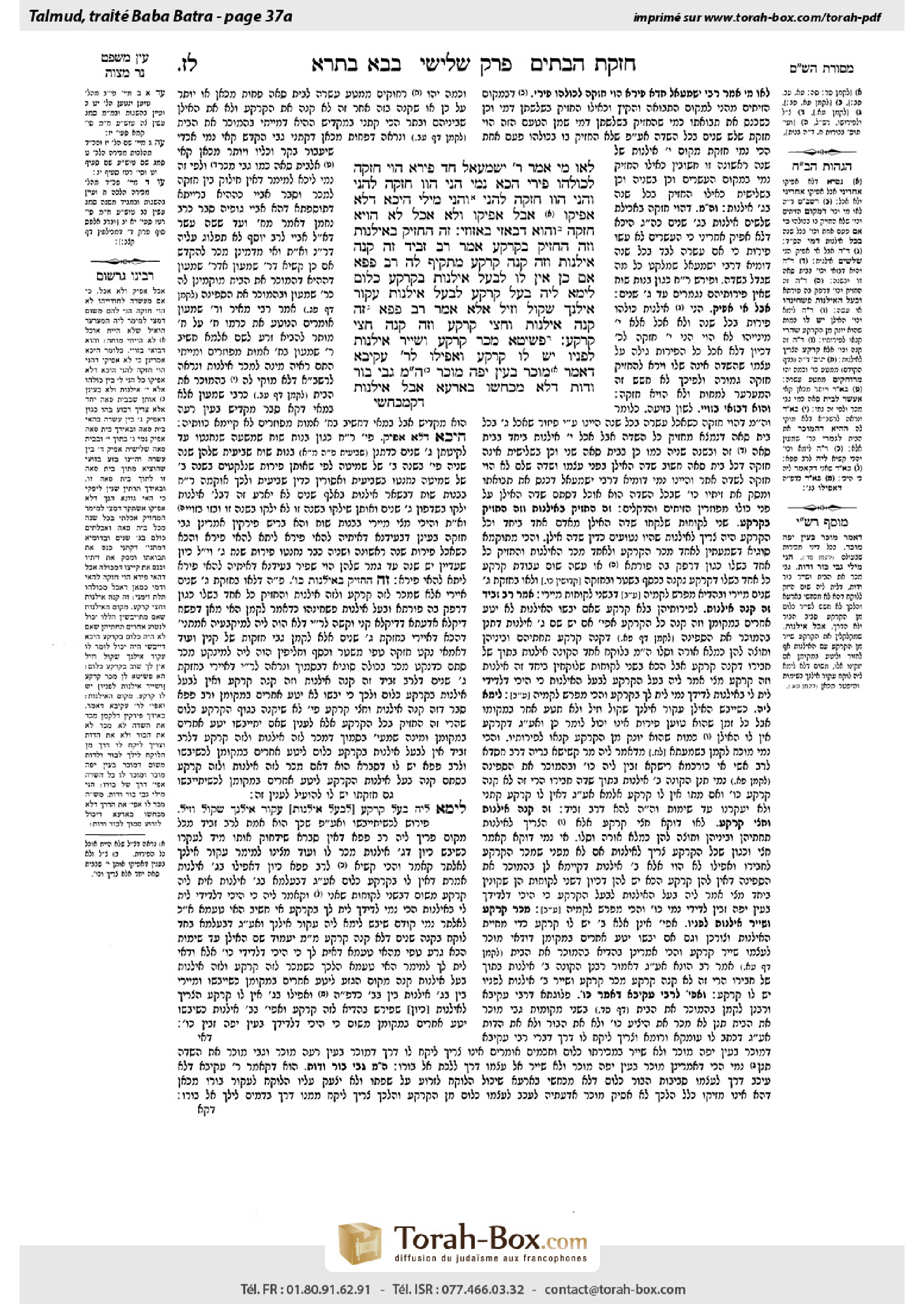
Bava Batra 37a: Talmud study for Daf Yomi
Study the Talmud for Daf Yomi with scanned pages, Hebrew text, English translations from Sefaria and AI-generated French translations.
Passage selection and English or AI-generated French translation are available where the scan has annotations. Daf Study is independent of Torah-Box and Sefaria.
Browse Bava Batra · בבא בתרא · All tractatesBava Batra 37a text and translations
This page of Bava Batra includes the Aramaic text, an English translation and an AI-generated French translation, alongside the scan above.
בבא בתרא ל״ז א · Aramaic and Hebrew text
לָאו מִי אָמַר רַבִּי יִשְׁמָעֵאל: חַד פֵּירָא הָוֵי חֲזָקָה לְכוּלְּהוּ פֵּירֵי? הָכָא נָמֵי – הָנֵי הָווּ חֲזָקָה לְהָנֵי, וְהָנֵי הָווּ חֲזָקָה לְהָנֵי.
וְהָנֵי מִילֵּי הֵיכָא דְּלָא אַפִּיקוּ, אֲבָל אַפִּיקוּ וְלָא אֲכַל – לָא הָוְיָא חֲזָקָה. וְהוּא דְּבַאזִּי בַּאזּוֹזֵי.
זֶה הֶחְזִיק בָּאִילָנוֹת, וְזֶה הֶחְזִיק בַּקַּרְקַע – אָמַר רַב זְבִיד: זֶה קָנָה אִילָנוֹת, וְזֶה קָנָה קַרְקַע. מַתְקֵיף לַהּ רַב פָּפָּא: אִם כֵּן, אֵין לוֹ לְבַעַל אִילָנוֹת בַּקַּרְקַע כְּלוּם; לֵימָא לֵיהּ בַּעַל קַרְקַע לְבַעַל אִילָנוֹת: עֲקוֹר אִילָנָךְ, שְׁקוֹל וְזִיל! אֶלָּא אָמַר רַב פָּפָּא: זֶה קָנָה אִילָנוֹת וַחֲצִי קַרְקַע, וָזֶה קָנָה חֲצִי קַרְקַע.
פְּשִׁיטָא – מָכַר קַרְקַע, וְשִׁיֵּיר אִילָנוֹת לְפָנָיו – יֵשׁ לוֹ קַרְקַע. וַאֲפִילּוּ לְרַבִּי עֲקִיבָא, דְּאָמַר: מוֹכֵר בְּעַיִן יָפָה מוֹכֵר, הָנֵי מִילֵּי גַּבֵּי בּוֹר וָדוּת –
דְּלָא מַכְחֲשׁוּ בְּאַרְעָא, אֲבָל אִילָנוֹת,
Bava Batra 37a · English translation
The Gemara explains the inference from the statement of Rabbi Yishmael and how it clarifies the opinion of the Rabbis: Didn’t Rabbi Yishmael say that harvesting one type of fruit is sufficient to establish the presumption of ownership for all of the types of fruit, i.e., for the entire field? Here too, these trees are sufficient to establish the presumption of ownership for those trees, and those trees are sufficient to establish the presumption of ownership for these trees.
The Gemara notes two restrictions to the aforementioned ruling: And this statement applies specifically where the other twenty trees did not produce fruit, but if the other trees produced fruit and he did not consume their fruit, then his conduct is not sufficient to establish the presumption of ownership with regard to the other trees. And this principle, that consuming the produce of some of the trees each year establishes the presumption of ownership for the entire field, applies only if it is the case that the trees are scattered [devazei bazuzei] throughout the field. Otherwise, he establishes the presumption of ownership only over the section where the trees are located.
§ In a case where there was a field with trees in it, and this person took possession of the trees and that person took possession of the land, Rav Zevid says: This one acquired the trees and that one acquired the land. Rav Pappa objects to this: If this is so, then the owner of the trees has no share in the land at all. Let the owner of the land say to the owner of the trees: Uproot your trees, take them, and go. Rather, Rav Pappa said: This one acquired the trees and half of the land, and that one acquired half of the land.
The Gemara notes: It is obvious that if one sold a section of land and left the ownership of the trees in that land for himself, he has ownership of the land surrounding the trees. And this is the halakha even according to the opinion of Rabbi Akiva, who says: One who sells, sells generously, and he is presumed to have included in the sale even items that were not explicitly specified, because that statement applies only concerning a case such as when one sold land and retained ownership of a pit or a cistern. In that case, Rabbi Akiva ruled that he does not retain any land, not even a path to access the pit or cistern, as he sold generously, including all of the land in the sale.
The Gemara explains the difference between the cases: That ruling applies there, as the pit or cistern causes no harm to the land surrounding them, and since the seller does not foresee a conflict arising from his pit and cistern being located adjacent to the buyer’s property, he therefore transfers the entire land. But in the case of his retaining the trees,
Bava Batra 37a · Traduction française (IA)
La Guemara explique l'inférence tirée de la déclaration du maître Yishmael et comment elle clarifie l'opinion des Rabbins : N’a-t-on pas dit que Yishmael a affirmé que la récolte d’un type de fruit suffit à établir la présomption d’appropriation pour tous les types de fruits, c’est-à-dire pour l’intégralité du champ ? Ici aussi, ces arbres suffisent à établir la présomption d’appropriation pour ces arbres, et ces arbres suffisent à établir la présomption d’appropriation pour ces arbres.
La Guemara note deux restrictions à la décision mentionnée précédemment : Cette déclaration s’applique spécifiquement dans le cas où les autres vingt arbres n’ont pas produit de fruits, mais si les autres arbres ont produit des fruits et qu’il n’a pas consommé leurs fruits, alors son comportement n’est pas suffisant pour établir la présomption d’appropriation concernant les autres arbres. Et ce principe, selon lequel la consommation des produits de certains arbres chaque année établit la présomption d’appropriation pour l’intégralité du champ, s’applique uniquement si les arbres sont dispersés [devazei bazuzei] dans le champ. Sinon, il établit la présomption d’appropriation uniquement sur la section où les arbres sont situés.
§ Dans un cas où il y avait un champ avec des arbres, et cette personne a pris possession des arbres et celle-ci a pris possession du terrain, Rav Zevid dit : Celui-ci a acquis les arbres et celui-ci a acquis le terrain. Rav Pappa s’oppose à cela : Si c’est ainsi, alors l’propriétaire des arbres n’a aucun droit sur le terrain. Que l’propriétaire du terrain dise à l’propriétaire des arbres : Démontez vos arbres, emportez-les et partez. En réalité, Rav Pappa a dit : Celui-ci a acquis les arbres et la moitié du terrain, et celui-ci a acquis la moitié du terrain.
La Guemara note que c’est évident que si l’on vend une section de terrain et qu’on laisse la propriété des arbres dans cette section à soi-même, on possède le terrain autour des arbres. Et c’est la halakha même selon l’opinion de Rabbi Akiva, qui dit : Celui qui vend, vend généreusement, et on suppose qu’il a inclus dans la vente même les choses qui n’étaient pas spécifiquement mentionnées, car cette déclaration s’applique uniquement dans le cas où l’on vend un terrain et qu’on conserve la propriété d’un puits ou d’un réservoir. Dans ce cas, Rabbi Akiva a décidé qu’il ne conserve aucun terrain, pas même un chemin d’accès au puits ou au réservoir, car il a vendu généreusement, incluant tout le terrain dans la vente.
La Guemara explique la différence entre les cas : Cette décision s’applique là, car le puits ou le réservoir ne causent aucun préjudice au terrain autour d’eux, et puisque le vendeur ne prévoit pas de conflit lié à la présence de son puits ou de son réservoir à côté de la propriété de l’acheteur, il transfère donc l’intégralité du terrain. Mais dans le cas où il conserve les arbres,
Traduction française générée par IA à partir de l’édition anglaise de Sefaria. Vérifie toujours un passage avec le texte source.
Text from Sefaria: William Davidson Edition - Vocalized Aramaic (CC BY NC); William Davidson Edition - English (CC BY NC).