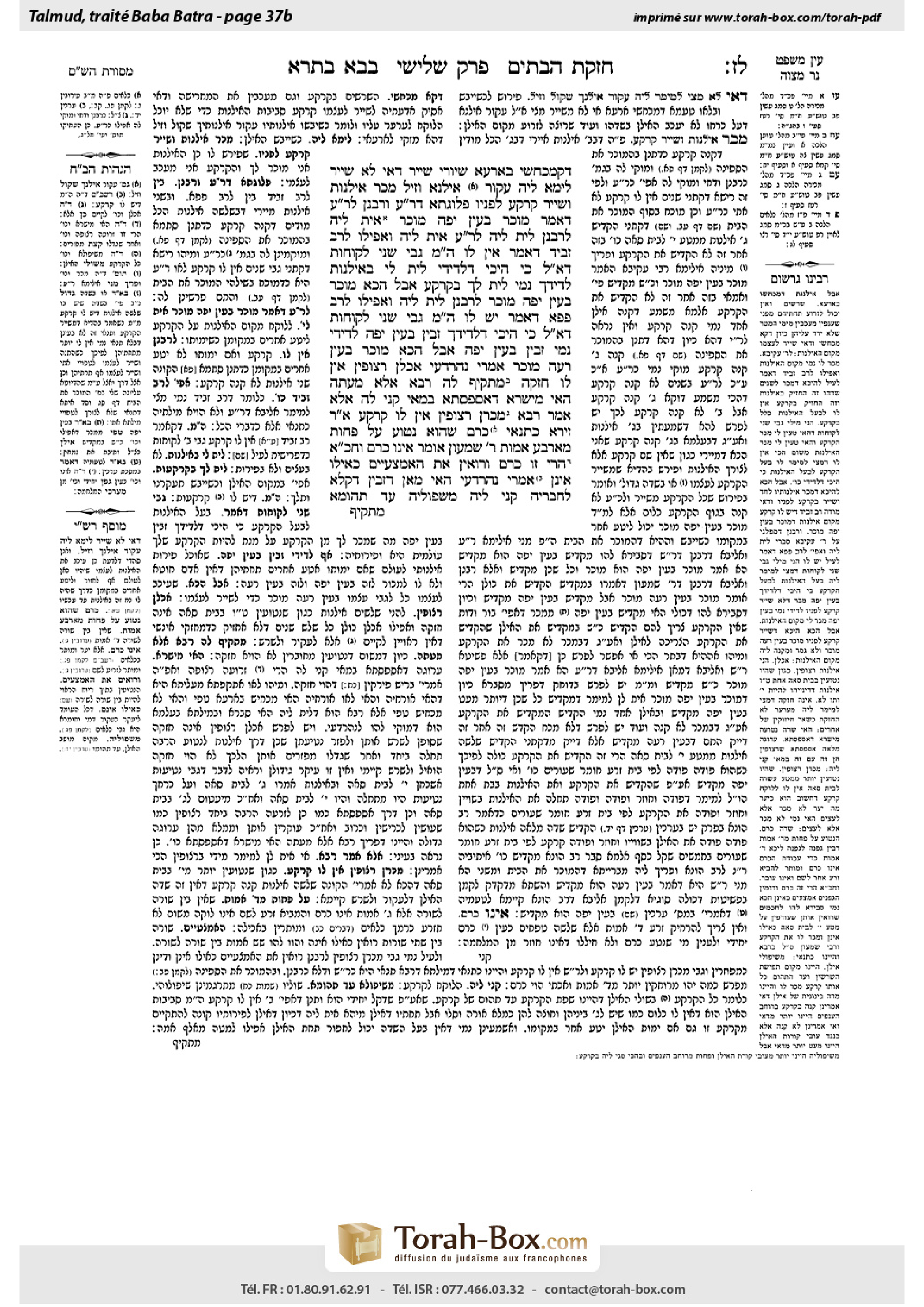
Bava Batra 37b: Talmud study for Daf Yomi
Study the Talmud for Daf Yomi with scanned pages, Hebrew text, English translations from Sefaria and AI-generated French translations.
Passage selection and English or AI-generated French translation are available where the scan has annotations. Daf Study is independent of Torah-Box and Sefaria.
Browse Bava Batra · בבא בתרא · All tractatesBava Batra 37b text and translations
This page of Bava Batra includes the Aramaic text, an English translation and an AI-generated French translation, alongside the scan above.
בבא בתרא ל״ז ב · Aramaic and Hebrew text
דְּקָמַכְחֲשִׁי בְּאַרְעָא – שַׁיּוֹרֵי שַׁיַּיר. דְּאִי לָא שַׁיַּיר, לֵימָא לֵיהּ: עֲקוֹר אִילָנָא וְזִיל.
מָכַר אִילָנוֹת וְשִׁיֵּיר קַרְקַע לְפָנָיו – פְּלוּגְתָּא דְּרַבִּי עֲקִיבָא וְרַבָּנַן; לְרַבִּי עֲקִיבָא דְּאָמַר: מוֹכֵר בְּעַיִן יָפָה מוֹכֵר – אִית לֵיהּ; לְרַבָּנַן – לֵית לֵיהּ.
לְרַבִּי עֲקִיבָא אִית לֵיהּ – וַאֲפִילּוּ לְרַב זְבִיד דְּאָמַר: אֵין לוֹ – הָנֵי מִילֵּי גַּבֵּי שְׁנֵי לָקוֹחוֹת, דְּאָמַר לֵיהּ: כִּי הֵיכִי דִּלְדִידִי לֵית לִי בְּאִילָנוֹת, לְדִידָךְ נָמֵי לֵית לָךְ בְּקַרְקַע; אֲבָל הָכָא – מוֹכֵר בְּעַיִן יָפָה מוֹכֵר.
לְרַבָּנַן לֵית לֵיהּ – וַאֲפִילּוּ לְרַב פָּפָּא דְּאָמַר: יֵשׁ לוֹ – הָנֵי מִילֵּי גַּבֵּי שְׁנֵי לָקוֹחוֹת, דְּאָמַר לֵיהּ: כִּי הֵיכִי דִּלְדִידָךְ זַבֵּין בְּעַיִן יָפָה, לְדִידִי נָמֵי זַבֵּין בְּעַיִן יָפָה; אֲבָל הָכָא – מוֹכֵר בְּעַיִן רָעָה מוֹכֵר.
אָמְרִי נְהַרְדָּעֵי: אֲכָלָן רְצוּפִין – אֵין לוֹ חֲזָקָה. מַתְקֵיף לַהּ רָבָא: אֶלָּא מֵעַתָּה, הַאי מֵישָׁרָא דְאַסְפַּסְתָּא – בְּמַאי קָנֵי לַהּ? אֶלָּא אָמַר רָבָא: מְכָרָן רְצוּפִין – אֵין לוֹ קַרְקַע.
אָמַר רַבִּי זֵירָא: כְּתַנָּאֵי – כֶּרֶם שֶׁהוּא נָטוּעַ עַל פָּחוֹת מֵאַרְבַּע אַמּוֹת, רַבִּי שִׁמְעוֹן אוֹמֵר: אֵינוֹ כֶּרֶם. וַחֲכָמִים אוֹמְרִים: הֲרֵי זוֹ כֶּרֶם, וְרוֹאִין אֶת הָאֶמְצָעִיִּים כְּאִילּוּ אֵינָן.
אָמְרִי נְהַרְדָּעֵי: הַאי מַאן דְּזָבֵין דִּקְלָא לְחַבְרֵיהּ – קָנֵי לֵיהּ מִשִּׁפּוּלֵיהּ עַד תְּהוֹמָא.
Bava Batra 37b · English translation
since they are causing harm to the land, the seller does leave the land that is surrounding the trees for himself, as if he did not leave it, let the buyer say to him: Uproot your trees and go.
The Gemara discusses the reverse case: If one sold the trees and left the ownership of the land for himself, the halakha depends on the outcome of the dispute of Rabbi Akiva and the Rabbis. According to Rabbi Akiva, who says: One who sells, sells generously, the buyer has ownership of the land surrounding the trees, as the presumption is that the seller included it in the sale. According to the Rabbis, who say: One who sells, sells sparingly, the buyer does not have ownership of the land surrounding the trees, as the presumption is that the seller did not include it in the sale.
The Gemara stated previously that according to the opinion of Rabbi Akiva, the buyer has ownership of the land surrounding the trees. The Gemara clarifies this opinion: And even according to Rav Zevid, who said (37a) that in a case where one took possession of the land and another took possession of the trees, the one who took possession of the trees has no share in the land, that matter applies only concerning the case of two buyers. As in that case, the one who acquired the land can say to the other: Just as it is so that I have no share in the trees, you also have no share in the land; but here, where one sold the trees and left the land for himself, one who sells, sells generously. Therefore, it is reasonable to assume that the sale included the land surrounding the trees.
The Gemara stated earlier that according to the opinion of the Rabbis, the buyer does not have ownership of the land surrounding the trees. The Gemara clarifies this opinion: And even according to Rav Pappa, who says above that in a case where one took possession of the land and another took possession of the trees that the one who took possession of the trees has ownership of half of the land as well, that matter applies only concerning the case of two buyers. As in that case, the one who acquired the trees can say to the other: Just as it is so that the seller sold to you generously, as you have both the land and the right to consume its produce, he also sold to me generously, including the land surrounding the trees; but here, where one sold the trees and left the land for himself, one who sells, sells sparingly, retaining for himself whatever he did not explicitly include in the sale.
§ The Sages of Neharde’a say: If one consumed the produce of an overcrowded orchard, he does not thereby have presumptive ownership of the orchard. Rava objects to this: If that is so, how does one ever acquire this alfalfa field, which is planted without spacing? Rather, Rava said: If one sold an overcrowded orchard, the buyer does not have ownership of the land surrounding the trees. Generally, if one purchases three or more trees, he acquires the surrounding land, as the trees are considered an orchard. If the trees are overcrowded, they will soon have to be uprooted, and that is why the buyer does not acquire the land surrounding the trees.
Rabbi Zeira said: This is like a dispute between tanna’im (Kilayim 5:2): With regard to a vineyard that is planted on an area where there is less than four cubits of open space between the vines, Rabbi Shimon says: It is not considered to be a vineyard with regard to the prohibition of diverse kinds and other halakhot, as it is overcrowded. And the Rabbis say: This is considered to be a vineyard, and the reason for this is that the middle vines are viewed as if they are not there, and the outer vines meet the requirements for a vineyard. It follows that according to the opinion of the Rabbis, if one sold an overcrowded orchard, the middle trees would be viewed as if they were not there. Therefore, it would be considered an orchard and the buyer would acquire the land surrounding the trees.
The Sages of Neharde’a say: This one who sells a date tree to another, the buyer acquires the land from its bottom until the depths.
Bava Batra 37b · Traduction française (IA)
puisque ils nuisent au sol, le vendeur laisse le sol entourant les arbres pour lui-même, comme s'il ne l'avait pas laissé, que l'acheteur dise à lui : Démontez vos arbres et partez.
La Guemara discute du cas inverse : Si l'on vend les arbres et l'on conserve la propriété du sol pour soi, la halakha dépend du débat entre Rabbi Akiva et les Rabbins. Selon Rabbi Akiva, qui dit : Celui qui vend, vend généreusement, l'acheteur possède le sol entourant les arbres, car la présomption est que le vendeur l'a inclus dans la vente. Selon les Rabbins, qui disent : Celui qui vend, vend parcimonieusement, l'acheteur ne possède pas le sol entourant les arbres, car la présomption est que le vendeur ne l'a pas inclus dans la vente.
La Guemara a dit précédemment que selon l'opinion de Rabbi Akiva, l'acheteur possède le sol entourant les arbres. La Guemara clarifie cette opinion : Et même selon Rav Zevid, qui a dit (37a) que dans le cas où l'un prend possession du sol et l'autre des arbres, celui qui a pris possession des arbres n'a pas de part dans le sol, cette affaire s'applique uniquement au cas de deux acheteurs. Car dans ce cas, celui qui a acquis le sol peut dire à l'autre : Comme il est ainsi que je n'ai pas de part dans les arbres, vous n'avez pas non plus de part dans le sol ; mais ici, où l'on vend les arbres et l'on conserve le sol pour soi, celui qui vend, vend généreusement. Par conséquent, il est raisonnable de présupposer que la vente inclut le sol entourant les arbres.
La Guemara a dit précédemment que selon l'opinion des Rabbins, l'acheteur ne possède pas le sol entourant les arbres. La Guemara clarifie cette opinion : Et même selon Rav Pappa, qui dit ci-dessus que dans le cas où l'un prend possession du sol et l'autre des arbres, celui qui a pris possession des arbres possède la moitié du sol également, cette affaire s'applique uniquement au cas de deux acheteurs. Car dans ce cas, celui qui a acquis les arbres peut dire à l'autre : Comme il est ainsi que le vendeur vous a vendu généreusement, car vous avez à la fois le sol et le droit de consommer ses fruits, il m'a aussi vendu généreusement, y compris le sol entourant les arbres ; mais ici, où l'on vend les arbres et l'on conserve le sol pour soi, celui qui vend, vend parcimonieusement, conservant pour lui tout ce qu'il n'a pas explicitement inclus dans la vente.
§ Les Sages de Neharde’a disent : Si l'on a consommé les fruits d'un verger surpeuplé, on ne possède pas présomptivement le verger. Rava s'oppose à cela : Si c'est ainsi, comment peut-on jamais acquérir ce champ d'alfalfas, planté sans espace ? Plutôt, Rava dit : Si l'on vend un verger surpeuplé, l'acheteur ne possède pas le sol entourant les arbres. Généralement, si l'on achète trois ou plus d'arbres, on acquiert le sol entourant les arbres, car les arbres sont considérés comme un verger. Si les arbres sont surpeuplés, ils doivent bientôt être arrachés, et c'est pourquoi l'acheteur ne possède pas le sol entourant les arbres.
Rabbi Zeira dit : C'est comme un débat entre les tanna’im (Kilayim 5:2) : Concernant un vignoble planté sur une surface où il y a moins de quatre cubits d'espace ouvert entre les vignes, Rabbi Shimon dit : Ce n'est pas considéré comme un vignoble concernant l'interdiction des espèces diverses et d'autres halakhot, car il est surpeuplé. Et les Rabbins disent : Cela est considéré comme un vignoble, et la raison est que les vignes du milieu sont vues comme si elles n'étaient pas là, et les vignes externes remplissent les critères d'un vignoble. Il en suit que selon l'opinion des Rabbins, si l'on vend un verger surpeuplé, les arbres du milieu seraient vus comme s'ils n'étaient pas là. Par conséquent, cela serait considéré comme un verger et l'acheteur acquiert le sol entourant les arbres.
Les Sages de Neharde’a disent : Celui qui vend un palmier à un autre, l'acheteur acquiert le sol depuis sa base jusqu'aux profondeurs.
Traduction française générée par IA à partir de l’édition anglaise de Sefaria. Vérifie toujours un passage avec le texte source.
Text from Sefaria: William Davidson Edition - Vocalized Aramaic (CC BY NC); William Davidson Edition - English (CC BY NC).