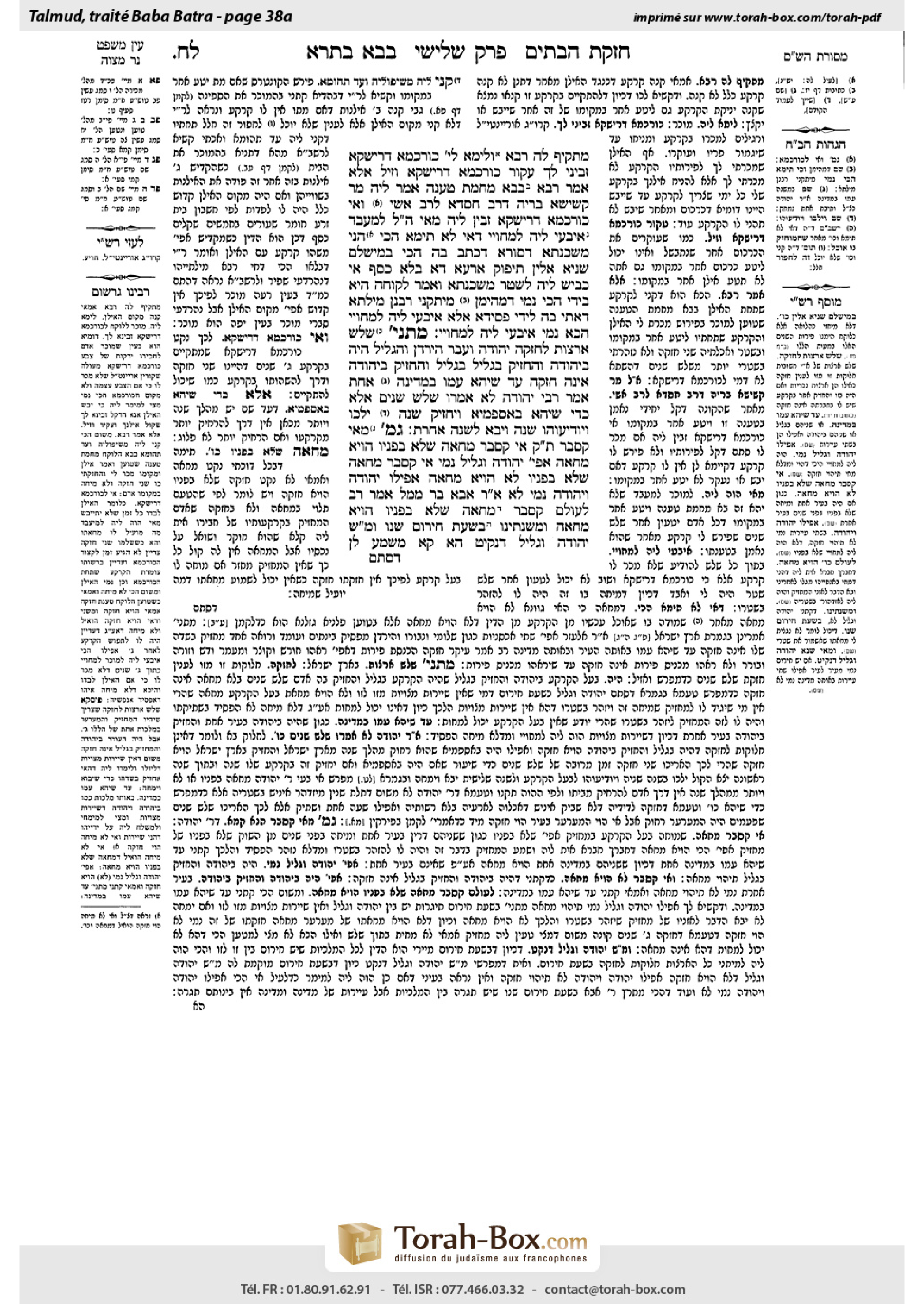
Bava Batra 38a: Talmud study for Daf Yomi
Study the Talmud for Daf Yomi with scanned pages, Hebrew text, English translations from Sefaria and AI-generated French translations.
Passage selection and English or AI-generated French translation are available where the scan has annotations. Daf Study is independent of Torah-Box and Sefaria.
Browse Bava Batra · בבא בתרא · All tractatesBava Batra 38a text and translations
This page of Bava Batra includes the Aramaic text, an English translation and an AI-generated French translation, alongside the scan above.
בבא בתרא ל״ח א · Aramaic and Hebrew text
מַתְקֵיף לַהּ רָבָא, וְלֵימָא לֵיהּ: כּוּרְכְּמָא דְרִישְׁקָא זַבֵּינִי לָךְ, עֲקוֹר כּוּרְכְּמָא דְרִישְׁקָא, וְזִיל! אֶלָּא אָמַר רָבָא: בְּבָא מֵחֲמַת טַעֲנָה.
אֲמַר לֵיהּ מָר קַשִּׁישָׁא בְּרֵיהּ דְּרַב חִסְדָּא לְרַב אָשֵׁי: וְאִי כּוּרְכְּמָא דְרִישְׁקָא זַבֵּין לֵיהּ, מַאי הֲוָה לֵיהּ לְמֶעְבַּד? אִיבְּעִי לֵיהּ לְמַחוֹיֵי.
דְּאִי לָא תֵּימָא הָכִי, הָנֵי מַשְׁכְּנָתָא דְסוּרָא – דִּכְתִב בְּהִי הָכִי: ״בְּמִישְׁלַם שְׁנַיָּא אִלֵּין, תִּיפּוֹק אַרְעָא דָּא בְּלָא כְּסַף״; אִי כָּבֵישׁ לֵיהּ לִשְׁטַר מַשְׁכַּנְתָּא, וְאָמַר: ״לְקוּחָה הִיא בְּיָדִי״ – הָכִי נָמֵי דִּמְהֵימַן?! מְיתַקְּנִי רַבָּנַן מִילְּתָא דְּאָתֵי בַּהּ לִידֵי פְסֵידָא? אֶלָּא אִיבְּעִי לֵיהּ לְמַחוֹיֵי; הָכָא נָמֵי, אִיבְּעִי לֵיהּ לְמַחוֹיֵי,
מַתְנִי׳ שָׁלֹשׁ אֲרָצוֹת לַחֲזָקָה – יְהוּדָה, וְעֵבֶר הַיַּרְדֵּן, וְהַגָּלִיל. הָיָה בִּיהוּדָה וְהֶחֱזִיק בַּגָּלִיל, בַּגָּלִיל וְהֶחֱזִיק בִּיהוּדָה – אֵינָהּ חֲזָקָה, עַד שֶׁיְּהֵא עִמּוֹ בִּמְדִינָה אַחַת. אָמַר רַבִּי יְהוּדָה: לֹא אָמְרוּ שָׁלֹשׁ שָׁנִים, אֶלָּא כְּדֵי שֶׁיְּהֵא בְּאַסְפַּמְיָא – וְיַחְזִיק שָׁנָה, יֵלְכוּ וְיוֹדִיעוּהוּ שָׁנָה, וְיָבֹא לְשָׁנָה אַחֶרֶת.
גְּמָ׳ מַאי קָסָבַר תַּנָּא קַמָּא? אִי קָסָבַר מֶחָאָה שֶׁלֹּא בְּפָנָיו הָוְיָא מֶחָאָה, אֲפִילּוּ יְהוּדָה וְגָלִיל נָמֵי! אִי קָסָבַר מֶחָאָה שֶׁלֹּא בְּפָנָיו לָא הָוְיָא מֶחָאָה, אֲפִילּוּ יְהוּדָה וִיהוּדָה נָמֵי לָא!
אָמַר רַבִּי אַבָּא בַּר מֶמֶל אָמַר רַב, לְעוֹלָם קָסָבַר: מֶחָאָה שֶׁלֹּא בְּפָנָיו הָוְיָא מֶחָאָה, וּמִשְׁנָתֵינוּ – בִּשְׁעַת חֵירוּם שָׁנוּ. וּמַאי שְׁנָא יְהוּדָה וְגָלִיל דְּנָקֵיט?
הָא קָא מַשְׁמַע לַן –
Bava Batra 38a · English translation
Rava objects to this ruling that the buyer of the tree acquires the land beneath it: And let the seller say to him: I sold you only the saffron crocus, a small plant normally uprooted by the buyer and taken with him. Therefore, uproot the saffron crocus and go. Rather, Rava said: This ruling is stated with regard to one who comes to court with a specific claim that the seller had stipulated that he would acquire the land. Without this specific claim he does not acquire the land beneath the tree.
Mar Kashisha, the son of Rav Ḥisda, said to Rav Ashi: And if, in fact, the seller sold him the saffron crocus, what was there for the seller to do to prevent the buyer from claiming the land beneath the tree, as the buyer could claim that there had been an explicit stipulation that he receive it? Rav Ashi answered: He should have protested during the first three years and publicized that the land was not included in the sale.
The assumption that lodging a protest would be effective must be correct, since if you do not say so, then in the case of these mortgages according to the custom in Sura, a city in Babylonia, the debtor will not have a way to prevent the creditor from keeping his land. As in mortgages of that type it is written like this: At the completion of these years this land will be released to its prior owner without any need for the prior owner to give money. If the creditor were to hide the mortgage document in his possession and say: This land is purchased and that is why it is in my possession, here is it also the case that he would be deemed credible? That cannot be, as is it reasonable that the Sages would institute a matter, such as this type of arrangement, that people can be led by it to suffer a loss? Rather, in the case of the mortgage the debtor should have protested, and by not protesting, he causes his own loss. Here too, in the case of the tree, the owner should have protested.
MISHNA: There are three independent lands in Eretz Yisrael with regard to establishing presumptive ownership: Judea, and Transjordan, and the Galilee. If the prior owner of the field was in Judea and another took possession of his field in the Galilee, or if he was in the Galilee and another took possession of his field in Judea, the possessor does not establish presumptive ownership until the one possessing the field will be with the prior owner in one province. Rabbi Yehuda says: The Sages said that establishing presumptive ownership requires three years only in order that if the owner will be in Spain [Aspamya], and another possesses his field for a year, people will go and inform the owner by the end of the next year, and the owner will come back in the following year and take the possessor to court.
GEMARA: What does the first tanna hold in ruling that the prior owner and the field need be in the same province in order for the possessor to establish presumptive ownership? If he holds that a protest that is lodged not in the presence of the one possessing the field is a valid protest, even in the case where one is in Judea and one is in the Galilee, the protest should be valid as well. If he holds that a protest lodged not in his presence is not a valid protest, even in the case where one is in Judea and the other one is in Judea, the protest should not be valid as well.
Rabbi Abba bar Memel says that Rav says: Actually, the tanna holds that a protest lodged not in his presence is a valid protest, and the Sages taught our mishna with regard to a period of crisis, when travel is perilous and information cannot be transmitted between Judea and the Galilee. Therefore, although no word of a protest was received, the possessor does not establish presumptive ownership of the field. The Gemara asks: But if it is due only to the exigent circumstances that word of the protest does not reach the one possessing the field, what is different about Judea and the Galilee that the tanna cited? Ostensibly, even within one of the three lands, if travel and communications are restricted the same halakha would apply.
The Gemara answers: The tanna, by citing specifically a case where each is located in a different land, teaches us this:
Bava Batra 38a · Traduction française (IA)
Rava s'oppose à cette décision selon laquelle l'acheteur de l'arbre acquiert la terre sous l'arbre : Et le vendeur dira à lui : J'ai vendu à toi seulement le crocus de safran, une petite plante normalement arrachée par l'acheteur et emportée avec lui. Par conséquent, arrache le crocus de safran et va-t'en. Rava a plutôt dit : Cette décision est formulée dans le cas d'une personne qui vient devant le tribunal avec une réclamation spécifique que le vendeur avait stipulé qu'il acquerrait la terre. Sans cette réclamation spécifique, il ne peut pas acquérir la terre sous l'arbre.
Mar Kashisha, fils de Rav Ḥisda, dit à Rav Ashi : Et si, en effet, le vendeur a vendu à lui le crocus de safran, qu'y avait-il pour que le vendeur empêche l'acheteur de revendiquer la terre sous l'arbre, puisque l'acheteur pouvait affirmer qu'il y avait une stipulation explicite qu'il le recevait ? Rav Ashi répondit : Il aurait dû protester pendant les trois premières années et faire savoir publiquement que la terre n'était pas incluse dans la vente.
L'hypothèse que le recours à une protestation serait efficace doit être correcte, car si l'on ne dit pas cela, alors dans le cas de ces hypothèques selon la coutume de Sura, une ville en Babylonie, le débiteur n'aurait pas de moyen d'empêcher le créancier de conserver sa terre. Comme dans ces hypothèques-là, il est écrit ainsi : À la fin de ces années, cette terre sera rendue à son propriétaire initial sans qu'il n'y ait besoin que le propriétaire initial verse de l'argent. Si le créancier avait caché le document d'hypothèque dans sa possession et disait : Cette terre est achetée et c'est pourquoi elle est en ma possession, ici aussi, il serait considéré comme crédible ? Cela ne peut pas être, car il est raisonnable que les Sages aient institué une affaire, telle que celle-ci, qui pourrait conduire les gens à subir une perte ? Plutôt, dans le cas de l'hypothèque, le débiteur aurait dû protester, et en ne protestant pas, il cause sa propre perte. De même, dans le cas de l'arbre, l'propriétaire aurait dû protester.
MICHNA : Il y a trois terres indépendantes en Eretz Yisrael concernant l'établissement de la propriété présumée : Juda, la Transjordanie et la Galilée. Si le propriétaire initial du champ était en Juda et un autre s'est emparé de son champ en Galilée, ou s'il était en Galilée et un autre s'est emparé de son champ en Juda, le possesseur ne peut pas établir la propriété présumée jusqu'à ce que celui qui possède le champ soit avec le propriétaire initial dans une même province. Rabbi Yehuda dit : Les Sages ont dit que l'établissement de la propriété présumée exige trois ans seulement afin que si le propriétaire sera en Espagne [Aspamya], et un autre s'empare de son champ pendant un an, les gens iront l'informer à la fin de l'année suivante, et le propriétaire reviendra l'année suivante et portera le possesseur devant le tribunal.
GUEMARA : Qu'est-ce que le premier tanna maintient dans la décision selon laquelle le propriétaire initial et le champ doivent être dans la même province afin que le possesseur établisse la propriété présumée ? Si le premier tanna maintient que la protestation portée sans la présence du possesseur est une protestation valide, même dans le cas où l'un est en Juda et l'autre en Galilée, la protestation devrait être valide également. Si le premier tanna maintient que la protestation portée sans sa présence n'est pas une protestation valide, même dans le cas où l'un est en Juda et l'autre est en Juda, la protestation ne devrait pas être valide non plus.
Rabbi Abba bar Memel dit que Rav dit : En réalité, le tanna affirme que la protestation formulée en l'absence du possesseur est une protestation valide, et les Sages ont enseigné notre mishna concernant une période de crise, où le voyage est périlleux et l'information ne peut être transmise entre Juda et la Galilée. Par conséquent, même si aucun mot de protestation n'a été reçu, le possesseur ne peut établir la propriété présumée du champ. La Guemara demande : Mais si c'est uniquement en raison des circonstances exigeantes que le mot de la protestation n'atteint pas le possesseur, qu'y a-t-il de particulier dans le cas de Juda et de la Galilée que le tanna a cité ? Apparemment, même à l'intérieur d'une des trois terres, si le voyage et les communications sont limités, la même halakha s'appliquerait.
La Guemara répond : Le tanna, en citant spécifiquement un cas où chacun est situé dans une terre différente, nous enseigne cela :
Traduction française générée par IA à partir de l’édition anglaise de Sefaria. Vérifie toujours un passage avec le texte source.
Text from Sefaria: William Davidson Edition - Vocalized Aramaic (CC BY NC); William Davidson Edition - English (CC BY NC).