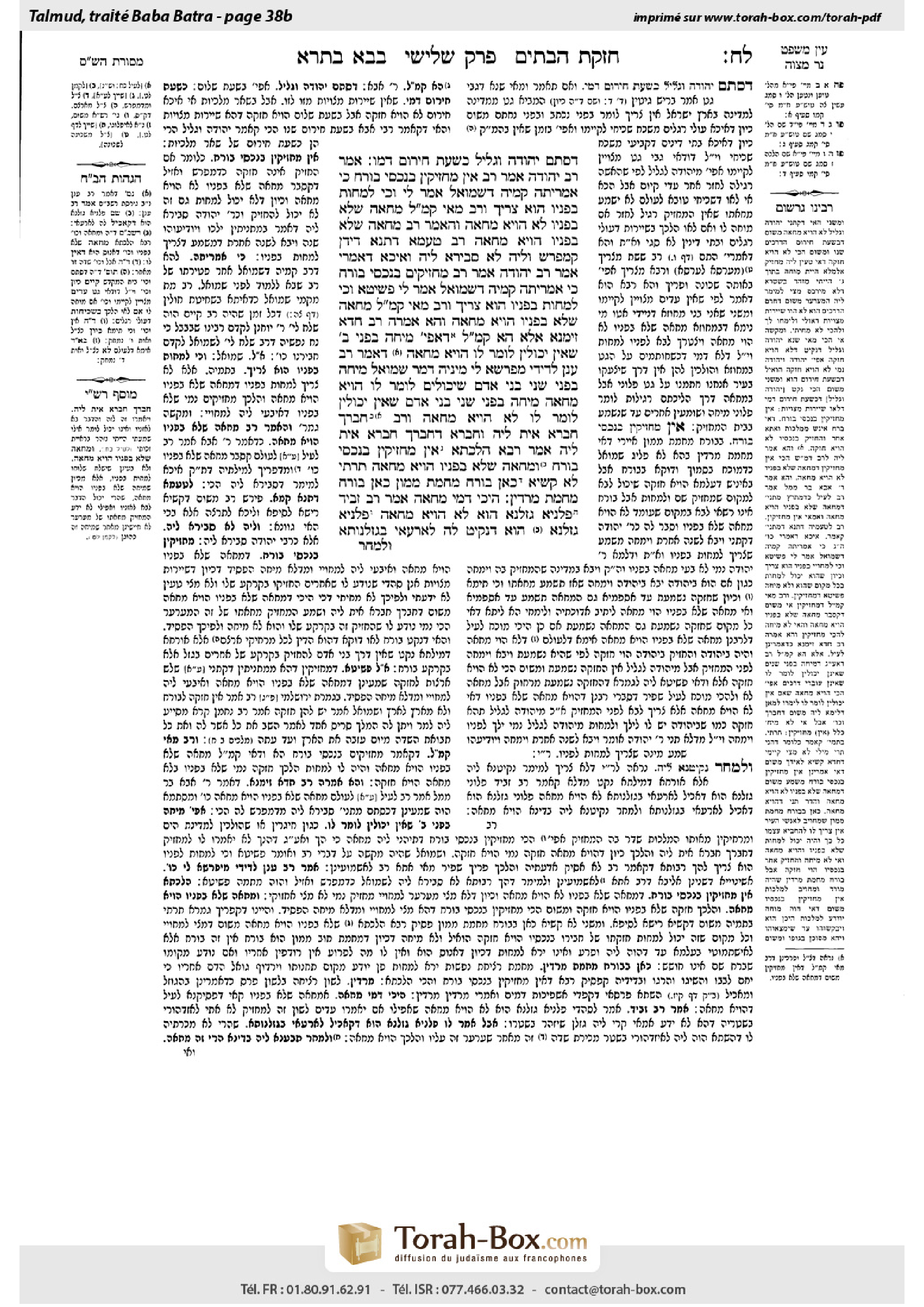
Bava Batra 38b: Talmud study for Daf Yomi
Study the Talmud for Daf Yomi with scanned pages, Hebrew text, English translations from Sefaria and AI-generated French translations.
Passage selection and English or AI-generated French translation are available where the scan has annotations. Daf Study is independent of Torah-Box and Sefaria.
Browse Bava Batra · בבא בתרא · All tractatesBava Batra 38b text and translations
This page of Bava Batra includes the Aramaic text, an English translation and an AI-generated French translation, alongside the scan above.
בבא בתרא ל״ח ב · Aramaic and Hebrew text
דִּסְתַם יְהוּדָה וּגְלִיל, כִּשְׁעַת חֵירוּם דָּמוּ.
אָמַר רַב יְהוּדָה אָמַר רַב: אֵין מַחֲזִיקִין בְּנִכְסֵי בוֹרֵחַ. כִּי אַמְרִיתַהּ קַמֵּיהּ דִּשְׁמוּאֵל, אָמַר לִי: וְכִי לִמְחוֹת בְּפָנָיו הוּא צָרִיךְ?!
וְרַב – מַאי קָא מַשְׁמַע לַן? מֶחָאָה שֶׁלֹּא בְּפָנָיו לָא הָוְיָא מֶחָאָה?! וְהָאָמַר רַב: מֶחָאָה שֶׁלֹּא בְּפָנָיו הָוְיָא מֶחָאָה! רַב – טַעְמָא דְּתַנָּא דִידַן קָמְפָרֵשׁ, וְלֵיהּ לָא סְבִירָא לֵיהּ.
וְאִיכָּא דְּאָמְרִי, אָמַר רַב יְהוּדָה אָמַר רַב: מַחֲזִיקִים בְּנִכְסֵי בוֹרֵחַ. כִּי אַמְרִיתַהּ קַמֵּיהּ דִּשְׁמוּאֵל, אֲמַר לִי: פְּשִׁיטָא! וְכִי לִמְחוֹת בְּפָנָיו הוּא צָרִיךְ?!
וְרַב – מַאי קָא מַשְׁמַע לַן? מֶחָאָה שֶׁלֹּא בְּפָנָיו הָוְיָא מֶחָאָה?! וְהָא אַמְרַהּ רַב חֲדָא זִימְנָא! אֶלָּא הָא קָא מַשְׁמַע לַן – דַּאֲפִילּוּ מִיחָה בִּפְנֵי שְׁנַיִם שֶׁאֵין יְכוֹלִין לוֹמַר לוֹ, הָוְיָא מֶחָאָה –
דְּאָמַר רַב עָנָן: לְדִידִי מִפָּרְשָׁא לִי מִינֵּיהּ דְּמָר שְׁמוּאֵל: מִיחָה בִּפְנֵי שְׁנֵי בְּנֵי אָדָם שֶׁיְּכוֹלִים לוֹמַר לוֹ – הָוְיָא מֶחָאָה, מִיחָה בִּפְנֵי שְׁנֵי בְּנֵי אָדָם שֶׁאֵין יְכוֹלִין לוֹמַר לוֹ – לָא הָוְיָא מֶחָאָה. וְרַב – חַבְרָךְ חַבְרָא אִית לֵיהּ, וְחַבְרָא דְחַבְרָךְ חַבְרָא אִית לֵיהּ.
אָמַר רָבָא, הִלְכְתָא: אֵין מַחְזִיקִין בְּנִכְסֵי בוֹרֵחַ, וּמֶחָאָה שֶׁלֹּא בְּפָנָיו הָוְיָא מֶחָאָה. תַּרְתֵּי?! לָא קַשְׁיָא; כָּאן בּוֹרֵחַ מֵחֲמַת מָמוֹן, כָּאן בּוֹרֵחַ מֵחֲמַת מְרָדִין.
הֵיכִי דָּמֵי מֶחָאָה? אָמַר רַב זְבִיד: ״פְּלָנְיָא גַּזְלָנָא הוּא״ – לָא הָוְיָא מֶחָאָה. ״פְּלָנְיָא גַּזְלָנָא הוּא, דְּנָקֵיט לַהּ לְאַרְעַאי בְּגַזְלָנוּתָא,
Bava Batra 38b · English translation
That an ordinary situation with regard to travel between Judea and the Galilee is tantamount to a period of crisis.
§ Rav Yehuda says that Rav says: One cannot establish the presumption of ownership with regard to the property of one who is fleeing, as he is unable to lodge a protest. Rav Yehuda reports: When I said this ruling before Shmuel, he disagreed and said to me: But does the owner actually have to protest in the presence of the possessor? Since that is not the case, and he can lodge a protest wherever he is, one can establish the presumption of ownership with regard to the property of one who is fleeing.
The Gemara asks: And Rav, who ruled that one cannot establish the presumption of ownership with regard to the property of one who is fleeing, what is he teaching us, that a protest that is lodged not in his presence is not a valid protest? But doesn’t Rav say: A protest that is lodged not in his presence is a valid protest? The Gemara answers: Rav was explaining the reason of the tanna of our mishna, but he himself does not hold accordingly. Rav holds, in accordance with the opinion of Rabbi Yehuda, that the protest is valid.
And there are those who say a different version of the previous discussion: Rav Yehuda says that Rav says: One can establish the presumption of ownership with regard to the property of one who is fleeing. Rav Yehuda reports: When I said this ruling before Shmuel, he said to me: Isn’t that obvious? But does the owner actually have to protest in the presence of the possessor?
The Gemara asks: And Rav, who ruled that one can establish the presumption of ownership with regard to the property of one who is fleeing, what is he teaching us, that a protest that is lodged not in his presence is a valid protest? But Rav already said this halakha one time, and he would not need to repeat it. Rather, Rav teaches us this: That even if the owner protested in the presence of two witnesses who are personally unable to tell the possessor about the protest, it is nevertheless a valid protest.
The Gemara explains: As Rav Anan said: This was explained to me personally by Shmuel himself: If the owner protested in the presence of two people who are able to personally tell the possessor, it is a valid protest, but if the owner protested in the presence of two people who are unable to personally tell the possessor, it is not a valid protest. And why does Rav hold that it is a valid protest? Because your friend who heard the protest has a friend to whom he tells about the protest, and your friend’s friend has a friend to whom he tells about the protest, and so forth. Therefore, word of the protest will reach the possessor.
Rava says: The halakha is that one cannot establish the presumption of ownership with regard to the property of one who is fleeing, and a protest that is lodged not in a possessor’s presence is a valid protest. The Gemara asks: How can he say these two statements that contradict each other? The Gemara answers: This is not difficult. Here, the second statement, is referring to a case where he is fleeing due to monetary difficulties. In such a case, he is able to ensure that the protest reaches the possessor, while there, the first statement, is referring to a case where he is fleeing due to a charge of killing [meradin]. In such a case, he is unable to publicize his protest out of fear of revealing his whereabouts.
§ The Gemara presents a series of disputes with regard to what is considered a valid protest. What manner of statement constitutes a protest? Rav Zevid said: If the owner says in general terms: So-and-so is a robber, it is not a valid protest, but if he says: So-and-so is a robber as he is holding my land through robbery,
Bava Batra 38b · Traduction française (IA)
Une situation ordinaire concernant le voyage entre Jérusalem et la Galilée équivaut à une période de crise.
§ Rav Yehuda dit que Rav dit : On ne peut pas établir la présomption d'ownership concernant la propriété d'une personne qui fuit, car il ne peut pas protester. Rav Yehuda rapporte : Lorsque j'ai dit cette décision devant Shmuel, il a désaccordé et m'a dit : Mais l'propriétaire a-t-il vraiment besoin de protester en présence du possesseur ? Puisque ce n'est pas le cas, et qu'il peut protester là où il est, on peut établir la présomption d'ownership concernant la propriété d'une personne qui fuit.
Le Guemara pose la question : Et Rav, qui a décidé que l'on ne peut pas établir la présomption d'ownership concernant la propriété d'une personne qui fuit, que nous apprend-il, que le protestation portée en dehors de sa présence n'est pas une protestation valide ? Mais ne dit-il pas Rav : Une protestation portée en dehors de sa présence est une protestation valide ? Le Guemara répond : Rav expliquait la raison du tanna de notre mitsva, mais il ne l'adopte pas lui-même. Rav considère, conformément à l'opinion de Rabbi Yehuda, que la protestation est valide.
Et il y a ceux qui disent une version différente de la discussion précédente : Rav Yehuda dit que Rav dit : On peut établir la présomption d'ownership concernant la propriété d'une personne qui fuit. Rav Yehuda rapporte : Lorsque j'ai dit cette décision devant Shmuel, il m'a dit : Ce n'est pas évident ? Mais l'owner a-t-il vraiment besoin de protester en présence du possesseur ?
Le Guemara pose la question : Et Rav, qui a décidé qu'on peut établir la présomption d'ownership concernant la propriété d'une personne qui fuit, que nous apprend-il, que la protestation portée en dehors de sa présence est une protestation valide ? Mais Rav a déjà dit cette halakha une fois, et il n'aurait pas besoin de la répéter. Plutôt, Rav nous enseigne cela : Même si l'owner a protesté en présence de deux témoins qui ne peuvent pas personnellement informer le possesseur de la protestation, il s'agit tout de même d'une protestation valide.
Le Guemara explique : Comme Rav Anan a dit : Cela m'a été expliqué personnellement par Shmuel lui-même : Si l'owner a protesté en présence de deux personnes qui peuvent personnellement informer le possesseur, il s'agit d'une protestation valide, mais si l'owner a protesté en présence de deux personnes qui ne peuvent pas personnellement informer le possesseur, il ne s'agit pas d'une protestation valide. Et pourquoi Rav considère-t-il que c'est une protestation valide ? Parce que votre ami qui a entendu la protestation a un ami à qui il raconte la protestation, et votre ami d'amis a un ami à qui il raconte la protestation, et ainsi de suite. Ainsi, le mot de la protestation parvient au possesseur.
Rava dit : La halakha est que l'on ne peut pas établir la présomption d'ownership concernant la propriété d'une personne qui fuit, et une protestation portée en dehors de la présence du possesseur est une protestation valide. Le Guemara pose la question : Comment peut-il dire ces deux déclarations qui s'opposent l'une à l'autre ? Le Guemara répond : Ce n'est pas difficile. Ici, la deuxième déclaration se réfère à un cas où il fuit en raison de difficultés financières. Dans ce cas, il peut s'assurer que la protestation parvienne au possesseur, tandis que là, la première déclaration se réfère à un cas où il fuit en raison d'une accusation de meurtre [meradin]. Dans ce cas, il ne peut pas publier sa protestation par crainte de révéler ses lieux de résidence.
§ Le Guemara présente une série de débats concernant ce qui constitue une protestation valide. Quel genre de déclaration constitue une protestation ? Rav Zevid a dit : Si l'propriétaire dit de manière générale : Tel est un voleur, ce n'est pas une protestation valide, mais s'il dit : Tel est un voleur car il tient ma terre par vol,
Traduction française générée par IA à partir de l’édition anglaise de Sefaria. Vérifie toujours un passage avec le texte source.
Text from Sefaria: William Davidson Edition - Vocalized Aramaic (CC BY NC); William Davidson Edition - English (CC BY NC).