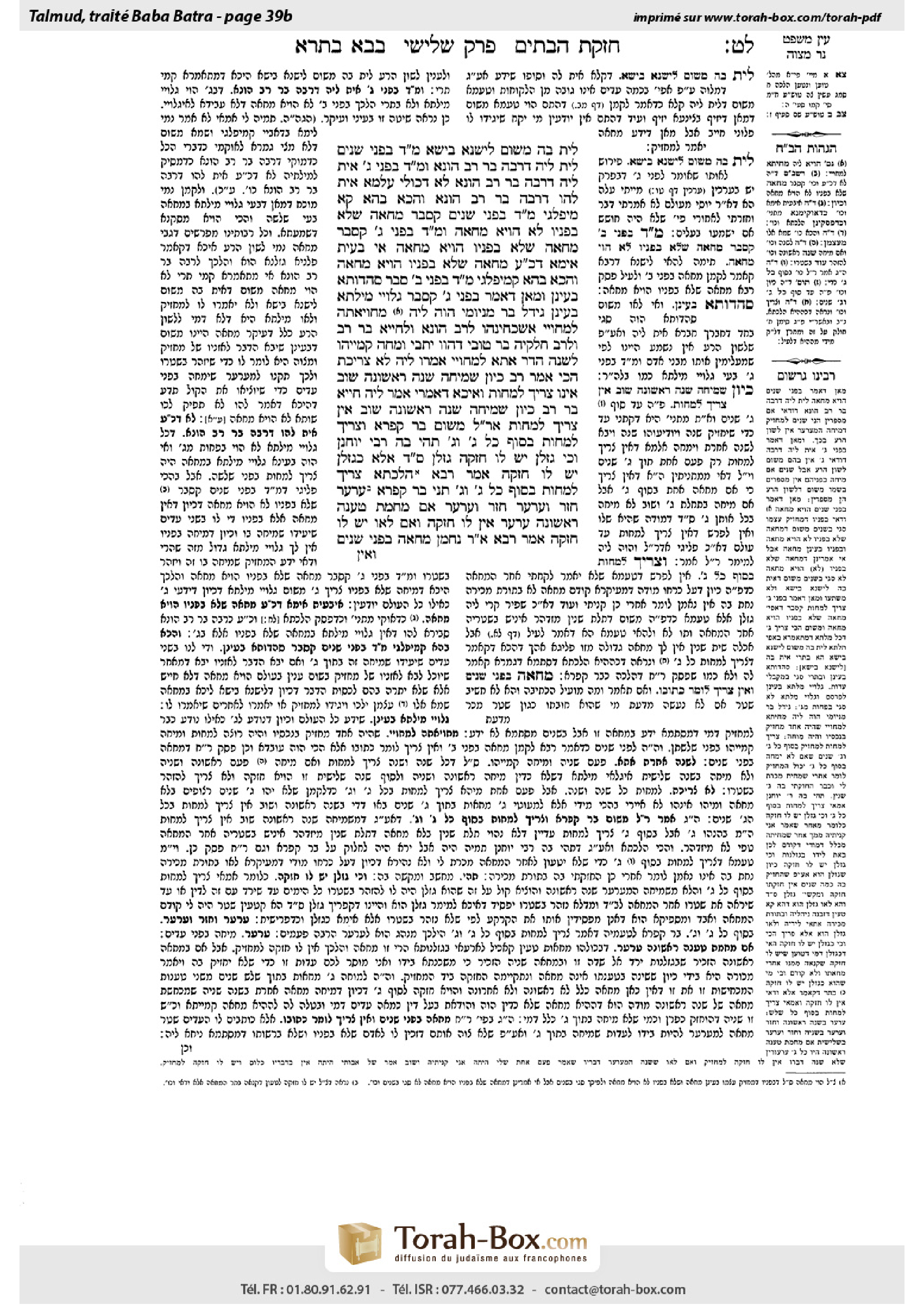
Bava Batra 39b: Talmud study for Daf Yomi
Study the Talmud for Daf Yomi with scanned pages, Hebrew text, English translations from Sefaria and AI-generated French translations.
Passage selection and English or AI-generated French translation are available where the scan has annotations. Daf Study is independent of Torah-Box and Sefaria.
Browse Bava Batra · בבא בתרא · All tractatesBava Batra 39b text and translations
This page of Bava Batra includes the Aramaic text, an English translation and an AI-generated French translation, alongside the scan above.
בבא בתרא ל״ט ב · Aramaic and Hebrew text
לֵית בָּהּ מִשּׁוּם לִישָּׁנָא בִּישָׁא; מַאן דְּאָמַר בִּפְנֵי שְׁנַיִם – לֵית לֵיהּ דְּרַבָּה בַּר רַב הוּנָא, וּמַאן דְּאָמַר בִּפְנֵי שְׁלֹשָׁה – אִית לֵיהּ דְּרַבָּה בַּר רַב הוּנָא?
לָא, דְּכוּלֵּי עָלְמָא אִית לְהוּ דְּרַבָּה בַּר רַב הוּנָא; וְהָכָא בְּהָא קָא מִיפַּלְגִי – מַאן דְּאָמַר בִּפְנֵי שְׁנַיִם, קָסָבַר: מֶחָאָה שֶׁלֹּא בְּפָנָיו לָא הָוְיָא מֶחָאָה. וּמַאן דְּאָמַר בִּפְנֵי שְׁלֹשָׁה, קָסָבַר: מֶחָאָה שֶׁלֹּא בְּפָנָיו הָוְיָא מֶחָאָה.
אִי בָּעֵית אֵימָא: דְּכוּלֵּי עָלְמָא – מֶחָאָה שֶׁלֹּא בְּפָנָיו הָוְיָא מֶחָאָה; וְהָכָא בְּהָא קָמִיפַּלְגִי – מַאן דְּאָמַר בִּפְנֵי שְׁנַיִם, סָבַר: סָהֲדוּתָא בָּעֵינַן. וּמַאן דְּאָמַר בִּפְנֵי שְׁלֹשָׁה, קָסָבַר: גַּלּוֹיֵי מִילְּתָא בָּעֵינַן.
גִּידֵּל בַּר מִנְיוֹמֵי הֲוָה לֵיהּ מַחוּיָאתָה לְמַחוֹיֵי. אַשְׁכְּחִינְהוּ לְרַב הוּנָא וּלְחִיָּיא בַּר רַב וּלְרַב חִלְקִיָּה בַּר טוֹבִי דַּהֲווֹ יָתְבִי, וּמַחָה קַמַּיְיהוּ. לְשָׁנָה – הֲדַר אֲתָא לְמַחוֹיֵי, אֲמַרוּ לֵיהּ: לָא צְרִיכַתְּ, הָכִי אָמַר רַב: כֵּיוָן שֶׁמִּיחָה שָׁנָה רִאשׁוֹנָה, שׁוּב אֵינוֹ צָרִיךְ לְמַחוֹת. וְאִיכָּא דְאָמְרִי, אֲמַר לֵיהּ חִיָּיא בַּר רַב: כֵּיוָן שֶׁמִּיחָה שָׁנָה רִאשׁוֹנָה, שׁוּב אֵין צָרִיךְ לְמַחוֹת.
אָמַר רֵישׁ לָקִישׁ מִשּׁוּם בַּר קַפָּרָא: וְצָרִיךְ לְמַחוֹת בְּסוֹף כׇּל שָׁלֹשׁ וְשָׁלֹשׁ. תָּהֵי בַּהּ רַבִּי יוֹחָנָן: וְכִי גַּזְלָן יֵשׁ לוֹ חֲזָקָה?! ״גַּזְלָן״ סָלְקָא דַּעְתָּךְ?! אֶלָּא ״כְּגַזְלָן״ יֵשׁ לוֹ חֲזָקָה.
אָמַר רָבָא: הִלְכְתָא – צָרִיךְ לְמַחוֹת בְּסוֹף כׇּל שָׁלֹשׁ וְשָׁלֹשׁ. תָּנֵי בַּר קַפָּרָא: עִרְעֵר, חָזַר וְעִרְעֵר, חָזַר וְעִרְעֵר – אִם מֵחֲמַת טַעֲנָה רִאשׁוֹנָה עִרְעֵר, אֵין לוֹ חֲזָקָה. וְאִם לָאו – יֵשׁ לוֹ חֲזָקָה.
אָמַר רָבָא אָמַר רַב נַחְמָן: מֶחָאָה – בִּפְנֵי שְׁנַיִם,
Bava Batra 39b · English translation
is not subject to the prohibition of malicious speech, as it is already public knowledge. The Gemara elaborates on the suggestion that the dispute hinges upon this point: The one who says that a protest can be lodged in the presence of two people is not of the opinion that the ruling is in accordance with the opinion of Rabba bar Rav Huna and holds that even if only two people hear of a matter it will become a matter of public knowledge. Therefore, it is sufficient to protest in the presence of two witnesses. And the one who says that a protest must be lodged in the presence of three people is of the opinion that the ruling is in accordance with the opinion of Rabba bar Rav Huna.
The Gemara rejects this suggestion: No, everyone is of the opinion that the ruling is in accordance with the opinion of Rabba bar Rav Huna, and here they disagree with regard to this: The one who says that a protest can be lodged in the presence of two people holds that a protest that is lodged not in his presence is not a valid protest. Therefore, two witnesses suffice, as they are needed to attest only to the fact that the owner protested. And the one who says that a protest must be lodged in the presence of three people holds that a protest that is lodged not in his presence is a valid protest. Since the protest can be lodged not in the possessor’s presence, three people are needed to ensure that word of the protest will reach him.
If you wish, say instead that everyone holds that a protest that is lodged not in his presence is a valid protest, and here they disagree with regard to this: The one who says that a protest can be lodged in the presence of only two people holds that we require testimony, and two are sufficient for testimony. And the one who says that a protest must be lodged in the presence of three people holds that we require that the matter of the protest be revealed, and for that purpose three people are needed.
§ The Gemara relates: Giddel bar Minyumi had a protest to lodge with regard to his property. He found Rav Huna and Ḥiyya bar Rav and Rav Ḥilkiya bar Tuvi, who were sitting, and he protested before them. After a year, he came to them again to protest. They said to him: You do not need to do so; this is what Rav says: Once the owner protested in the first year, he no longer needs to protest. And there are those who say that Ḥiyya bar Rav said to him, not in the name of Rav: Once the owner protested in the first year, he no longer needs to protest.
Reish Lakish says in the name of bar Kappara: And he needs to protest at the end of each and every period of three years, so that the possessor will not hold his property for three consecutive years uncontested. Rabbi Yoḥanan expressed surprise at this ruling of Reish Lakish and said: But does a robber have the ability to establish the presumption of ownership? Once the owner lodged one protest, he demonstrated that the possessor occupied his land unlawfully. Therefore, the possessor should never be able to establish the presumption of ownership. The Gemara clarifies: Does it enter your mind that the possessor is actually a robber? There is no evidence that he robbed, there is only a protest by the prior owner. Rather, emend his question as follows: Does one who is akin to a robber have the ability to establish the presumption of ownership?
Rava says that the halakha is: The owner needs to protest at the end of each and every period of three years. Bar Kappara teaches: If the owner protested, returned and protested, and then returned and protested, if, when he protested the later times, his protest was based on the same claim as the initial claim, the possessor has no presumptive ownership. But if the later protests were not based on the same claim as the initial protest, the possessor has presumptive ownership since each time the owner advanced a new claim, he thereby nullified his earlier claims.
§ Rava says that Rav Naḥman says: A protest can be lodged in the presence of two witnesses,
Bava Batra 39b · Traduction française (IA)
il n'est pas soumis à l'interdiction de la parole malveillante, car cela est déjà connu du public. La Guemara développe la suggestion selon laquelle le débat repose sur ce point : celui qui affirme qu'une protestation peut être portée en présence de deux personnes ne considère pas que la décision suit l'opinion de Rabba bar Rav Huna et considère que même si seulement deux personnes apprennent d'une affaire, cela devient une affaire publique. Par conséquent, il suffit de protester en présence de deux témoins. Et celui qui affirme qu'une protestation doit être portée en présence de trois personnes considère que la décision suit l'opinion de Rabba bar Rav Huna.
La Guemara rejette cette suggestion : Non, tout le monde considère que la décision suit l'opinion de Rabba bar Rav Huna, et ici ils divergent sur ce point : celui qui affirme qu'une protestation peut être portée en présence de deux personnes considère qu'une protestation portée sans sa présence n'est pas une protestation valide. Par conséquent, deux témoins suffisent, car ils sont nécessaires pour attester seulement du fait que l'owner a protesté. Et celui qui affirme qu'une protestation doit être portée en présence de trois personnes considère qu'une protestation portée sans sa présence est une protestation valide. Puisque la protestation peut être portée sans la présence du propriétaire, trois personnes sont nécessaires pour garantir que la nouvelle de la protestation parvienne à lui.
Si vous le souhaitez, dites plutôt que tout le monde considère qu'une protestation portée sans sa présence est une protestation valide, et ici ils divergent sur ce point : celui qui affirme qu'une protestation peut être portée en présence de seulement deux personnes considère que nous exigeons témoignage, et deux suffisent pour témoigner. Et celui qui affirme qu'une protestation doit être portée en présence de trois personnes considère que nous exigeons que l'affaire de la protestation soit révélée, et à cet effet, trois personnes sont nécessaires.
§ La Guemara rapporte : Giddel bar Minyumi avait une protestation à porter concernant sa propriété. Il trouva Rav Huna et Ḥiyya bar Rav et Rav Ḥilkiya bar Tuvi, qui étaient assis, et il protesta devant eux. Après un an, il revint vers eux pour protester à nouveau. Ils lui dirent : Vous n'avez pas besoin de le faire ; c'est ce que Rav dit : Une fois que l'owner a protesté dans la première année, il n'a plus besoin de protester. Et il y a ceux qui disent que Ḥiyya bar Rav lui dit, pas en nom de Rav : Une fois que l'owner a protesté dans la première année, il n'a plus besoin de protester.
Reish Lakish dit en nom de bar Kappara : Et il a besoin de protester à la fin de chaque période de trois ans, afin que le possesseur ne détienne pas sa propriété pendant trois ans consécutifs sans contestation. Rabbi Yoḥanan exprima son étonnement à l'égard de cette décision de Reish Lakish et dit : Mais un voleur a-t-il la capacité d'établir la présomption d'ownership ? Une fois que l'owner a porté une protestation, il a démontré que le possesseur occupait son terrain illégalement. Par conséquent, le possesseur ne devrait jamais pouvoir établir la présomption d'ownership. La Guemara clarifie : Entrez-vous dans l'idée que le possesseur est effectivement un voleur ? Il n'y a pas de preuve qu'il a volé, il y a seulement une protestation de l'owner précédent. Plutôt, reformulez votre question ainsi : Un individu semblable à un voleur a-t-il la capacité d'établir la présomption d'ownership ?
Rava dit que la halakha est : L'propriétaire doit protester à la fin de chaque période de trois ans. Bar Kappara enseigne : Si l'propriétaire a protesté, est revenu et a protesté, puis est revenu et a protesté, et que lorsqu'il a protesté à des moments ultérieurs, sa protestation était basée sur la même revendication que la revendication initiale, le possesseur n'a pas de présomption d'ownership. Mais si les protestations ultérieures n'étaient pas basées sur la même revendication que la protestation initiale, le possesseur a une présomption d'ownership, car chaque fois que l'propriétaire avançait une nouvelle revendication, il annulait ainsi ses revendications antérieures.
§ Rava dit que Rav Naḥman dit : Une protestation peut être portée en présence de deux témoins,
Traduction française générée par IA à partir de l’édition anglaise de Sefaria. Vérifie toujours un passage avec le texte source.
Text from Sefaria: William Davidson Edition - Vocalized Aramaic (CC BY NC); William Davidson Edition - English (CC BY NC).