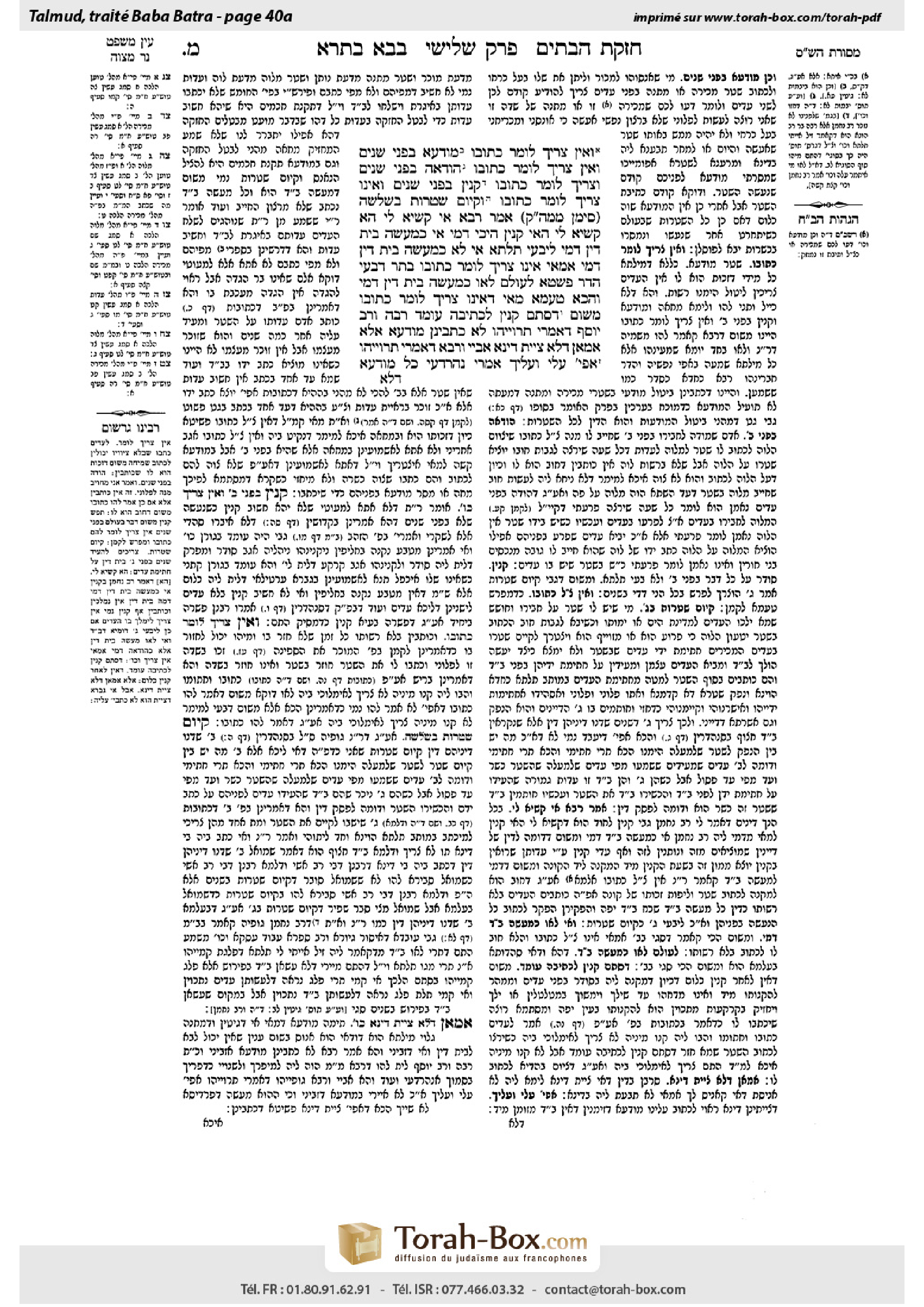
Bava Batra 40a: Talmud study for Daf Yomi
Study the Talmud for Daf Yomi with scanned pages, Hebrew text, English translations from Sefaria and AI-generated French translations.
Passage selection and English or AI-generated French translation are available where the scan has annotations. Daf Study is independent of Torah-Box and Sefaria.
Browse Bava Batra · בבא בתרא · All tractatesBava Batra 40a text and translations
This page of Bava Batra includes the Aramaic text, an English translation and an AI-generated French translation, alongside the scan above.
בבא בתרא מ׳ א · Aramaic and Hebrew text
וְאֵין צָרִיךְ לוֹמַר ״כְּתוֹבוּ״; מוֹדָעָא – בִּפְנֵי שְׁנַיִם, וְאֵין צָרִיךְ לוֹמַר ״כְּתוֹבוּ״;
הוֹדָאָה – בִּפְנֵי שְׁנַיִם, וְצָרִיךְ לוֹמַר ״כְּתוֹבוּ״; קִנְיָן – בִּפְנֵי שְׁנַיִם, וְאֵינוֹ צָרִיךְ לוֹמַר ״כְּתוֹבוּ״; וְקִיּוּם שְׁטָרוֹת בִּשְׁלֹשָׁה;
סִימָן – ממה״ק.
אָמַר רָבָא: אִי קַשְׁיָא לִי, הָא קַשְׁיָא לִי – הַאי קִנְיָן, הֵיכִי דָמֵי? אִי כְּמַעֲשֵׂה בֵּית דִּין דָּמֵי, לִיבְעֵי תְּלָתָא! אִי לָא כְּמַעֲשֵׂה בֵּית דִּין דָּמֵי, אַמַּאי אֵינוֹ צָרִיךְ לוֹמַר ״כְּתוֹבוּ״?
בָּתַר דְּבָעֵי, הֲדַר פַּשְׁטַאּ: לְעוֹלָם לָאו כְּמַעֲשֵׂה בֵּית דִּין דָּמֵי; וְהָכָא, טַעְמָא מַאי דְּאֵינוֹ צָרִיךְ לוֹמַר ״כְּתוֹבוּ״ – מִשּׁוּם דִּסְתַם קִנְיָן לִכְתִיבָה עוֹמֵד.
רַבָּה וְרַב יוֹסֵף דְּאָמְרִי תַּרְוַיְיהוּ: לָא כָּתְבִינַן מוֹדָעָא, אֶלָּא אַמַּאן דְּלָא צָיֵית דִּינָא. אַבָּיֵי וְרָבָא דְּאָמְרִי תַּרְוַיְיהוּ: אֲפִילּוּ עָלַי וְעָלֶיךָ. אָמְרִי נְהַרְדָּעֵי: כֹּל מוֹדָעָא
Bava Batra 40a · English translation
and the prior owner does not need to say to the witnesses: Write a document detailing the protest; they can write one even absent a directive. Similarly, one who desires to state a declaration, preemptively invalidating a bill of sale by notifying the court that it was executed under duress, needs to state the declaration in the presence of two witnesses, and he does not need to say to them: Write a document detailing the declaration; they can write one even absent a directive.
The Gemara continues with the statement of Rava: An admission of a monetary obligation needs to be stated in the presence of two witnesses, and in this case, the one stating the admission needs to say to the witnesses: Write a document detailing the admission, as this document is to his detriment; they may not write one absent a directive. Acquisition by means of a symbolic act utilizing a cloth needs to be done in the presence of two witnesses, and the parties do not need to say to the witnesses: Write a document detailing the acquisition; they can write one even absent a directive. And ratification of legal documents needs to be done by means of three people.
The Gemara presents a mnemonic for the cases discussed above: Mem, protest [meḥa’a]; mem, declaration [moda’a]; heh, admission [hoda’a]; kuf, acquisition [kinyan].
Rava now discusses the statement of Rav Naḥman that he quoted. Rava said: If any part of this statement is difficult to me, this is what is difficult to me. This acquisition, what is it like? If it is like an act of the court, it should require three witnesses for it to take effect, as a court must consist of at least three men. If it is not like an act of the court, why does he not have to say to the witnesses that they should write the document detailing the acquisition? Isn’t transferring an item to another tantamount to admitting a monetary obligation?
After Rava raised the dilemma, he then resolves it. Actually, it is not considered like an act of the court. And here, what is the reason that he does not have to say to the witnesses that they should write? It is due to the fact that a record of an unspecified acquisition is ready to be written. A symbolic act of acquisition indicates one’s intention to do everything possible to finalize the transaction as soon as possible without waiting for the actual transfer of the item. Therefore, it is assumed that the parties would desire that a document be written, and no explicit authorization is necessary.
§ The Gemara discusses the halakhot of a preemptive declaration. Rabba and Rav Yosef both say: We write a preemptive declaration only concerning one who does not generally listen to and implement the judgment of the court. In such a case, there is no recourse other than to write a preemptive declaration on behalf of the seller nullifying the transaction. If the buyer would be willing to listen to the court, the seller is expected to deal with the matter in court, rather than participating in the sale and writing a preemptive declaration. Abaye and Rava both say: A preemptive declaration may be written even concerning someone who is law abiding, such as for me and for you, as not every issue can be settled through the courts. The Sages of Neharde’a say: Any preemptive declaration
Bava Batra 40a · Traduction française (IA)
et l'ancien propriétaire n'a pas besoin de dire aux témoins : Écrivez un document détaillant la protestation ; ils peuvent l'écrire même sans instruction. De même, celui qui veut émettre une déclaration, annulant préalablement un contrat de vente en informant le tribunal qu'il a été signé sous la contrainte, doit émettre la déclaration en présence de deux témoins, et il n'a pas besoin de dire aux témoins : Écrivez un document détaillant la déclaration ; ils peuvent l'écrire même sans instruction.
La Guemara continue avec la déclaration de Rava : Une admission d'une obligation monétaire doit être émise en présence de deux témoins, et dans ce cas, celui qui émet l'admission doit dire aux témoins : Écrivez un document détaillant l'admission, car ce document est à son préjudice ; ils ne peuvent pas l'écrire sans instruction. L'acquisition par un acte symbolique utilisant un tissu doit être faite en présence de deux témoins, et les parties n'ont pas besoin de dire aux témoins : Écrivez un document détaillant l'acquisition ; ils peuvent l'écrire même sans instruction. Et la ratification des documents légaux doit être faite par trois personnes.
La Guemara présente un mnémonique pour les cas discutés ci-dessus : Mem, protestation [meḥa’a] ; mem, déclaration [moda’a] ; heh, admission [hoda’a] ; kuf, acquisition [kinyan].
Rava discute maintenant la déclaration de Rav Naḥman qu'il cite. Rava dit : Si une partie de cette déclaration me semble difficile, c'est ce qui me semble difficile. Cette acquisition, de quelle nature est-elle ? Si elle est comme un acte du tribunal, elle devrait nécessiter trois témoins pour être valide, car un tribunal doit être composé de trois hommes au minimum. Si elle n'est pas comme un acte du tribunal, pourquoi n'a-t-il pas besoin de dire aux témoins qu'ils doivent écrire le document détaillant l'acquisition ? N'est-ce pas transférer un objet à un autre équivalent à admettre une obligation monétaire ?
Après que Rava ait soulevé ce dilemme, il le résout ensuite. En réalité, cela n'est pas considéré comme un acte du tribunal. Et ici, quelle est la raison qu'il n'a pas besoin de dire aux témoins qu'ils doivent écrire ? C'est en raison du fait qu'un document d'acquisition indéterminée est prêt à être écrit. Un acte symbolique d'acquisition indique l'intention de faire tout ce qui est nécessaire pour finaliser la transaction aussi rapidement que possible sans attendre le transfert réel de l'objet. Par conséquent, on suppose que les parties souhaitent que le document soit écrit, et aucune autorisation explicite n'est nécessaire.
§ La Guemara discute des halakhot d'une déclaration préalable. Rabba et Rav Yosef disent tous les deux : Nous écrivons une déclaration préalable uniquement concernant celui qui ne tends généralement pas à écouter et à appliquer le jugement du tribunal. Dans ce cas, il n'y a pas de recours autre que d'écrire une déclaration préalable au nom du vendeur annulant la transaction. Si l'acheteur est prêt à écouter le tribunal, le vendeur est attendu de traiter la question devant le tribunal, plutôt que de participer à la vente et d'écrire une déclaration préalable. Abaye et Rava disent tous les deux : Une déclaration préalable peut être écrite même concernant une personne qui respecte la loi, comme pour moi et pour vous, car non toutes les questions peuvent être résolues par les tribunaux. Les Sages de Neharde’a disent : Toute déclaration préalable
Traduction française générée par IA à partir de l’édition anglaise de Sefaria. Vérifie toujours un passage avec le texte source.
Text from Sefaria: William Davidson Edition - Vocalized Aramaic (CC BY NC); William Davidson Edition - English (CC BY NC).