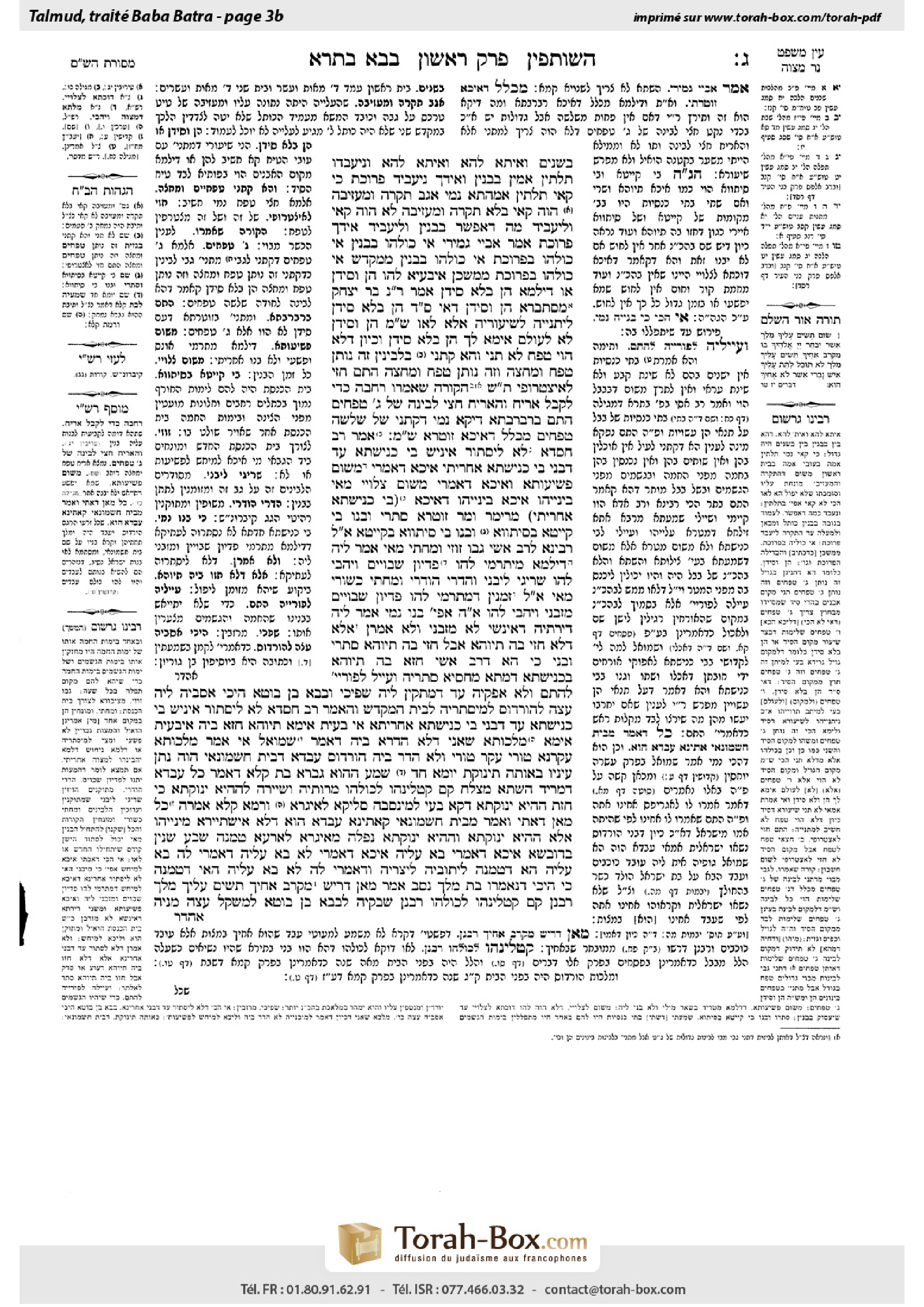
Bava Batra 3b: Talmud study for Daf Yomi
Study the Talmud for Daf Yomi with scanned pages, Hebrew text, English translations from Sefaria and AI-generated French translations.
Passage selection and English or AI-generated French translation are available where the scan has annotations. Daf Study is independent of Torah-Box and Sefaria.
Browse Bava Batra · בבא בתרא · All tractatesBava Batra 3b text and translations
This page of Bava Batra includes the Aramaic text, an English translation and an AI-generated French translation, alongside the scan above.
בבא בתרא ג׳ ב · Aramaic and Hebrew text
בְּשָׁנִים. וְאִיתָא לְהָא וְאִיתָא לְהָא.
וְנֶיעְבְּדוּ תְּלָתִין אַמִּין בְּבִנְיָן, וְאִידַּךְ נֶיעְבֵּיד פָּרוֹכֶת! כִּי קָאֵי תְּלָתִין אַמְּהָתָא נָמֵי – אַגַּב תִּקְרָה וּמַעֲזִיבָה הֲוָה קָאֵי, בְּלֹא תִּקְרָה וּמַעֲזִיבָה – לָא הֲוָה קָאֵי.
וְלֶיעְבֵּיד מָה דְאֶפְשָׁר בְּבִנְיָן, וְלֶיעְבֵּיד אִידַּךְ פָּרוֹכֶת! אָמַר אַבָּיֵי, גְּמִירִי: אִי כּוּלְּהוּ בְּבִנְיָן, אִי כּוּלְּהוּ בְּפָרוֹכֶת. אִי כּוּלְּהוּ בְּבִנְיָן – מִמִּקְדָּשׁ, אִי כּוּלְּהוּ בְּפָרוֹכֶת – מִמִּשְׁכָּן.
אִיבַּעְיָא לְהוּ: הֵן וְסִידָן, אוֹ דִילְמָא הֵן בְּלֹא סִידָן? אָמַר רַב נַחְמָן בַּר יִצְחָק, מִסְתַּבְּרָא: הֵן וְסִידָן; דְּאִי סָלְקָא דַעְתָּךְ הֵן בְּלֹא סִידָן, לִיתְנְיֵיהּ לְשִׁיעוּרֵיהּ! אֶלָּא לָאו שְׁמַע מִינַּהּ: הֵן וְסִידָן? לָא; לְעוֹלָם אֵימָא לָךְ: הֵן בְּלֹא סִידָן; וְכֵיוָן דְּלָא הָוֵי טֶפַח, לָא תָּנֵי.
וְהָא קָתָנֵי: בִּלְבֵינִין – זֶה נוֹתֵן טֶפַח וּמֶחֱצָה וְזֶה נוֹתֵן טֶפַח וּמֶחֱצָה! הָתָם חֲזִי לְאִיצְטְרוֹפֵי.
תָּא שְׁמַע: הַקּוֹרָה שֶׁאָמְרוּ – רְחָבָה כְּדֵי לְקַבֵּל אָרִיחַ, וְהָאָרִיחַ – חֲצִי לְבֵינָה שֶׁל שְׁלֹשָׁה טְפָחִים!
הָתָם בְּרַבְרְבָתָא. דַּיְקָא נָמֵי, דְּקָתָנֵי: ״שֶׁל שְׁלֹשָׁה טְפָחִים״, מִכְלָל דְּאִיכָּא זוּטְרָא; שְׁמַע מִינַּהּ.
אָמַר רַב חִסְדָּא: לֹא לִיסְתּוֹר אִינִישׁ בֵּי כְנִישְׁתָּא, עַד דְּבָנֵי בֵּי כְנִישְׁתָּא אַחֲרִיתִי. אִיכָּא דְאָמְרִי: מִשּׁוּם פְּשִׁיעוּתָא, וְאִיכָּא דְאָמְרִי: מִשּׁוּם צַלּוֹיֵי.
מַאי בֵּינַיְיהוּ? אִיכָּא בֵּינַיְיהוּ דְּאִיכָּא בֵּי כְנִישְׁתָּא אַחֲרִיתִי. מָרִימָר וּמַר זוּטְרָא סָתְרִי וּבָנוּ בֵּי קַיְיטָא בְּסִיתְווֹא, וּבָנוּ בֵּי סִיתְווֹא בְּקַיְיטָא.
אֲמַר לֵיהּ רָבִינָא לְרַב אָשֵׁי: גְּבוּ זוּזֵי וּמַחֲתִי, מַאי? אֲמַר לֵיהּ: דִּילְמָא מִיתְרְמֵי לְהוּ פִּדְיוֹן שְׁבוּיִים, וְיָהֲבִי לְהוּ.
שְׁרִיגִי לִיבְנֵי, וְהָדְרִי הוּדְרֵי, וּמַחֲתִי כְּשׁוּרֵי, מַאי? אֲמַר לֵיהּ: זִמְנִין דְּמִתְרְמֵי לְהוּ פִּדְיוֹן שְׁבוּיִים, מְזַבְּנִי וְיָהֲבִי לְהוּ. אִי הָכִי, אֲפִילּוּ בָּנוּ נָמֵי! אֲמַר לֵיהּ: דִּירְתֵיהּ דְּאִינָשֵׁי לָא מְזַבְּנִי.
וְלָא אֲמַרַן אֶלָּא דְּלָא חָזֵי בָּהּ תִּיוְהָא, אֲבָל חָזֵי בָּהּ תִּיוְהָא – סָתְרִי וּבָנֵי. כִּי הָא דְּרַב אָשֵׁי חֲזָא בָּהּ תִּיוְהָא בִּכְנִישְׁתָּא דְּמָתָא מַחְסֵיָא, סַתְרֵיהּ וְעַיֵּיל לְפוּרְיֵיהּ לְהָתָם, וְלָא אַפְּקֵיהּ עַד דִּמְתַקֵּין לֵיהּ שְׁפִיכֵי.
וּבָבָא בֶּן בּוּטָא, הֵיכִי אַסְּבֵיהּ לֵיהּ עֵצָה לְהוֹרְדוֹס לְמִיסְתְּרֵיהּ לְבֵית הַמִּקְדָּשׁ? וְהָאָמַר רַב חִסְדָּא: לָא לִיסְתּוֹר אִינִישׁ בֵּי כְנִישְׁתָּא עַד דְּבָנֵי בֵּי כְנִישְׁתָּא אַחְרִיתָא! אִי בָּעֵית אֵימָא: תִּיוְהָא חֲזָא בֵּיהּ, אִיבָּעֵית אֵימָא: מַלְכוּתָא שָׁאנֵי, דְּלָא הָדְרָא בֵּיהּ; דְּאָמַר שְׁמוּאֵל, אִי אָמַר מַלְכוּתָא: ״עָקַרְנָא טוּרֵי״ – עָקַר טוּרֵי וְלָא הָדַר בֵּיהּ.
הוֹרְדוֹס עַבְדָּא דְּבֵית חַשְׁמוֹנַאי הֲוָה. נָתַן עֵינָיו בְּאוֹתָהּ תִּינוֹקֶת. יוֹמָא חַד, שְׁמַע הָהוּא גַּבְרָא בַּת קָלָא דְּאָמַר: כָּל עַבְדָּא דְּמָרֵיד הַשְׁתָּא, מַצְלַח. קָם קַטְלִינְהוּ לְכוּלְּהוּ מָרְוָתֵיהּ, וְשַׁיְּירַהּ לְהַהִיא יָנוֹקְתָּא. כִּי חֲזָת הָהִיא יָנוֹקְתָּא דְּקָא בָּעֵי לְמִינְסְבַהּ, סְלִיקָא לְאִיגָּרָא, וּרְמָא קָלָא אֲמַרָה: ״כֹּל מַאן דְּאָתֵי וְאָמַר: מִבֵּית חַשְׁמוֹנַאי קָאָתֵינָא – עַבְדָּא הוּא, דְּלָא אִישְׁתְּיַירָא מִינַּיְיהוּ אֶלָּא הַהִיא יָנוֹקְתָּא, וְהַהִיא יָנוֹקְתָּא נְפַלָה מֵאִיגָּרָא לְאַרְעָא״.
טַמְנַהּ שְׁבַע שְׁנִין בְּדוּבְשָׁא. אִיכָּא דְּאָמְרִי: בָּא עָלֶיהָ, אִיכָּא דְאָמְרִי: לָא בָּא עָלֶיהָ. דְּאָמְרִי לַהּ בָּא עָלֶיהָ, הָא דְּטַמְנַהּ – לְיַתּוֹבֵיהּ לְיִצְרֵיהּ. וּדְאָמְרִי לַהּ לֹא בָּא עָלֶיהָ, הַאי דְּטַמְנַהּ – כִּי הֵיכִי דְּנֵאמְרוּ: בַּת מֶלֶךְ נְסַב.
אֲמַר: מַאן דָּרֵישׁ ״מִקֶּרֶב אַחֶיךָ תָּשִׂים עָלֶיךָ מֶלֶךְ״? רַבָּנַן. קָם קַטְלִינְהוּ לְכוּלְּהוּ רַבָּנַן, שַׁבְקֵיהּ לְבָבָא בֶּן בּוּטָא לְמִשְׁקַל עֵצָה מִנֵּיהּ.
Bava Batra 3b · English translation
that it will be greater in years, meaning that the Second Temple will stand for a longer period of time than the First Temple. And the Gemara comments that this is true and that is true, meaning that the Second Temple was taller than the First Temple and also stood for a longer period of time.
The Gemara asks: If so, if the Second Temple building was taller, then to separate between the Holy of Holies and the Sanctuary in the Second Temple they should have made a wall thirty cubits high and then made a curtain for the rest of the height, the seventy-cubit difference in height between the First and Second Temples. The Gemara answers: This would have been impossible, as even when a thirty-cubit wall that is six handbreadths thick stands, it is due to the ceiling and plaster which attaches it to the ceiling that it stands. But without a ceiling and plaster holding it in place, it does not stand.
The Gemara continues: But they should have made a wall as high as can possibly stand by itself, and then should have made a curtain for the rest of the height. Abaye said: The Sages learned as a tradition that the partition separating the Holy of Holies from the Sanctuary should be built either entirely as a wall or entirely as a curtain. It should be built either entirely as a wall, as is learned from the First Temple, or it should be built entirely as a curtain, as is learned from the Tabernacle. At no time, however, was there a partition that combined a wall and a curtain.
§ A dilemma was raised before the Sages: Do the measurements given in the mishna apply to them, the thickness of the materials themselves, and the plaster with which the materials were coated, or perhaps just to them without their plaster? Rav Naḥman bar Yitzḥak said: It is reasonable to say the measurements refer to them and their plaster, as, if it should enter your mind to say they refer to them without their plaster, then the tanna should have taught the measurements of the plaster as well. Rather, isn’t it correct to conclude from here that the measurements refer to them and their plaster? The Gemara rejects this conclusion: No, actually I could say to you that they apply to them without their plaster, and since the plaster does not have the thickness of one handbreadth the tanna did not teach such a small measurement.
The Gemara asks: But doesn’t the tanna teach with regard to bricks that this one provides one and a half handbreadths, and that one provides one and a half handbreadths? Evidently, the tanna lists even an amount less than one handbreadth. The Gemara answers: There mention is made of half-handbreadths because they are fit to be combined into a full handbreadth.
The Gemara suggests: Come and hear a solution to the question, from a mishna (Eiruvin 13b) in which it is taught: The cross beam, which the Sages stated may be used to render an alleyway fit for one to carry within it on Shabbat, must be wide enough to receive and hold a small brick. And this small brick is half a large brick, the width of which is three handbreadths. That mishna is referring to a brick without the plaster.
The Gemara answers: There, the mishna in Eiruvin is referring to large bricks that measure three full handbreadths, whereas here the mishna is referring to bricks that measure slightly less than three handbreadths, and the measurement of three handbreadths includes the plaster with which they are coated. The Gemara comments: The language of the mishna there is also precise, as it teaches about a brick of three handbreadths, from which one can conclude by inference that there exists also a smaller-sized brick. The Gemara affirms: Learn from here that the mishna there is referring to large bricks.
§ Rav Ḥisda says: A person may not demolish a synagogue until he first builds another synagogue to take its place. There are those who say that the reason for this halakha is due to potential negligence, lest he fail to build a new structure after the old one has been razed. And there are those who say that the reason for this halakha is due to the disruption of prayer, for in the meantime there will be nowhere to pray.
The Gemara asks: What is the practical difference between these two explanations? The Gemara answers that there is a difference between them in a situation where there is another synagogue. Even though the community has an alternative place to pray there is still a concern that the new synagogue will never get built. It is related that Mareimar and Mar Zutra demolished and built a summer synagogue in the winter, and, in like manner, they built a winter synagogue in the summer, so that the community would never be left without a synagogue.
Ravina said to Rav Ashi: What is the halakha if money for the construction of a new synagogue has already been collected and it rests before us for that purpose? Is it then permitted to demolish the old synagogue before building the new one? Rav Ashi said to him: Even if the money has been collected there is still concern that perhaps an opportunity for redeeming captives will present itself, and they will hand over the money for that urgent requirement, and the community will be left without a synagogue.
Ravina continues: What is the halakha if the bricks to be used for the construction of the new synagogue are piled up, the boards are prepared, and the beams are ready? Is it permitted to demolish the old synagogue before building the new one? Rav Ashi said to him: Even so, sometimes an opportunity for redeeming captives will present itself, and they will sell the building materials and hand over the proceeds for this purpose. Ravina raises an objection: If so, that is, if you are concerned that they will sell the materials to redeem captives, then even in a case where they already built the synagogue there should be a concern that they might come to sell the structure for that purpose, and therefore one should never be permitted to destroy an old synagogue. Rav Ashi said to him: People do not sell their residences, and certainly not their synagogues.
The Gemara comments: And we said that an old synagogue must not be razed before its replacement is built only in a case where cracks are not seen in the old synagogue. But if cracks are seen they may first demolish the old synagogue and then build the new one. This is like the incident involving Rav Ashi, who saw cracks in the synagogue in his town of Mata Meḥasya and immediately demolished it. He then brought his bed in there, to the building site, so that there should be no delays in the construction, as he himself required shelter from the rain, and he did not remove his bed from there until they finished building the synagogue and even affixed drainpipes to the structure.
The Gemara asks: How could Bava ben Buta have advised Herod to raze the Temple and build another in its place, as will be described later? But doesn’t Rav Ḥisda say that a person must not demolish a synagogue unless he first builds another synagogue to take its place? The Gemara answers: If you wish, say that he saw cracks in the old Temple structure. And if you wish, say that actions taken by the government are different, as the government does not go back on its decisions. Therefore, there is no need to be concerned about negligence, as there is in the case of ordinary people. As Shmuel says: If the government says it will uproot mountains, it will uproot mountains and not retract its word.
§ The Gemara elaborates on the episode involving Bava ben Buta. Herod was a slave in the house of the Hasmoneans. He set his eyes upon a certain young girl from the house of the Hasmoneans. One day that man, Herod, heard a Divine Voice that said: Any slave who rebels now will succeed. He rose up and killed all his masters, but spared that girl. When that girl saw that he wanted to marry her, she went up to the roof and raised her voice, and said: Whoever comes and says: I come from the house of the Hasmoneans, is a slave, since only that girl, i.e., I, remained from them. And that girl fell from the roof to the ground and died.
It is related that Herod preserved the girl’s body in honey for seven years to prevent it from decaying. There are those who say that he engaged in necrophilia with her corpse and there are those who say he did not engage in necrophilia with her corpse. According to those who say he engaged in necrophilia with her corpse, the reason that he preserved her body was to gratify his carnal desires. And according to those who say he did not engage in necrophilia with her corpse, the reason that he preserved her body was so that people would say he married a king’s daughter.
Herod said to himself: Who expounds the verse: “One from among your brothers you shall set as king over you” (Deuteronomy 17:15) as meaning that he who is appointed as king must come from a Jewish family and cannot be an emancipated slave or a convert? It is the Sages who expound the verse in this manner, insisting that a king must have Jewish roots. He then rose up and killed all the Sages, but spared Bava ben Buta in order to take counsel with him.
Bava Batra 3b · Traduction française (IA)
que cela signifie que le Temple Second restera debout plus longtemps que le Temple Premier. Et la Guemara commente que cela est vrai et que cela est vrai, c'est-à-dire que le Temple Second était plus haut que le Temple Premier et qu'il restera debout plus longtemps également.
La Guemara pose la question : Si c'est ainsi, c'est-à-dire si le Temple Second était plus haut, alors pour séparer entre le Saint des Saints et le Saint des Saints dans le Temple Second, ils auraient dû construire un mur de trente coudées de haut et ensuite faire un rideau pour la hauteur restante, soit la différence de soixante-dix coudées entre le Temple Premier et le Temple Second. La Guemara répond : Cela aurait été impossible, car même lorsqu'un mur de trente coudées d'épaisseur six paumes est construit, il est tenu debout grâce au plafond et au plâtre qui le maintiennent. Mais sans plafond et plâtre, il ne reste pas debout.
La Guemara continue : Mais ils auraient dû construire un mur aussi haut que possible, et ensuite faire un rideau pour la hauteur restante. Abaye dit : Les Sages ont appris en tradition que la séparation entre le Saint des Saints et le Saint des Saints devait être construite soit entièrement comme un mur, soit entièrement comme un rideau. Elle devait être construite soit entièrement comme un mur, comme on l'apprend du Temple Premier, soit entièrement comme un rideau, comme on l'apprend du Tabernacle. Cependant, à aucun moment n'a-t-il existé une séparation combinant un mur et un rideau.
§ Un dilemme a été soulevé devant les Sages : Les mesures données dans la Michna s'appliquent-elles à la matière elle-même et au plâtre avec lequel elle est recouverte, ou peut-être seulement à la matière sans le plâtre ? Rav Naḥman bar Yitzḥak dit : Il est raisonnable de dire que les mesures s'appliquent à la matière et au plâtre, car, si l'idée vous vient de dire qu'elles s'appliquent à la matière seule, alors le tanna aurait dû enseigner les mesures du plâtre également. Plutôt, n'est-ce pas correct de conclure d'ici que les mesures s'appliquent à la matière et au plâtre ? La Guemara rejette cette conclusion : Non, en réalité, je pourrais dire à vous qu'elles s'appliquent à la matière seule, et puisque le plâtre n'a pas une épaisseur d'une paume, le tanna n'a pas enseigné une mesure aussi petite.
La Guemara pose la question : Mais ne dit pas le tanna, concernant les briques, que celle-ci fournit un et demi paumes, et celle-ci un et demi paumes ? Évidemment, le tanna mentionne même une quantité inférieure à une paume. La Guemara répond : L'expression fait référence à des demi-paumes, car elles sont adaptées à être combinées en une paume complète.
La Guemara suggère : Viens entendre une solution à cette question, à partir d'une Michna (Eiruvin 13b) dans laquelle il est enseigné : La traverse, que les Sages ont déclaré pouvoir être utilisée pour rendre un passage adapté à la marche le sabbat, doit être large suffisamment pour recevoir et tenir une petite brique. Et cette petite brique est la moitié d'une grande brique, dont la largeur est de trois paumes. Cette Michna fait référence à une brique sans plâtre.
La Guemara répond : Là, la Michna d'Eiruvin fait référence à des briques grandes mesurant trois paumes entières, tandis que celle-ci fait référence à des briques mesurant légèrement moins de trois paumes, et la mesure de trois paumes inclut le plâtre avec lequel elles sont recouvertes. La Guemara commente : La langue de la Michna là-bas est aussi précise, car elle enseigne sur une brique de trois paumes, d'où l'on peut conclure par déduction qu'il existe aussi une brique plus petite. La Guemara affirme : Apprends-en ici que la Michna là-bas fait référence à des briques grandes.
§ Rav Ḥisda dit : On ne peut pas détruire une synagogue avant d'avoir construit une autre pour la remplacer. Certains disent que la raison de cette halakha est due à un risque de négligence, de crainte qu'il ne construise pas une nouvelle structure après que l'ancienne ait été détruite. Et d'autres disent que la raison de cette halakha est due à la perturbation de la prière, car pendant ce temps, il n'y aura nulle part où prier.
La Guemara pose la question : Quelle est la différence pratique entre ces deux explications ? La Guemara répond que cette différence existe dans un cas où il y a une autre synagogue. Même si la communauté a un lieu alternatif pour prier, il y a toujours une crainte que la nouvelle synagogue ne soit jamais construite. Il est rapporté que Mareimar et Mar Zutra ont détruit et construit une synagogue d'été en hiver, et, de même, ils ont construit une synagogue d'hiver en été, afin que la communauté ne soit jamais laissée sans synagogue.
Ravina dit à Rav Ashi : Quelle est la halakha si les fonds pour la construction d'une nouvelle synagogue ont déjà été collectés et sont destinés à cet effet ? Est-il alors permis de détruire la synagogue ancienne avant de construire la nouvelle ? Rav Ashi dit à lui : Même si les fonds ont été collectés, il y a toujours une crainte que l'occasion de racheter des captifs se présente, et qu'ils remettent les fonds pour cette nécessité urgente, et la communauté restera sans synagogue.
Ravina continue : Quelle est la halakha si les briques à utiliser pour la construction de la nouvelle synagogue sont empilées, les planches sont préparées et les poutres sont prêtes ? Est-il permis de détruire la synagogue ancienne avant de construire la nouvelle ? Rav Ashi dit à lui : Même ainsi, parfois l'occasion de racheter des captifs se présente, et ils vendent les matériaux de construction et remettent les recettes pour cette raison. Ravina soulève un objection : Si c'est ainsi, c'est-à-dire si vous avez peur qu'ils vendent les matériaux pour racheter des captifs, alors même dans le cas où ils ont déjà construit la synagogue, il devrait y avoir une crainte qu'ils puissent vendre la structure à cette fin, et donc on ne devrait jamais être autorisé à détruire une synagogue ancienne. Rav Ashi dit à lui : Les gens ne vendent pas leurs résidences, et certainement pas leurs synagogues.
La Guemara commente : Et nous avons dit qu’une synagogue ancienne ne doit pas être détruite avant que sa remplaçante ne soit construite, uniquement dans le cas où les fissures ne sont pas visibles dans la synagogue ancienne. Mais si les fissures sont visibles, on peut d’abord détruire la synagogue ancienne et ensuite construire la nouvelle. C’est comme l’incident concernant Rav Ashi, qui a vu des fissures dans la synagogue de sa ville de Mata Meḥasya et a immédiatement détruit celle-ci. Il a ensuite apporté son lit là, au site de construction, afin qu’il n’y ait pas de retards dans la construction, car lui-même avait besoin de se protéger de la pluie, et il n’a pas retiré son lit d’là jusqu’à ce qu’ils aient fini de construire la synagogue et même installé des canalisations d’évacuation sur la structure.
La Guemara pose la question : Comment Bava ben Buta a-t-il pu conseiller à Hérode de détruire le Temple et de construire un autre à sa place, comme cela sera décrit plus tard ? Mais ne dit pas Rav Ḥisda que personne ne doit détruire une synagogue sans avoir d’abord construit une autre à sa place ? La Guemara répond : Si tu veux, dis qu’il a vu des fissures dans la structure du Temple ancien. Et si tu veux, dis que les actions du gouvernement sont différentes, car le gouvernement ne recule pas sur ses décisions. Ainsi, il n’est pas nécessaire de s’inquiéter de la négligence, comme c’est le cas pour les gens ordinaires. Comme Shmuel dit : Si le gouvernement dit qu’il va détruire des montagnes, il détruirait des montagnes et ne reculera pas.
§ La Guemara développe l’incident concernant Bava ben Buta. Hérode était un esclave dans la maison des Hasmoneens. Il fixa son regard sur une jeune fille de la maison des Hasmoneens. Un jour, ce homme, Hérode, entendit une Voix Divine qui disait : Tout esclave qui se rebelle maintenant réussira. Il se leva et tua tous ses maîtres, mais préserva cette fille. Lorsque cette fille vit qu’il voulait l’épouser, elle monta sur le toit et éleva la voix, et dit : Qui vient et dit : Je viens de la maison des Hasmoneens, est un esclave, car seule cette fille, c’est-à-dire moi, reste de leur lignée. Et cette fille tomba du toit au sol et mourut.
On raconte que Hérode conserva le corps de la fille dans du miel pendant sept ans pour l’empêcher de se dégrader. Certains disent qu’il a eu des relations avec son cadavre et d’autres disent qu’il n’a pas eu de relations avec son cadavre. Selon ceux qui disent qu’il a eu des relations avec son cadavre, la raison pour laquelle il a conservé son corps était de satisfaire ses désirs charnels. Et selon ceux qui disent qu’il n’a pas eu de relations avec son cadavre, la raison pour laquelle il a conservé son corps était afin que les gens disent qu’il avait épousé une fille royale.
Hérode se dit : Qui interprète la parole : « Tu établiras parmi tes frères un roi sur toi » (Deutéronome 17:15) comme signifiant que celui qui est élu roi doit venir d’une famille juive et ne peut pas être un esclave libéré ou un converti ? Ce sont les Sages qui interprètent ainsi la parole, insistant sur le fait qu’un roi doit avoir des origines juives. Il se leva alors et tua tous les Sages, mais préserva Bava ben Buta afin de lui demander son avis.
Traduction française générée par IA à partir de l’édition anglaise de Sefaria. Vérifie toujours un passage avec le texte source.
Text from Sefaria: William Davidson Edition - Vocalized Aramaic (CC BY NC); William Davidson Edition - English (CC BY NC).