Bava Batra 4a: Talmud study for Daf Yomi
Study the Talmud for Daf Yomi with scanned pages, Hebrew text, English translations from Sefaria and AI-generated French translations.
Passage selection and English or AI-generated French translation are available where the scan has annotations. Daf Study is independent of Torah-Box and Sefaria.
Browse Bava Batra · בבא בתרא · All tractatesBava Batra 4a text and translations
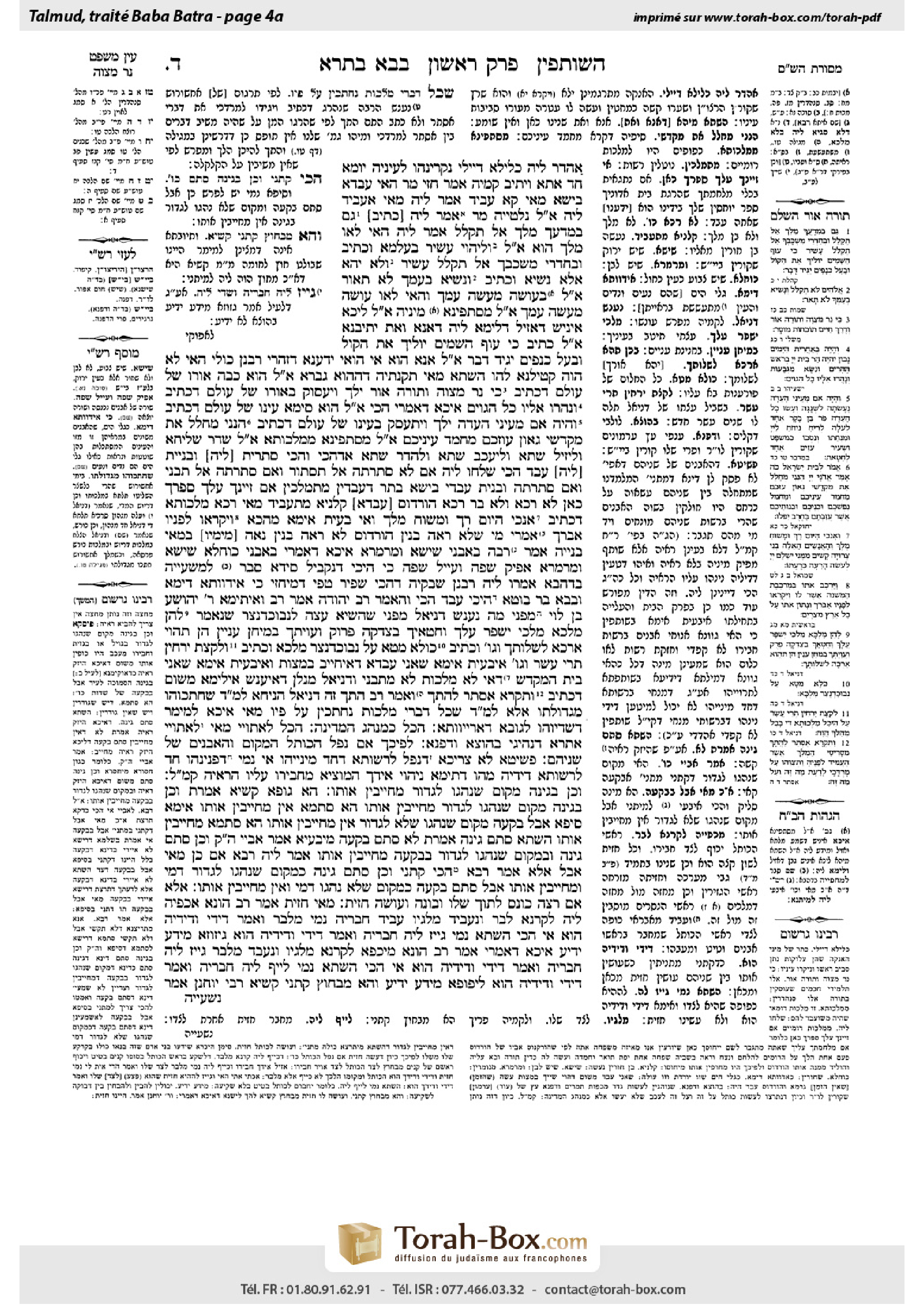
This page of Bava Batra includes the Aramaic text, an English translation and an AI-generated French translation, alongside the scan above.
בבא בתרא ד׳ א · Aramaic and Hebrew text
אַהְדַּר לֵיהּ כְּלִילָא דְּיָילֵי, נַקְּרִינְהוּ לְעֵינֵיהּ. יוֹמָא חַד אֲתָא וִיתִיב קַמֵּיהּ, אֲמַר: חֲזִי מַר, הַאי עַבְדָּא בִּישָׁא מַאי קָא עָבֵיד! אֲמַר לֵיהּ: מַאי אֶעֱבֵיד לֵיהּ? אֲמַר לֵיהּ: נִלְטְיֵיהּ מָר! אֲמַר לֵיהּ: כְּתִיב ״גַּם בְּמַדָּעֲךָ, מֶלֶךְ אַל תְּקַלֵּל״. אֲמַר לֵיהּ: הַאי לָאו מֶלֶךְ הוּא! אֲמַר לֵיהּ: וְלִיהְוֵי עָשִׁיר בְּעָלְמָא, וּכְתִיב: ״וּבְחַדְרֵי מִשְׁכָּבְךָ אַל תְּקַלֵּל עָשִׁיר״; וְלֹא יְהֵא אֶלָּא נָשִׂיא, וּכְתִיב: ״וְנָשִׂיא בְעַמְּךָ לֹא תָאֹר״.
אֲמַר לֵיהּ: בְּעוֹשֶׂה מַעֲשֵׂה עַמְּךָ, וְהַאי לָאו עוֹשֶׂה מַעֲשֵׂה עַמְּךָ! אֲמַר לֵיהּ: מִסְתְּפֵינָא מִינֵּיהּ. אֲמַר לֵיהּ: לֵיכָּא אִינִישׁ דְּאָזֵיל דְּלֵימָא לֵיהּ, דַּאֲנָא וְאַתְּ יָתֵיבְנָא. אֲמַר לֵיהּ, כְּתִיב: ״כִּי עוֹף הַשָּׁמַיִם יוֹלִיךְ אֶת הַקּוֹל וּבַעַל כְּנָפַיִם יַגֵּיד דָּבָר״.
אֲמַר לֵיהּ: אֲנָא הוּא, אִי הֲוַאי יָדַעְנָא דִּזְהִרִי רַבָּנַן כּוּלֵּי הַאי, לָא הֲוָה קָטֵילְנָא לְהוּ; הַשְׁתָּא מַאי תַּקַּנְתֵּיהּ דְּהָהוּא גַּבְרָא? אֲמַר לֵיהּ: הוּא כִּבָּה אוֹרוֹ שֶׁל עוֹלָם, דִּכְתִיב: ״כִּי נֵר מִצְוָה וְתוֹרָה אוֹר״, יֵלֵךְ וְיַעֲסוֹק בְּאוֹרוֹ שֶׁל עוֹלָם, דִּכְתִיב: ״וְנָהֲרוּ אֵלָיו כָּל הַגּוֹיִם״. אִיכָּא דְּאָמְרִי, הָכִי אֲמַר לֵיהּ: הוּא סִימֵּא עֵינוֹ שֶׁל עוֹלָם, דִּכְתִיב: ״וְהָיָה אִם מֵעֵינֵי הָעֵדָה״, יֵלֵךְ וְיִתְעַסֵּק בְּעֵינוֹ שֶׁל עוֹלָם, דִּכְתִיב: ״הִנְנִי מְחַלֵּל אֶת מִקְדָּשִׁי, גְּאוֹן עֻזְּכֶם מַחְמַד עֵינֵיכֶם״.
אֲמַר לֵיהּ: מִסְתְּפֵינָא מִמַּלְכוּתָא. אֲמַר לֵיהּ: שַׁדַּר שְׁלִיחָא; וְלֵיזִיל שַׁתָּא, וְלִיעַכַּב שַׁתָּא, וְלֶהְדַּר שַׁתָּא; אַדְּהָכִי וְהָכִי סָתְרַיתְּ [לֵיהּ] וּבָנְיַית [לֵיהּ]. עֲבַד הָכִי. שְׁלַחוּ לֵיהּ: אִם לֹא סָתַרְתָּה – אַל תִּסְתּוֹר; וְאִם סָתַרְתָּה – אַל תִּבְנֵי; וְאִם סָתַרְתָּה וּבָנִיתָ – עַבְדֵי בִּישָׁא, בָּתַר דְּעָבְדִין מִתְמַלְכִין. אִם זַיְינָךְ עֲלָךְ, סִפְרָךְ כָּאן – לָא רֵכָא וְלָא בַּר רֵכָא, הוֹרְדוֹס [עַבְדָּא] קָלָנְיָא מִתְעֲבִיד.
מַאי ״רֵכָא״? מַלְכוּתָא – דִּכְתִיב: ״אָנֹכִי הַיּוֹם רַךְ וּמָשׁוּחַ מֶלֶךְ״. וְאִי בָּעֵית אֵימָא, מֵהָכָא: ״וַיִּקְרְאוּ לְפָנָיו אַבְרֵךְ״.
אָמְרִי: מִי שֶׁלֹּא רָאָה בִּנְיַן הוֹרְדוֹס, לֹא רָאָה בִּנְיָן נָאֶה [מִיָּמָיו]. בְּמַאי בַּנְיֵיהּ? אָמַר רַבָּה: בְּאַבְנֵי שִׁישָׁא וּמַרְמְרָא. אִיכָּא דְּאָמְרִי: בְּאַבְנֵי כּוּחְלָא, שִׁישָׁא וּמַרְמְרָא. אַפֵּיק שָׂפָה וְעַיֵּיל שָׂפָה, כִּי הֵיכִי דִּנְקַבֵּיל סִידָא. סְבַר לְמִשְׁעֲיֵיהּ בְּדַהֲבָא, אֲמַרוּ לֵיהּ רַבָּנַן: שִׁבְקֵיהּ, דְּהָכִי שַׁפִּיר טְפֵי, דְּמִיחְזֵי כִּי אִידְווֹתָא דְיַמָּא.
וּבָבָא בַּר בּוּטָא הֵיכִי עֲבַד הָכִי? וְהָאָמַר רַב יְהוּדָה אָמַר רַב, וְאִיתֵּימָא רַבִּי יְהוֹשֻׁעַ בֶּן לֵוִי: מִפְּנֵי מָה נֶעֱנַשׁ דָּנִיֵּאל? מִפְּנֵי שֶׁהִשִּׂיא עֵצָה לִנְבוּכַדְנֶצַּר, שֶׁנֶּאֱמַר: ״לָהֵן מַלְכָּא, מִלְכִּי יִשְׁפַּר עֲלָךְ, וַחֲטָאָיךְ בְּצִדְקָה פְרֻק, וַעֲוָיָתָךְ בְּמִחַן עֲנָיִן, הֵן תֶּהֱוֵי אַרְכָא לִשְׁלֵוְתָךְ וְגוֹ׳״, וּכְתִיב: ״כֹּלָּא מְּטָא עַל נְבוּכַדְנֶצַּר מַלְכָּא״, וּכְתִיב: ״וְלִקְצָת יַרְחִין תְּרֵי עֲשַׂר וְגוֹ׳״!
אִיבָּעֵית אֵימָא: שָׁאנֵי עַבְדָּא, דְּאִיחַיַּיב בְּמִצְוֹת. וְאִיבָּעֵית אֵימָא: שָׁאנֵי בֵּית הַמִּקְדָּשׁ, דְּאִי לָא מַלְכוּת – לָא מִתְבְּנֵי.
וְדָנִיֵּאל – מְנָלַן דְּאִיעֲנַשׁ? אִילֵּימָא מִשּׁוּם דִּכְתִיב: ״וַתִּקְרָא אֶסְתֵּר לַהֲתָךְ״, וְאָמַר רַב: הֲתָךְ – זֶה דָּנִיאֵל; הָנִיחָא לְמַאן דְּאָמַר: ״שֶׁחֲתָכוּהוּ מִגְּדוּלָּתוֹ״, אֶלָּא לְמַאן דְּאָמַר: ״שֶׁכׇּל דִּבְרֵי מַלְכוּת נֶחְתָּכִין עַל פִּיו״, מַאי אִיכָּא לְמֵימַר? דְּשַׁדְיוּהוּ לְגוּבָּא דְאַרְיָיווֹתָא.
הַכֹּל כְּמִנְהַג הַמְּדִינָה. ״הַכֹּל״ – לְאֵתוֹיֵי מַאי? לְאֵתוֹיֵי אַתְרָא דִּנְהִיגִי בְּהוּצָא וְדַפְנָא.
לְפִיכָךְ, אִם נָפַל הַכּוֹתֶל – הַמָּקוֹם וְהָאֲבָנִים שֶׁל שְׁנֵיהֶם. פְּשִׁיטָא! לָא צְרִיכָא, דִּנְפַל לִרְשׁוּתָא דְּחַד מִינַּיְיהוּ, אִי נָמֵי דְּפַנִּינְהוּ חַד לִרְשׁוּתָא דִידֵיהּ; מַהוּ דְּתֵימָא: נִיהְוֵי אִידַּךְ ״הַמּוֹצִיא מֵחֲבֵירוֹ עָלָיו הָרְאָיָה״, קָא מַשְׁמַע לַן.
וְכֵן בְּגִינָּה, מְקוֹם שֶׁנָּהֲגוּ לִגְדּוֹר – מְחַיְּיבִין אוֹתוֹ. הָא גוּפָא קַשְׁיָא – אָמְרַתְּ: וְכֵן בְּגִינָּה, מְקוֹם שֶׁנָּהֲגוּ לִגְדּוֹר – מְחַיְּיבִין אוֹתוֹ; הָא סְתָמָא – אֵין מְחַיְּיבִין אוֹתוֹ;
אֵימָא סֵיפָא: אֲבָל בִּקְעָה, מְקוֹם שֶׁנָּהֲגוּ שֶׁלֹּא לִגְדּוֹר – אֵין מְחַיְּיבִין אוֹתוֹ; הָא סְתָמָא – מְחַיְּיבִין אוֹתוֹ. הַשְׁתָּא סְתָם גִּינָּה – אָמְרַתְּ לָא, סְתָם בִּקְעָה מִיבַּעְיָא?!
אָמַר אַבָּיֵי, הָכִי קָאָמַר: וְכֵן סְתָם גִּינָּה, וּבִמְקוֹם שֶׁנָּהֲגוּ לִגְדּוֹר בְּבִקְעָה – מְחַיְּיבִין אוֹתוֹ. אֲמַר לֵיהּ רָבָא: אִם כֵּן, מַאי ״אֲבָל״? אֶלָּא אָמַר רָבָא, הָכִי קָתָנֵי: וְכֵן סְתָם גִּינָּה – כִּמְקוֹם שֶׁנָּהֲגוּ לִגְדּוֹר דָּמֵי, וּמְחַיְּיבִין אוֹתוֹ. אֲבָל סְתָם בִּקְעָה – כִּמְקוֹם שֶׁלֹּא נָהֲגוּ דָּמֵי, וְאֵין מְחַיְּיבִין אוֹתוֹ.
אֶלָּא אִם רָצָה, כּוֹנֵס לְתוֹךְ שֶׁלּוֹ וּבוֹנֶה, וְעוֹשֶׂה חֲזִית. מַאי ״חֲזִית״? אָמַר רַב הוּנָא: אַכְפְּיֵהּ לֵיהּ לְקַרְנָא לְבַר. וְנַעֲבֵיד מִלְּגָיו! עָבֵיד חַבְרֵיהּ נָמֵי מִלְּבַר, וְאָמַר: דִּידִי וְדִידֵיהּ הוּא. אִי הָכִי, הַשְׁתָּא נָמֵי – גָּיֵיז לֵיהּ חַבְרֵיהּ, וַאֲמַר: דִּידִי וְדִידֵיהּ הוּא! גִּיזּוּזָא מִידָּע יְדִיעַ.
אִיכָּא דְּאָמְרִי, אָמַר רַב הוּנָא: מִיכְפָּא לְקַרְנָא מִלְּגָיו. וְנֶעְבַּד מִלְּבַר! גָּיֵיז לֵיהּ חַבְרֵיהּ, וְאָמַר: דִּידִי וְדִידֵיהּ הוּא. אִי הָכִי, הַשְׁתָּא נָמֵי לָיֵיף לֵיהּ חַבְרֵיהּ, וְאָמַר: דִּידִי וְדִידֵיהּ הוּא! לִיפּוּפָא מִידָּע יְדִיעַ. וְהָא ״מִבַּחוּץ״ קָתָנֵי! קַשְׁיָא.
רַבִּי יוֹחָנָן אָמַר:
Bava Batra 4a · English translation
Herod placed a garland made of porcupine hide on Bava ben Buta’s head, which pricked his eyes out. One day Herod came and sat before him without identifying himself in order to test him. He, Herod, said: See, Master, what this evil slave Herod is doing. Bava ben Buta said to him: What should I do to him? Herod said to him: The Master should curse him. Bava ben Buta said to him: But it is written: “Do not curse the king, not even in your thoughts” (Ecclesiastes 10:20). Herod said to him: He is not a king, since he rules illegally. Bava ben Buta said to him: And even if he were merely a rich man I would not curse him, as it is written: “And do not curse a rich person in your bedchamber” (Ecclesiastes 10:20). And even were he only a leader I would not curse him, as it is written: “And you shall not curse a leader among your people” (Exodus 22:27).
Herod said to him: That halakha stated with regard to “a leader among your people,” that is, to a fit Jew who acts as a member of your people, i.e., in accordance with Torah law, and this one does not do the deeds of your people. Bava ben Buta said to him: Nevertheless, I am afraid of him. Herod said to him: There is nobody who will go and tell him, since you and I are sitting here alone. Bava ben Buta said to him: Nevertheless, it is written: “For a bird of the sky shall carry the sound, and that which has wings shall tell the matter” (Ecclesiastes 10:20).
Herod said to him: I am he. Had I known that the Sages were so cautious I would not have killed them. Now, what is that man’s remedy, i.e., what can I do to repent for my sinful actions? Bava ben Buta said to him: He who extinguished the light of the world by killing the Torah Sages, as it is written: “For the mitzva is a lamp, and the Torah is light” (Proverbs 6:23), should go and occupy himself with the light of the world, the Temple, as it is written with regard to the Temple: “And all the nations shall flow [venaharu] unto it” (Isaiah 2:2), the word venaharu alluding to light [nehora]. There are those who say that this is what he said to him: He who blinded the eye of the world, as it is written in reference to the Sages: “And if it be committed through ignorance by the eyes of the congregation” (Numbers 15:24), should go and occupy himself with the eye of the world, the Temple, as it is written: “I will desecrate my Temple, the pride of your strength, the delight of your eyes” (Ezekiel 24:21).
Herod said to him: I am afraid of the Roman government, that they will not permit me to make changes in the Temple. Bava ben Buta said to him: Send a messenger who will travel there for a year, and remain there for another year, and take yet another year to return. In the meantime, you can demolish the Temple and rebuild it. He did so. Eventually, they sent a message to Herod from Rome: If you have not yet demolished it, do not demolish it; and if you have already demolished it, do not rebuild it; and if you have demolished it and already rebuilt it, you shall be counted among those who act wickedly, seeking counsel only after they have already acted. Even if you are armed and in command of a military force, your book, i.e., your genealogical record, is here. You are neither a king [reikha] nor the son of a king, but rather Herod the slave who has made himself a freeman [kelonya].
The Gemara explains: What is the meaning of the word reikha? It denotes royalty, as it is written: “I am today a tender [rakh] and anointed king” (II Samuel 3:39). And if you wish, say that the meaning of the word is learned from here, from the term describing Joseph after he was appointed viceroy to the king: “And they cried before him, Avrekh” (Genesis 41:43).
The Sages say: One who has not seen Herod’s building has never seen a beautiful building in his life. The Gemara asks: With what did he build it? Rabba said: With stones of white and green marble [umarmara]. There are those who say that he built it with stones of blue, white, and green marble. Alternate rows of stones sent out an edge a bit and drew in an edge a bit, so that they would better receive and hold the plaster. He considered covering it with gold, but the Rabbis said to him: Leave it, and do not cover it, since it is more beautiful this way, as it looks like the waves of the sea.
The Gemara asks: And how did Bava ben Buta do this, i.e., give advice to Herod the wicked? But doesn’t Rav Yehuda say that Rav says, and some say it was Rabbi Yehoshua ben Levi who says: For what reason was Daniel punished? Because he offered advice to Nebuchadnezzar, as after sharing a harsh prophecy with him, it is stated: “Therefore, O king, let my counsel be acceptable to you, redeem your sins with charity and your iniquities with graciousness to the poor, that there may be a lengthening of your prosperity” (Daniel 4:24). And it is written: “All this came upon King Nebuchadnezzar” (Daniel 4:25). And it is written: “And at the end of twelve months” (Daniel 4:26). Only after a year was the prophecy fulfilled but not before that, apparently because Nebuchadnezzar heeded Daniel’s advice.
The Gemara answers: If you wish, say that a slave like Herod is different since he is obligated in the mitzvot, and therefore Bava ben Buta had to help him repent. And if you wish, say the Temple is different, as without the help of the government it would not have been built.
The Gemara asks: And from where do we derive that Daniel was punished? If we say we know this because it is written: “And Esther called for Hatach, one of the king’s chamberlains, whom he had appointed to attend upon her” (Esther 4:5), and Rav said: Hatach is Daniel. This works out well according to the one who says Daniel was called Hatach because they cut him down [ḥatakh] from his greatness and turned him into a minor attendant. But according to the one who says he was called Hatach because all governmental matters were determined [ḥatakh] according to his word, what is there to say? What punishment did he receive? The Gemara answers: His punishment was that they threw him into the den of lions.
§ The mishna teaches: In a place where it is customary to build a wall of non-chiseled stone, or chiseled stone, or small bricks, or large bricks, they must build the partition with that material. Everything is in accordance with the regional custom. The Gemara asks: What does the word everything serve to add? The Gemara answers: It serves to add a place where it is customary to build a partition out of palm and laurel branches. In such a place, the partition is built from those materials.
The mishna teaches: Therefore, if the wall later falls, the assumption is that the space where the wall stood and the stones belong to both of them, to be divided equally. The Gemara questions the need for this ruling: Isn’t it obvious that this is the case, since both neighbors participated in the construction of the wall? The Gemara answers: No, it is necessary to teach this halakha for a case where the entire wall fell into the domain of one of them. Alternatively, it is necessary in a case where one of them already cleared all the stones into his own domain. Lest you say that the other party should be governed by the principle that the burden of proof rests upon the claimant, that is, if the other party should have to prove that he had been a partner in the construction of the wall, the mishna teaches us that they are presumed to have been partners in the building of the wall, and neither requires further proof.
§ The mishna continues: And similarly with regard to a garden, in a place where it is customary to build a partition in the middle of a garden jointly owned by two people, and one of them wishes to build such a partition, the court obligates his neighbor to join in building the partition. The Gemara comments: This matter itself is difficult. On the one hand, you said: And similarly with regard to a garden, in a place where it is customary to build a partition in the middle of a garden jointly owned by two people, and one of them wishes to build such a partition, the court obligates his neighbor to join in building the partition. One can infer that ordinarily, where there is no custom, the court does not obligate him to build a partition.
But say the latter clause of the mishna: But with regard to an expanse of fields, in a place where it is customary not to build a partition between two people’s fields, and one person wishes to build a partition between his field and that of his neighbor, the court does not obligate his neighbor to build such a partition. One can infer that ordinarily, where there is no custom, the court obligates him to build a partition. The Gemara explains the difficulty: Now that you said by inference that in an ordinary garden the court does not obligate him to build a partition, is it necessary to say that the court does not obligate him to build a partition in an ordinary field? Clearly in a field there is less of a need for a partition, as there is less damage caused by exposure to the gaze of others.
Abaye said that this is what the tanna is saying: And similarly with regard to an ordinary garden, and also in a place where it is customary to build a partition in an expanse of fields, the court obligates him to build a partition. Rava said to him: If so, what is the point of the word: But, mentioned afterward in connection with an expanse of fields, which seems to indicate that the issue of fields had not yet been addressed? Rather, Rava said that this is what the tanna is teaching: And similarly an ordinary garden is treated like a place where it is customary to build a partition, and therefore the court obligates him to build a partition. But an ordinary expanse of fields is treated like a place where it is customary not to build a partition, and therefore the court does not obligate him to build one.
§ The mishna teaches: Rather, if one person wishes to erect a partition, he must withdraw into his own field and build the partition there. And he makes a border mark on the outer side of the barrier facing his neighbor’s property, indicating that he built the entire structure of his own materials and on his own land. The Gemara asks: What is the meaning of a border mark? Rav Huna said: He bends the edge of the wall toward the outside. The Gemara suggests: Let him make it on the inside. The Gemara explains: In that case, his neighbor might also make a mark on the outside, that is, on the side facing his own property, and say: The wall is both mine and his. The Gemara responds: If so, that is, there is a concern about such deception, now also when the person who builds the wall makes a border mark on the outer side of the wall, his neighbor might cut it off and say: The wall is both mine and his. The Gemara answers: Such a cut is noticeable and the deception will not work.
There are those who say that in answer to the question: What is the meaning of a border mark, Rav Huna said: He bends the edge of the wall toward the inside. The Gemara suggests: Let him make it on the outside. The Gemara explains: In that case, his neighbor might cut it off and say: The wall is both mine and his. The Gemara asks: If so, that is, there is a concern for such deception, now also when the person who builds the wall makes a border mark toward the inside, his neighbor might add a border mark on his own side and say: The wall is both mine and his. The Gemara answers: An addition is noticeable and the deception will not work. The Gemara asks: But doesn’t the mishna teach that he makes the border mark on the outside and not on the inside? The Gemara comments: This is a difficulty.
Rabbi Yoḥanan said:
Bava Batra 4a · Traduction française (IA)
Hérode a placé un diadème fait de cuir d'écureuil sur la tête de Bava ben Buta, ce qui a percé ses yeux. Un jour, Hérode est venu s'asseoir devant lui sans se présenter afin de le tester. Il, Hérode, a dit : Voyez, Maître, ce que cet esclave malveillant Hérode est en train de faire. Bava ben Buta a dit à lui : Que dois-je faire à son égard ? Hérode a dit à lui : Le Maître devrait le maudire. Bava ben Buta a dit à lui : Mais il est écrit : « Ne maudis pas le roi, même en pensée » (Ecclésiaste 10:20). Hérode a dit à lui : Il n'est pas un roi, puisqu'il règne illégalement. Bava ben Buta a dit à lui : Et même s'il était simplement un homme riche, je ne le maudirais pas, car il est écrit : « Et ne maudis pas un homme riche dans ta chambre » (Ecclésiaste 10:20). Et même s'il était seulement un chef, je ne le maudirais pas, car il est écrit : « Et tu ne maudiras pas un chef parmi ton peuple » (Exode 22:27).
Hérode a dit à lui : Cette halakha s'applique à « un chef parmi votre peuple », c'est-à-dire à un Juif digne qui agit comme membre de votre peuple, c'est-à-dire selon la loi de la Torah, et cet homme n'agit pas selon les décrets de votre peuple. Bava ben Buta a dit à lui : Néanmoins, j'ai peur de lui. Hérode a dit à lui : Personne ne viendra le lui dire, car vous et moi sommes ici seuls. Bava ben Buta a dit à lui : Néanmoins, il est écrit : « Car un oiseau du ciel portera le son, et celui qui a des ailes racontera l'histoire » (Ecclésiaste 10:20).
Hérode a dit à lui : Je suis lui. Si j'avais su que les Sages étaient si prudents, je n'aurais pas tué les Sages. Maintenant, quel est le remède de cette personne, c'est-à-dire, que puis-je faire pour me repentir de mes actions pénales ? Bava ben Buta a dit à lui : Celui qui a éteint la lumière du monde en tuant les Sages de la Torah, car il est écrit : « La mitsva est une lampe, et la Torah est la lumière » (Proverbes 6:23), devrait se consacrer à la lumière du monde, le Temple, car il est écrit à propos du Temple : « Et tous les peuples s'écouleront [venaharu] vers lui » (Isaïe 2:2), le mot venaharu faisant allusion à la lumière [nehora]. Il y a ceux qui disent que c'est ce qu'il a dit à lui : Celui qui a aveuglé l'œil du monde, car il est écrit à propos des Sages : « Et si c'est fait par ignorance aux yeux de la congrégation » (Nombres 15:24), devrait se consacrer à l'œil du monde, le Temple, car il est écrit : « Je déshonorerai mon Temple, la fierté de votre force, le plaisir de vos yeux » (Ezechiel 24:21).
Hérode a dit à lui : J'ai peur du gouvernement romain, qu'ils ne permettront pas de modifier le Temple. Bava ben Buta a dit à lui : Envoie un messager qui voyage là-bas pendant un an, reste là pendant un autre an, et prend un autre an pour revenir. Pendant ce temps, tu peux détruire le Temple et le reconstruire. Il a fait ainsi. Finalement, un message est venu à Hérode de Rome : Si tu n'as pas encore détruit, ne le détruis pas ; et si tu as déjà détruit, ne le reconstruis pas ; et si tu as détruit et déjà reconstruit, tu seras compté parmi ceux qui agissent mal, cherchant conseil seulement après avoir déjà agi. Même si tu es armé et en commandement d'une force militaire, ton livre, c'est-à-dire ton acte de naissance, est ici. Tu n'es ni un roi [reikha] ni le fils d'un roi, mais plutôt Hérode l'esclave qui s'est fait libre [kelonya].
La Guemara explique : Quelle est la signification du mot reikha ? Elle désigne la royauté, car il est écrit : « Je suis aujourd'hui un tendre [rakh] et un roi consacré » (II Samuel 3:39). Et si tu veux, dis que la signification du mot est tirée d'ici, du terme décrivant Joseph après qu'il ait été nommé viceroy du roi : « Et ils crièrent devant lui, Avrekh » (Genèse 41:43).
Les Sages disent : Celui qui n'a pas vu la construction d'Hérode n'a jamais vu une belle construction dans sa vie. La Guemara demande : Avec quels matériaux a-t-il construit ? Rabba a dit : Avec des marbres blancs et verts [umarmara]. Il y a ceux qui disent qu'il l'a construit avec des marbres bleus, blancs et verts. Des rangées alternatives de pierres ont été un peu reculées et un peu avancées afin de mieux recevoir et tenir le plâtre. Il a considéré de le recouvrir d'or, mais les Rabbis lui ont dit : Laisse-le, ne le recouvre pas, car ainsi il est plus beau, car cela ressemble aux vagues de la mer.
La Guemara demande : Et comment Bava ben Buta a-t-il fait cela, c'est-à-dire donné des conseils à Hérode le méchant ? Mais ne dit-on pas que Rav Yehuda dit que Rav dit, et certains disent que c'était Rabbi Yehoshua ben Levi qui dit : Pourquoi a-t-on puni Daniel ? Parce qu'il a donné des conseils à Nebuchadnezzar, car après avoir partagé une prophétie dure avec lui, il est dit : « Donc, ô roi, que mon conseil soit acceptable pour toi, rachète tes péchés par la charité et tes iniquités par la bonté envers les pauvres, afin que la prospérité de ton règne s'étende » (Daniel 4:24). Et il est écrit : « Et cela est arrivé à roi Nebuchadnezzar » (Daniel 4:25). Et il est écrit : « Et à la fin de douze mois » (Daniel 4:26). Seulement après un an la prophétie s'est accomplie, mais pas avant cela, apparemment parce que Nebuchadnezzar a suivi le conseil de Daniel.
La Guemara répond : Si tu veux, dis qu'un esclave comme Hérode est différent, car il est tenu des mitsvot, et donc Bava ben Buta avait besoin de l'aider à se repentir. Et si tu veux, dis que le Temple est différent, car sans l'aide du gouvernement, il n'aurait pas été construit.
La Guemara demande : Et d'où dérivons-nous que Daniel a été puni ? Si nous disons que nous le savons parce qu'il est écrit : « Et Esther appela Hatach, l'un des chambrières du roi, qu'il avait nommé pour s'occuper d'elle » (Esther 4:5), et Rav dit : Hatach est Daniel. Cela s'aligne bien avec celui qui dit que Daniel a été appelé Hatach parce qu'ils l'ont coupé [ḥatakh] de sa grandeur et le sont devenu un serviteur mineur. Mais selon celui qui dit qu'il a été appelé Hatach parce que toutes les affaires gouvernementales étaient déterminées [ḥatakh] selon son mot, que dire ? Quelle punition a-t-il reçue ? La Guemara répond : Sa punition était qu'ils l'ont jeté dans la fosse des lions.
§ La Michna enseigne : Dans un lieu où il est coutumier de construire un mur en pierre non taillée, ou en pierre taillée, ou en petits briques, ou en grandes briques, on doit construire le partage avec ce matériau. Tout est conforme à la coutume locale. La Guemara pose la question : À quoi sert le mot « tout » ? La Guemara répond : Il sert à ajouter un cas où il est coutumier de construire un partage en branches de palmier et de laurier. Dans un tel lieu, le partage est construit à partir de ces matériaux.
La Michna enseigne : Ainsi, si le mur tombe plus tard, on suppose que l'espace où le mur était et les pierres appartiennent aux deux, à être divisé équitablement. La Guemara questionne la nécessité de cette décision : N'est-ce pas évident, puisque les deux voisins ont participé à la construction du mur ? La Guemara répond : Non, il est nécessaire d'enseigner cette halakha dans le cas où le mur entier tombe dans le domaine de l'un d'eux. Alternativement, il est nécessaire dans le cas où l'un d'eux a déjà nettoyé toutes les pierres dans son propre domaine. De peur que l'on dise que l'autre partie est soumise au principe selon lequel la charge de la preuve repose sur le plaignant, c'est-à-dire si l'autre partie devrait avoir à prouver qu'il était un partenaire dans la construction du mur, la Michna nous enseigne que l'on suppose qu'ils étaient partenaires dans la construction du mur, et aucun ne nécessite une preuve supplémentaire.
§ La Michna continue : De même concernant un jardin, dans un lieu où il est coutumier de construire un partage au milieu d'un jardin appartenant à deux personnes, et que l'un d'eux souhaite construire un tel partage, la cour oblige son voisin à participer à la construction du partage. La Guemara commente : Cette question elle-même est difficile. D'une part, vous dites : De même concernant un jardin, dans un lieu où il est coutumier de construire un partage au milieu d'un jardin appartenant à deux personnes, et que l'un d'eux souhaite construire un tel partage, la cour oblige son voisin à participer à la construction du partage. On peut en déduire que normalement, où il n'y a pas de coutume, la cour ne force pas à construire un partage.
Mais disons la seconde partie de la Michna : Mais concernant un vaste champ, dans un lieu où il est coutumier de ne pas construire de partage entre les champs de deux personnes, et qu'une personne souhaite construire un partage entre son champ et celui de son voisin, la cour ne force pas son voisin à construire un tel partage. On peut en déduire que normalement, où il n'y a pas de coutume, la cour force à construire un partage. La Guemara explique la difficulté : Maintenant que vous avez dit par déduction que dans un jardin ordinaire la cour ne force pas à construire un partage, est-il nécessaire de dire que la cour ne force pas à construire un partage dans un champ ordinaire ? Évidemment, dans un champ il y a moins besoin de partage, car il y a moins de dommage causé par l'exposition au regard des autres.
Abaye dit que c'est ce que le tanna dit : De même concernant un jardin ordinaire, et aussi dans un lieu où il est coutumier de construire un partage dans un vaste champ, la cour force à construire un partage. Rava lui dit : Si c'est ainsi, à quoi sert le mot « mais », mentionné ensuite en rapport avec un vaste champ, qui semble indiquer que la question des champs n'avait pas encore été abordée ? Plutôt, Rava dit que c'est ce que le tanna enseigne : De même un jardin ordinaire est traité comme un lieu où il est coutumier de construire un partage, et donc la cour force à construire un partage. Mais un vaste champ ordinaire est traité comme un lieu où il est coutumier de ne pas construire un partage, et donc la cour ne force pas à en construire un.
§ La Michna enseigne : Plutôt, si une personne souhaite ériger un partage, il doit se retirer dans son propre champ et construire le partage là. Et il marque une borne sur le côté extérieur du mur, face à la propriété de son voisin, indiquant qu'il a construit l'ensemble de la structure à partir de ses propres matériaux et sur son propre terrain. La Guemara pose la question : Quelle est la signification d'une borne ? Rav Huna dit : Il fait saillir le bord du mur vers l'extérieur. La Guemara suggère : Fasse-le à l'intérieur. La Guemara explique : Dans ce cas, son voisin pourrait aussi marquer une borne sur l'extérieur, c'est-à-dire sur le côté face à sa propre propriété, et dire : Le mur est à la fois le mien et le sien. La Guemara répond : Si c'est ainsi, c'est-à-dire qu'il y a une crainte de telle tromperie, maintenant même lorsque la personne qui construit le mur marque une borne sur le côté extérieur du mur, son voisin pourrait la couper et dire : Le mur est à la fois le mien et le sien. La Guemara répond : Une telle coupure est visible et la tromperie ne fonctionnera pas.
Certains disent que dans la réponse à la question : Quelle est la signification d'une borne, Rav Huna dit : Il fait saillir le bord du mur vers l'intérieur. La Guemara suggère : Fasse-le à l'extérieur. La Guemara explique : Dans ce cas, son voisin pourrait le couper et dire : Le mur est à la fois le mien et le sien. La Guemara pose la question : Si c'est ainsi, c'est-à-dire qu'il y a une crainte de telle tromperie, maintenant même lorsque la personne qui construit le mur marque une borne vers l'intérieur, son voisin pourrait ajouter une borne sur son propre côté et dire : Le mur est à la fois le mien et le sien. La Guemara répond : Une telle addition est visible et la tromperie ne fonctionnera pas. La Guemara pose la question : Mais ne dit pas la Michna que l'on doit marquer la borne à l'extérieur et non à l'intérieur ? La Guemara commente : C'est une difficulté.
Rabbi Yoḥanan dit :
Traduction française générée par IA à partir de l’édition anglaise de Sefaria. Vérifie toujours un passage avec le texte source.
Text from Sefaria: William Davidson Edition - Vocalized Aramaic (CC BY NC); William Davidson Edition - English (CC BY NC).