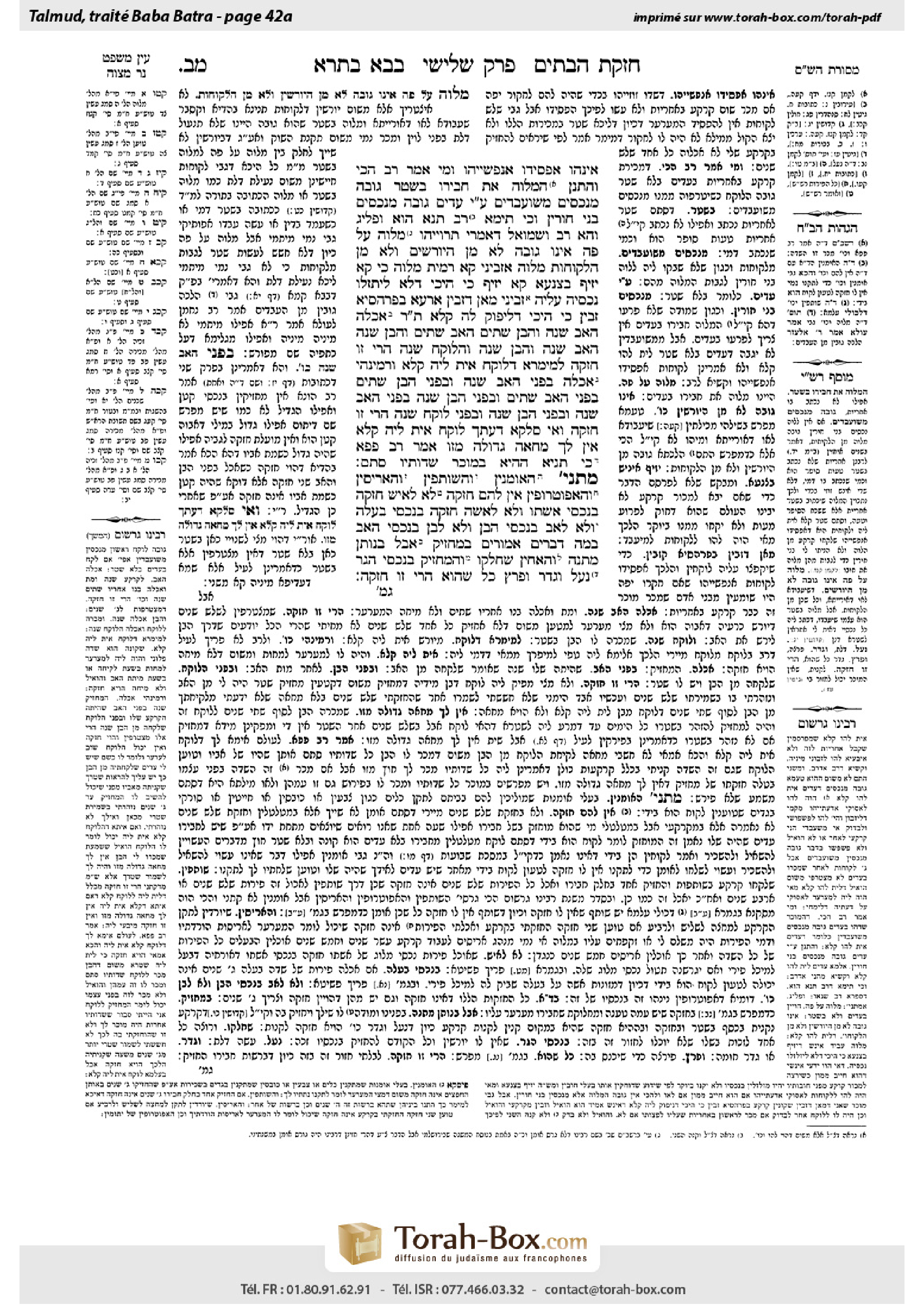
Bava Batra 42a: Talmud study for Daf Yomi
Study the Talmud for Daf Yomi with scanned pages, Hebrew text, English translations from Sefaria and AI-generated French translations.
Passage selection and English or AI-generated French translation are available where the scan has annotations. Daf Study is independent of Torah-Box and Sefaria.
Browse Bava Batra · בבא בתרא · All tractatesBava Batra 42a text and translations
This page of Bava Batra includes the Aramaic text, an English translation and an AI-generated French translation, alongside the scan above.
בבא בתרא מ״ב א · Aramaic and Hebrew text
אִינְהוּ אַפְסִידוּ אַנַּפְשַׁיְיהוּ.
וּמִי אָמַר רַב הָכִי? וְהָתְנַן: הַמַּלְוֶה אֶת חֲבֵירוֹ בִּשְׁטָר – גּוֹבֶה מִנְּכָסִים מְשׁוּעְבָּדִים, עַל יְדֵי עֵדִים – גּוֹבֶה מִנְּכָסִים בְּנֵי חוֹרִין!
וְכִי תֵּימָא: רַב תַּנָּא הוּא וּפָלֵיג, וְהָא רַב וּשְׁמוּאֵל דְּאָמְרִי תַּרְוַיְיהוּ: מִלְוֶה עַל פֶּה – אֵינוֹ גּוֹבֶה לֹא מִן הַיּוֹרְשִׁים וְלֹא מִן הַלָּקוֹחוֹת!
מִלְוֶה אַזְּבִינֵי קָא רָמֵית?! מִלְוֶה, כִּי קָא יָזֵיף – בְּצִנְעָא קָא יָזֵיף, כִּי הֵיכִי דְּלָא לִיתַּזְלוּ נִכְסֵיהּ עֲלֵיהּ. זְבִינֵי, מַאן דְּזָבֵין אַרְעָא – בְּפַרְהֶסְיָא זָבֵין, כִּי הֵיכִי דְּלִיפּוֹק לַהּ קָלָא.
תָּנוּ רַבָּנַן: אֲכָלָהּ הָאָב שָׁנָה וְהַבֵּן שְׁתַּיִם; הָאָב שְׁתַּיִם וְהַבֵּן שָׁנָה; הָאָב שָׁנָה, וְהַבֵּן שָׁנָה, וְהַלּוֹקֵחַ שָׁנָה – הֲרֵי זוֹ חֲזָקָה.
לְמֵימְרָא דְּלוֹקֵחַ אִית לֵיהּ קָלָא?! וּרְמִינְהִי: אֲכָלָהּ בִּפְנֵי הָאָב שָׁנָה וּבִפְנֵי הַבֵּן שְׁתַּיִם; בִּפְנֵי הָאָב שְׁתַּיִם וּבִפְנֵי הַבֵּן שָׁנָה; בִּפְנֵי הָאָב שָׁנָה, וּבִפְנֵי הַבֵּן שָׁנָה, וּבִפְנֵי לוֹקֵחַ שָׁנָה – הֲרֵי זוֹ חֲזָקָה. וְאִי סָלְקָא דַעְתָּךְ לוֹקֵחַ אִית לֵיהּ קָלָא, אֵין לְךָ מְחָאָה גְּדוֹלָה מִזּוֹ!
אָמַר רַב פָּפָּא: כִּי תַּנְיָא הָהִיא – בְּמוֹכֵר שְׂדוֹתָיו סְתָם.
מַתְנִי׳ הָאוּמָּנִין, וְהַשּׁוּתָּפִין, וְהָאֲרִיסִין, וְהָאַפּוֹטְרוֹפִּין – אֵין לָהֶם חֲזָקָה. לֹא לָאִישׁ חֲזָקָה בְּנִכְסֵי אִשְׁתּוֹ, וְלֹא לָאִשָּׁה חֲזָקָה בְּנִכְסֵי בַּעֲלָהּ; וְלֹא לָאָב בְּנִכְסֵי הַבֵּן, וְלֹא לַבֵּן בְּנִכְסֵי הָאָב.
בַּמֶּה דְּבָרִים אֲמוּרִים – בְּמַחְזִיק; אֲבָל בְּנוֹתֵן מַתָּנָה, וְהָאַחִין שֶׁחָלְקוּ, וְהַמַּחְזִיק בְּנִכְסֵי הַגֵּר – נָעַל וְגָדֵר וּפָרַץ כׇּל שֶׁהוּא – הֲרֵי זוֹ חֲזָקָה.
Bava Batra 42a · English translation
they caused their own loss by not investigating whether there was a lien on the property that they intended to buy.
The Gemara asks: And did Rav, in fact, say this, that one can collect sold property by means of witnesses alone? But didn’t we learn in a mishna (175a): One who lends money to another with a promissory note collects his debt from liened property that had been sold after the loan, if the debtor has no other property; but if one lent by means of witnesses without a promissory note, he collects his debt only from unsold property?
And if you would say that Rav is a tanna, and as such has the authority to dispute the determination in the mishna, but didn’t Rav himself and Shmuel both say: One who is owed a debt due to a loan by oral contract does not collect liened property, not from the heirs of the debtor nor from the buyers, despite the fact that there are witnesses?
The Gemara answers: Are you raising a contradiction from a case of a loan to a case of a sale? They are not comparable. In the case of a loan, when one borrows money he borrows discreetly, in order that his property not be devalued, as people will pay less for his property if they know that he is pressed for capital. Since a loan is issued discreetly, the presumption is that the buyers were unaware of the loan. Therefore, the creditor does not collect from sold property. By contrast, in the case of a sale, one who sells land sells it in public in order that publicity be generated with regard to it. Therefore, the cases of loans and sales are not comparable.
The Gemara continues the discussion of the establishment of the presumption of ownership by successive possessors. The Sages taught: If the father worked and profited from the land for one year and the son who inherited it from him worked and profited from it for two years, or if the father worked and profited from the land for two years and the son worked and profited from it for one year, or if the father worked and profited from the land for one year and the son worked and profited from it for one year, and the buyer, who purchased it from the son, worked and profited from it for one year, this is sufficient to establish the presumption of ownership.
The Gemara asks: Is this to say that with regard to a buyer, the transaction generates publicity? And one can raise a contradiction from a baraita (Tosefta 2:8): If one worked and profited from the land in the presence of the father, the prior owner, for one year, and in the presence of the son, who then inherited it from the father, for two years; or in the presence of the father for two years and in the presence of the son for one year; or in the presence of the father for one year and in the presence of the son for one year and in the presence of the buyer, who purchased it from the son, for one year; this is sufficient to establish the presumption of ownership. And if it enters your mind that with regard to a buyer, the transaction generates publicity, there is no greater protest than this. By selling his land to someone else, the son of the prior owner is clearly stating that it does not belong to the possessor.
Rav Pappa said: That is not a contradiction, as when that baraita is taught, it is taught with regard to one who sells his fields without specification. The son of the prior owner sold his fields without clarifying which fields he was selling. Since he did not specify the field from which the possessor is profiting, the possessor had no reason to assume that this field was being sold and that he needed to hold on to his deed, and he establishes the presumption of ownership despite the sale. In a case where the son of the prior owner stated explicitly that he was selling the field in question, the sale would serve as his protest.
MISHNA: Craftsmen who are in possession of items that they are repairing, and partners, and sharecroppers, and stewards [veha’apotropin] do not have the ability to establish the presumption of ownership with regard to property in their possession, as their possession is not indicative of ownership. Similarly, a man does not have the ability to establish the presumption of ownership with regard to his wife’s property, and a wife does not have the ability to establish the presumption of ownership with regard to her husband’s property. And a father similarly does not have the ability to establish the presumption of ownership with regard to a son’s property, and a son does not have the ability to establish the presumption of ownership with regard to a father’s property. A husband and wife, or son and father, use each other’s property freely. Possession is therefore not indicative of ownership.
The mishna continues: In what case is this statement, that one establishes the presumption of ownership after profiting from the property for a certain duration, with the exception of the above people, said? It is said in a case of one who has mere possession of the property, which does, in some cases, serve as proof of ownership. But in a case where another person gives one a gift, or there are brothers who divided their inheritance, or there is one who takes possession of the property of a convert who died without heirs and his property is now ownerless, as soon as one locked the door of the property, or fenced it or breached its fence even a bit, this is considered taking possession of the property, and it effects acquisition.
Bava Batra 42a · Traduction française (IA)
ils ont causé leur propre perte en n'ayant pas vérifié s'il y avait un droit de gage sur la propriété qu'ils souhaitaient acheter.
La Guemara demande : Et Rav, en effet, a-t-il dit cela, que l'on peut récupérer une propriété vendue par des témoins seulement ? Mais n'avons-nous pas appris dans une mitsva (175a) : Celui qui prête de l'argent à un autre avec un reçu récupère son créance sur une propriété gagée qui a été vendue après le prêt, si le débiteur n'a plus d'autres biens ; mais si l'on prête par témoins sans reçu, il récupère sa créance uniquement sur une propriété non vendue ?
Et si vous dites que Rav est un tanna, et en tant que tel a le pouvoir de contester la détermination de la mitsva, mais n'ont pas Rav lui-même et Shmuel tous deux dit : Celui qui est dû un créance en raison d'un prêt par contrat oral ne récupère pas une propriété gagée, ni des héritiers du débiteur ni des acheteurs, malgré le fait qu'il y ait des témoins ?
La Guemara répond : Vous élevez-vous contre un cas de prêt à un cas de vente ? Ils ne sont pas comparables. Dans le cas d'un prêt, quand on emprunte de l'argent, on le fait discrètement, afin que sa propriété ne se déprécie pas, car les gens paieront moins pour sa propriété s'ils savent qu'il est en difficulté. Puisque le prêt est fait discrètement, la présomption est que les acheteurs étaient ignares du prêt. Ainsi, le créancier ne récupère pas sur une propriété vendue. À l'inverse, dans le cas d'une vente, celui qui vend une terre le fait en public afin que la publicité soit générée à son égard. Ainsi, les cas de prêt et de vente ne sont pas comparables.
La Guemara continue la discussion sur l'établissement de la présomption de propriété par les possesseurs successifs. Les Sages ont enseigné : Si le père a travaillé et tiré profit de la terre pendant un an et le fils qui l'a hérité a travaillé et tiré profit de celle-ci pendant deux ans, ou si le père a travaillé et tiré profit de la terre pendant deux ans et le fils a travaillé et tiré profit de celle-ci pendant un an, ou si le père a travaillé et tiré profit de la terre pendant un an et le fils a travaillé et tiré profit de celle-ci pendant un an, et l'acheteur, qui l'a achetée auprès du fils, a travaillé et tiré profit de celle-ci pendant un an, cela suffit à établir la présomption de propriété.
La Guemara demande : Est-ce que cela signifie que, concernant un acheteur, la transaction génère une publicité ? Et l'on peut élever une contradiction à partir d'une baraïta (Tosefta 2:8) : Si l'on a travaillé et tiré profit de la terre en présence du père, propriétaire précédent, pendant un an, et en présence du fils, qui l'a hérité du père, pendant deux ans ; ou en présence du père pendant deux ans et en présence du fils pendant un an ; ou en présence du père pendant un an et en présence du fils pendant un an et en présence de l'acheteur, qui l'a achetée auprès du fils, pendant un an ; cela suffit à établir la présomption d'ownership. Et si cela entre en votre tête que, concernant un acheteur, la transaction génère une publicité, il n'y a pas de protestation plus forte que celle-ci. En vendant sa terre à quelqu'un d'autre, le fils du propriétaire précédent affirme clairement qu'elle n'appartient pas au possesseur.
Rav Pappa a dit : Ce n'est pas une contradiction, car lorsque cette baraïta est enseignée, elle est enseignée concernant celui qui vend ses champs sans précision. Le fils du propriétaire précédent a vendu ses champs sans préciser lesquels il vendait. Puisque ce n'était pas spécifié, le possesseur n'avait pas de raison de penser que ce champ était en vente et qu'il devait conserver son titre, et il établit la présomption d'ownership malgré la vente. Dans le cas où le fils du propriétaire précédent a explicitement indiqué qu'il vendait le champ en question, la vente aurait servi de protestation.
MICHNA : Les artisans qui possèdent des objets qu'ils réparent, les partenaires, les cultivateurs en partage et les stewards [veha’apotropin] n'ont pas la capacité d'établir la présomption de propriété concernant les biens en leur possession, car leur possession n'indique pas la propriété. De même, un homme n'a pas la capacité d'établir la présomption de propriété concernant les biens de sa femme, et une femme n'a pas la capacité d'établir la présomption de propriété concernant les biens de son mari. Un père n'a pas non plus la capacité d'établir la présomption de propriété concernant les biens de son fils, et un fils n'a pas la capacité d'établir la présomption de propriété concernant les biens de son père. Un mari et une femme, ou un fils et un père, utilisent librement les biens de l'autre. La possession n'indique donc pas la propriété.
La Michna continue : Dans quel cas cette déclaration, que l'on établit la présomption de propriété après avoir tiré profit de la propriété pendant une certaine durée, avec l'exception des personnes mentionnées ci-dessus, est-elle dite ? Elle est dite dans le cas d'une possession simple de la propriété, qui, dans certains cas, peut servir de preuve de propriété. Mais dans le cas où une autre personne donne un cadeau, ou il y a des frères qui ont divisé leur héritage, ou il y a quelqu'un qui prend possession des biens d'un converti décédé sans héritiers et dont les biens sont désormais sans propriétaire, dès qu'on a verrouillé la porte de la propriété, ou entouré la propriété ou même abîmé un peu son mur, cela est considéré comme prendre possession de la propriété, et cela constitue une acquisition.
Traduction française générée par IA à partir de l’édition anglaise de Sefaria. Vérifie toujours un passage avec le texte source.
Text from Sefaria: William Davidson Edition - Vocalized Aramaic (CC BY NC); William Davidson Edition - English (CC BY NC).