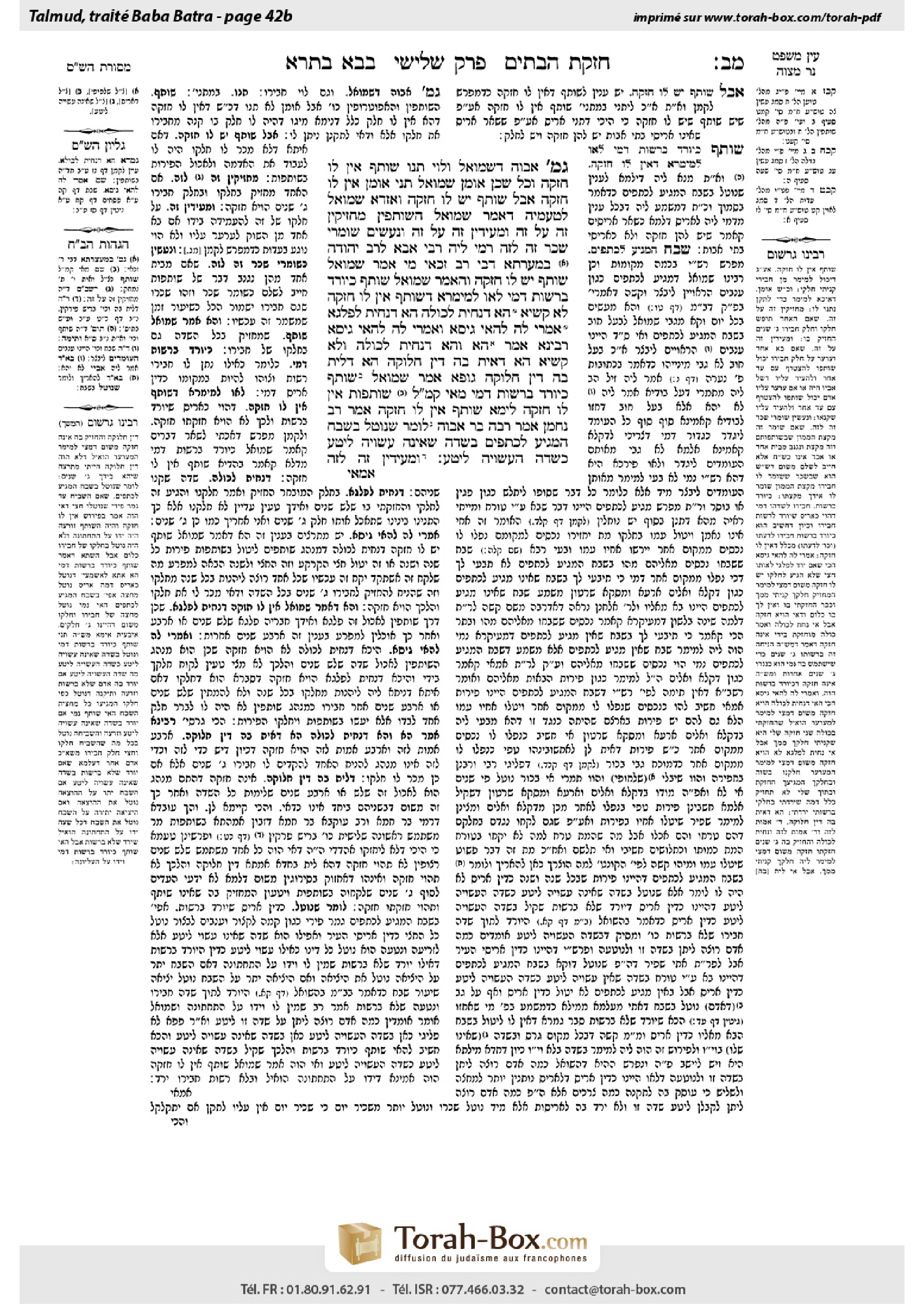
Bava Batra 42b: Talmud study for Daf Yomi
Study the Talmud for Daf Yomi with scanned pages, Hebrew text, English translations from Sefaria and AI-generated French translations.
Passage selection and English or AI-generated French translation are available where the scan has annotations. Daf Study is independent of Torah-Box and Sefaria.
Browse Bava Batra · בבא בתרא · All tractatesBava Batra 42b text and translations
This page of Bava Batra includes the Aramaic text, an English translation and an AI-generated French translation, alongside the scan above.
בבא בתרא מ״ב ב · Aramaic and Hebrew text
גְּמָ׳ אֲבוּהּ דִּשְׁמוּאֵל וְלֵוִי תָּנוּ: שׁוּתָּף אֵין לוֹ חֲזָקָה, וְכׇל שֶׁכֵּן אוּמָּן. שְׁמוּאֵל תָּנֵי: אוּמָּן אֵין לוֹ חֲזָקָה, אֲבָל שׁוּתָּף יֵשׁ לוֹ חֲזָקָה. וְאַזְדָּא שְׁמוּאֵל לְטַעְמֵיהּ – דְּאָמַר שְׁמוּאֵל: הַשּׁוּתָּפִין מַחְזִיקִין זֶה עַל זֶה, וּמְעִידִין זֶה עַל זֶה, וְנַעֲשִׂים שׁוֹמְרֵי שָׂכָר זֶה לָזֶה.
רָמֵי לֵיהּ רַבִּי אַבָּא לְרַב יְהוּדָה בִּמְעָרְתָּא דְּבֵי רַב זַכַּאי, מִי אָמַר שְׁמוּאֵל: שׁוּתָּף יֵשׁ לוֹ חֲזָקָה? וְהָאָמַר שְׁמוּאֵל: שׁוּתָּף כְּיוֹרֵד בִּרְשׁוּת דָּמֵי. לָאו לְמֵימְרָא דְּשׁוּתָּף אֵין לוֹ חֲזָקָה? לָא קַשְׁיָא; הָא דִּנְחֵית לְכוּלַּהּ, הָא דִּנְחֵית לְפַלְגָא.
אָמְרִי לַהּ לְהַאי גִּיסָא, וְאָמְרִי לַהּ לְהַאי גִּיסָא.
רָבִינָא אָמַר: הָא וְהָא דִּנְחֵית לְכוּלַּהּ; וְלָא קַשְׁיָא – הָא דְּאִית בָּהּ דִּין חֲלוּקָהּ, הָא דְּלֵית בָּהּ דִּין חֲלוּקָהּ.
גּוּפָא – אָמַר שְׁמוּאֵל: שׁוּתָּף – כְּיוֹרֵד בִּרְשׁוּת דָּמֵי. מַאי קָא מַשְׁמַע לַן, שׁוּתָּפוּת אֵין לוֹ חֲזָקָה? לֵימָא: שׁוּתָּף אֵין לוֹ חֲזָקָה!
אָמַר רַב נַחְמָן אָמַר רַבָּה בַּר אֲבוּהּ: לוֹמַר שֶׁנּוֹטֵל בַּשֶּׁבַח הַמַּגִּיעַ לִכְתֵפַיִם – בְּשָׂדֶה שֶׁאֵינָהּ עֲשׂוּיָה לִיטַּע, כְּשָׂדֶה הָעֲשׂוּיָה לִיטַּע.
וּמְעִידִין זֶה לָזֶה.
Bava Batra 42b · English translation
GEMARA: Shmuel’s father and Levi taught: A partner does not have the ability to establish the presumption of ownership of property in his possession, and, all the more so, this inability applies to a craftsman as well. But Shmuel teaches: A craftsman does not have the ability to establish the presumption of ownership of property in his possession, but a partner does have the ability to establish the presumption of ownership. The Gemara comments: And Shmuel follows his line of reasoning, as Shmuel says: Partners establish the presumption of ownership with regard to the property of each other, and they testify for each other and become paid bailees of their joint property with regard to each other. In terms of these issues, Shmuel considers partners to be independent parties.
Rabbi Abba raises a contradiction to Rav Yehuda in the case of Rav Zakkai’s house: Did Shmuel actually say that a partner has the ability to establish the presumption of ownership? But doesn’t Shmuel say: A partner is considered as one who enters the field with permission, such as a sharecropper? Isn’t that to say that a partner does not have the ability to establish the presumption of ownership? The Gemara answers: It is not difficult. This is referring to where he enters all of the field, and that is referring to where he enters half of the field.
The Gemara explains: Some say it in this manner and some say it in that manner. On the one hand, it is possible to explain that if he entered half of the field he establishes the presumption of ownership with regard to that half, but if he entered the entire field he is merely acting as a partner. On the other hand, one could explain that entering half of the field does not establish the presumption of ownership at all, while entering the entire field does establish it.
Ravina stated a different resolution to the contradiction: Both this and that are referring to a case where he enters the entire field, and it is not difficult. This is referring to a case where the field is of sufficient area to be subject to the halakha of division. In this case, his being in possession of the other half of the field as well, which belonged to his partner, establishes the presumption of ownership. That is referring to a case where the field is not of sufficient area to be subject to the halakha of division. Since the property will not be divided but will remain co-owned, he is merely possessing it as a partner and does not establish the presumption of ownership.
§ The Gemara addresses the matter itself. Shmuel says: A partner is considered as one who enters the field with permission. What is this teaching us, that there is not the presumption of ownership in the context of partnership? If so, let him say explicitly: A partner does not have the ability to establish the presumption of ownership of property in his possession.
Rav Naḥman says that Rabba bar Avuh says: Shmuel’s intent was to state that a partner who proactively works to improve their mutual property collects the enhancement that reaches shoulders, i.e., when the produce that grew due to the efforts of the partner is fully grown and ripened and can be harvested and carried upon one’s shoulders. He is not considered as one who entered another’s field without permission and improved it, who collects only for his expenditures. This is the halakha if he planted trees in a field that is not commonly used for planting trees, just as it is if he planted in a field that is commonly used for planting trees.
The Gemara continues its discussion of Shmuel’s statement: And testify for each other. A partner may join another witness in testifying with regard to the fact that his partner owns a share of their field in order to counter the claim of a one who claims ownership of the field, and his testimony is not disqualified due to being biased.
Bava Batra 42b · Traduction française (IA)
GUEMARA : Le père de Shmuel et Levi enseignent : Un partenaire ne peut pas établir la présomption de propriété sur les biens qu'il possède, et encore moins un artisan. Mais Shmuel enseigne : Un artisan ne peut pas établir la présomption de propriété sur les biens qu'il possède, mais un partenaire peut établir la présomption de propriété. La Guemara commente : Et Shmuel suit sa ligne de raisonnement, car Shmuel dit : Les partenaires établissent la présomption de propriété les uns envers les autres et témoignent l'un pour l'autre, et deviennent des dépositaires payés de leurs biens communs les uns envers les autres. En ce qui concerne ces questions, Shmuel considère les partenaires comme des parties indépendantes.
Rabbi Abba soulève une contradiction avec Rav Yehuda dans le cas de la maison de Rav Zakkai : A-t-il vraiment dit que le partenaire peut établir la présomption de propriété ? Mais ne dit-il pas Shmuel : Le partenaire est considéré comme celui qui entre dans le champ avec la permission, comme un cultivateur en partage ? N'est-ce pas dire que le partenaire ne peut pas établir la présomption de propriété ? La Guemara répond : Ce n'est pas difficile. Cela fait référence à un cas où il entre dans l'ensemble du champ, et cela fait référence à un cas où il entre dans la moitié du champ.
La Guemara explique : Certains disent cela de cette manière et d'autres de celle-ci. D'une part, il est possible d'expliquer que s'il entre dans la moitié du champ, il établit la présomption de propriété concernant cette moitié, mais s'il entre dans l'ensemble du champ, il est simplement un partenaire. D'autre part, on pourrait expliquer que l'entrée dans la moitié du champ ne constitue pas du tout la présomption de propriété, tandis que l'entrée dans l'ensemble du champ la constitue.
Ravina a proposé une résolution différente à la contradiction : à la fois cela et cela font référence à un cas où il entre dans l'ensemble du champ, et ce n'est pas difficile. Cela fait référence à un cas où le champ est d'une superficie suffisante pour être soumis à la halakha de division. Dans ce cas, son possession de l'autre moitié du champ, qui appartenait à son partenaire, établit la présomption de propriété. Cela fait référence à un cas où le champ n'est pas d'une superficie suffisante pour être soumis à la halakha de division. Puisque la propriété ne sera pas divisée mais restera en partage, il est simplement en possession en tant que partenaire et ne constitue pas la présomption de propriété.
§ La Guemara aborde la question elle-même. Shmuel dit : Le partenaire est considéré comme celui qui entre dans le champ avec la permission. Quelle est la leçon de cette enseignement, que la présomption de propriété n'existe pas dans le contexte du partage ? Si c'est le cas, qu'il dise explicitement : Le partenaire ne peut pas établir la présomption de propriété sur les biens qu'il possède.
Rav Naḥman dit que Rabba bar Avuh dit : L'intention de Shmuel était d'indiquer que le partenaire qui s'efforce activement d'améliorer leur propriété commune récolte l'amélioration qui atteint les épaules, c'est-à-dire lorsque les récoltes qui ont grandi grâce aux efforts du partenaire sont pleinement mûres et peuvent être récoltées et transportées sur ses épaules. Il n'est pas considéré comme celui qui entre dans un champ sans permission et améliore ce dernier, qui récolte uniquement pour ses dépenses. C'est la halakha si l'on plante des arbres dans un champ qui n'est pas habituellement utilisé pour la plantation d'arbres, tout comme c'est le cas si l'on plante dans un champ habituellement utilisé pour la plantation d'arbres.
La Guemara poursuit sa discussion sur l'enseignement de Shmuel : Et témoigner l'un pour l'autre. Un partenaire peut s'associer à un témoin pour témoigner du fait que son partenaire possède une part de leur champ afin de contester la revendication d'une personne qui prétend posséder le champ, et son témoignage n'est pas disqualifié en raison d'un biais.
Traduction française générée par IA à partir de l’édition anglaise de Sefaria. Vérifie toujours un passage avec le texte source.
Text from Sefaria: William Davidson Edition - Vocalized Aramaic (CC BY NC); William Davidson Edition - English (CC BY NC).