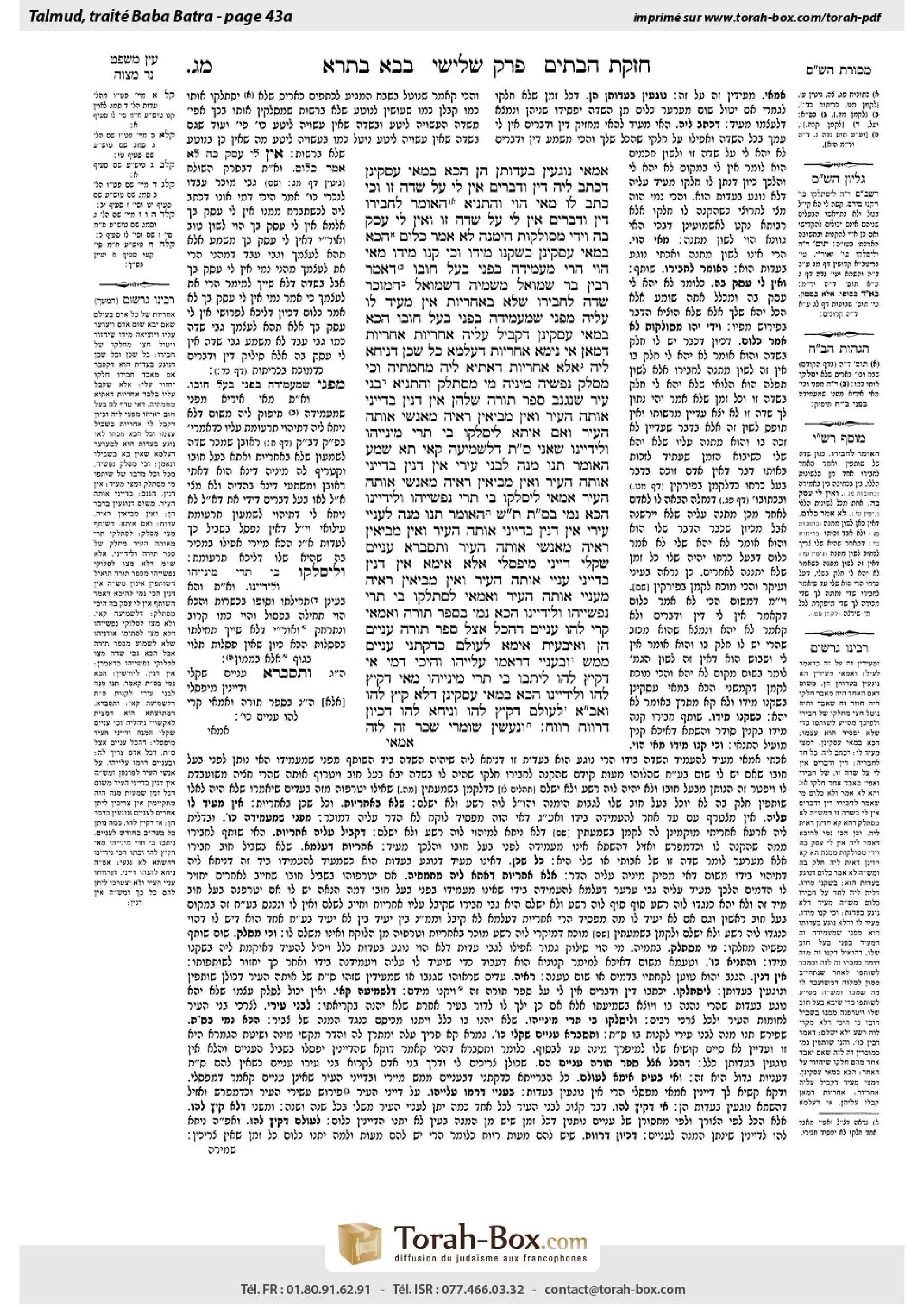
Bava Batra 43a: Talmud study for Daf Yomi
Study the Talmud for Daf Yomi with scanned pages, Hebrew text, English translations from Sefaria and AI-generated French translations.
Passage selection and English or AI-generated French translation are available where the scan has annotations. Daf Study is independent of Torah-Box and Sefaria.
Browse Bava Batra · בבא בתרא · All tractatesBava Batra 43a text and translations
This page of Bava Batra includes the Aramaic text, an English translation and an AI-generated French translation, alongside the scan above.
בבא בתרא מ״ג א · Aramaic and Hebrew text
אַמַּאי? נוֹגְעִין בְּעֵדוּתָן הֵן!
הָכָא בְּמַאי עָסְקִינַן – דִּכְתַב לֵיהּ: ״דִּין וּדְבָרִים אֵין לִי עַל שָׂדֶה זוֹ״. וְכִי כְּתַב לוֹ מַאי הָוֵי? וְהָתַנְיָא, הָאוֹמֵר לַחֲבֵירוֹ: ״דִּין וּדְבָרִים אֵין לִי עַל שָׂדֶה זו״;ֹ וְ״אֵין לִי עֵסֶק בָּהּ״; וְ״יָדַי מְסוּלָּקוֹת הֵימֶנָּה – לֹא אָמַר כְּלוּם!
הָכָא בְּמַאי עָסְקִינַן – כְּשֶׁקָּנוּ מִיָּדוֹ. וְכִי קָנוּ מִיָּדוֹ מַאי הָוֵי? הֲרֵי מַעֲמִידָהּ בִּפְנֵי בַּעַל חוֹבוֹ –
דְּאָמַר רָבִין בַּר שְׁמוּאֵל מִשְּׁמֵיהּ דִּשְׁמוּאֵל: הַמּוֹכֵר שָׂדֶה לַחֲבֵירוֹ שֶׁלֹּא בְּאַחְרָיוּת – אֵין מֵעִיד לוֹ עָלֶיהָ, מִפְּנֵי שֶׁמַּעֲמִידָהּ בִּפְנֵי בַּעַל חוֹבוֹ!
הָכָא בְּמַאי עָסְקִינַן – דְּקַבֵּיל עֲלֵיהּ אַחְרָיוּת. אַחְרָיוּת דְּמַאן? אִי נֵימָא אַחְרָיוּת דְּעָלְמָא, כׇּל שֶׁכֵּן דְּנִיחָא לֵיהּ! אֶלָּא אַחְרָיוּת דְּאָתְיָא לֵיהּ מֵחֲמָתֵיהּ.
וְכִי מְסַלֵּק נַפְשֵׁיהּ מִינֵּיהּ – מִי מִסְתַּלַּק? וְהָתַנְיָא: בְּנֵי עִיר שֶׁנִּגְנַב סֵפֶר תּוֹרָה שֶׁלָּהֶן, אֵין דָּנִין בְּדַיָּינֵי אוֹתָהּ הָעִיר, וְאֵין מְבִיאִין רְאָיָה מֵאַנְשֵׁי אוֹתָהּ הָעִיר. וְאִם אִיתָא, לִיסַלְּקוּ בֵּי תְרֵי מִינַּיְיהוּ, וְלִידַיְינוּ!
שָׁאנֵי סֵפֶר תּוֹרָה, דְּלִשְׁמִיעָה קָאֵי.
תָּא שְׁמַע: הָאוֹמֵר ״תְּנוּ מָנֶה לִבְנֵי עִירִי״ – אֵין דָּנִין בְּדַיָּינֵי אוֹתָהּ הָעִיר, וְאֵין מְבִיאִין רְאָיָה מֵאַנְשֵׁי אוֹתָהּ הָעִיר. אַמַּאי? לִיסַלְּקוּ בֵּי תְרֵי נַפְשַׁיְיהוּ, וְלִידַיְינוּ!
הָכָא נָמֵי בְּסֵפֶר תּוֹרָה.
תָּא שְׁמַע: הָאוֹמֵר ״תְּנוּ מָנֶה לַעֲנִיֵּי עִירִי״ – אֵין דָּנִין בְּדַיָּינֵי אוֹתָהּ הָעִיר, וְאֵין מְבִיאִין רְאָיָה מֵאַנְשֵׁי אוֹתָהּ הָעִיר. וְתִסְבְּרָא – עֲנִיִּים שָׁקְלִי, דַּיָּינֵי מִיפַּסְלִי?! אֶלָּא אֵימָא: אֵין דָּנִין בְּדַיָּינֵי עֲנִיֵּי אוֹתָהּ הָעִיר, וְאֵין מְבִיאִין רְאָיָה מֵעֲנִיֵּי אוֹתָהּ הָעִיר. וְאַמַּאי? לִסְתַּלְּקוּ בֵּי תְרֵי נַפְשַׁיְיהוּ, וְלִידַיְינוּ!
הָכָא נָמֵי בְּסֵפֶר תּוֹרָה. וְאַמַּאי קָרֵי לְהוּ ״עֲנִיִּים״? דְּהַכֹּל אֵצֶל סֵפֶר תּוֹרָה – עֲנִיִּים הֵן.
וְאִיבָּעֵית אֵימָא: לְעוֹלָם כִּדְקָתָנֵי – עֲנִיִּים מַמָּשׁ, וּבְעַנְיֵי דְּרָאמוּ עֲלַיְיהוּ. וְהֵיכִי דָּמֵי? אִי דְּקִיץ לְהוּ – לִיתְּבוּ בֵּי תְרֵי מִינַּיְיהוּ מַאי דְּקִיץ לְהוּ, וְלִידַיְינוּ!
הָכָא בְּמַאי עָסְקִינַן – דְּלָא קִיץ לְהוּ. וְאִיבָּעֵית אֵימָא: לְעוֹלָם דְּקִיץ לְהוּ, וְנִיחָא לְהוּ – דְּכֵיוָן דְּרָוַוח, רָוַוח.
וְנַעֲשִׁין שׁוֹמְרֵי שָׂכָר זֶה לָזֶה.
Bava Batra 43a · English translation
The Gemara asks: Why is this so? Aren’t partners biased in their testimony, as they jointly own the property in question?
The Gemara answers: With what are we dealing here? We are dealing with a case where the partner who is testifying wrote to the other partner: I do not have any legal dealings or involvement with regard to this field, thereby relinquishing his ownership of the field. The Gemara asks: And if he wrote this to him, what of it? But isn’t it taught in a baraita that one who says to another: I do not have any legal dealings or involvement concerning this field, or: I have no dealings with it, or: My hands are removed from it, has said nothing? That is to say, these statements have no legal standing.
The Gemara answers: With what are we dealing here? We are dealing with a case where the one testifying performed an act of acquisition with the other partner. Since relinquishing his share in this fashion is effective, his testimony is no longer biased. The Gemara asks: And if he performed an act of acquisition with the one testifying, what of it? His testimony is still biased, as he is establishing the field before his creditor. Once he transferred his share to his partner, his creditor will now be able to collect from the property that he formerly co-owned, as a creditor can collect from property that a debtor once owned despite the fact that he has relinquished his ownership of it. Since his testimony enables him to repay his debt, it is biased.
As Ravin bar Shmuel says in the name of Shmuel: One who sells a field to another even without a guarantee that if the field will be repossessed the seller will compensate the buyer for his loss cannot testify with regard to ownership of that field on behalf of the buyer because he is establishing the field before his creditor.
The Gemara answers: With what are we dealing here? We are dealing with a case where the one testifying assumes financial responsibility for the field. Therefore, his testimony is not biased. The Gemara clarifies: Responsibility with regard to whom? If we say that he assumes general responsibility, such that if anyone collects the field from his former partner for whatever reason, he is liable to compensate the partner, then all the more so it is preferable for him that the field remain in his former partner’s possession, as if the claimant will be successful in obtaining the field, the witness will have to compensate the partner. Rather, it is referring to a case where he assumes responsibility only for a loss that comes to his former partner in the property resulting from the field being seized by one of his creditors to collect payment for his debts. He is, therefore, not an interested party, as in any event he owes the same debt, either to his creditor or to his partner.
The Gemara asks: And if he removes himself from the property by having the former partner acquire his share in it, is it actually effective to remove him, so that there is no longer a concern for biased testimony? But isn’t it taught in a baraita: With regard to a case of residents of a city whose Torah scroll was stolen, the case is not adjudicated by the judges of that city, and proof may not be brought from the testimony of the people of that city, as their testimony is biased? And if it is so that relinquishing one’s share renders one as not biased, then let two of them remove themselves from their share in the Torah scroll, and then the court can judge the case based on their testimony.
The Gemara answers: A Torah scroll is different, as it stands for the people to listen to the Torah reading from it. Since they are obligated to listen to the Torah reading, they stand to benefit from this Torah scroll even if they relinquish their ownership share in it, and their testimony is biased.
The Gemara suggests: Come and hear a proof from a baraita: With regard to one who says: Give one hundred dinars to the residents of my city, the distribution of the funds is not adjudicated by the judges of that city, and proof may not be brought from the testimony of the people of that city, as their testimony is biased. Why not? Let two people remove themselves from their share in the funds and then the court can judge the case based on their testimony.
The Gemara answers: Here too, this halakha is stated with regard to a case where the gift was for the purpose of procuring a Torah scroll, and the same aforementioned reasoning applies.
The Gemara suggests: Come and hear a proof from a baraita: With regard to one who says: Give one hundred dinars to the poor people of my city, the distribution of the funds is not adjudicated by the judges of that city, and proof may not be brought from testimony of the people of that city, as their testimony is biased. And how can you understand the fact that the poor take the money and the judges are thereby disqualified as interested parties? Rather, say: The distribution of the funds is not adjudicated by the poor judges of that city, and proof may not be brought from the testimony of the poor people of that city. And why not? Let two people remove themselves from their share in the funds and then the court can judge the case based on their testimony.
The Gemara answers: Here, too this halakha is stated with regard to a case where the gift was for the purpose of procuring a Torah scroll, and the same aforementioned reasoning applies. The Gemara asks: And if it is referring to money for purchasing a Torah scroll rather than money earmarked for charity, why does the baraita call the recipients: Poor people? Because everyone is poor with regard to a Torah scroll, as it is very expensive.
And if you wish, say instead: Actually, it is referring to people who are literally poor, as it teaches. And the ruling of the baraita is stated with regard to poor people, whose support is incumbent upon all of the residents. Therefore, a gift to these poor people reduces their obligation, and all of their testimony is biased. The Gemara clarifies: And what are the circumstances in which this baraita states its ruling? If it is a place where the sum of charity that each resident is obligated to give is fixed for them, let two of them give what is fixed for them to give to the poor, and then the court can judge the case based on their testimony.
The Gemara answers: With what are we dealing here? We are dealing with a case where the sum is not fixed for them. Therefore, this is not an option. And if you wish, say instead: Actually, it is referring to a place where the sum is fixed for them. And nevertheless, it is amenable to the residents of the city that the poor receive a gift, because once there is a gain for the poor people from this donation, there is a gain, and it lightens the burden on all of the people of the city.
§ The Gemara returns to discuss Shmuel’s statement concerning partners: And they become paid bailees of their joint property with regard to each other.
Bava Batra 43a · Traduction française (IA)
La Guemara pose la question : Pourquoi est-ce ainsi ? Les associés ne sont-ils pas biaisés dans leur témoignage, puisqu'ils partagent la propriété en question ?
La Guemara répond : De quoi sommes-nous en train de parler ? Nous parlons d'un cas où l'associé qui témoigne a écrit à l'autre associé : Je n'ai aucun engagement légal ou implication concernant ce champ, ce qui lui fait renoncer à sa propriété sur ce champ. La Guemara pose la question : Et si il a écrit cela à l'autre, qu'est-ce que cela change ? Mais n'est-il pas enseigné dans une baraïta que celui qui dit à un autre : Je n'ai aucun engagement légal ou implication concernant ce champ, ou : Je n'ai aucun lien avec cela, ou : Mes mains sont éloignées de cela, a dit rien ? C'est-à-dire, ces déclarations n'ont aucun effet juridique.
La Guemara répond : De quoi sommes-nous en train de parler ? Nous parlons d'un cas où l'associé qui témoigne a accompli un acte d'acquisition avec l'autre associé. Puisque le renoncement à sa part de cette manière est efficace, son témoignage n'est plus biaisé. La Guemara pose la question : Et si il a accompli un acte d'acquisition avec celui qui témoigne, qu'est-ce que cela change ? Son témoignage reste biaisé, car il établit le champ devant son créancier. Une fois qu'il a transféré sa part à son associé, son créancier pourra désormais récupérer sur la propriété qu'il possédait autrefois en commun, car un créancier peut récupérer sur une propriété que le débiteur a autrefois possédée, même s'il a renoncé à sa propriété. Puisque son témoignage permet à son créancier de récupérer sa dette, il est biaisé.
Ravin bar Shmuel dit en nom de Shmuel : Celui qui vend un champ à un autre, même sans garantie que si le champ est réclamé, le vendeur compensera l'acheteur pour sa perte, ne peut pas témoigner en faveur de l'acheteur concernant la propriété de ce champ, car il établit le champ devant son créancier.
La Guemara répond : De quoi sommes-nous en train de parler ? Nous parlons d'un cas où l'associé qui témoigne assume la responsabilité financière sur le champ. Par conséquent, son témoignage n'est pas biaisé. La Guemara précise : La responsabilité concernant qui ? Si nous disons qu'il assume une responsabilité générale, telle que si quelqu'un récupère le champ de son associé pour quelque raison que ce soit, il est tenu de compenser l'associé, alors encore plus cela est préférable qu'il reste dans la possession de son associé, car si le demandeur réussit à obtenir le champ, le témoin devra compenser l'associé. Par contre, il s'agit d'un cas où il assume la responsabilité uniquement pour une perte qui affecte son associé dans la propriété résultant de la saisie du champ par l'un de ses créanciers pour recouvrer ses dettes. Il n'est donc pas une partie intéressée, car dans tous les cas, il doit la même dette, soit à son créancier, soit à son associé.
La Guemara pose la question : Et si l'on fait partir celui-ci de la propriété en faisant acquérir sa part à son associé, est-ce efficace pour le faire partir, de sorte qu'il n'y ait plus de préoccupation concernant un témoignage biaisé ? Mais n'est-il pas enseigné dans une baraïta : Concernant un cas de résidents d'une ville dont un rouleau de Torah a été volé, le cas n'est pas jugé par les juges de cette ville, et la preuve ne peut pas être apportée à partir du témoignage des résidents de cette ville, car leur témoignage est biaisé ? Et si le renoncement à sa part rend une personne non biaisée, alors que deux d'entre eux se retirent de leur part dans le rouleau de Torah, et alors le tribunal peut juger le cas sur leur témoignage.
La Guemara répond : Le rouleau de Torah est différent, car il sert à ce que les gens écoutent la lecture de la Torah à partir de lui. Puisque les gens sont obligés d'écouter la lecture de la Torah, ils en tirent un bénéfice même s'ils renoncent à leur part de propriété, et leur témoignage est biaisé.
La Guemara suggère : Viens écouter une preuve à partir d'une baraïta : Concernant celui qui dit : Donne cent dinars aux résidents de ma ville, la distribution des fonds n'est pas jugée par les juges de cette ville, et la preuve ne peut pas être apportée à partir du témoignage des résidents de cette ville, car leur témoignage est biaisé. Pourquoi pas ? Laisse deux personnes se retirer de leur part dans les fonds et alors le tribunal peut juger le cas sur leur témoignage.
La Guemara répond : Ici aussi, cette halakha est énoncée concernant un cas où la donation était faite à l'effet d'acquérir un rouleau de Torah, et la même raison précédente s'applique.
La Guemara suggère : Viens écouter une preuve à partir d'une baraïta : Concernant celui qui dit : Donne cent dinars aux pauvres de ma ville, la distribution des fonds n'est pas jugée par les juges de cette ville, et la preuve ne peut pas être apportée à partir du témoignage des résidents de cette ville, car leur témoignage est biaisé. Et comment peux-tu comprendre le fait que les pauvres prennent l'argent et les juges sont ainsi désqualifiés comme parties intéressées ? Plutôt, dis : La distribution des fonds n'est pas jugée par les juges de cette ville, et la preuve ne peut pas être apportée à partir du témoignage des pauvres de cette ville. Et pourquoi pas ? Laisse deux personnes se retirer de leur part dans les fonds et alors le tribunal peut juger le cas sur leur témoignage.
La Guemara répond : Ici aussi, cette halakha est énoncée concernant un cas où la donation était faite à l'effet d'acquérir un rouleau de Torah, et la même raison précédente s'applique. La Guemara pose la question : Et si elle fait référence à de l'argent pour acheter un rouleau de Torah plutôt qu'à de l'argent destiné à la charité, pourquoi la baraïta appelle-t-elle les bénéficiaires : pauvres ? Parce que tout le monde est pauvre concernant un rouleau de Torah, car il est très coûteux.
Et si tu veux, dis plutôt : En réalité, il s'agit de personnes littéralement pauvres, comme il l'enseigne. La décision de la baraïta est formulée concernant les pauvres, dont le soutien incombe à tous les habitants. Ainsi, un don à ces pauvres réduit leur obligation, et tout leur témoignage est biaisé. La Guemara clarifie : Et dans quelles circonstances cette baraïta formule sa décision ? Si c'est un lieu où la somme de charité que chaque habitant est tenu de donner est fixée pour eux, laissez deux d'entre eux donner ce qui est fixé pour eux donner aux pauvres, et alors le tribunal peut juger le cas en se basant sur leur témoignage.
La Guemara répond : Avec quoi sommes-nous en train de nous occuper ici ? Nous sommes en train de nous occuper d'un cas où la somme n'est pas fixée pour eux. Ainsi, cela n'est pas une option. Et si tu veux, dis plutôt : En réalité, il s'agit d'un lieu où la somme est fixée pour eux. Et pourtant, cela est acceptable pour les habitants de la ville que les pauvres reçoivent un don, car une fois qu'il y a un bénéfice pour les pauvres grâce à cette donation, il y a un bénéfice, et cela allège la charge pour tous les habitants de la ville.
§ La Guemara reprend la discussion sur la déclaration de Shmuel concernant les partenaires : Et ils deviennent des dépositaires payés de leur propriété commune envers les uns et les autres.
Traduction française générée par IA à partir de l’édition anglaise de Sefaria. Vérifie toujours un passage avec le texte source.
Text from Sefaria: William Davidson Edition - Vocalized Aramaic (CC BY NC); William Davidson Edition - English (CC BY NC).