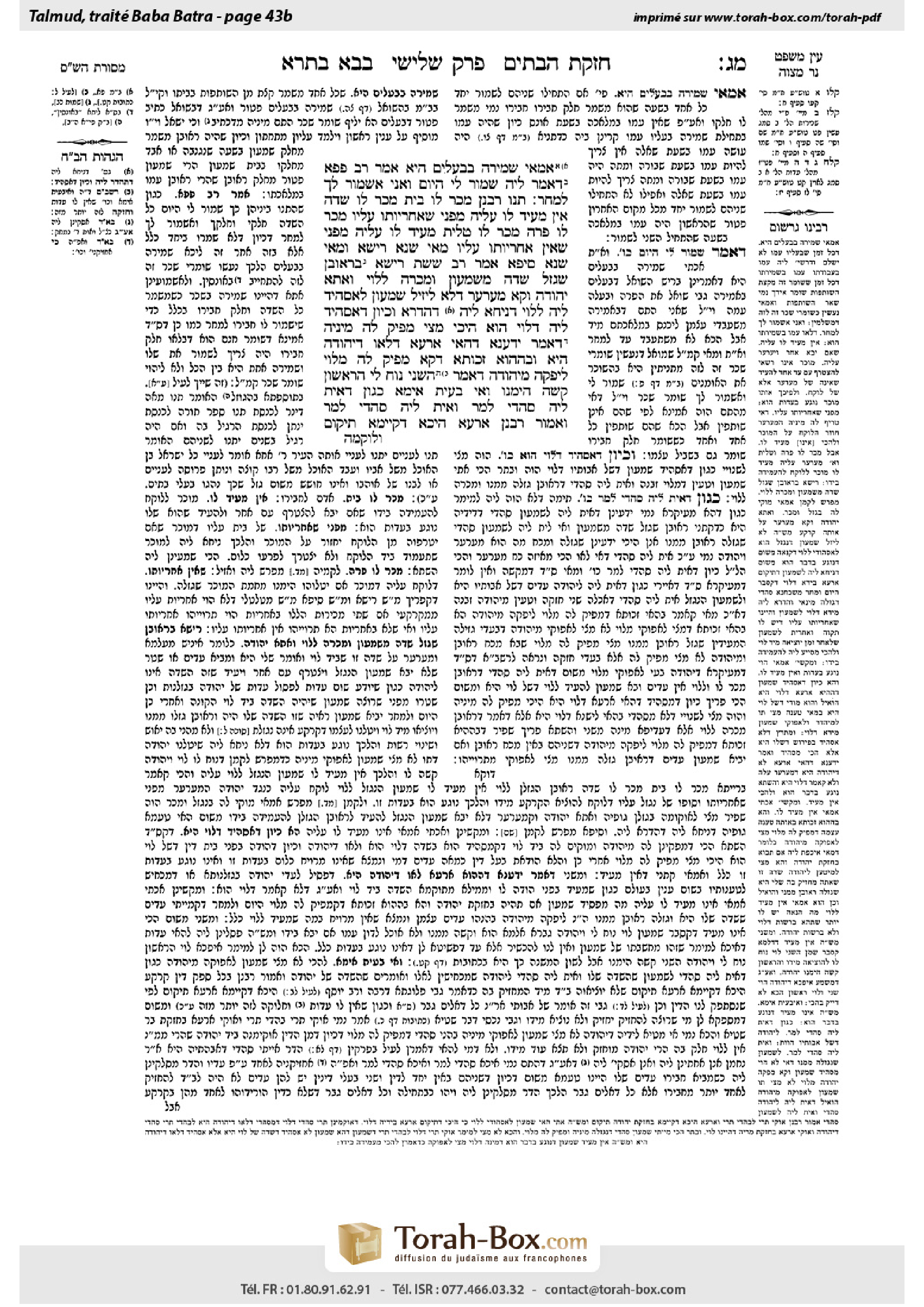
Bava Batra 43b: Talmud study for Daf Yomi
Study the Talmud for Daf Yomi with scanned pages, Hebrew text, English translations from Sefaria and AI-generated French translations.
Passage selection and English or AI-generated French translation are available where the scan has annotations. Daf Study is independent of Torah-Box and Sefaria.
Browse Bava Batra · בבא בתרא · All tractatesBava Batra 43b text and translations
This page of Bava Batra includes the Aramaic text, an English translation and an AI-generated French translation, alongside the scan above.
בבא בתרא מ״ג ב · Aramaic and Hebrew text
אַמַּאי? שְׁמִירָה בִּבְעָלִים הִיא! אָמַר רַב פָּפָּא, דְּאָמַר לֵיהּ: שְׁמוֹר לִי הַיּוֹם, וַאֲנִי אֶשְׁמוֹר לְךָ לְמָחָר.
תָּנוּ רַבָּנַן: מָכַר לוֹ בַּיִת, מָכַר לוֹ שָׂדֶה – אֵין מֵעִיד לוֹ עָלֶיהָ, מִפְּנֵי שֶׁאַחְרָיוּתוֹ עָלָיו. מָכַר לוֹ פָּרָה, מָכַר לוֹ טַלִּית – מֵעִיד לוֹ עָלֶיהָ, מִפְּנֵי שֶׁאֵין אַחְרָיוּתוֹ עָלָיו. מַאי שְׁנָא רֵישָׁא וּמַאי שְׁנָא סֵיפָא?
אָמַר רַב שֵׁשֶׁת: רֵישָׁא – בִּרְאוּבֵן שֶׁגָּזַל שָׂדֶה מִשִּׁמְעוֹן, וּמְכָרָהּ לְלֵוִי, וַאֲתָא יְהוּדָה וְקָא מְעַרְעֵר; דְּלָא לֵיזִיל שִׁמְעוֹן לַאסְהֵיד לֵיהּ לְלֵוִי, דְּנִיחָא לֵיהּ דְּהָדְרָא.
וְכֵיוָן דְּאַסְהֵיד לֵיהּ דְּלֵוִי הוּא, הֵיכִי מָצֵי מַפֵּיק לַהּ מִינֵּיהּ? דְּאָמַר: יָדַעְנָא דְּהַאי אַרְעָא דְּלָאו דִּיהוּדָה הִיא. וּבְהָהוּא זְכוּתָא דְּקָא מַפֵּיק לַהּ מִלֵּוִי – לַיפְּקַהּ מִיהוּדָה?
דְּאָמַר: הַשֵּׁנִי נוֹחַ לִי, הָרִאשׁוֹן קָשֶׁה הֵימֶנּוּ.
וְאִי בָּעֵית אֵימָא: כְּגוֹן דְּאִית לֵיהּ סָהֲדֵי לְמָר וְאִית לֵיהּ סָהֲדֵי לְמָר, וַאֲמוּר רַבָּנַן: אַרְעָא, הֵיכָא דְּקַיְימָא – תֵּיקוּם.
Bava Batra 43b · English translation
The Gemara asks: Why are they liable as paid bailees? Isn’t it a case of safeguarding accompanied by employment of the owner? Since both partners are safeguarding each other’s property, they are both employed by each other, and they should therefore be exempt from the obligations of safeguarding. Rav Pappa said: Shmuel is referring to a case where he says to his partner: Safeguard for me today, and I will safeguard for you tomorrow. In this circumstance, they are each the sole bailee at any given moment, and they do not receive the exemption from bailee payments for being employed by the owner.
§ The Sages taught: If one sold a house to another, or if he sold a field to him, he cannot testify about it for the buyer against a claimant because the financial responsibility to compensate the buyer for it is upon him, and his testimony is biased. By contrast, if he sold a cow to him, or if he sold a cloak to him, he can testify about it for the buyer because the financial responsibility to compensate the buyer for it is not upon him. The Gemara asks: What is different in the first clause that he cannot testify and what is different in the latter clause that he can? Why would one assume that in the first case he does bear responsibility, but not in the second?
Rav Sheshet said: The first clause is stated with regard to the case of Reuven, who robbed Shimon of a field and sold it to Levi, and then Yehuda comes and contests Levi’s ownership, stating that it was actually his. The baraita teaches that Shimon cannot go to court to testify for Levi, because it is preferable for Shimon that the field be returned to Levi, so that he can later collect it from him.
The Gemara asks: But once he testified that the field is Levi’s, how is he able to later remove it from his possession? The Gemara answers: This is referring to a case where Shimon says in his testimony: I know that this land is not Yehuda’s, but he did not explicitly testify that it belonged to Levi. He is therefore able to later claim it is his and not Levi’s. The Gemara asks: But why should he testify that it does not belong to Yehuda? With that same right by which he removes the land from the possession of Levi, let him remove it from the possession of Yehuda. It is not to his advantage to lie in order to establish it in the possession of Levi, and his testimony should not be considered biased.
The Gemara answers: Because Shimon says to himself: The second person is amenable to me, while the first is more difficult than he is, i.e., I prefer to litigate with Levi rather than with Yehuda.
And if you wish, say instead: It is referring to a case where this Master, Shimon, has witnesses attesting to his ownership, and that Master, Yehuda, also has witnesses attesting to his ownership, and the Sages said that under such circumstances the land should remain where it is. That is to say, it should remain with the one currently in possession. If Yehuda were to be awarded the land, Shimon would not be able to remove the land from his possession despite having witnesses to support his claim, as Yehuda also has witnesses supporting his claim and would be in possession of the land. As a result of Shimon’s testimony, the land will be awarded to Levi, who has possession as a result of his purchase from Reuven. Then Shimon will be able to remove the land from Levi’s possession by proving that Reuven stole it from him. Therefore, Shimon’s testimony is biased.
Bava Batra 43b · Traduction française (IA)
Le Guemara pose la question : Pourquoi sont-ils redevables comme des dépositaires payés ? N'est-ce pas un cas de garde accompagné de l'emploi du propriétaire ? Puisque les deux partenaires garde mutuellement les biens de l'autre, ils s'emploient l'un l'autre, et ils devraient donc être exemptés des obligations de garde. Rav Pappa dit : Shmuel fait référence à un cas où il dit à son partenaire : Garde-moi aujourd'hui, et je garde pour toi demain. Dans ce cas, chacun est le seul dépositaire à tout moment, et ils ne bénéficient donc pas de l'exemption des paiements de dépositaire en raison de l'emploi du propriétaire.
§ Les Sages enseignent : Si l'on vend une maison à un autre, ou si l'on vend un champ à lui, on ne peut pas témoigner contre le vendeur pour le bénéfice de l'acheteur, car la responsabilité financière de compenser l'acheteur est sur lui, et son témoignage est biaisé. À l'inverse, si l'on vend un bovin à lui, ou si l'on vend une cape à lui, on peut témoigner contre le vendeur pour le bénéfice de l'acheteur, car la responsabilité financière de compenser l'acheteur n'est pas sur lui. Le Guemara pose la question : Qu'est-ce qui diffère dans la première clause où il ne peut pas témoigner et qu'est-ce qui diffère dans la seconde clause où il peut ? Pourquoi supposerait-on que dans le premier cas il assume la responsabilité, mais pas dans le second ?
Rav Sheshet dit : La première clause est énoncée dans le cas de Reuven, qui a volé un champ à Shimon et l'a vendu à Levi, et ensuite Yehuda vient contester la propriété de Levi, affirmant qu'il s'agit en réalité de la sienne. La baraïta enseigne que Shimon ne peut pas témoigner en justice pour Levi, car il est préférable à Shimon que le champ revienne à Levi, afin qu'il puisse le récupérer plus tard chez lui.
Le Guemara pose la question : Mais une fois qu'il a témoigné que le champ appartient à Levi, comment peut-il ensuite le retirer de sa possession ? Le Guemara répond : Cela fait référence à un cas où Shimon dit dans son témoignage : Je sais que cette terre n'appartient pas à Yehuda, mais il n'a pas témoigné explicitement qu'elle appartenait à Levi. Il peut donc plus tard revendiquer qu'il s'agit de la sienne et non de celle de Levi. Le Guemara pose la question : Mais pourquoi devrait-il témoigner qu'il n'appartient pas à Yehuda ? Avec le même droit par lequel il retire la terre de la possession de Levi, laissez-le la retirer de la possession de Yehuda. Il n'est pas dans son intérêt de mentir pour établir la possession de Levi, et son témoignage ne devrait pas être considéré comme biaisé.
Le Guemara répond : Parce que Shimon se dit : La deuxième personne est plus accessible à moi, tandis que la première est plus difficile que lui, c'est-à-dire que je préfère me battre avec Levi plutôt qu'avec Yehuda.
Et si vous le souhaitez, dites plutôt : Cela fait référence à un cas où ce maître, Shimon, a des témoins attestant de sa propriété, et que ce maître, Yehuda, a également des témoins attestant de sa propriété, et les Sages ont dit que dans de tels cas, la terre doit rester là où elle est. C'est-à-dire qu'elle doit rester avec celui qui l'a en possession. Si Yehuda était récompensé par la terre, Shimon ne pourrait pas retirer la terre de sa possession malgré ses témoins, car Yehuda a également des témoins en faveur de sa revendication et serait en possession de la terre. En raison du témoignage de Shimon, la terre sera attribuée à Levi, qui a la possession en raison de son achat de Reuven. Puis Shimon pourra retirer la terre de la possession de Levi en prouvant que Reuven l'a volée. Ainsi, le témoignage de Shimon est biaisé.
Traduction française générée par IA à partir de l’édition anglaise de Sefaria. Vérifie toujours un passage avec le texte source.
Text from Sefaria: William Davidson Edition - Vocalized Aramaic (CC BY NC); William Davidson Edition - English (CC BY NC).