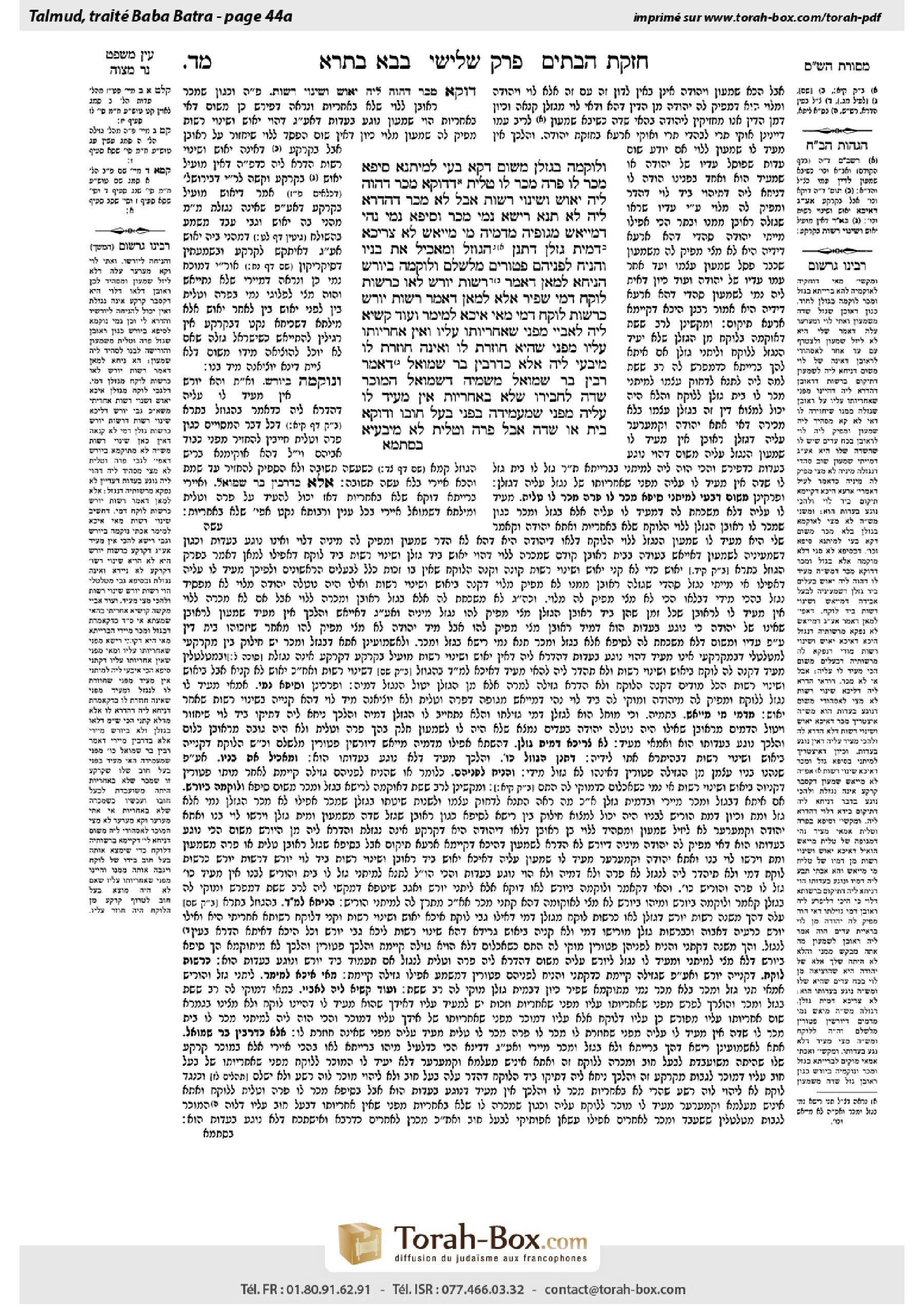
Bava Batra 44a: Talmud study for Daf Yomi
Study the Talmud for Daf Yomi with scanned pages, Hebrew text, English translations from Sefaria and AI-generated French translations.
Passage selection and English or AI-generated French translation are available where the scan has annotations. Daf Study is independent of Torah-Box and Sefaria.
Browse Bava Batra · בבא בתרא · All tractatesBava Batra 44a text and translations
This page of Bava Batra includes the Aramaic text, an English translation and an AI-generated French translation, alongside the scan above.
בבא בתרא מ״ד א · Aramaic and Hebrew text
וְלוֹקְמַהּ בְּגַזְלָן!
מִשּׁוּם דְּקָא בָּעֵי לְמִיתְנָא סֵיפָא: מָכַר לוֹ פָּרָה, מָכַר לוֹ טַלִּית – דְּדַוְקָא מָכַר, דְּהָוֵה לֵיהּ יֵאוּשׁ וְשִׁינּוּי רְשׁוּת; אֲבָל לֹא מָכַר, דְּהָדְרָא לֵיהּ – לָא; תְּנָא רֵישָׁא נָמֵי מָכַר.
וְסֵיפָא נָמֵי – נְהִי דְּמִיָּיאַשׁ מִגּוּפַיהּ, מִדְּמֶיהָ מִי מִיָּיאַשׁ? לָא צְרִיכָא, דְּמִית גַּזְלָן – דִּתְנַן: הַגּוֹזֵל וּמַאֲכִיל אֶת בָּנָיו, וְהִנִּיחַ לִפְנֵיהֶם – פְּטוּרִים מִלְּשַׁלֵּם.
וְלוֹקְמַהּ בְּיוֹרֵשׁ!
הָנִיחָא לְמַאן דְּאָמַר: רְשׁוּת יוֹרֵשׁ לָאו כִּרְשׁוּת לוֹקֵחַ דָּמֵי – שַׁפִּיר; אֶלָּא לְמַאן דְּאָמַר: רְשׁוּת יוֹרֵשׁ כִּרְשׁוּת לוֹקֵחַ דָּמֵי – מַאי אִיכָּא לְמֵימַר?
וְעוֹד קַשְׁיָא לֵיהּ לְאַבָּיֵי: מִפְּנֵי שֶׁ״אַחְרָיוּתוֹ עָלָיו״ וְ״אֵין אַחְרָיוּתוֹ עָלָיו״?! מִפְּנֵי שֶׁ״הִיא חוֹזֶרֶת לוֹ״ וְ״אֵינָהּ חוֹזֶרֶת לוֹ״ מִיבְּעֵי לֵיהּ!
אֶלָּא כִּדְרָבִין בַּר שְׁמוּאֵל – דְּאָמַר רָבִין בַּר שְׁמוּאֵל מִשְּׁמֵיהּ דִּשְׁמוּאֵל: הַמּוֹכֵר שָׂדֶה לַחֲבֵירוֹ שֶׁלֹּא בְּאַחְרָיוּת – אֵין מֵעִיד לוֹ עָלֶיהָ, מִפְּנֵי שֶׁמַּעֲמִידָהּ בִּפְנֵי בַּעַל חוֹבוֹ.
וְדַוְקָא בַּיִת אוֹ שָׂדֶה, אֲבָל פָּרָה וְטַלִּית – לָא מִיבַּעְיָא
Bava Batra 44a · English translation
The Gemara asks: And according to the understanding of Rav Sheshet, that the baraita is disqualifying one whose field was stolen from testifying on behalf of one who purchased the field from the robber, why is it necessary to discuss a case involving a buyer, when it would be simpler to establish it with regard to testifying for the robber himself?
The Gemara answers: The tanna of the baraita discusses a case involving a buyer because he wants to teach the latter clause: If he sold a cow to him, or if he sold a cloak to him, he can testify about it for the buyer. As in this clause, the tanna specifically needs to discuss a case where the robber sold it, because then it is a case of despair by the owners due to the robbery, and there is also a change in possession due to the sale, and the one who was robbed can no longer reclaim the stolen item. He is therefore no longer biased in his testimony and can testify for the one who purchased the item. But in the latter clause, if the robber did not sell it, in which case the stolen item is returned to the robbery victim, he cannot testify, as he prefers that the item be in the possession of the robber, so that he can recover it from him. Therefore, the tanna taught in the first clause as well about a case where he sold it.
The Gemara asks: And in the latter clause as well, where there is despair and change in possession, granted that he despairs of recovering the item itself, but did he despair of being reimbursed for its value? While it is true that he lost his ownership of the item, he is still entitled to payment. Therefore, he is still biased in his testimony. The Gemara answers: No, it is necessary in a case where the robber died, in which case the robbery victim cannot collect even the value of the stolen item, and is no longer biased in his testimony. As we learned in a mishna (Bava Kamma 111b): In the case of one who robs another of food and feeds it to his own children, or who left a stolen item to them as an inheritance, the children are exempt from paying the victim of the robbery after their father’s death. Since he is no longer able to collect the value of the stolen item, he is not biased in his testimony and can testify on behalf of the buyer.
The Gemara asks: And why not establish the entire baraita with regard to testifying for the robber’s heir? This would demonstrate the contrast that the tanna wanted to teach. In the case of a stolen field, which always must be returned to its owner, the robbery victim is biased in his testimony because the field can be recovered. Therefore, it is in his interest to establish that it is in the possession of the robber’s heirs. In the case of movable property, which cannot be recovered after the death of the robber, he is not biased in his testimony.
The Gemara notes: This works out well according to the one who says that the transfer of an item to the possession of an heir is not like the transfer of an item to the possession of a buyer, but is viewed as an extension of the possession of the legator. According to this opinion, it is well that the baraita did not establish its case with regard to the robber’s heir, as the robbery victim would be able to recover the item, and would be considered biased in his testimony. But according to the one who says that the transfer of an item to the possession of an heir is like the transfer of an item to the possession of a buyer, and the item is not recoverable in either case, what can be said to explain why the baraita does not state its case with regard to an heir?
And furthermore, this explanation was difficult for Abaye to understand, as according to Rav Sheshet’s explanation, is it accurate to state, as the baraita does, that the distinction exists between the cases of land and movable property because in the first clause the financial responsibility to compensate the buyer for the land is upon him, and in the latter clause the financial responsibility to compensate the buyer for the movable property is not upon him? That is not the crucial distinction. The tanna should have taught instead that the difference is: Here he cannot testify because the stolen field returns to him, and here he can testify because the stolen item does not return to him.
The Gemara offers a new explanation of the baraita: Rather, explain instead in accordance with the statement of Ravin bar Shmuel, as Ravin bar Shmuel says in the name of Shmuel: One who sells a field to another even without a guarantee that if the field will be repossessed the seller will compensate the buyer for his loss cannot testify with regard to ownership of that field on behalf of the buyer, because he is establishing the field before his creditor.
The Gemara clarifies this by noting: And this is the case specifically in the case of a house or a field. But in the case of a cow or a cloak, he is not biased in his testimony, and can testify on behalf of the buyer. The Gemara explains: It is not necessary to say that this is the halakha
Bava Batra 44a · Traduction française (IA)
Le Guemara pose la question : Selon la compréhension de R. Shéshét, la baraïta disqualifie celui dont le champ a été volé pour témoigner en faveur de celui qui a acheté le champ auprès du voleur, pourquoi est-il nécessaire de discuter d’un cas impliquant un acheteur, lorsqu’il aurait été plus simple d’établir le cas en faveur du voleur lui-même ?
Le Guemara répond : Le tanna de la baraïta discute d’un cas impliquant un acheteur car il veut enseigner la clause suivante : Si on a vendu un taureau à lui, ou s’il a vendu une cape à lui, il peut témoigner à son sujet. Comme dans cette clause, le tanna a besoin spécifiquement de discuter d’un cas où le voleur a vendu l’objet, car alors c’est un cas de désespoir de la part des propriétaires en raison du vol, et il y a aussi un changement de possession en raison de la vente, et celui qui a été volé ne peut plus récupérer l’objet volé. Il est donc plus objectif dans son témoignage et peut témoigner en faveur de celui qui a acheté l’objet. Mais dans la clause suivante, si le voleur n’a pas vendu l’objet, dans ce cas l’objet volé est rendu à la victime du vol, il ne peut pas témoigner, car il préfère que l’objet reste en possession du voleur, afin de pouvoir le récupérer auprès de lui. Ainsi, le tanna a enseigné dans la première clause également sur un cas où il l’a vendu.
Le Guemara pose la question : Et dans la clause suivante également, où il y a désespoir et changement de possession, admettons qu’il ait désespéré de récupérer l’objet lui-même, mais a-t-il désespéré de se faire rembourser de sa valeur ? Bien que l’objet lui ait été volé, il est toujours dû à la victime du vol. Il est donc encore partial dans son témoignage. Le Guemara répond : Non, il est nécessaire dans un cas où le voleur est mort, dans lequel cas la victime du vol ne peut même pas récupérer la valeur de l’objet volé, et n’est plus partial dans son témoignage. Comme nous avons appris dans une mitsva (Bava Kamma 111b) : Dans le cas où l’on vole de la nourriture à quelqu’un et qu’on la donne à ses enfants, ou qu’on la laisse à ses enfants comme héritage, les enfants sont exemptés de payer la victime du vol après la mort de leur père. Puisque l’objet ne peut plus être récupéré, il n’est plus partial dans son témoignage et peut témoigner en faveur de l’acheteur.
Le Guemara pose la question : Et pourquoi ne pas établir toute la baraïta en faveur du héritier du voleur ? Cela démontrerait le contraste que le tanna voulait enseigner. Dans le cas d’un champ volé, qui doit toujours être rendu à son propriétaire, la victime du vol est partial dans son témoignage car le champ peut être récupéré. Il est donc dans son intérêt d’établir que le champ est en possession des héritiers du voleur. Dans le cas d’un objet mobile, qui ne peut être récupéré après la mort du voleur, il n’est pas partial dans son témoignage.
Le Guemara note : Cela fonctionne bien selon celui qui dit que le transfert d’un objet à la possession d’un héritier n’est pas comme le transfert d’un objet à la possession d’un acheteur, mais est vu comme une prolongation de la possession du donateur. Selon cet avis, il est bien que la baraïta n’ait pas établi son cas en faveur des héritiers du voleur, car la victime du vol pourrait récupérer l’objet et serait considérée comme partial dans son témoignage. Mais selon celui qui dit que le transfert d’un objet à la possession d’un héritier est comme le transfert d’un objet à la possession d’un acheteur, et l’objet n’est pas récupérable dans les deux cas, que peut-on dire pour expliquer pourquoi la baraïta n’a pas établi son cas en faveur d’un héritier ?
Et de plus, cette explication était difficile à comprendre pour Abaye, car selon l’explication de R. Shéshét, est-ce exact de dire, comme le fait la baraïta, que la distinction existe entre les cas de terrain et d’objet mobile, car dans la première clause la responsabilité financière de compenser l’acheteur pour le terrain incombe à lui, et dans la clause suivante la responsabilité financière de compenser l’acheteur pour l’objet mobile n’incombe pas à lui ? Ce n’est pas la distinction cruciale. Le tanna aurait dû enseigner plutôt que la différence est : ici il ne peut pas témoigner car le champ volé revient à lui, et ici il peut témoigner car l’objet volé ne revient pas à lui.
Le Guemara propose une nouvelle explication de la baraïta : Plutôt, expliquez plutôt selon l’affirmation de Ravin bar Shmuel, comme Ravin bar Shmuel dit au nom de Shmuel : Celui qui vend un champ à un autre, même sans garantie que si le champ est réclamé, le vendeur compensera l’acheteur pour sa perte, ne peut pas témoigner en faveur de l’acheteur concernant la propriété de ce champ, car il établit le champ devant son créancier.
Le Guemara clarifie cela en notant : Et c’est spécifiquement le cas dans le cas d’une maison ou d’un champ. Mais dans le cas d’un taureau ou d’une cape, il n’est pas partial dans son témoignage et peut témoigner en faveur de l’acheteur. Le Guemara explique : Il n’est pas nécessaire de dire que c’est la halakha
Traduction française générée par IA à partir de l’édition anglaise de Sefaria. Vérifie toujours un passage avec le texte source.
Text from Sefaria: William Davidson Edition - Vocalized Aramaic (CC BY NC); William Davidson Edition - English (CC BY NC).