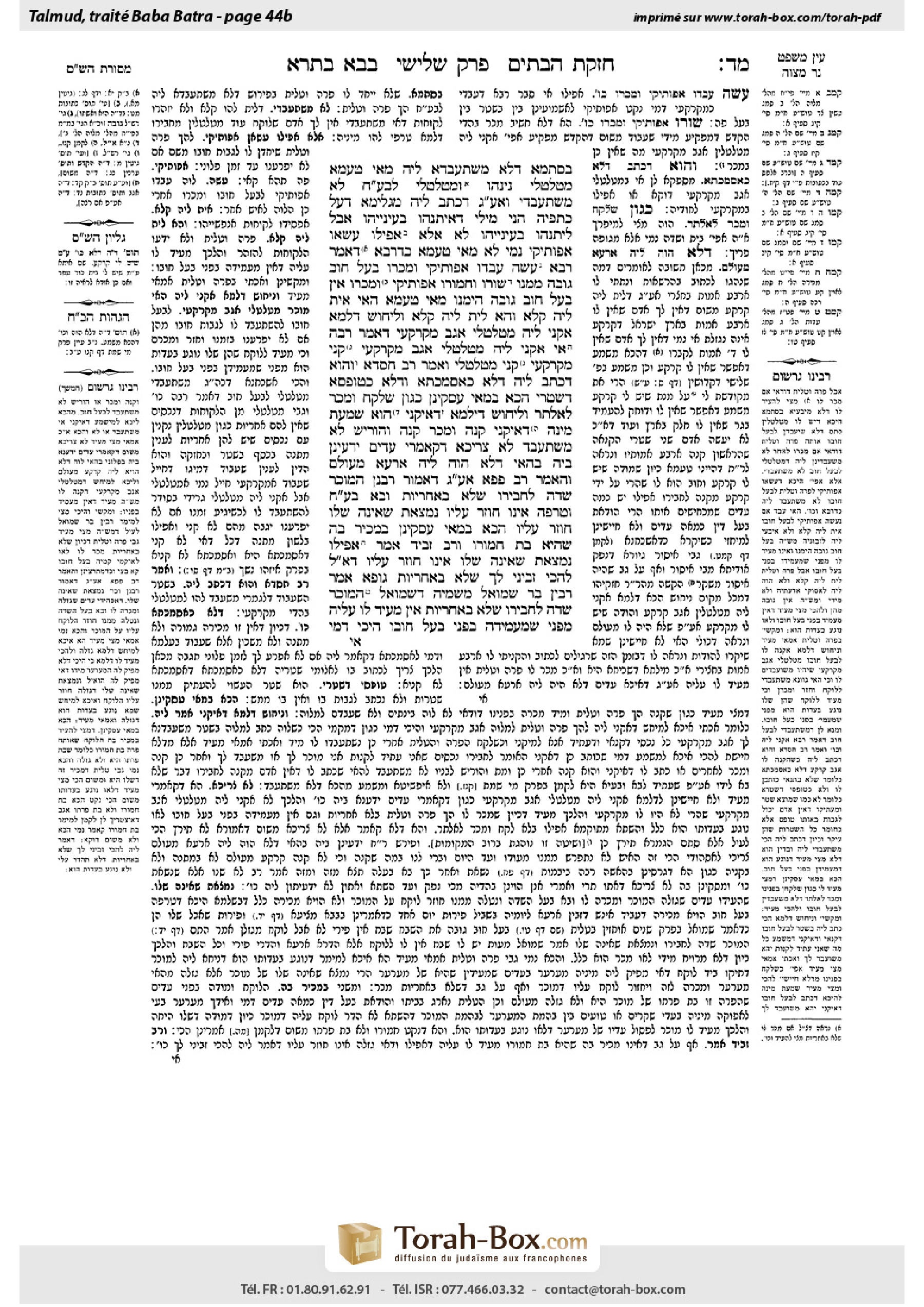
Bava Batra 44b: Talmud study for Daf Yomi
Study the Talmud for Daf Yomi with scanned pages, Hebrew text, English translations from Sefaria and AI-generated French translations.
Passage selection and English or AI-generated French translation are available where the scan has annotations. Daf Study is independent of Torah-Box and Sefaria.
Browse Bava Batra · בבא בתרא · All tractatesBava Batra 44b text and translations
This page of Bava Batra includes the Aramaic text, an English translation and an AI-generated French translation, alongside the scan above.
בבא בתרא מ״ד ב · Aramaic and Hebrew text
בִּסְתָמָא דְּלָא מִשְׁתַּעְבְּדָא לֵיהּ, מַאי טַעְמָא? מִטַּלְטְלֵי נִינְהוּ, וּמִטַּלְטְלֵי לְבַעַל חוֹב לָא מִשְׁתַּעְבְּדִי – וְאַף עַל גַּב דִּכְתַב לֵיהּ מִגְּלִימָא דְּעַל כַּתְפֵּיהּ, הָנֵי מִילֵּי דְּאִיתַנְהוּ בְּעֵינַיְיהוּ, אֲבָל לֵיתַנְהוּ בְּעֵינַיְיהוּ – לָא;
אֶלָּא אֲפִילּוּ עֲשָׂאוֹ אַפּוֹתֵיקֵי – נָמֵי לָא. מַאי טַעְמָא? כִּדְרָבָא – דְּאָמַר רָבָא: עָשָׂה עַבְדּוֹ אַפּוֹתֵיקֵי וּמְכָרוֹ – בַּעַל חוֹב גּוֹבֶה מִמֶּנּוּ. שׁוֹרוֹ וַחֲמוֹרוֹ אַפּוֹתֵיקֵי וּמְכָרוֹ – אֵין בַּעַל חוֹב גּוֹבֶה הֵימֶנּוּ,
מַאי טַעְמָא? הַאי אִית לֵיהּ קָלָא, וְהָא לֵית לֵיהּ קָלָא.
וְלֵיחוּשׁ דִּלְמָא אַקְנִי לֵיהּ מִטַּלְטְלֵי אַגַּב מְקַרְקְעֵי! דְּאָמַר רַבָּה: אִי אַקְנִי לֵיהּ מִטַּלְטְלֵי אַגַּב מְקַרְקְעֵי – קָנֵי מְקַרְקְעֵי קָנֵי מִטַּלְטְלֵי. וְאָמַר רַב חִסְדָּא: וְהוּא דִּכְתַב לֵיהּ: ״דְּלָא כְּאַסְמַכְתָּא וּדְלָא כְּטוּפְסָא דִשְׁטָרֵי״.
הָכָא בְּמַאי עָסְקִינַן – כְּגוֹן שֶׁלָּקַח, וּמָכַר לְאַלְתַּר.
וְלֵיחוּשׁ דִּילְמָא ״דְּאֶיקְנֵי״ הוּא! שָׁמְעַתְּ מִינַּהּ: ״דְּאֶיקְנֵי״; קָנָה וּמָכַר, קָנָה וְהוֹרִישׁ – לֹא מִשְׁתַּעְבֵּד?
לָא צְרִיכָא, דְּקָאָמְרִי עֵדִים: יָדְעִינַן בֵּיהּ בְּהַאי דְּלָא הֲוָה לֵיהּ אַרְעָא מֵעוֹלָם.
וְהָאָמַר רַב פָּפָּא, אַף עַל גַּב דַּאֲמוּר רַבָּנַן: הַמּוֹכֵר שָׂדֶה לַחֲבֵירוֹ שֶׁלֹּא בְּאַחְרָיוּת, וּבָא בַּעַל חוֹב וּטְרָפָהּ – אֵינוֹ חוֹזֵר עָלָיו; נִמְצֵאת שֶׁאֵינָהּ שֶׁלּוֹ – חוֹזֵר עָלָיו!
הָכָא בְּמַאי עָסְקִינַן – בְּמַכִּיר בָּהּ שֶׁהִיא בַּת חֲמוֹרוֹ.
וְרַב זְבִיד אָמַר: אֲפִילּוּ נִמְצֵאת שֶׁאֵינָהּ שֶׁלּוֹ – אֵינוֹ חוֹזֵר עָלָיו, דַּאֲמַר לֵיהּ: לְהָכִי זַבֵּינִי לָךְ שֶׁלֹּא בְּאַחְרָיוּת.
גּוּפָא – אָמַר רָבִין בַּר שְׁמוּאֵל מִשְּׁמֵיהּ דִּשְׁמוּאֵל: הַמּוֹכֵר שָׂדֶה לַחֲבֵירוֹ שֶׁלֹּא בְּאַחְרָיוּת – אֵין מֵעִיד לוֹ עָלֶיהָ, מִפְּנֵי שֶׁמַּעֲמִידָהּ בִּפְנֵי בַּעַל חוֹבוֹ. הֵיכִי דָּמֵי?
Bava Batra 44b · English translation
in a case where he sold a cow or cloak without specification, where it is not liened to the creditor. What is the reason for this? It is because these items are movable property, and movable property is not liened to a creditor. And even though it is so that the debtor wrote to the creditor that he can collect the debt even from the cloak that is on his shoulders, that matter applies only when it is as is and in the possession of the debtor, but if it is not as is, since it is in the possession of the buyer, then no, the creditor cannot collect from movable property. Therefore, the debtor can testify on behalf of the buyer.
The Gemara continues: But even in a case where he set the cow or cloak aside as designated repayment [apoteiki], the creditor cannot collect from it. What is the reasoning? It is in accordance with the statement of Rava, as Rava says: If a master set aside his slave as designated repayment of a debt and then sold him, the master’s creditor collects the debt from the proceeds from the sale of the slave. But if one set aside his ox or his donkey as designated repayment and then sold it, the creditor does not collect the debt from the proceeds of the sale of the ox or the donkey.
What is the reason for this distinction? This setting aside of the slave as designated repayment generates publicity, and that setting aside of the ox or donkey as designated repayment does not generate publicity. Therefore, when the slave had been set aside as designated repayment, the buyer would have been aware of this. Since he bought the slave while having this knowledge, the slave can be seized from him by the seller’s creditor. By contrast, the buyer of the cow or cloak would not have been aware that it had been set aside as designated repayment, so the seller’s creditor cannot seize it from him.
The Gemara asks: But let there be a concern that perhaps the debtor transferred the movable property to the creditor, not for him to own, but for him to have a lien on the movable property, by means of, i.e., together with, an acquisition of land, as Rabba said: If the debtor transferred movable property to the creditor as liened property by means of an acquisition of land, the creditor acquires the land and acquires the movable property, i.e., a lien is created with regard to both. And Rav Ḥisda said: And that is the halakha only where the debtor wrote to the creditor: This lien is not like a transaction with inconclusive consent [ke’asmakhta], which does not effect acquisition, and not like the template [ketofesa] for documents, which are not actually used to collect debts. Rather, it is a legally binding document.
The Gemara answers: With what are we dealing here? We are dealing with a case where the debtor had purchased the movable property and immediately sold it, and there was no opportunity for him to have it become liened to a creditor. Therefore, there is no possibility of his being biased in his testimony due to a desire to repay his debt.
The Gemara asks: But let there be a concern that perhaps it is a case in which the debtor wrote to the creditor: I will repay you even from that which I will acquire in the future, which would presumably mean that the creditor can collect from the buyer even though the debtor purchased the item after taking the loan. From the fact that this is not a concern, do you learn from it that even if the debtor wrote: I will repay you even from that which I will acquire in the future, and he then purchased and sold property or purchased and bequeathed it, that which he purchases is not liened to his creditor? This would seem to settle what is otherwise assumed to be an unresolved question.
The Gemara rejects this proof: No, one need not reach that conclusion, as it is necessary to teach the halakha in a case where witnesses say: We know about this one who sold these items that he never had any land. Therefore, it cannot be that the creditor acquired a lien on the movable property by means of an acquisition of land.
The Gemara asks: But doesn’t Rav Pappa say that even though the Sages said: In the case of one who sells a field to another without a guarantee, and a creditor came and repossessed it, the buyer cannot return to the seller, i.e. the debtor, who sold him the field, to claim reimbursement; but if it is found that the field was not the seller’s in the first place, the buyer can return to the seller to claim reimbursement. In this case, if the claimant establishes that the cow or cloak is his and was not the seller’s, the buyer will be able to claim reimbursement. The seller is therefore biased in his testimony, and should not be able to testify on behalf of the buyer.
The Gemara answers: With what are we dealing here? We are dealing with a case where the buyer admits that he recognizes that this is the offspring of the seller’s donkey, and will not claim in court that the seller had no right to sell it.
The Gemara returns to the statement of Rav Pappa and comments: But in contrast to the opinion of Rav Pappa, Rav Zevid says: Even if it is found that the field was not the seller’s, the buyer cannot return to the seller to claim reimbursement, as the seller can say to the buyer: It is for this reason that I sold it to you without a guarantee, i.e., so that if it is taken from you, I will not bear liability.
§ The Gemara returns to Shmuel’s statement, in order to examine the matter itself. Ravin bar Shmuel says in the name of Shmuel: One who sells a field to another even without a guarantee that if the field will be repossessed the seller will compensate the buyer for his loss cannot testify with regard to ownership of that field on behalf of the buyer, because he is establishing the field before his creditor. The Gemara asks: What are the circumstances of this halakha?
Bava Batra 44b · Traduction française (IA)
Dans un cas où l'on vend un bovin ou une cape sans précision, et où il n'est pas lié au créancier. Quelle est la raison de cela ? C'est parce que ces objets sont des biens mobiliers, et les biens mobiliers ne sont pas liés au créancier. Et même si c'est ainsi que le débiteur écrit au créancier qu'il peut récupérer la dette même de la cape qui est sur ses épaules, cette situation s'applique uniquement lorsque l'objet est tel qu'il est et en possession du débiteur, mais si ce n'est pas le cas, puisque l'objet est en possession de l'acheteur, alors non, le créancier ne peut récupérer sur les biens mobiliers. Ainsi, le débiteur peut témoigner en faveur de l'acheteur.
La Guemara continue : Mais même dans un cas où l'on a mis de côté le bovin ou la cape comme remboursement désigné, le créancier ne peut pas récupérer sur celui-ci. Quelle est la raison ? C'est selon l'opinion de Rava, car Rava dit : Si un maître a désigné son esclave comme remboursement d'une dette et l'a ensuite vendu, le créancier du maître récupère la dette des revenus de la vente de l'esclave. Mais si l'on a désigné son bœuf ou son âne comme remboursement désigné et l'a ensuite vendu, le créancier ne récupère pas la dette des revenus de la vente du bœuf ou de l'âne.
Quelle est la raison de cette distinction ? La désignation de l'esclave comme remboursement génère une publicité, tandis que la désignation du bœuf ou de l'âne comme remboursement ne génère pas de publicité. Ainsi, lorsque l'esclave avait été désigné comme remboursement, l'acheteur aurait été conscient de cela. Puisqu'il l'a acheté en sachant cela, l'esclave peut être saisi par le créancier du vendeur. En revanche, l'acheteur du bœuf ou de la cape ne serait pas conscient qu'il avait été désigné comme remboursement, donc le créancier du vendeur ne peut pas le saisir.
La Guemara pose la question : Mais supposons qu'il y ait une crainte que le débiteur ait transféré les biens mobiliers au créancier, pas pour qu'il les possède, mais pour qu'il ait un droit de gage, par le biais, c'est-à-dire avec, d'une acquisition de terre, comme Rabba dit : Si le débiteur transfère des biens mobiliers au créancier comme biens gageés par le biais d'une acquisition de terre, le créancier acquiert la terre et les biens mobiliers, c'est-à-dire un droit de gage est créé à l'égard des deux. Et Rav Ḥisda dit : Et c'est la halakha uniquement dans le cas où le débiteur écrit au créancier : Ce droit de gage n'est pas comme une transaction avec un consentement indéterminé [ke’asmakhta], qui ne produit pas l'acquisition, et pas comme le modèle [ketofesa] des documents, qui ne sont pas réellement utilisés pour récupérer des dettes. Plutôt, c'est un document juridiquement contraignant.
La Guemara répond : Avec quels cas sommes-nous en train de parler ? Nous parlons d'un cas où le débiteur avait acheté les biens mobiliers et les avait immédiatement vendus, et il n'y avait pas eu l'opportunité pour lui de les gager au créancier. Ainsi, il n'y a pas de possibilité qu'il soit partial dans son témoignage en raison d'un désir de rembourser sa dette.
La Guemara pose la question : Mais supposons qu'il y ait une crainte que ce soit un cas où le débiteur a écrit au créancier : Je te rembourserai même de ce que j'acquerrai à l'avenir, ce qui signifierait probablement que le créancier peut récupérer de l'acheteur même si le débiteur a acheté l'objet après avoir pris le prêt. À partir du fait que cela n'est pas une crainte, apprends-tu que même si le débiteur écrit : Je te rembourserai même de ce que j'acquerrai à l'avenir, et qu'il achète et vend un bien ou achète et léguera un bien, ce qu'il achète n'est pas gageable par son créancier ? Cela semble résoudre ce qui était autrement une question non résolue.
La Guemara rejette cette preuve : Non, il n'est pas nécessaire d'en arriver à cette conclusion, car il est nécessaire d'enseigner la halakha dans un cas où des témoins disent : Nous savons à propos de cette personne qui a vendu ces objets qu'il n'avait jamais de terre. Il ne peut donc pas être que le créancier ait acquis un droit de gage sur les biens mobiliers par le biais d'une acquisition de terre.
La Guemara pose la question : Mais ne dit pas Rav Pappa que même si les Sages disent : Dans le cas d'une personne qui vend un champ à un autre sans garantie, et qu'un créancier vient et récupère ce champ, l'acheteur ne peut pas revenir au vendeur, c'est-à-dire au débiteur, qui lui a vendu le champ, pour réclamer un remboursement ; mais si on découvre que le champ n'était pas celui du vendeur d'abord, l'acheteur peut revenir au vendeur pour réclamer un remboursement. Dans ce cas, si le plaignant établit que le bovin ou la cape est le sien et n'était pas celui du vendeur, l'acheteur pourra réclamer un remboursement. Le vendeur est donc partial dans son témoignage et ne devrait pas pouvoir témoigner en faveur de l'acheteur.
La Guemara répond : Avec quels cas sommes-nous en train de parler ? Nous parlons d'un cas où l'acheteur admet qu'il reconnaît que c'est l'offspring du cheval du vendeur, et qu'il ne réclamera pas en justice que le vendeur n'avait pas le droit de le vendre.
La Guemara reprend l'opinion de Rav Pappa et commente : Mais contrairement à l'opinion de Rav Pappa, Rav Zevid dit : Même si l'on découvre que le champ n'était pas celui du vendeur, l'acheteur ne peut pas revenir au vendeur pour réclamer un remboursement, car le vendeur peut dire à l'acheteur : C'est pour cette raison que je l'ai vendu à toi sans garantie, c'est-à-dire afin que si on te le prend, je ne sois pas tenu responsable.
§ La Guemara reprend la déclaration de Shmuel, afin d'examiner la question elle-même. Ravin bar Shmuel cite en nom de Shmuel : Celui qui vend un champ à un autre, même sans garantie que si le champ est réclamé par le créancier, le vendeur compensera la perte à l'acheteur, ne peut pas témoigner concernant la propriété de ce champ en faveur de l'acheteur, car il établit le champ devant son créancier. La Guemara pose la question : Quelles sont les circonstances de cette halakha ?
Traduction française générée par IA à partir de l’édition anglaise de Sefaria. Vérifie toujours un passage avec le texte source.
Text from Sefaria: William Davidson Edition - Vocalized Aramaic (CC BY NC); William Davidson Edition - English (CC BY NC).