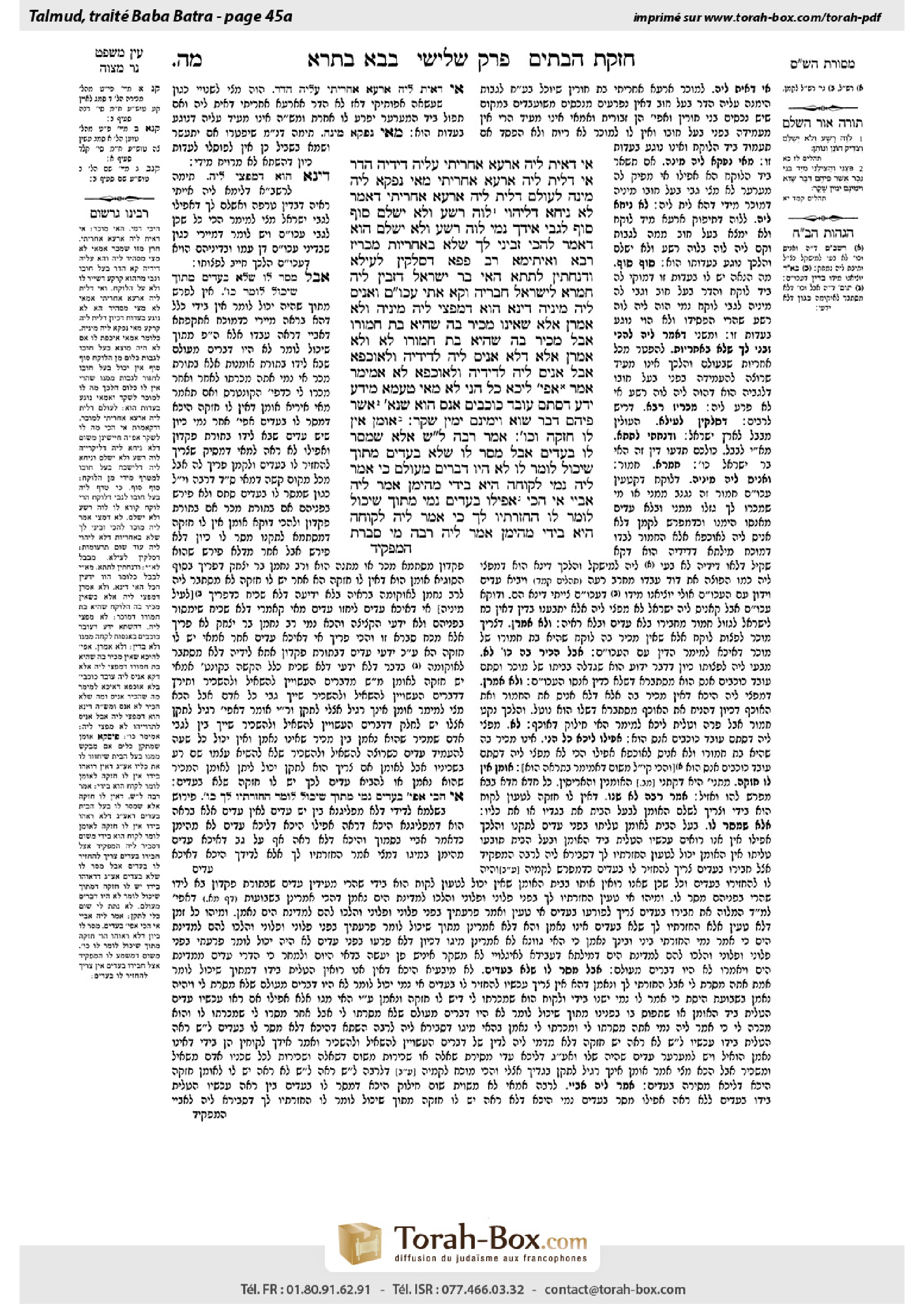
Bava Batra 45a: Talmud study for Daf Yomi
Study the Talmud for Daf Yomi with scanned pages, Hebrew text, English translations from Sefaria and AI-generated French translations.
Passage selection and English or AI-generated French translation are available where the scan has annotations. Daf Study is independent of Torah-Box and Sefaria.
Browse Bava Batra · בבא בתרא · All tractatesBava Batra 45a text and translations
This page of Bava Batra includes the Aramaic text, an English translation and an AI-generated French translation, alongside the scan above.
בבא בתרא מ״ה א · Aramaic and Hebrew text
אִי דְּאִית לֵיהּ אַרְעָא אַחֲרִיתִי, עֲלֵיהּ דִּידֵיהּ הָדַר! אִי דְּלֵית לֵיהּ אַרְעָא אַחֲרִיתִי, מַאי נָפְקָא לֵיהּ מִינָּה?
לְעוֹלָם דְּלֵית לֵיהּ אַרְעָא אַחֲרִיתִי, דְּאָמַר: לָא נִיחָא דְּלֶיהְוֵי ״לֹוֶה רָשָׁע וְלֹא יְשַׁלֵּם״.
סוֹף סוֹף, לְגַבֵּי אִידַּךְ נָמֵי – ״לֹוֶה רָשָׁע וְלֹא יְשַׁלֵּם״ הוּא! דְּאָמַר: לְהָכִי זַבֵּינִי לָךְ שֶׁלֹּא בְּאַחְרָיוּת.
מַכְרֵיז רָבָא, וְאִיתֵּימָא רַב פָּפָּא: דְּסָלְקִין לְעֵילָּא וּדְנָחֲתִין לְתַתָּא; הַאי בַּר יִשְׂרָאֵל דְּזָבֵין לֵיהּ חֲמָרָא לְיִשְׂרָאֵל חַבְרֵיהּ, וְקָא אָתֵי גּוֹי וְאָנֵיס לֵיהּ מִינֵּיהּ, דִּינָא הוּא דִּמְפַצֵּי לֵיהּ מִינֵּיהּ.
וְלָא אֲמַרַן אֶלָּא שֶׁאֵינוֹ מַכִּיר בָּהּ שֶׁהִיא בַּת חֲמוֹרוֹ, אֲבָל מַכִּיר בָּהּ שֶׁהִיא בַּת חֲמוֹרוֹ – לָא. וְלָא אֲמַרַן אֶלָּא דְּלָא אָנֵיס לֵיהּ לְדִידֵיהּ וּלְאוּכָּפָא, אֲבָל אָנֵיס לֵיהּ לְדִידֵיהּ וּלְאוּכָּפָא – לָא.
אַמֵּימָר אָמַר: אֲפִילּוּ לֵיכָּא כׇּל הָנֵי – לָא. מַאי טַעְמָא? מִידָּע יָדַע דִּסְתַם גּוֹי אַנָּס הוּא – שֶׁנֶּאֱמַר: ״אֲשֶׁר פִּיהֶם דִּבֶּר שָׁוְא וִימִינָם יְמִין שָׁקֶר״.
אוּמָּן אֵין לוֹ חֲזָקָה וְכוּ׳. אָמַר רַבָּה: לֹא שָׁנוּ אֶלָּא שֶׁמָּסַר לוֹ בְּעֵדִים, אֲבָל מָסַר לוֹ שֶׁלֹּא בְּעֵדִים – מִתּוֹךְ שֶׁיָּכוֹל לוֹמַר לוֹ ״לֹא הָיוּ דְבָרִים מֵעוֹלָם״, כִּי אָמַר לֵיהּ נָמֵי ״לְקוּחָה הִיא בְּיָדִי״ – מְהֵימַן.
אֲמַר לֵיהּ אַבָּיֵי: אִי הָכִי, אֲפִילּוּ בְּעֵדִים נָמֵי – מִתּוֹךְ שֶׁיָּכוֹל לוֹמַר לוֹ: ״הֶחְזַרְתִּיו לְךָ״, כִּי אָמַר לֵיהּ: ״לְקוּחָה הִיא בְּיָדִי״ – מְהֵימַן!
אֲמַר לֵיהּ רַבָּה: מִי סָבְרַתְּ
Bava Batra 45a · English translation
If this is a case where the seller has other land, that he did not sell, in addition to the field that he sold with regard to which he currently wishes to testify, his creditor will go after it, and collect from that land. In that case, he is not biased in his testimony concerning the field that he sold. If this is a case where the seller does not have other land, what difference does it make to him if the buyer is unable to keep the land? In any event the creditor cannot collect directly from the seller.
The Gemara answers: Actually, Shmuel is referring to a case where the seller does not have other land, and the reason that he is nevertheless biased in his testimony is that he wants his creditors to be able to collect the debt because he says to himself that it is uncomfortable for him to be in the category of: “The wicked borrows, and pays not” (Psalms 37:21).
The Gemara asks: But ultimately, he is also in the category of: “The wicked borrows, and pays not” (Psalms 37:21) with regard to the other one, to whom he sold the land. He took money from the buyer, who did not receive anything in exchange, as the land was seized from him. The Gemara answers: He is not concerned about his behavior toward the buyer, as he can say to him: For this very reason I sold it to you without a guarantee, so that if it would be seized from you I would not be liable.
§ The Gemara relates: Rava announced, and some say it was Rav Pappa who announced: All those who ascend from Babylonia to Eretz Yisrael and all those who descend from Eretz Yisrael to Babylonia should be aware of the following: In a case of this Jew who sold a donkey to another Jew, and then a gentile came and seized it from him, claiming that it was really his, the halakha is that the seller should rescue [dimfatzei] it from the gentile or reimburse the buyer.
The Gemara points out: And we said this halakha only in a case where the buyer does not recognize that this is the offspring of the seller’s donkey, and it is possible that the gentile’s claim is true. But if the buyer recognizes that this is the offspring of the seller’s donkey, then the seller is not liable to reimburse him. It is clear that the gentile’s claim is false, so the seller bears no responsibility for the buyer’s loss. And furthermore, we said this halakha only in a case where the gentile did not seize it and the saddle with it. But if he seized it and the saddle with it, it is clear that the gentile is a robber, and it is assumed that there is no validity to his claim with regard to the donkey. Therefore, the seller is not liable to reimburse him.
Ameimar said: Even if there are not any of these factors, the seller is not liable to reimburse him. What is the reasoning for this? It is that it is known that an ordinary gentile is an extortionist, so it is assumed that the donkey did indeed belong to the seller, as it is stated: “Whose mouth speaks falsehood, and their right hand is a right hand of lying” (Psalms 144:8).
§ The Gemara returns to discuss the statement of Shmuel (42b): A craftsman does not have the ability to establish the presumption of ownership of the property in his possession, but a partner has the ability to establish the presumption of ownership. Rabba says: They taught this only in a case where the owner transferred the item to the craftsman in the presence of witnesses. But if the owner transferred the item to the craftsman not in the presence of witnesses, then, since the craftsman is able to say to the one who claims to be the owner: These matters never occurred, i.e., you did not give me this item but it was mine to begin with, and he would keep possession of the item with that claim, then even when the craftsman says to him: It is purchased by me from you, and that is why it is in my possession, he is deemed credible.
Abaye said to Rabba: If so, then even if the owner transferred the item to the craftsman in the presence of witnesses as well, he should be deemed credible. Since the craftsman is able to say to the owner: I returned the item to you, and he would be exempt from payment, when the craftsman says to him: It is purchased by me from you, and that is why it is in my possession, he is deemed credible.
Rabba said to Abaye: Do you maintain that
Bava Batra 45a · Traduction française (IA)
Si c'est un cas où le vendeur possède d'autres terres, qu'il n'a pas vendues, en plus du champ qu'il a vendu, concernant lequel il souhaite actuellement témoigner, son créancier ira après ces terres et les saisira. Dans ce cas, il n'est pas partial dans son témoignage concernant le champ qu'il a vendu. Si c'est un cas où le vendeur n'a pas d'autres terres, à quoi bon s'occuper du fait que l'acheteur ne puisse pas garder la terre ? En tout cas, le créancier ne peut pas saisir directement le vendeur.
La Guemara répond : En réalité, Shmuel fait référence à un cas où le vendeur n'a pas d'autres terres, et la raison pour laquelle il est tout de même partial dans son témoignage est qu'il veut que ses créanciers puissent récupérer leur dette, car il se dit que cela lui est inconfortable d'être dans la catégorie : « Le méchant emprunte et ne paie pas » (Psaumes 37:21).
La Guemara pose la question : Mais finalement, il est aussi dans la catégorie : « Le méchant emprunte et ne paie pas » (Psaumes 37:21) concernant l'autre, celui à qui il a vendu la terre. Il a pris de l'argent de l'acheteur, qui n'a reçu rien en échange, car la terre lui a été confisquée. La Guemara répond : Il ne s'occupe pas de son comportement envers l'acheteur, car il peut lui dire : Pour cette raison exacte j'ai vendu cela à toi sans garantie, afin que si cela te fut confisqué, je ne sois pas tenu responsable.
§ La Guemara rapporte : Rava a déclaré, et certains disent que c'est Rav Pappa qui l'a déclaré : Tous ceux qui montent de Babylone vers la Terre d'Israël et tous ceux qui descendent de la Terre d'Israël vers Babylone doivent être informés du suivant : Dans le cas d'un Juif qui a vendu un âne à un autre Juif, et ensuite un non-Juif est venu et l'a confisqué, affirmant qu'il était vraiment à lui, la halakha est que le vendeur doit sauver [dimfatzei] l'âne du non-Juif ou indemniser l'acheteur.
La Guemara souligne : Et nous avons dit cette halakha uniquement dans le cas où l'acheteur ne reconnaît pas que c'est l'offspring de l'âne du vendeur, et il est possible que la revendication du non-Juif soit vraie. Mais si l'acheteur reconnaît que c'est l'offspring de l'âne du vendeur, alors le vendeur n'est pas tenu d'indemniser l'acheteur. Il est clair que la revendication du non-Juif est fausse, donc le vendeur n'assume pas la responsabilité de la perte de l'acheteur. Et de plus, nous avons dit cette halakha uniquement dans le cas où le non-Juif n'a pas confisqué l'âne et la selle avec lui. Mais s'il a confisqué l'âne et la selle avec lui, il est clair que le non-Juif est un voleur, et on suppose qu'il n'y a pas de validité à sa revendication concernant l'âne. Ainsi, le vendeur n'est pas tenu d'indemniser l'acheteur.
Ameimar a dit : Même s'il n'y a aucun de ces facteurs, le vendeur n'est pas tenu d'indemniser l'acheteur. Quelle est la raison de cela ? C'est que l'on sait qu'un non-Juif ordinaire est un extorqueur, donc on suppose que l'âne appartenait effectivement au vendeur, comme il est dit : « Qui parle de mensonge, et leur main droite est une main droite de mensonge » (Psaumes 144:8).
§ La Guemara reprend la discussion sur l'affirmation de Shmuel (42b) : Un artisan n'a pas la capacité d'établir la présomption de propriété de l'objet qu'il possède, mais un partenaire a la capacité d'établir la présomption de propriété. Rabba dit : Ils ont enseigné cela uniquement dans le cas où l'owner a transféré l'objet à l'artisan en présence de témoins. Mais si l'owner a transféré l'objet à l'artisan sans la présence de témoins, alors, puisque l'artisan peut dire à celui qui affirme être le propriétaire : Ces choses n'ont jamais eu lieu, c'est-à-dire que tu ne m'as pas donné cet objet mais il m'appartenait déjà, et il pourrait conserver la possession de l'objet avec cette affirmation, alors même que l'artisan dit à lui : J'ai acheté cela de toi, et c'est pourquoi il est en ma possession, il est considéré comme crédible.
Abaye a dit à Rabba : Si c'est ainsi, alors même si l'owner a transféré l'objet à l'artisan en présence de témoins, il devrait être considéré comme crédible. Puisque l'artisan peut dire à l'owner : J'ai rendu l'objet à toi, et il serait exempt de paiement, lorsque l'artisan dit à lui : J'ai acheté cela de toi, et c'est pourquoi il est en ma possession, il est considéré comme crédible.
Rabba a dit à Abaye : Maintenez-vous que
Traduction française générée par IA à partir de l’édition anglaise de Sefaria. Vérifie toujours un passage avec le texte source.
Text from Sefaria: William Davidson Edition - Vocalized Aramaic (CC BY NC); William Davidson Edition - English (CC BY NC).