Bava Batra 46a: Talmud study for Daf Yomi
Study the Talmud for Daf Yomi with scanned pages, Hebrew text, English translations from Sefaria and AI-generated French translations.
Passage selection and English or AI-generated French translation are available where the scan has annotations. Daf Study is independent of Torah-Box and Sefaria.
Browse Bava Batra · בבא בתרא · All tractatesBava Batra 46a text and translations
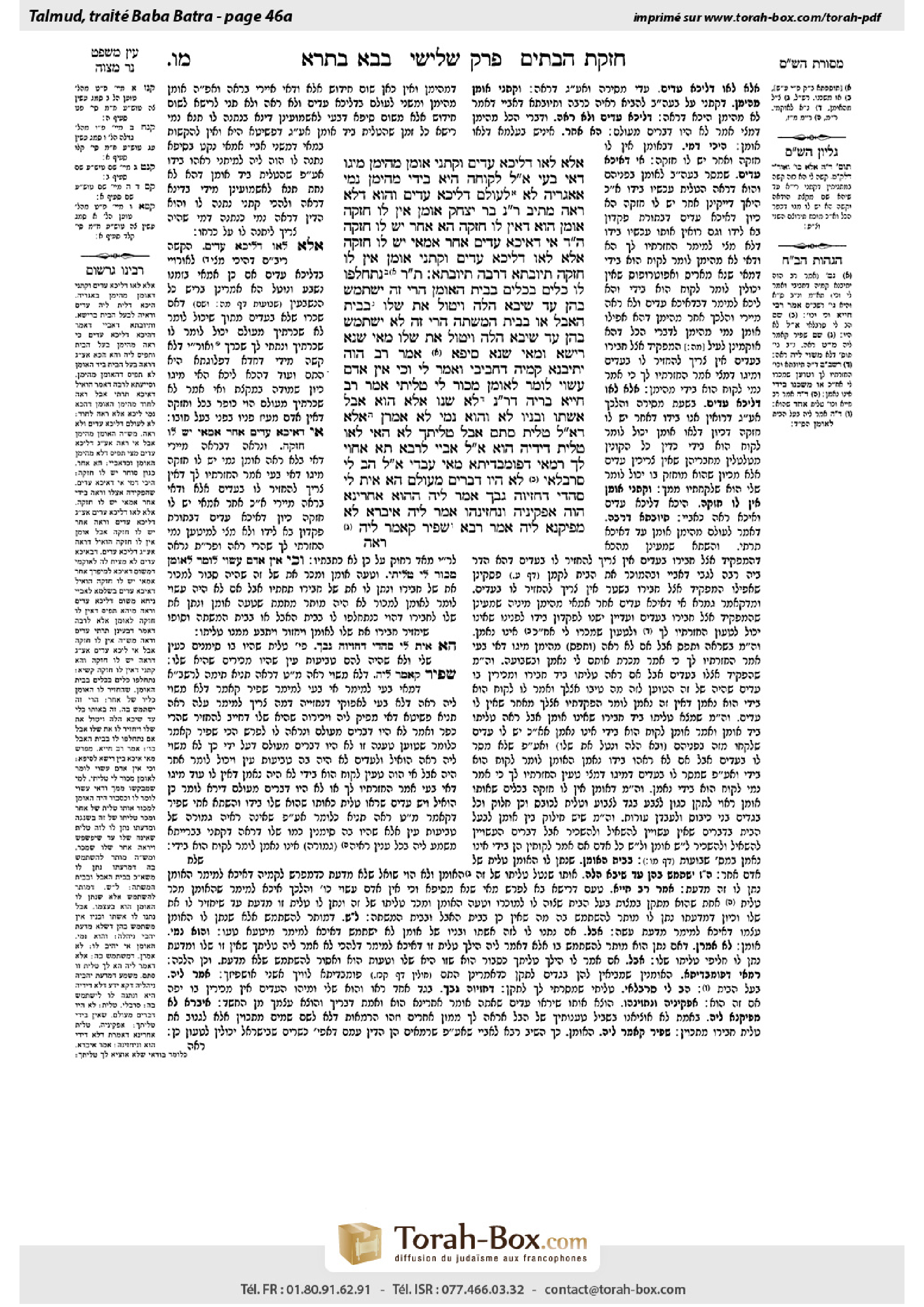
This page of Bava Batra includes the Aramaic text, an English translation and an AI-generated French translation, alongside the scan above.
בבא בתרא מ״ו א · Aramaic and Hebrew text
אֶלָּא לָאו דְּלֵיכָּא עֵדִים? וְקָתָנֵי: אוּמָּן מְהֵימַן – מִיגּוֹ דְּאִי בָּעֵי אָמַר לֵיהּ ״לְקוּחָה הִיא בְּיָדִי״, מְהֵימַן נָמֵי אַאַגְרֵיהּ!
לָא, לְעוֹלָם דְּלֵיכָּא עֵדִים; וְהוּא דְּלֹא רָאָה.
מֵתִיב רַב נַחְמָן בַּר יִצְחָק: אוּמָּן אֵין לוֹ חֲזָקָה. אוּמָּן הוּא דְּאֵין לוֹ חֲזָקָה – הָא אַחֵר יֵשׁ לוֹ חֲזָקָה.
הֵיכִי דָמֵי? אִי דְּאִיכָּא עֵדִים, אַחֵר – אַמַּאי יֵשׁ לוֹ חֲזָקָה? אֶלָּא לָאו דְּלֵיכָּא עֵדִים? וְקָתָנֵי: אוּמָּן אֵין לוֹ חֲזָקָה. תְּיוּבְתָּא דְּרַבָּה! תְּיוּבְתָּא.
תָּנוּ רַבָּנַן: נִתְחַלְּפוּ לוֹ כֵּלִים בְּכֵלִים בְּבֵית הָאוּמָּן – הֲרֵי זֶה יִשְׁתַּמֵּשׁ בָּהֶן, עַד שֶׁיָּבֹא הַלָּה וְיִטּוֹל אֶת שֶׁלּוֹ. בְּבֵית הָאֵבֶל אוֹ בְּבֵית הַמִּשְׁתֶּה – הֲרֵי זֶה לֹא יִשְׁתַּמֵּשׁ בָּהֶן, עַד שֶׁיָּבֹא הַלָּה וְיִטּוֹל אֶת שֶׁלּוֹ. מַאי שְׁנָא רֵישָׁא וּמַאי שְׁנָא סֵיפָא?
אָמַר רַב: הֲוָה יָתֵיבְנָא קַמֵּיהּ דְּחַבִּיבִי, וַאֲמַר לִי: וְכִי אֵין אָדָם עָשׂוּי לוֹמַר לָאוּמָּן ״מְכוֹר לִי טַלִּיתִי״?!
אָמַר רַב חִיָּיא בְּרֵיהּ דְּרַב נַחְמָן: לֹא שָׁנוּ אֶלָּא הוּא, אֲבָל אִשְׁתּוֹ וּבָנָיו – לֹא. וְהוּא נָמֵי – לָא אֲמַרַן אֶלָּא דַּאֲמַר לֵיהּ: ״טַלִּית״ סְתָם, אֲבָל ״טַלִּיתְךָ״ – לָא, הַאי לָאו טַלִּית דִּידֵיהּ הוּא.
אֲמַר לֵיהּ אַבָּיֵי לְרָבָא: תָּא אַחְוִי לָךְ רַמָּאֵי דְפוּמְבְּדִיתָא, מַאי עָבְדִי. אָמַר לֵיהּ: ״הַב לִי סַרְבָּלַאי״. ״לֹא הָיוּ דְבָרִים מֵעוֹלָם״. ״הָא אִית לִי סָהֲדִי דְּחַזְיוּהּ גַּבָּךְ!״ אָמַר לֵיהּ: ״הָהוּא אַחֲרִינָא הֲוָה״. ״אַפְּקִינֵּיהּ וְנֶחְזִינְהוּ!״ אָמַר לֵיהּ: ״אִיבְרָא לָא מַפֵּיקְנָא לֵיהּ״.
אָמַר רָבָא: שַׁפִּיר קָאָמַר לֵיהּ –
Bava Batra 46a · English translation
Rather, is it not referring to a case where there are no witnesses to the transfer, and it teaches that the craftsman is deemed credible? Since if he had wanted to he could have said to him: It is purchased and that is why it is in my possession, he is deemed credible with regard to his claim about his fee as well. This supports the ruling of Rabba that if there are no witnesses, the craftsman is deemed credible if he says that the item belongs to him.
The Gemara rejects this proof: No, actually, perhaps the baraita is referring to a case where there are no witnesses to the transfer, but it is specifically referring to a case where the owner did not see the cloak in the possession of the craftsman, who could consequently deny ever having received it from the owner. Therefore, it is not a proof in support of the ruling of Rabba that the craftsman would be deemed credible even if there are witnesses that it is currently in his possession.
Rav Naḥman bar Yitzḥak raises an objection to Rabba’s ruling from Shmuel’s paraphrase of the mishna: A craftsman does not have the ability to establish the presumption of ownership of property in his possession. This indicates that it is specifically a craftsman who does not have the ability to establish the presumption of ownership, but another person in similar circumstances has the ability to establish the presumption of ownership.
What are the circumstances in which this would apply? If it is referring to a case where there are witnesses that the person in question received the item from another, why is it that another person has the ability to establish the presumption of ownership, when there are witnesses that he received this item as a deposit? Rather, is it not referring to a case where there are no witnesses, and yet, the mishna teaches: A craftsman does not have the ability to establish the presumption of ownership. This indicates that a craftsman does not establish the presumption of ownership under any circumstances, contrary to the ruling of Rabba. The Gemara concludes: The refutation of the opinion of Rabba is indeed a conclusive refutation, and his ruling is rejected.
§ The Gemara discusses another halakha pertaining to the giving of an item to a craftsman. The Sages taught: If one’s utensils were mistakenly switched with another’s utensils in the house of a craftsman, this one who received the wrong utensils may use them until the time when that one, whose utensils he received, comes and takes his. But if his utensils and another’s utensils were mistakenly switched in a house of mourning or in a house of a wedding feast, this one who took the wrong utensils may not use them in the interim, i.e., until the time when that one, whose utensils he took, comes and takes his. The Gemara asks: What is different in the first clause where he may use the utensils, and what is different in the latter clause where he may not?
Rav said: I was sitting before my uncle, Rav Ḥiyya, and he said the explanation to me: And is a person not likely to say to the craftsman: Sell my cloak for me after you finish repairing it? It is possible that the craftsman mistakenly sold the utensils of another client instead, and gave to that other client the utensils that should have been sold. Since the owner of these utensils received the money from the sale of the other client’s utensils, the craftsman has a right to give the remaining utensils to the other client in the interim. This reasoning does not apply in the case of the house of mourning or a wedding feast, where one simply took utensils belonging to another.
Rav Ḥiyya, son of Rav Naḥman, said: They taught that it is permitted to use the utensils only if the craftsman himself gave them to his customer, as in that case, the above reasoning applies. But if the craftsman’s wife or children gave them to him, the customer may not use the utensils, as it is likely that they were given to him in error. And even if the craftsman himself gave the utensils to his customer, we said that it is permitted for him to use them only in a case where the craftsman said to him, for example: I am returning a cloak, without specification. But if the craftsman said to him: I am returning your cloak, then he may not use it, as this is not his cloak, and clearly it was given to him in error.
§ The Gemara presents another statement with regard to craftsmen. Abaye said to Rava: Come and I will show you what the swindlers of Pumbedita do. There was a case where the owner of an item said to a craftsman: Give me back my cloak [sarbelai] that I gave you to repair, and the craftsman replied: These matters never occurred. The owner responded: But I have witnesses who saw it in your possession. The craftsman said to the owner: That was a different cloak that they saw. The witnesses are uncertain as to whether it was really his cloak. The owner then said: Bring it out and we will see it, so as to determine whose it is. The craftsman said to the owner: In truth, I will not bring it out, as you have no valid claim to the cloak and I am not willing to show you another’s property. This is the trickery to which Abaye referred, as it is not a sincere response, and the craftsman merely wishes to keep the cloak.
Rava said to Abaye: The craftsman is saying well to the owner, and his claim will be accepted,
Bava Batra 46a · Traduction française (IA)
Plutôt, ne s'agit-il pas d'un cas où il n'y a pas de témoins à la transmission, et il enseigne que le menuisier est considéré comme crédible ? Car s'il avait voulu, il aurait pu dire à l'autre : C'est acheté et c'est pourquoi il est en mon possession, il est crédible concernant son revendication quant à sa rémunération également. Cela soutient la décision de Rabba qui dit que si il n'y a pas de témoins, le menuisier est considéré comme crédible s'il dit que l'objet lui appartient.
La Guemara rejette cette preuve : Non, en réalité, peut-être la baraïta fait référence à un cas où il n'y a pas de témoins à la transmission, mais elle fait spécifiquement référence à un cas où l'owner n'a pas vu la cape en possession du menuisier, qui pourrait donc nier avoir reçu celle-ci de l'owner. Ainsi, ce n'est pas une preuve en faveur de la décision de Rabba que le menuisier serait considéré comme crédible même s'il y a des témoins qui affirment qu'il est actuellement en son possession.
Rav Naḥman bar Yitzḥak émet un objet contre la décision de Rabba à partir de la paraphrase de Shmuel sur la mishna : Un menuisier n'a pas la capacité d'établir la présomption de propriété d'un objet en son possession. Cela indique que c'est spécifiquement un menuisier qui n'a pas la capacité d'établir la présomption de propriété, mais une autre personne dans des circonstances similaires a la capacité d'établir la présomption de propriété.
Quelles sont les circonstances où cela s'applique ? Si cela fait référence à un cas où il y a des témoins que la personne en question a reçu l'objet d'un autre, pourquoi est-ce que l'autre personne a la capacité d'établir la présomption de propriété, lorsqu'il y a des témoins qu'il a reçu cet objet en dépôt ? Plutôt, ne s'agit-il pas d'un cas où il n'y a pas de témoins, et pourtant, la Michna enseigne : Un menuisier n'a pas la capacité d'établir la présomption de propriété. Cela indique qu'un menuisier n'établit la présomption de propriété sous aucun cas, contrairement à la décision de Rabba. La Guemara conclut : La réfutation de l'opinion de Rabba est effectivement une réfutation concluante, et sa décision est rejetée.
§ La Guemara discute d'une autre halakha concernant la remise d'un objet à un menuisier. Les Sages enseignèrent : Si les ustensiles d'une personne ont été mélangés par erreur avec ceux d'une autre dans la maison d'un menuisier, celui qui a reçu les ustensiles erronés peut les utiliser jusqu'au moment où celui dont les ustensiles ont été reçus viendra les récupérer. Mais si les ustensiles d'une personne et ceux d'une autre ont été mélangés par erreur dans la maison d'un deuil ou dans la maison d'une fête nuptiale, celui qui a reçu les ustensiles erronés ne peut pas les utiliser pendant l'intervalle, c'est-à-dire jusqu'au moment où celui dont les ustensiles ont été reçus viendra les récupérer. La Guemara pose la question : Qu'est-ce qui diffère dans la première clause où il peut utiliser les ustensiles, et qu'est-ce qui diffère dans la seconde clause où il ne peut pas ?
Rav dit : J'étais assis devant mon oncle, Rav Ḥiyya, et il me dit l'explication : Et un homme n'est-il pas susceptible de dire au menuisier : Vends ma cape pour moi après que tu aies terminé de la réparer ? Il est possible que le menuisier ait vendu par erreur les ustensiles d'un autre client au lieu de ceux qui lui appartenaient, et ait donné à ce client les ustensiles qui devaient être vendus. Puisque l'propriétaire de ces ustensiles a reçu l'argent de la vente des ustensiles d'un autre client, le menuisier a le droit de donner les ustensiles restants à ce client en attendant. Ce raisonnement ne s'applique pas dans le cas d'une maison de deuil ou d'une fête nuptiale, où l'on a simplement pris les ustensiles d'une autre personne.
Rav Ḥiyya, fils de Rav Naḥman, dit : Ils enseignèrent que l'utilisation des ustensiles est permise uniquement si le menuisier lui-même les a donnés à son client, comme dans ce cas, le raisonnement ci-dessus s'applique. Mais si c'est la femme ou les enfants du menuisier qui les ont donnés à son client, le client ne peut pas utiliser les ustensiles, car il est probable qu'ils aient été donnés par erreur. Et même si le menuisier lui-même a donné les ustensiles à son client, nous disons que l'utilisation est permise uniquement dans le cas où le menuisier a dit à son client, par exemple : Je rends une cape, sans précision. Mais si le menuisier a dit à son client : Je rends ta cape, alors il ne peut pas l'utiliser, car ce n'est pas sa cape, et clairement, elle a été donnée par erreur.
§ La Guemara présente une autre déclaration concernant les artisans. Abaye dit à Rava : Viens, je vais te montrer ce que les escrocs de Pumbedita font. Il y avait un cas où l'propriétaire d'un objet dit à un artisan : Rends-moi ma cape [sarbelai] que j'ai donnée à réparer, et l'artisan répondit : Ces affaires n'ont jamais eu lieu. L'propriétaire répondit : Mais j'ai des témoins qui ont vu cela en ton possession. L'artisan dit à l'propriétaire : C'était une autre cape que ceux-ci ont vue. Les témoins sont incertains quant à ce que c'était vraiment sa cape. L'propriétaire dit alors : Apporte-la et nous la verrons, afin de déterminer à qui elle appartient. L'artisan dit à l'propriétaire : En vérité, je ne la sortirai pas, car tu n'as pas un droit valide à la cape et je ne suis pas prêt à te montrer la propriété d'un autre. C'est cette tromperie à laquelle Abaye faisait référence, car ce n'est pas une réponse sincère, et l'artisan souhaite simplement garder la cape.
Rava dit à Abaye : L'artisan dit bien à l'propriétaire, et sa revendication sera acceptée,
Traduction française générée par IA à partir de l’édition anglaise de Sefaria. Vérifie toujours un passage avec le texte source.
Text from Sefaria: William Davidson Edition - Vocalized Aramaic (CC BY NC); William Davidson Edition - English (CC BY NC).