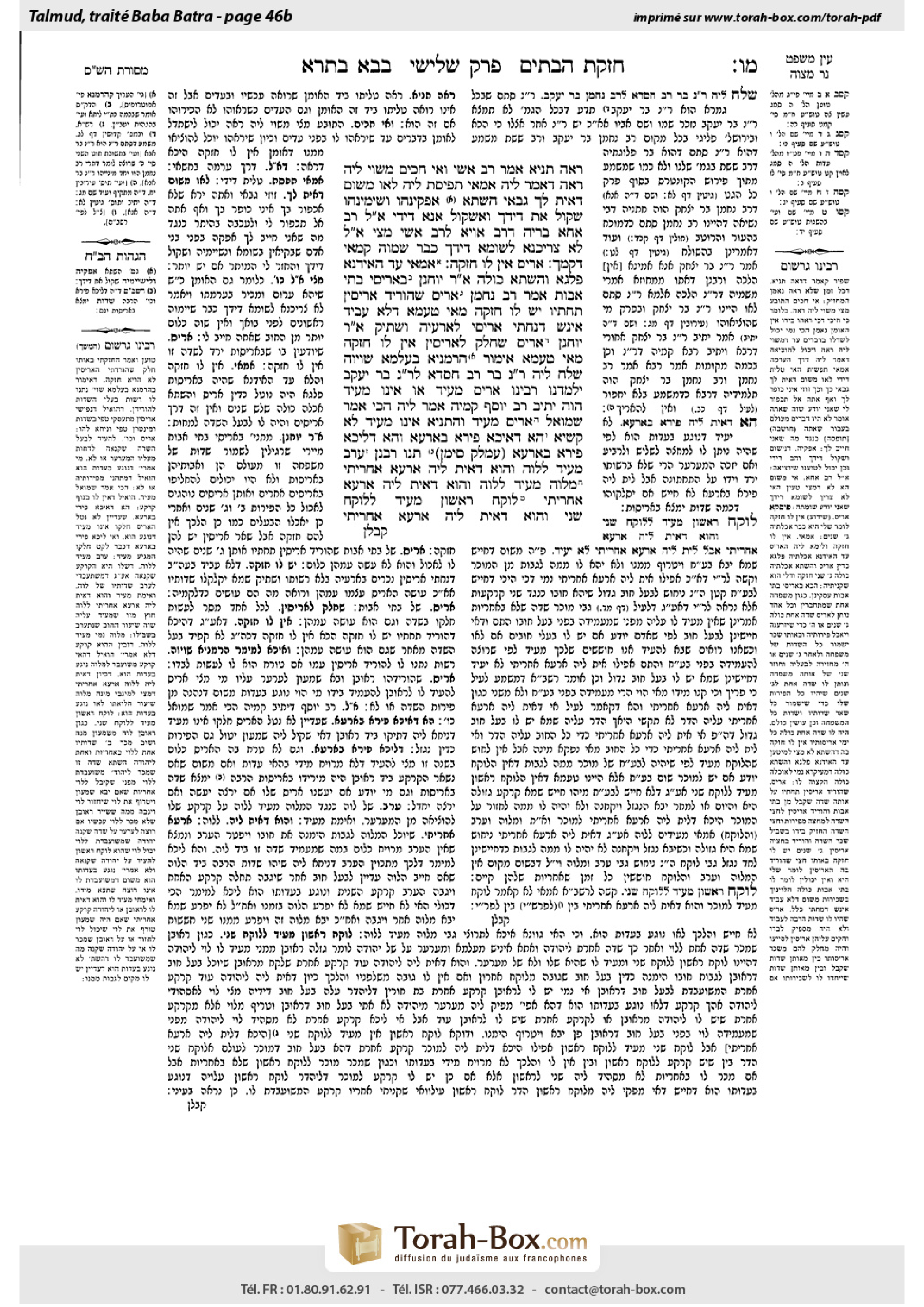
Bava Batra 46b: Talmud study for Daf Yomi
Study the Talmud for Daf Yomi with scanned pages, Hebrew text, English translations from Sefaria and AI-generated French translations.
Passage selection and English or AI-generated French translation are available where the scan has annotations. Daf Study is independent of Torah-Box and Sefaria.
Browse Bava Batra · בבא בתרא · All tractatesBava Batra 46b text and translations
This page of Bava Batra includes the Aramaic text, an English translation and an AI-generated French translation, alongside the scan above.
בבא בתרא מ״ו ב · Aramaic and Hebrew text
״רָאָה״ תַּנְיָא.
אָמַר רַב אָשֵׁי: וְאִי חַכִּים, מְשַׁוֵּי לֵיהּ ״רָאָה״ – דְּאָמַר לֵיהּ: אַמַּאי תְּפִיסַתְּ לֵיהּ, לָאו מִשּׁוּם דְּאִית לָךְ גַּבַּאי? הַשְׁתָּא אַפְּקִינְהוּ וְשַׁיְּמִינְהוּ – שְׁקוֹל אַתְּ דִּידָך,ְ וְאֶשְׁקוֹל אֲנָא דִּידִי. אֲמַר לֵיהּ רַב אַחָא בְּרֵיהּ דְּרַב אַוְיָא לְרַב אָשֵׁי, מָצֵי אָמַר לֵיהּ: לָא צְרִיכְנָא לְשׁוּמָא דִידָךְ, כְּבָר שָׁמוּהַּ קַמָּאֵי דְקַמָּךְ.
אָרִיס אֵין לוֹ חֲזָקָה. אַמַּאי? עַד הָאִידָּנָא פַּלְגָא, וְהַשְׁתָּא כּוּלַּהּ! אָמַר רַבִּי יוֹחָנָן: בַּאֲרִיסֵי בָּתֵּי אָבוֹת.
אָמַר רַב נַחְמָן: אָרִיס שֶׁהוֹרִיד אֲרִיסִין תַּחְתָּיו – יֵשׁ לוֹ חֲזָקָה. מַאי טַעְמָא? דְּלָא עֲבִיד אִינָשׁ דְּנָחֲתִי אֲרִיסֵי לְאַרְעֵיהּ, וְשָׁתֵיק.
אָמַר רַבִּי יוֹחָנָן: אָרִיס שֶׁחִלֵּק לַאֲרִיסִין – אֵין לוֹ חֲזָקָה. מַאי טַעְמָא? אֵימוֹר הַרְמַנְיָא בְּעָלְמָא שַׁוְּיוּהּ.
שְׁלַח לֵיהּ רַב נַחְמָן בַּר רַב חִסְדָּא לְרַב נַחְמָן בַּר יַעֲקֹב, יְלַמְּדֵנוּ רַבֵּינוּ: אָרִיס מֵעִיד, אוֹ אֵינוֹ מֵעִיד? הֲוָה יָתֵיב רַב יוֹסֵף קַמֵּיהּ, אֲמַר לֵיהּ: הָכִי אָמַר שְׁמוּאֵל: אָרִיס מֵעִיד. וְהָתַנְיָא: אֵינוֹ מֵעִיד!
לָא קַשְׁיָא – הָא דְּאִיכָּא פֵּירָא בְּאַרְעָא, וְהָא דְּלֵיכָּא פֵּירָא בְּאַרְעָא.
(עֲמָלֵק סִימָן)
תָּנוּ רַבָּנַן: עָרֵב מֵעִיד לַלֹּוֶה, וְהוּא דְּאִית לֵיהּ אַרְעָא אַחֲרִיתִי. מַלְוֶה מֵעִיד לַלֹּוֶה, וְהוּא דְּאִית לֵיהּ אַרְעָא אַחֲרִיתִי.
לוֹקֵחַ רִאשׁוֹן מֵעִיד לְלוֹקֵחַ שֵׁנִי, וְהוּא דְּאִית לֵיהּ אַרְעָא אַחֲרִיתִי.
Bava Batra 46b · English translation
as it is taught in the earlier baraita that the owner has a valid claim only when he, and witnesses, saw his cloak in the possession of the launderer and can definitively identify it. He cannot state a claim based on the mere possibility that it is his. This validates the claim of the craftsmen of Pumbedita.
Rav Ashi said: And if the owner is clever, he will render the situation into one of his having seen his cloak, as the owner can say to the craftsman: Why are you holding it? Is it not due to the fact that there is money of yours with me, and you are using the cloak as a means of collecting the debt that I owe you? Now bring out my cloak before the appraisers and they will appraise its value, and then you take what is rightfully yours, and I will take what is rightfully mine. When the craftsman presents the cloak, the ruling will change, as the owner will have seen the cloak. Rav Aḥa, son of Rav Avya, said to Rav Ashi: If the craftsman is clever, he can say to the owner: I do not need your appraisal, as the earlier ones who preceded you already appraised it and determined that its value does not exceed that of your debt to me.
§ The Gemara discusses a ruling that it paraphrases from the mishna: A sharecropper does not have the ability to establish the presumption of ownership of property in his possession. Why not? Isn’t it so that until that time, while he was definitely working as a sharecropper, he consumed only half of the produce of the land, and now, for the past three years, he consumed all of its produce? He should be able to establish the presumption of ownership by consuming more produce than a sharecropper does. Rabbi Yoḥanan says: The ruling of the mishna is stated with regard to family sharecroppers. This type of sharecropper, who works for a family for many years, gathers all of the produce into his property, and then returns the landowner’s share. Therefore, his collecting all of the produce into his property does not establish the presumption of ownership.
Rav Naḥman says: A sharecropper who installed other sharecroppers in his place has the ability to establish the presumption of ownership. What is the reason? It is that it is not common for a person to see that unknown sharecroppers have been installed in his land and remain silent. If the prior owner did not lodge a protest, it indicates that the sharecropper is the owner of the land.
Rabbi Yoḥanan says: A sharecropper who divided among different sharecroppers does not have the ability to establish the presumption of ownership by that act. What is the reason? It is that one can say that the landowner merely appointed him as an administrator [harmanya], and there is no indication that he is acting as an owner.
The Gemara relates: Rav Naḥman bar Rav Ḥisda sent this message to Rav Naḥman bar Yaakov: Our teacher, instruct us. Can a sharecropper testify with regard to the ownership of a field of which he is a sharecropper, or can he not testify, as he is biased in his testimony? Rav Yosef was sitting before Rav Naḥman bar Yaakov and said to him: This is what Shmuel said: A sharecropper can testify. Rav Naḥman bar Yaakov said to him: But isn’t it taught in a baraita that a sharecropper cannot testify?
Rav Yosef answered: It is not difficult. This baraita, which states that he cannot testify, is referring to a case where there is produce on the land. Therefore, he is biased in his testimony, as, if the current owner will lose possession of the land, the sharecropper will lose his right to consume the produce. And that statement of Shmuel that he can testify is referring to a case where there is no produce on the land, and he is not biased in his testimony.
§ The Gemara presents the word Amalek as a mnemonic for the cases discussed in the baraita. It stands for: Ayin, guarantor [arev]; mem, creditor [malve]; lamed, buyer [loke’aḥ]; kuf, unconditional guarantor [kablan].
The Sages taught: A guarantor can testify for the benefit of the debtor that the latter owns a particular parcel of land, but that is the halakha only if the debtor has other land from which the creditor can collect the debt. Otherwise, he is biased in his testimony, as the creditor could collect from him if the debtor were to lose ownership of this land. A creditor can testify for the benefit of the debtor that the latter owns a particular parcel of land, but that is the halakha only if the debtor has other land from which the creditor can collect. Otherwise, he is biased in his testimony, as this land is the only land available for collection.
Similarly, if two people purchase land from one seller, the first buyer can testify for the benefit of the second buyer if someone else were to claim that the land was his, but that is the halakha only if the second buyer has other land that he purchased from the same seller either concurrent with or subsequent to the first buyer’s purchase of the land in question. A creditor of the seller can collect a debt from the land that the seller sold most recently. Therefore, if the second buyer purchased only the land in question from the seller, the first buyer is biased in his testimony, as the second buyer’s ownership of the land prevents the creditor from collecting a debt from the land from the first buyer.
Bava Batra 46b · Traduction française (IA)
Comme il est enseigné dans la baraïta précédente, l'propriétaire a un droit valable uniquement lorsqu'il, et des témoins, ont vu son manteau entre les mains du blanchisseur et peuvent l'identifier avec certitude. Il ne peut présenter une réclamation basée uniquement sur la possibilité qu'il s'agisse de son manteau. Cela valide la réclamation des artisans de Pumbedita.
Rav Ashi a dit : Et si l'propriétaire est rusé, il rendra la situation telle qu'il ait vu son manteau, comme l'propriétaire peut dire au menuisier : Pourquoi tiens-tu cela ? N'est-ce pas à cause de l'argent que tu as chez moi, et tu utilises le manteau comme moyen de récupérer la dette que je dois à toi ? Maintenant, présente-moi mon manteau devant les experts et ils évalueront sa valeur, puis tu prendras ce qui t'appartient, et je prendrai ce qui m'appartient. Lorsque le menuisier présente le manteau, le verdict changera, car l'propriétaire aura vu le manteau. Rav Aḥa, fils de Rav Avya, a dit à Rav Ashi : Si le menuisier est rusé, il peut dire à l'propriétaire : Je n'ai pas besoin de ton expertise, car ceux qui t'ont précédé ont déjà évalué cela et ont déterminé que sa valeur ne dépasse pas celle de ta dette.
§ La Guemara discute d'un verdict qui reprend celui de la Michna : Un cultivateur en partage ne peut pas établir la présomption de propriété sur les biens qu'il possède. Pourquoi pas ? N'est-ce pas que jusqu'à ce moment, pendant qu'il travaillait effectivement en partage, il ne consommait que la moitié des récoltes du champ, et maintenant, pendant les trois dernières années, il a consommé toute la récolte ? Il devrait pouvoir établir la présomption de propriété en consommant plus de récolte qu'un cultivateur en partage. Rabbi Yoḥanan dit : Ce verdict de la Michna est énoncé concernant les cultivateurs en partage de famille. Ce type de cultivateur en partage, qui travaille pour une famille pendant de nombreuses années, rassemble toute la récolte dans sa propriété, puis rend la part du propriétaire. Par conséquent, son rassemblement de toute la récolte dans sa propriété ne permet pas d'établir la présomption de propriété.
Rav Naḥman dit : Un cultivateur en partage qui a installé d'autres cultivateurs en partage à sa place peut établir la présomption de propriété. Pourquoi ? C'est que ce n'est pas courant qu'une personne voie des cultivateurs en partage inconnus installés sur son terrain et reste muette. Si l'ancien propriétaire n'a pas porté plainte, cela indique que le cultivateur en partage est le propriétaire du terrain.
Rabbi Yoḥanan dit : Un cultivateur en partage qui a divisé entre différents cultivateurs en partage ne peut pas établir la présomption de propriété par cet acte. Pourquoi ? C'est que l'on peut dire que le propriétaire du terrain a simplement nommé lui-même comme administrateur [harmanya], et il n'y a pas d'indication qu'il agit comme propriétaire.
La Guemara rapporte : Rav Naḥman bar Rav Ḥisda a envoyé ce message à Rav Naḥman bar Yaakov : Notre maître, instruisez-nous. Un cultivateur en partage peut-il témoigner concernant la propriété d'un champ dont il est un cultivateur en partage, ou ne peut-il pas témoigner, car il est partial dans son témoignage ? Rav Yosef était assis devant Rav Naḥman bar Yaakov et lui a dit : C'est ce que Shmuel a dit : Un cultivateur en partage peut témoigner. Rav Naḥman bar Yaakov lui a répondu : Mais n'est-ce pas enseigné dans une baraïta que le cultivateur en partage ne peut pas témoigner ?
Rav Yosef a répondu : Ce n'est pas difficile. Cette baraïta, qui dit qu'il ne peut pas témoigner, se réfère à un cas où il y a des récoltes sur la terre. Par conséquent, il est partial dans son témoignage, car si l'actuel propriétaire perd possession de la terre, le cultivateur en partage perdra son droit de consommer les récoltes. Et cette déclaration de Shmuel, qui dit qu'il peut témoigner, se réfère à un cas où il n'y a pas de récoltes sur la terre, et il n'est pas partial dans son témoignage.
§ La Guemara présente le mot Amalek comme un mnémonique pour les cas discutés dans la baraïta. Il signifie : Ayin, garant [arev] ; mem, créancier [malve] ; lamed, acheteur [loke’aḥ] ; kuf, garant inconditionnel [kablan].
Les Sages ont enseigné : Un garant peut témoigner en faveur du débiteur que ce dernier possède un terrain particulier, mais cela est la halakha uniquement si le débiteur possède d'autres terres depuis lesquelles le créancier peut récupérer la dette. Sinon, il est partial dans son témoignage, car le créancier pourrait récupérer auprès de lui si le débiteur perdait la propriété de ce terrain. Un créancier peut témoigner en faveur du débiteur que ce dernier possède un terrain particulier, mais cela est la halakha uniquement si le débiteur possède d'autres terres depuis lesquelles le créancier peut récupérer. Sinon, il est partial dans son témoignage, car ce terrain est la seule terre disponible pour la récupération.
De même, si deux personnes achètent un terrain d'un même vendeur, le premier acheteur peut témoigner en faveur du second acheteur si quelqu'un affirme que le terrain lui appartient, mais cela est la halakha uniquement si le second acheteur possède d'autres terres qu'il a achetées auprès du même vendeur soit en même temps que, soit après, l'achat du premier acheteur du terrain en question. Un créancier du vendeur peut récupérer une dette sur le terrain que le vendeur a vendu le plus récemment. Par conséquent, si le second acheteur a acheté uniquement le terrain en question auprès du vendeur, le premier acheteur est partial dans son témoignage, car la propriété du second acheteur sur le terrain empêche le créancier de récupérer une dette sur le terrain auprès du premier acheteur.
Traduction française générée par IA à partir de l’édition anglaise de Sefaria. Vérifie toujours un passage avec le texte source.
Text from Sefaria: William Davidson Edition - Vocalized Aramaic (CC BY NC); William Davidson Edition - English (CC BY NC).