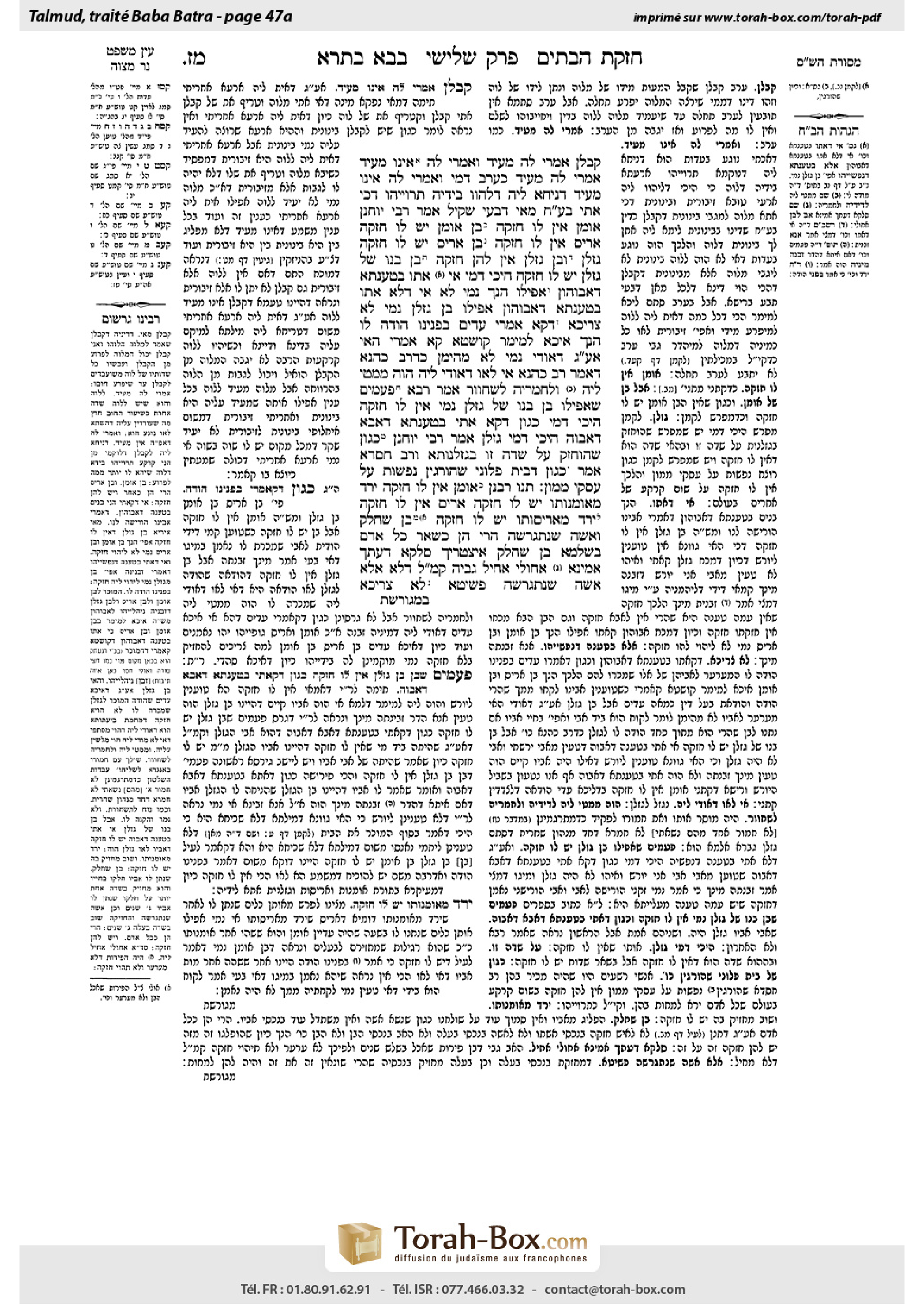
Bava Batra 47a: Talmud study for Daf Yomi
Study the Talmud for Daf Yomi with scanned pages, Hebrew text, English translations from Sefaria and AI-generated French translations.
Passage selection and English or AI-generated French translation are available where the scan has annotations. Daf Study is independent of Torah-Box and Sefaria.
Browse Bava Batra · בבא בתרא · All tractatesBava Batra 47a text and translations
This page of Bava Batra includes the Aramaic text, an English translation and an AI-generated French translation, alongside the scan above.
בבא בתרא מ״ז א · Aramaic and Hebrew text
קַבְּלָן – אָמְרִי לַהּ מֵעִיד, וְאָמְרִי לַהּ אֵינוֹ מֵעִיד. אָמְרִי לַהּ מֵעִיד – כְּעָרֵב דָּמֵי. וְאָמְרִי לַהּ אֵינוֹ מֵעִיד – דְּנִיחָא לֵיהּ דְּלֶהֱווֹ בִּידֵיהּ תַּרְוַיְיהוּ, דְּכִי אָתֵי בַּעַל חוֹב – מַאי דְּבָעֵי שָׁקֵיל.
אָמַר רַבִּי יוֹחָנָן: אוּמָּן אֵין לוֹ חֲזָקָה, בֶּן אוּמָּן יֵשׁ לוֹ חֲזָקָה. אָרִיס אֵין לוֹ חֲזָקָה, בֶּן אָרִיס יֵשׁ לוֹ חֲזָקָה. גַּזְלָן וּבֶן גַּזְלָן אֵין לָהֶן חֲזָקָה, בֶּן בְּנוֹ שֶׁל גַּזְלָן יֵשׁ לוֹ חֲזָקָה.
הֵיכִי דָמֵי? אִי אָתוּ בְּטַעְנְתָא דַאֲבוּהוֹן – אֲפִילּוּ הָנָךְ נָמֵי לָא. אִי דְּלָא אָתוּ בְּטַעְנְתָא דַאֲבוּהוֹן – אֲפִילּוּ בֶּן גַּזְלָן נָמֵי!
לָא צְרִיכָא, דְּקָא אָמְרִי עֵדִים: ״בְּפָנֵינוּ הוֹדָה לוֹ״. הָנָךְ – אִיכָּא לְמֵימַר קוּשְׁטָא קָא אָמְרִי. הַאי – אַף עַל גַּב דְּאוֹדִי נָמֵי לָא מְהֵימַן, כִּדְרַב כָּהֲנָא – דְּאָמַר רַב כָּהֲנָא: אִי לָאו דְּאוֹדִי לֵיהּ, הֲוָה מַמְטֵי לֵיהּ וּלְחַמְרֵיהּ לְשַׁחְווֹר.
אָמַר רָבָא: פְּעָמִים שֶׁאֲפִילּוּ בֶּן בְּנוֹ שֶׁל גַּזְלָן נָמֵי אֵין לוֹ חֲזָקָה. הֵיכִי דָּמֵי? כְּגוֹן דְּקָא אָתֵי בְּטַעְנְתָא דְּאַבָּא דַּאֲבוּהּ.
הֵיכִי דָּמֵי גַּזְלָן? אָמַר רַבִּי יוֹחָנָן: כְּגוֹן שֶׁהוּחְזַק עַל שָׂדֶה זוֹ בְּגַזְלָנוּתָא. וְרַב חִסְדָּא אָמַר: כְּגוֹן דְּבֵית פְּלוֹנִי, שֶׁהוֹרְגִין נְפָשׁוֹת עַל עִסְקֵי מָמוֹן.
תָּנוּ רַבָּנַן: אוּמָּן – אֵין לוֹ חֲזָקָה, יָרַד מֵאוּמָּנוּתוֹ – יֵשׁ לוֹ חֲזָקָה. אָרִיס – אֵין לוֹ חֲזָקָה, יָרַד מֵאֲרִיסוּתוֹ – יֵשׁ לוֹ חֲזָקָה. בֵּן שֶׁחָלַק, וְאִשָּׁה שֶׁנִּתְגָּרְשָׁה – הֲרֵי הֵן כִּשְׁאָר כׇּל אָדָם.
בִּשְׁלָמָא בֵּן שֶׁחָלַק – אִיצְטְרִיךְ, סָלְקָא דַּעְתָּךְ אָמֵינָא: אַחוֹלֵי אַחֵיל גַּבֵּיהּ, קָמַשְׁמַע לַן דְּלָא. אֶלָּא אִשָּׁה שֶׁנִּתְגָּרְשָׁה – פְּשִׁיטָא! לָא צְרִיכָא,
Bava Batra 47a · English translation
With regard to an unconditional guarantor [kablan], from whom the creditor can collect even if the debtor is able to repay the loan, some say that he can testify on behalf of the debtor if the latter owns other land, and some say that he cannot testify even if the debtor owns other land. The Gemara explains: Some say that he can testify because he is like a guarantor, and some say that he cannot testify, as it is preferable for him that both fields be in the debtor’s possession, so that when a creditor comes to collect the debt, he will take what he wants, and not collect from the unconditional guarantor.
§ Rabbi Yoḥanan said: A craftsman does not have the ability to establish the presumption of ownership, but the son of a craftsman has the ability to establish the presumption of ownership. A sharecropper does not have the ability to establish the presumption of ownership, but the son of a sharecropper has the ability to establish the presumption of ownership. Both a robber and the son of a robber do not have the ability to establish the presumption of ownership, but the son of the son of a robber has the ability to establish the presumption of ownership.
The Gemara asks: What are the circumstances under which there is a distinction between the sons of the craftsman and the sharecropper and the son of the robber? If they come to court with the claim that the item in question belonged to their fathers, then even these sons of the craftsman and the sharecropper should not be able to establish the presumption of ownership, since their claims are based on ownership by those who cannot establish the presumption of ownership. If the case is that they do not come to court with the claim that the item in question belonged to their fathers, but that they own the item in their own right, then even the son of a robber should be able to establish the presumption of ownership.
The Gemara answers: No, it is necessary to state this distinction in a case where the witnesses say: The prior owner admitted to their father in our presence that the property was the father’s and not stolen. The Gemara explains: With regard to these, the sons of the craftsman and sharecropper, it can be said that the sons are saying the truth, as their claim is substantiated by the testimony of the admission. But with regard to that one, the son of the robber, even though the prior owner admitted this, the son is still not deemed credible, in accordance with the statement of Rav Kahana, as Rav Kahana said: If the prior owner would not have admitted this to the robber, the robber would have brought him and his donkey to the taskmaster [leshaḥvar], meaning he would have caused him great difficulties. As a robber is assumed to be a ruffian, it is likely that the prior owner admitted this because he was intimidated, and not because the statement was true, so there is no evidence to support the claim of the robber’s son.
Rava says: There are times when even the son of the son of the robber does not have the ability to establish the presumption of ownership. What are the circumstances under which this is so? This is so, for example, in a case where he comes to court with the claim that the item in question belonged to his father’s father. Since his claim is based on its having belonged to one who did not have the ability to establish the presumption of ownership, he too is unable to establish the presumption of ownership.
The Gemara asks: What are the circumstances under which one is considered a robber, who does not have the ability to establish the presumption of ownership? Rabbi Yoḥanan says: In a case such as where it is established that he is in possession of this field through robbery. And Rav Ḥisda says: Not only in a case where there is knowledge about this specific field, but even in a case such as one where he is a member of the household of so-and-so, a certain known criminal family at the time who kill people over monetary matters. Since people would be afraid to lodge a protest against them, members of this family cannot establish the presumption of ownership with regard to any land.
§ The Sages taught: A craftsman does not have the ability to establish the presumption of ownership. If he descended from his position of craftsmanship and no longer works at that craft, then he has the ability to establish the presumption of ownership with regard to items related to his former craft. A sharecropper does not have the ability to establish the presumption of ownership. If he descended from his position as a sharecropper, then he has the ability to establish the presumption of ownership with regard to land that he works and from which he profits for three years. A son does not have the ability to establish the presumption of ownership with regard to his father’s property, nor a wife with regard to her husband’s property. But with regard to a son who separated himself from his father’s finances, and a woman who became divorced, they are like other people with regard to this property, and have the ability to establish the presumption of ownership.
The Gemara asks: Granted, it was necessary to state that a son who separated himself establishes the presumption of ownership. If the baraita had not stated this, it would enter your mind to say that the father forgave the unauthorized use of his land by his son, and did not lodge a protest despite the fact that the land did not belong to the son. Therefore, the baraita teaches us that this is not so, and that the son does establish the presumption of ownership. But in the case of the woman who became divorced, it is obvious that she has no relationship with her ex-husband, so why is it necessary for the baraita to teach that she is able to establish the presumption of ownership? The Gemara answers: No, it is necessary to teach that she does not establish the presumption of ownership
Bava Batra 47a · Traduction française (IA)
Concernant un garant inconditionnel [kablan], duquel le créancier peut récupérer même si le débiteur est en mesure de rembourser le prêt, certains disent qu'il peut témoigner en faveur du débiteur si ce dernier possède d'autres terres, et d'autres disent qu'il ne peut pas témoigner même si le débiteur possède d'autres terres. La Guemara explique : Certains disent qu'il peut témoigner car il est comme un garant, et d'autres disent qu'il ne peut pas témoigner, car il est préférable que les deux champs soient en possession du débiteur, afin que lorsqu'un créancier vient réclamer le prêt, il prenne ce qu'il veut, et ne réclame pas au garant inconditionnel.
§ Rabbi Yoḥanan dit : Un artisan n'a pas la capacité d'établir la présomption de propriété, mais le fils d'un artisan a cette capacité. Un cultivateur en partage n'a pas la capacité d'établir la présomption de propriété, mais le fils d'un cultivateur en partage a cette capacité. Un voleur et le fils d'un voleur n'ont pas la capacité d'établir la présomption de propriété, mais le fils du fils d'un voleur a cette capacité.
La Guemara pose la question : Quelles sont les circonstances où il y a une distinction entre les fils de l'artisan et du cultivateur en partage et le fils du voleur ? Si ils viennent devant le tribunal avec la revendication selon laquelle l'objet en question appartenait à leurs pères, alors même ces fils de l'artisan et du cultivateur en partage ne devraient pas avoir la capacité d'établir la présomption de propriété, car leurs revendications sont basées sur la propriété de ceux qui ne peuvent pas établir la présomption de propriété. Si c'est le cas qu'ils ne viennent pas devant le tribunal avec la revendication selon laquelle l'objet en question appartenait à leurs pères, mais qu'ils affirment posséder l'objet en leur propre droit, alors même le fils du voleur devrait avoir la capacité d'établir la présomption de propriété.
La Guemara répond : Non, il est nécessaire d'énoncer cette distinction dans un cas où les témoins disent : L'ancien propriétaire a admis devant nous qu'il s'agissait de la propriété de son père et non d'une propriété volée. La Guemara explique : Concernant ces fils de l'artisan et du cultivateur en partage, on peut dire qu'ils disent la vérité, car leur revendication est appuyée par le témoignage de l'admission. Concernant celui-là, le fils du voleur, même si l'ancien propriétaire a admis cela, le fils n'est pas considéré comme crédible, conformément à la déclaration de Rav Kahana, car Rav Kahana a dit : Si l'ancien propriétaire n'avait pas admis cela au voleur, le voleur aurait amené lui et son âne devant le responsable [leshaḥvar], ce qui signifie qu'il aurait causé des difficultés. Puisque le voleur est supposé être un voyou, il est probable que l'ancien propriétaire ait admis cela par peur, et non parce que l'affirmation était vraie, donc il n'y a pas de preuve pour soutenir la revendication du fils du voleur.
Rava dit : Il y a des moments où même le fils du fils du voleur n'a pas la capacité d'établir la présomption de propriété. Quelles sont les circonstances où cela est le cas ? Cela est le cas, par exemple, dans un cas où il vient devant le tribunal avec la revendication selon laquelle l'objet en question appartenait à son père et à son père. Puisque sa revendication est basée sur le fait qu'il appartenait à quelqu'un qui n'avait pas la capacité d'établir la présomption de propriété, il n'a pas non plus la capacité d'établir la présomption de propriété.
La Guemara pose la question : Quelles sont les circonstances où l'on considère quelqu'un comme un voleur, celui qui n'a pas la capacité d'établir la présomption de propriété ? Rabbi Yoḥanan dit : Dans un cas où il est établi qu'il possède ce champ par vol. Et Rav Ḥisda dit : Non seulement dans un cas où il y a connaissance de ce champ spécifique, mais même dans un cas où il est membre de la famille de telle ou telle personne, une famille connue de criminels à l'époque qui tuent des gens pour des questions monétaires. Puisque les gens auraient peur de protester contre eux, les membres de cette famille ne peuvent pas établir la présomption de propriété concernant aucune terre.
§ Les Sages ont enseigné : Un artisan n'a pas la capacité d'établir la présomption de propriété. Si il a quitté sa position d'artisan et ne travaille plus dans ce métier, alors il a la capacité d'établir la présomption de propriété concernant les objets liés à son ancien métier. Un cultivateur en partage n'a pas la capacité d'établir la présomption de propriété. Si il a quitté sa position de cultivateur en partage, alors il a la capacité d'établir la présomption de propriété concernant la terre qu'il cultive et d'où il tire profit pendant trois ans. Un fils n'a pas la capacité d'établir la présomption de propriété concernant la propriété de son père, ni une femme concernant la propriété de son mari. Mais concernant un fils qui s'est détaché de la gestion de son père, et une femme divorcée, ils sont comme les autres personnes concernant cette propriété, et ont la capacité d'établir la présomption de propriété.
La Guemara pose la question : D'accord, il était nécessaire d'énoncer que le fils qui s'est détaché établit la présomption de propriété. Si la baraïta n'avait pas énoncé cela, cela vous aurait traversé l'esprit de dire que le père a pardonné l'utilisation non autorisée de sa terre par son fils, et n'a pas protesté malgré le fait que la terre n'appartenait pas au fils. Ainsi, la baraïta nous apprend que cela n'est pas le cas, et que le fils établit la présomption de propriété. Mais dans le cas de la femme divorcée, il est évident qu'elle n'a plus de lien avec son ex-mari, donc pourquoi la baraïta doit-elle enseigner qu'elle peut établir la présomption de propriété ? La Guemara répond : Non, il est nécessaire d'enseigner qu'elle ne peut pas établir la présomption de propriété
Traduction française générée par IA à partir de l’édition anglaise de Sefaria. Vérifie toujours un passage avec le texte source.
Text from Sefaria: William Davidson Edition - Vocalized Aramaic (CC BY NC); William Davidson Edition - English (CC BY NC).