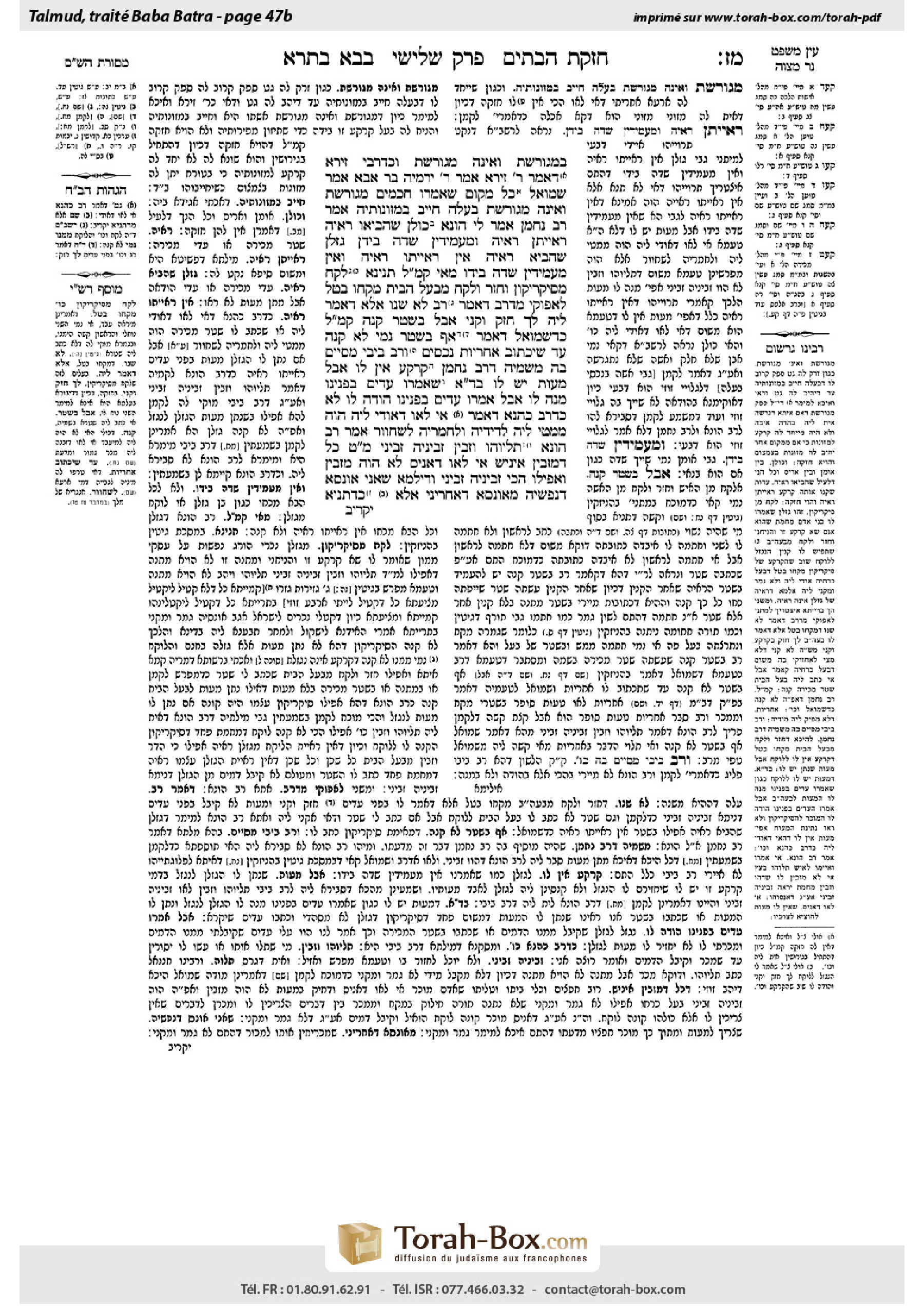
Bava Batra 47b: Talmud study for Daf Yomi
Study the Talmud for Daf Yomi with scanned pages, Hebrew text, English translations from Sefaria and AI-generated French translations.
Passage selection and English or AI-generated French translation are available where the scan has annotations. Daf Study is independent of Torah-Box and Sefaria.
Browse Bava Batra · בבא בתרא · All tractatesBava Batra 47b text and translations
This page of Bava Batra includes the Aramaic text, an English translation and an AI-generated French translation, alongside the scan above.
בבא בתרא מ״ז ב · Aramaic and Hebrew text
בִּמְגוֹרֶשֶׁת וְאֵינָהּ מְגוֹרֶשֶׁת, וְכִדְרַבִּי זֵירָא – דְּאָמַר רַבִּי זֵירָא אָמַר רַבִּי יִרְמְיָה בַּר אַבָּא אָמַר שְׁמוּאֵל: כׇּל מָקוֹם שֶׁאָמְרוּ חֲכָמִים: מְגוֹרֶשֶׁת וְאֵינָהּ מְגוֹרֶשֶׁת – בַּעְלָהּ חַיָּיב בִּמְזוֹנוֹתֶיהָ.
אָמַר רַב נַחְמָן, אָמַר לִי הוּנָא: כּוּלָּן שֶׁהֵבִיאוּ רְאָיָה – רְאָיָיתָן רְאָיָה, וּמַעֲמִידִין שָׂדֶה בְּיָדָן. גַּזְלָן שֶׁהֵבִיא רְאָיָה – אֵין רְאָיָיתוֹ רְאָיָה, וְאֵין מַעֲמִידִין שָׂדֶה בְּיָדוֹ.
מַאי קָא מַשְׁמַע לַן? תְּנֵינָא: לָקַח מִסִּיקָרִיקוֹן, וְחָזַר וְלָקַח מִבַּעַל הַבַּיִת – מִקָּחוֹ בָּטֵל!
לְאַפּוֹקֵי מִדְּרַב – דְּאָמַר רַב: לֹא שָׁנוּ אֶלָּא דַּאֲמַר לֵיהּ: ״לֵךְ חֲזֵק וּקְנִי״, אֲבָל בִּשְׁטָר – קָנָה;
קָא מַשְׁמַע לַן כְּדִשְׁמוּאֵל – דְּאָמַר: אַף בִּשְׁטָר נָמֵי לֹא קָנָה, עַד שֶׁיִּכְתּוֹב אַחְרָיוּת נְכָסִים.
וְרַב בִּיבִי מְסַיֵּים בַּהּ מִשְּׁמֵיהּ דְּרַב נַחְמָן: קַרְקַע אֵין לוֹ, אֲבָל מָעוֹת יֵשׁ לוֹ. בַּמֶּה דְּבָרִים אֲמוּרִים – שֶׁאָמְרוּ עֵדִים: ״בְּפָנֵינוּ מָנָה לוֹ״, אֲבָל אָמְרוּ עֵדִים: ״בְּפָנֵינוּ הוֹדָה לוֹ״ – לֹא; כִּדְרַב כָּהֲנָא, דְּאָמַר: אִי לָאו דְּאוֹדִי לֵיהּ, הֲוָה מַמְטֵי לֵיהּ לְדִידֵיהּ וְלַחֲמָרֵיהּ לְשַׁחְווֹר.
אָמַר רַב הוּנָא: תַּלְיוּהוּ וְזַבֵּין – זְבִינֵיהּ זְבִינֵי. מַאי טַעְמָא? כֹּל דִּמְזַבֵּין אִינִישׁ, אִי לָאו דַּאֲנִיס – לָא הֲוָה מְזַבֵּין, וַאֲפִילּוּ הָכִי זְבִינֵיהּ זְבִינֵי. וְדִילְמָא שָׁאנֵי אוּנְסָא דְנַפְשֵׁיהּ מֵאוּנְסָא דְאַחֲרִינֵי! אֶלָּא כִּדְתַנְיָא:
Bava Batra 47b · English translation
in a case where there is uncertainty whether she is divorced or whether she is not divorced, and this is in accordance with the opinion of Rabbi Zeira. As Rabbi Zeira says that Rabbi Yirmeya bar Abba says that Shmuel says: Wherever the Sages said with regard to a woman that there is uncertainty whether she is divorced or whether she is not divorced, her husband is still obligated with regard to her sustenance. One might have thought that since she still has some right to her husband’s property, insofar as he still has an obligation with regard to her sustenance he would not lodge a protest if she used his land without his authorization. It is therefore necessary to clarify that this is not so, and she has the ability to establish the presumption of ownership in her husband’s property.
§ Rav Naḥman said: Rav Huna said to me that with regard to all of the types of people who do not have the ability to establish the presumption of ownership, when they bring proof by means of a document or witnesses that a field belongs to them, their proof is a valid proof and the court places the field in their possession. But if there is a robber who brings proof that a field is his, his proof is not a valid proof, and the court does not place the field in his possession. This is due to a concern that the proof was obtained through illegitimate means.
The Gemara asks: What is this teaching us? We already learned in a mishna (Gittin 55b): If one purchased land from a Sicarius [Sikarikon], a violent gentile who had extorted the field from its owner with threats, and afterward one returned and purchased the same field from the prior owner, his purchase is void, as the owner of the field can say that he did not actually intend to sell him the field. This teaches that a purchase following a robbery is invalid, despite the existence of documents or testimony, rendering the statement of Rav Huna superfluous.
The Gemara answers: Rav Huna’s statement serves to exclude that which Rav says, as Rav says: They taught that the purchase of a field from the prior owner after one purchased it from a Sicarius is void only when the prior owner said to the buyer at the time of the sale: Go take possession and thereby acquire the field, but did not write a document. But if the transaction was performed along with a document being given, the buyer acquired the field.
Therefore, Rav Huna teaches us that he rules in accordance with the opinion of Shmuel, as Shmuel says: He does not acquire the field even if the transaction was performed along with a document being given, until the owner of the field writes a property guarantee, i.e., a document that states that if the property is seized by the seller’s creditor, the seller will reimburse the buyer for his loss. Writing such a document indicates that it is a sincere transaction.
And Rav Beivai concludes that discussion of the statement of Rav Huna, that a robber does not retain possession of the field even if he brings proof of the transaction, with a comment in the name of Rav Naḥman: The robber does not have rights to the land, but he does have rights to the money that he paid for the land, and the owner has to reimburse him. In what case is this statement that the robber is reimbursed said? It is specifically where the witnesses said: The robber counted out the money for the owner and gave it to him in our presence; but if the witnesses said: The owner admitted to the robber in our presence that he received payment, then the robber is not reimbursed, as the admission may have been made under duress. This is in accordance with the opinion of Rav Kahana, who says: If the owner would not have admitted to the robber that he received payment, the robber would have brought him and his donkey to the taskmaster.
§ Apropos transactions performed under duress, the Gemara cites that which Rav Huna says: If one was suspended, e.g., from a tree, and thereby coerced to sell a certain item, and he sold it, his sale is valid. What is the reason? The Gemara suggests that it is because whatever a person sells, were it not for the fact that he is compelled by his need for money, he would not sell it, and even so, his sale is valid. This indicates that a transaction performed under duress is valid. The Gemara rejects this: But perhaps duress that results from his own needs, such as his need for money, is different from duress that results from another, as in this case. Rather, the basis for Rav Huna’s ruling is as it is taught in a baraita:
Bava Batra 47b · Traduction française (IA)
Dans un cas où il y a incertitude quant à savoir si elle est divorcée ou non, et cela selon l'opinion de Rabbi Zeira. Comme dit Rabbi Zeira, Rabbi Yirmeya bar Abba rapporte que Shmuel dit : Partout où les Sages ont dit concernant une femme qu'il y a incertitude quant à savoir si elle est divorcée ou non, son mari est encore tenu de lui fournir sa subsistance. On aurait pu penser que puisqu'elle a encore un droit sur les biens de son mari, en ce que celui-ci est tenu de lui fournir sa subsistance, il ne protesterait pas si elle utilisait ses terres sans son autorisation. Il est donc nécessaire de clarifier que cela n'est pas le cas, et qu'elle a la capacité d'établir la présomption de propriété sur les biens de son mari.
§ Rav Naḥman dit : Rav Huna m'a dit que concernant tous les types de personnes incapables d'établir la présomption de propriété, lorsqu'ils apportent une preuve par un document ou par témoins que un champ leur appartient, leur preuve est une preuve valide et la cour place le champ sous leur possession. Mais si un voleur apporte une preuve qu'un champ lui appartient, sa preuve n'est pas une preuve valide, et la cour ne place pas le champ sous sa possession. Cela est dû à une crainte que la preuve ait été obtenue par des moyens illicites.
La Guemara pose la question : Qu'est-ce que cette enseignement nous apprend ? Nous avons déjà appris dans une mitsna (Gittin 55b) : Si l'on achète un terrain d'un Sicarius [Sikarikon], un gentil violent qui avait extorqué le terrain à son propriétaire par des menaces, et ensuite l'on revient et l'on achète le même terrain du propriétaire précédent, l'achat est nul, car le propriétaire du terrain peut dire qu'il n'avait pas l'intention de vendre le terrain. Cela enseigne que l'achat après un vol est nul, malgré l'existence de documents ou de témoignages, ce qui rend l'enseignement de Rav Huna superflu.
La Guemara répond : L'enseignement de Rav Huna sert à exclure celui de Rav, car Rav dit : Ils ont appris que l'achat d'un terrain du propriétaire précédent après avoir acheté celui-ci auprès d'un Sicarius est nul uniquement lorsque le propriétaire précédent a dit au acheteur lors de la vente : Va prendre possession et ainsi acquérir le terrain, mais n'a pas rédigé un document. Mais si la transaction a été effectuée avec la remise d'un document, l'acheteur a acquis le terrain.
Par conséquent, Rav Huna nous enseigne qu'il suit l'opinion de Shmuel, car Shmuel dit : Il ne possède pas le terrain même si la transaction a été effectuée avec la remise d'un document, jusqu'à ce que le propriétaire du terrain rédige une garantie de propriété, c'est-à-dire un document indiquant que si la propriété est saisie par les créanciers du vendeur, le vendeur remboursera l'acheteur pour sa perte. Rédiger un tel document indique que c'est une transaction sincère.
Et Rav Beivai conclut la discussion sur l'enseignement de Rav Huna, selon lequel un voleur ne conserve pas la possession du terrain même s'il apporte une preuve de la transaction, avec un commentaire en nom de Rav Naḥman : Le voleur n'a pas de droits sur la terre, mais il a des droits sur l'argent qu'il a payé pour la terre, et le propriétaire doit le rembourser. Dans quel cas cette déclaration selon laquelle le voleur est remboursé est-elle dite ? C'est spécifiquement lorsque les témoins dirent : Le voleur a compté l'argent pour le propriétaire et l'a donné à celui-ci devant nous ; mais si les témoins dirent : Le propriétaire a admis au voleur devant nous qu'il avait reçu le paiement, alors le voleur n'est pas remboursé, car l'admission pourrait avoir été faite sous la contrainte. Cela est selon l'opinion de Rav Kahana, qui dit : Si le propriétaire n'aurait pas admis au voleur qu'il avait reçu le paiement, le voleur aurait amené celui-ci et son âne au tâcheron.
§ A propos des transactions effectuées sous la contrainte, la Guemara cite ce que dit Rav Huna : Si l'on était suspendu, par exemple d'un arbre, et ainsi contraint de vendre un certain objet, et qu'on a vendu, sa vente est valide. Quelle est la raison ? La Guemara suggère que c'est parce que tout ce que la personne vend, s'il n'était pas contraint par son besoin d'argent, il ne le vendrait pas, et même ainsi, sa vente est valide. Cela indique qu'une transaction effectuée sous la contrainte est valide. La Guemara rejette cela : Mais peut-être la contrainte provenant de ses propres besoins, comme son besoin d'argent, est différente de la contrainte provenant d'un autre, comme dans ce cas. Plutôt, la base de la décision de Rav Huna est comme il est enseigné dans une baraïta :
Traduction française générée par IA à partir de l’édition anglaise de Sefaria. Vérifie toujours un passage avec le texte source.
Text from Sefaria: William Davidson Edition - Vocalized Aramaic (CC BY NC); William Davidson Edition - English (CC BY NC).