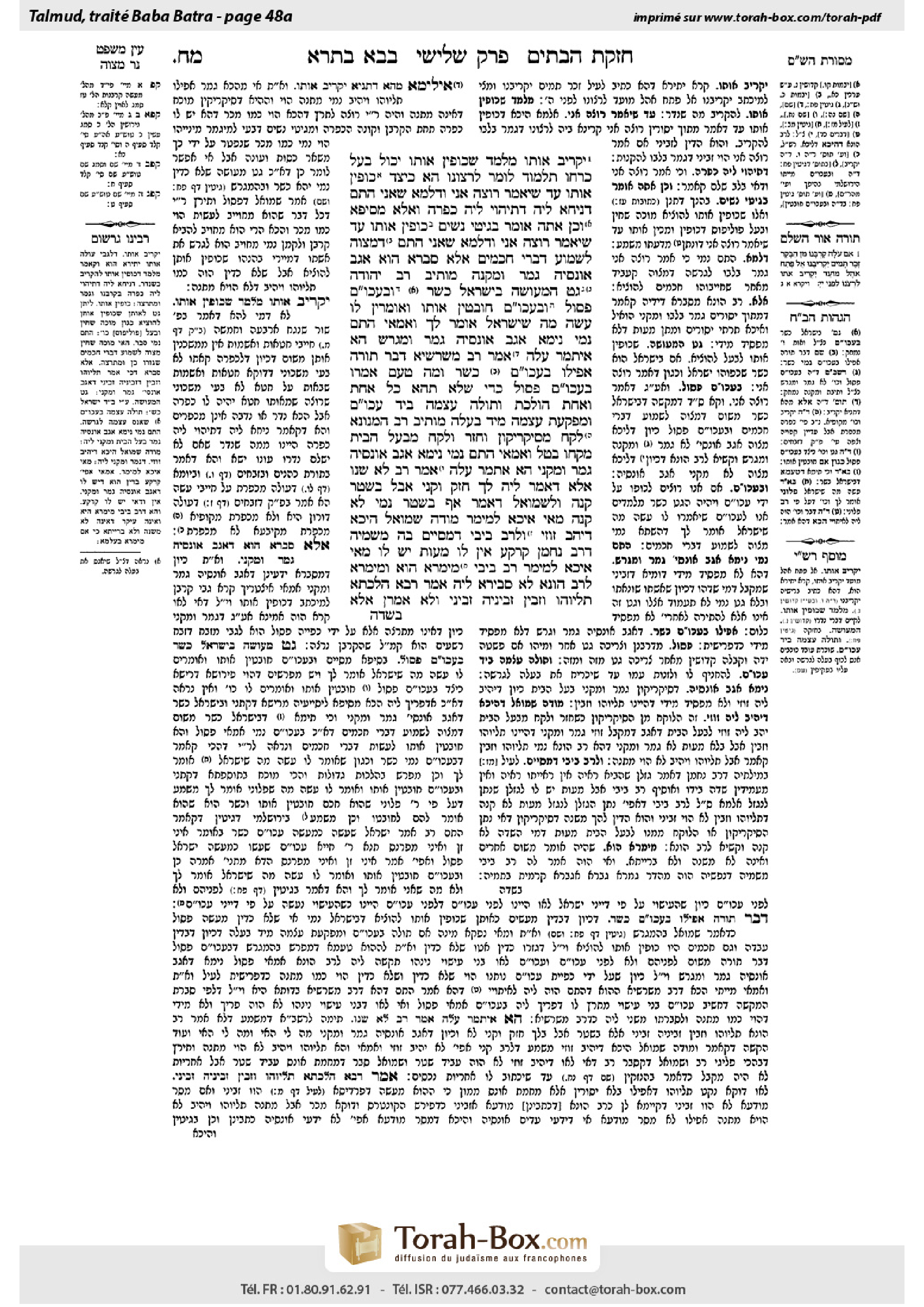
Bava Batra 48a: Talmud study for Daf Yomi
Study the Talmud for Daf Yomi with scanned pages, Hebrew text, English translations from Sefaria and AI-generated French translations.
Passage selection and English or AI-generated French translation are available where the scan has annotations. Daf Study is independent of Torah-Box and Sefaria.
Browse Bava Batra · בבא בתרא · All tractatesBava Batra 48a text and translations
This page of Bava Batra includes the Aramaic text, an English translation and an AI-generated French translation, alongside the scan above.
בבא בתרא מ״ח א · Aramaic and Hebrew text
״יַקְרִיב אֹתוֹ״ – מְלַמֵּד שֶׁכּוֹפִין אוֹתוֹ. יָכוֹל בְּעַל כׇּרְחוֹ? תַּלְמוּד לוֹמַר: ״לִרְצוֹנוֹ״. הָא כֵּיצַד? כּוֹפִין אוֹתוֹ עַד שֶׁיֹּאמַר: ״רוֹצֶה אֲנִי״.
וְדִלְמָא שָׁאנֵי הָתָם, דְּנִיחָא לֵיהּ דְּתִיהְוֵי לֵיהּ כַּפָּרָה! וְאֶלָּא מִסֵּיפָא: וְכֵן אַתָּה אוֹמֵר בְּגִיטֵּי נָשִׁים – כּוֹפִין אוֹתוֹ עַד שֶׁיֹּאמַר: ״רוֹצֶה אֲנִי״.
וְדִלְמָא שָׁאנֵי הָתָם, דְּמִצְוָה לִשְׁמוֹעַ דִּבְרֵי חֲכָמִים! אֶלָּא סְבָרָא הוּא – אַגַּב אוּנְסֵיהּ גָּמַר וּמַקְנֵה.
מוֹתֵיב רַב יְהוּדָה: גֵּט הַמְעוּשֶּׂה; בְּיִשְׂרָאֵל – כָּשֵׁר, וּבְגוֹיִם – פָּסוּל. וּבְגוֹיִם – חוֹבְטִין אוֹתוֹ, וְאוֹמְרִין לוֹ: עֲשֵׂה מַה שֶּׁיִּשְׂרָאֵל אוֹמֵר לָךְ. וְאַמַּאי? הָתָם נָמֵי, נֵימָא: אַגַּב אוּנְסֵיהּ גָּמַר וּמְגָרֵשׁ!
הָא אִיתְּמַר עֲלַהּ, אָמַר רַב מְשַׁרְשְׁיָא: דְּבַר תּוֹרָה – אֲפִילּוּ בְּגוֹיִם כָּשֵׁר, וּמַה טַּעַם אָמְרוּ בְּגוֹיִים פָּסוּל? כְּדֵי שֶׁלֹּא תְּהֵא כׇּל אַחַת וְאַחַת הוֹלֶכֶת וְתוֹלָה עַצְמָהּ בְּיַד גּוֹי, וּמַפְקַעַת עַצְמָהּ מִיַּד בַּעְלָהּ.
מוֹתֵיב רַב הַמְנוּנָא: לָקַח מִסִּיקָרִיקוֹן, וְחָזַר וְלָקַח מִבַּעַל הַבַּיִת – מִקָּחוֹ בָּטֵל. וְאַמַּאי? הָתָם נָמֵי נֵימָא: אַגַּב אוּנְסֵיהּ גְּמַר וּמַקְנֵי!
הָא אִתְּמַר עֲלַהּ, אָמַר רַב: לֹא שָׁנוּ אֶלָּא דַּאֲמַר לֵיהּ: ״לֵךְ חֲזֵק וּקְנִי״, אֲבָל בִּשְׁטָר – קָנָה.
וְלִשְׁמוּאֵל, דְּאָמַר: אַף בִּשְׁטָר נָמֵי לֹא קָנָה, מַאי אִיכָּא לְמֵימַר? מוֹדֶה שְׁמוּאֵל הֵיכָא דִּיהַב זוּזֵי.
וּלְרַב בִּיבִי, דִּמְסַיֵּים בַּהּ מִשְּׁמֵיהּ דְּרַב נַחְמָן: קַרְקַע אֵין לוֹ, מָעוֹת יֵשׁ לוֹ – מַאי אִיכָּא לְמֵימַר? רַב בִּיבִי מֵימְרָא הוּא, וּמֵימְרָא לְרַב הוּנָא לָא סְבִירָא לֵיהּ.
אָמַר רָבָא, הִלְכְתָא: תַּלְיוּהוּ וְזַבֵּין – זְבִינֵיהּ זְבִינֵי. וְלָא אֲמַרַן אֶלָּא
Bava Batra 48a · English translation
With regard to one who pledges to bring a burnt-offering, the verse states: “If his offering be a burnt-offering of the herd, he shall offer it a male without blemish; he shall bring it to the door of the Tent of Meeting, according to his will, before the Lord” (Leviticus 1:3). The seemingly superfluous phrase “he shall offer it” teaches that they can coerce him to bring the offering. One might have thought that it can be offered entirely against his will, by taking it from his possession and sacrificing it. Therefore, the verse states: “According to his will” (Leviticus 1:3). How can these texts be reconciled? They coerce him with various punishments until he says: I want to bring the offering. This seems to prove that consent resulting from coercion is considered to be valid consent. Perhaps this principle can apply to acquisition, as a source for Rav Huna’s ruling.
The Gemara rejects this proof: But perhaps there it is different, since he is in fact amenable to achieving atonement, despite his earlier statement to the contrary. But rather, prove Rav Huna’s ruling from the latter clause of a mishna (Arakhin 21a): And similarly you find this halakha with bills of divorce, that when the court rules that he must divorce his wife, they coerce him until he says: I want to divorce my wife.
The Gemara rejects this proof as well: But perhaps there it is different, because it is a mitzva to listen to the statement of the Sages. The assumption is that when he is required by the court to divorce his wife, his real desire is to perform the mitzva of listening to the Sages, and therefore he actually wants to divorce her. This does not apply to the case of a transaction performed under duress. Rather, Rav Huna’s ruling does not have a source in a mishna or baraita, but is based on logical reasoning: By means of his being coerced, the seller then willingly decides to sell the field and transfers it.
Rav Yehuda raises an objection to Rav Huna’s ruling from a mishna (Gittin 88b): With regard to a bill of divorce that the husband was compelled by the court to write and give his wife, if he was compelled by a Jewish court it is valid, but if he was compelled by gentiles it is not valid. And with regard to gentiles, they may beat him at the request of the Jewish court and say to him: Do what the Jews are telling you, and the divorce would then be valid. The Gemara asks: But why is a bill of divorce compelled by a gentile court invalid? There too, let us say that as a result of his coercion, the husband decides to do what the court says and divorces her.
The Gemara answers: In fact that reasoning is correct, as for this reason wasn’t it stated with regard to that mishna that Rav Mesharshiyya says: By Torah law a bill of divorce that the husband was compelled to give, even if he was compelled by gentiles, is valid. And what is the reason the Sages said that if it is compelled by gentiles it is not valid? It is so that each and every woman will not go and through temptation or bribery depend on a gentile to compel her husband to divorce her, and thereby release herself from her husband illegitimately.
Rav Hamnuna raises an objection to Rav Huna’s ruling from a mishna (Gittin 55b): If one purchased land from a Sicarius and afterward returned and purchased the same field from the prior owner, his purchase is void, as the prior owner of the field can say that he did not actually intend to sell the field to this buyer. But why is the sale invalid? There too, let us say that by means of his being coerced, the seller then willingly decides to sell the field and transfers it.
The Gemara answers: In fact that reasoning is correct, as it was stated with regard to that mishna that Rav says: They taught that the purchase from the prior owner after the purchase from a Sicarius is void only when the prior owner said to the buyer at the time of the sale: Go take possession and thereby acquire the field, but did not write a bill of sale. But if the transaction was performed along with a bill of sale being given, the buyer acquires the field.
The Gemara asks: And according to Shmuel, who says: He does not acquire the field even if the transaction was performed along with a bill of sale being given, what can be said? The Gemara answers: Shmuel concedes that the sale is valid where the buyer gave money for the field even though the owner sold it under duress, as is the case in the ruling of Rav Huna.
The Gemara asks: And according to Rav Beivai, who concludes that statement of Rav Huna with a comment in the name of Rav Naḥman: The robber does not have rights to the land, but he does have rights to the money that he paid for the land, and the owner has to reimburse him, what can be said? Rav Beivai, who is referring to a case where there was a payment, as the robber is being reimbursed, seems to hold that the sale is invalid even where the robber paid for the field. The Gemara answers: The statement of Rav Beivai is an amoraic statement, not a citation of a tannaitic ruling, and Rav Huna, who is also an amora, does not hold in accordance with that amoraic statement.
Rava says: The halakha is that if one was suspended and thereby coerced to sell a certain item, and he sold it, his sale is valid. And we said that this is the halakha only
Bava Batra 48a · Traduction française (IA)
Concernant celui qui s'engage à apporter un holocauste, la Parashah dit : « Si son offrande est un holocauste du bétail, il offrira un mâle sans tache ; il le présentera à la porte de la Tente de la Rencontre, selon son désir, devant l'Éternel » (Lévitique 1:3). La phrase superflue « il offrira » enseigne que l'on peut le contraindre à apporter l'offrande. On aurait pu penser qu'il pouvait être offert entièrement contre sa volonté, en le prenant de ses possessions et en le sacrifiant. Ainsi, la Parashah dit : « selon son désir » (Lévitique 1:3). Comment ces textes peuvent-ils être conciliés ? On le contraint avec diverses sanctions jusqu'à ce qu'il dise : Je veux apporter l'offrande. Cela semble prouver que le consentement résultant de la contrainte est considéré comme un consentement valide. Peut-être ce principe peut-il s'appliquer à l'acquisition, en tant que source pour la décision de Rav Huna.
La Guemara rejette cette preuve : Mais peut-être cela est-il différent, puisque, en réalité, il est enclin à obtenir la rédemption, malgré son précédent déclaration contraire. Mais plutôt, prouve la décision de Rav Huna à partir de la clause ultérieure d'une Michna (Arakhin 21a) : Et vous trouvez également cette halakha avec les certificats de divorce, que lorsque le tribunal décide qu'il doit divorcer de son épouse, on le contraint jusqu'à ce qu'il dise : Je veux divorcer de mon épouse.
La Guemara rejette cette preuve également : Mais peut-être cela est-il différent, car il s'agit d'une mitsva d'écouter la parole des Sages. L'hypothèse est que lorsque l'on est requis par le tribunal à divorcer, son désir réel est d'accomplir la mitsva d'écouter les Sages, et donc il veut effectivement divorcer. Cela ne s'applique pas au cas d'une transaction accomplie sous la contrainte. Plutôt, la décision de Rav Huna ne trouve pas son origine dans une Michna ou une baraïta, mais s'appuie sur un raisonnement logique : Par le fait qu'il est contraint, le vendeur décide alors volontairement de vendre le champ et de le transférer.
Rav Yehuda soulève une objection contre la décision de Rav Huna à partir d'une Michna (Gittin 88b) : Concernant un certificat de divorce que le mari a été contraint par le tribunal à écrire et à donner à son épouse, si c'est un tribunal juif qui l'a contraint, il est valide, mais si c'est un tribunal païen, il n'est pas valide. Et concernant les païens, ils peuvent le battre à la demande du tribunal juif et lui dire : Fais ce que les Juifs te disent, et le divorce serait alors valide. La Guemara demande : Mais pourquoi un certificat de divorce contraint par un tribunal païen est-il invalide ? Là aussi, disons que par la contrainte, le mari décide de faire ce que le tribunal dit et divorce.
La Guemara répond : En effet, ce raisonnement est correct, car c'est pour cette raison que ce n'était pas mentionné dans cette Michna que Rav Mesharshiyya dit : Par la Loi, un certificat de divorce que le mari a été contraint à donner, même s'il l'a été par des païens, est valide. Et quelle est la raison pour laquelle les Sages ont dit que si c'est par des païens, il n'est pas valide ? C'est afin que chaque femme ne se tourne pas vers la tentation ou la corruption pour dépendre d'un païen afin de contraindre son mari à divorcer, et ainsi se libérer illégitimement de son mari.
Rav Hamnuna soulève une objection contre la décision de Rav Huna à partir d'une Michna (Gittin 55b) : Si l'on achète un champ d'un Sicarius et ensuite revient et achète le même champ du propriétaire précédent, l'achat est nul, car le propriétaire précédent peut dire que, lors de la vente, il n'avait pas l'intention de vendre le champ à cet acheteur. Mais pourquoi l'achat est-il nul ? Là aussi, disons que par la contrainte, le vendeur décide alors volontairement de vendre le champ et de le transférer.
La Guemara répond : En effet, ce raisonnement est correct, car il a été dit concernant cette Michna que Rav dit : Ils ont enseigné que l'achat du propriétaire précédent après l'achat d'un Sicarius est nul uniquement lorsque le propriétaire précédent a dit à l'acheteur lors de la vente : Prends possession et ainsi acquiers le champ, mais n'a pas écrit un certificat de vente. Mais si la transaction a été accomplie avec la remise d'un certificat de vente, l'acheteur acquiert le champ.
La Guemara demande : Et selon Shmuel, qui dit : Il ne l'acquiert pas même si la transaction a été accomplie avec la remise d'un certificat de vente, que peut-on dire ? La Guemara répond : Shmuel reconnaît que la vente est valide lorsque l'acheteur a donné de l'argent pour le champ, même si l'acheteur l'a vendu sous la contrainte, comme c'est le cas dans la décision de Rav Huna.
La Guemara demande : Et selon Rav Beivai, qui conclut la déclaration de Rav Huna avec un commentaire en nom de Rav Naḥman : Le voleur n'a pas de droits sur la terre, mais il a des droits sur l'argent qu'il a payé pour la terre, et l'acheteur doit le rembourser, que peut-on dire ? Rav Beivai, qui parle d'un cas où il y a eu un paiement, comme le voleur est remboursé, semble tenir que la vente est nulle même si le voleur a payé pour le champ. La Guemara répond : La déclaration de Rav Beivai est une déclaration d'amora, pas une citation d'un enseignement tannaitique, et Rav Huna, qui est également un amora, ne suit pas cette déclaration d'amora.
Rava dit : La halakha est que si l'on a été suspendu et ainsi contraint à vendre un certain objet, et qu'on l'a vendu, sa vente est valide. Et nous avons dit que cela est la halakha uniquement
Traduction française générée par IA à partir de l’édition anglaise de Sefaria. Vérifie toujours un passage avec le texte source.
Text from Sefaria: William Davidson Edition - Vocalized Aramaic (CC BY NC); William Davidson Edition - English (CC BY NC).