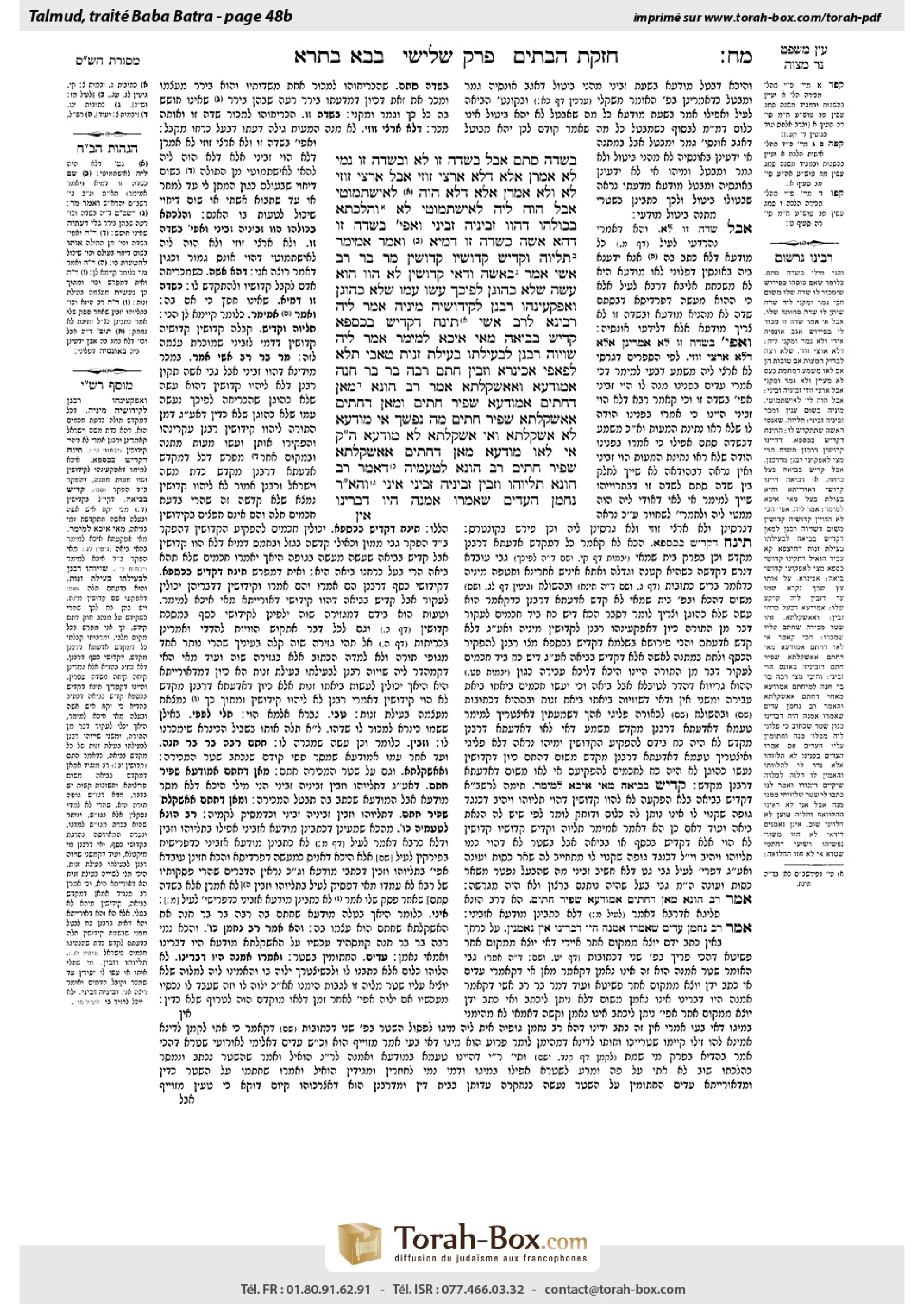
Bava Batra 48b: Talmud study for Daf Yomi
Study the Talmud for Daf Yomi with scanned pages, Hebrew text, English translations from Sefaria and AI-generated French translations.
Passage selection and English or AI-generated French translation are available where the scan has annotations. Daf Study is independent of Torah-Box and Sefaria.
Browse Bava Batra · בבא בתרא · All tractatesBava Batra 48b text and translations
This page of Bava Batra includes the Aramaic text, an English translation and an AI-generated French translation, alongside the scan above.
בבא בתרא מ״ח ב · Aramaic and Hebrew text
בְּ״שָׂדֶה״ סְתָם, אֲבָל בְּ״שָׂדֶה זוֹ״ – לֹא.
וּבְ״שָּׂדֶה זוֹ״ נָמֵי לָא אֲמַרַן – אֶלָּא דְּלָא אַרְצִי זוּזֵי, אֲבָל אַרְצִי זוּזֵי – לָא.
וְלָא אֲמַרַן אֶלָּא דְּלָא הֲוָה לְאִישְׁתְּמוֹטֵי, אֲבָל הֲוָה לֵיהּ לְאִישְׁתְּמוֹטֵי – לָא.
וְהִלְכְתָא בְּכוּלְּהוּ דְּהָווּ זְבִינֵיהּ זְבִינֵי, וַאֲפִילּוּ בְּשָׂדֶה זוֹ – דְּהָא אִשָּׁה כְּ״שָׂדֶה זוֹ״ דָּמְיָא, וְאָמַר אַמֵּימָר: תַּלְיוּהָ וְקַדֵּישׁ – קִדּוּשָׁיו קִדּוּשִׁין.
מָר בַּר רַב אָשֵׁי אָמַר: בְּאִשָּׁה וַדַּאי קִדּוּשִׁין לָא הָווּ; הוּא עָשָׂה שֶׁלֹּא כַּהוֹגֶן, לְפִיכָךְ עָשׂוּ עִמּוֹ שֶׁלֹּא כַּהוֹגֶן – וְאַפְקְעִינְהוּ רַבָּנַן לְקִידּוּשֵׁיהּ מִינֵּיהּ.
אֲמַר לֵיהּ רָבִינָא לְרַב אָשֵׁי: תִּינַח דְּקַדֵּישׁ בְּכַסְפָּא, קַדֵּישׁ בְּבִיאָה מַאי אִיכָּא לְמֵימַר? אֲמַר לֵיהּ: שַׁוְּיוּהּ רַבָּנַן לִבְעִילָתוֹ בְּעִילַת זְנוּת.
טָאבִי תְּלָא לְפָאפִּי אַכִּינָּרָא, וְזַבֵּין. חֲתַם רַבָּה בַּר בַּר חָנָה אַמּוֹדָעָא, וְאַאַשְׁקָלְתָּא. אָמַר רַב הוּנָא: מַאן דְּחָתֵים אַמּוֹדָעָא – שַׁפִּיר חָתֵים, וּמַאן דְּחָתֵים אַאַשְׁקָלְתָּא – שַׁפִּיר חָתֵים.
מָה נַפְשָׁךְ? אִי מוֹדָעָא – לָא אַשְׁקָלְתָּא, וְאִי אַשְׁקָלְתָּא – לָא מוֹדָעָא! הָכִי קָאָמַר: אִי לָאו מוֹדָעָא, מַאן דְּחָתֵים אַאַשְׁקָלְתָּא – שַׁפִּיר חָתֵים. רַב הוּנָא לְטַעְמֵיהּ – דְּאָמַר רַב הוּנָא: תַּלְיוּהוּ וְזַבֵּין – זְבִינֵיהּ זְבִינֵי.
אִינִי?! וְהָאָמַר רַב נַחְמָן: הָעֵדִים שֶׁאָמְרוּ ״אֲמָנָה הָיוּ דְּבָרֵינוּ״ –
Bava Batra 48b · English translation
in a case where the seller was compelled to sell an unspecified field. Since he had a choice as to which field to sell, the presumption is that he sold it sincerely. But in a case where the one coercing him specified this specific field to be sold, the sale is not valid, as the seller did not decide freely on any aspect of the sale.
And even in a case where the one coercing him specified this specific field to be sold, we said that the sale is invalid only where the seller did not count [artzei] the money for the field, but if the seller did count the money, then we do not say that the sale is invalid.
And we said that the sale is invalid in the case of a specified field when money was not counted only where the seller had no way to avoid the coercion. But if the seller had a way to avoid the coercion and did not avoid it, then we do not say that the sale is invalid.
The Gemara concludes: And the halakha in all of these cases is that the sale is valid, and this is so even in the case of a specified field. This can be inferred because the case of a woman forced to accept betrothal is comparable to the case of a specified field, as a specific man is performing the betrothal, and Ameimar says: If a man suspended a woman and betrothed her, his betrothal is valid, despite the fact that she was coerced.
Mar bar Rav Ashi said: In the case of a woman who was forced to accept betrothal, the betrothal is certainly not valid. This man acted improperly; consequently, the Sages acted improperly with him, and the Sages expropriated her betrothal from him.
Ravina said to Rav Ashi: This works out well in a case where he betrothed his wife with money, as it is possible to say that the Sages expropriated from the possession of its owner the money used for the betrothal, resulting in a retroactive cancellation of the betrothal. But if he betrothed her by means of sexual intercourse, then what is there to say? Rav Ashi said to him: The Sages deemed his sexual intercourse as licentious sexual intercourse, which does not create a bond of betrothal.
§ The Gemara relates: Someone named Tavi suspended another person named Pafi on a kinara and compelled him to sell his field. Rabba bar bar Ḥana signed both on Pafi’s preemptive declaration nullifying the sale (see 40b) and on the bill of sale [ashkalta]. Rav Huna said: The one who signed on the preemptive declaration acted well by signing, and the one who signed on the bill of sale acted well by signing.
The Gemara challenges: Whichever way you look at it, Rav Huna’s statement is problematic. If the preemptive declaration is valid, then there is no place for a bill of sale. And if the bill of sale is valid, then there is no place for a preemptive declaration. How can Rav Huna commend signing on both of these mutually exclusive documents? The Gemara explains: This is what Rav Huna is saying: If it were not for his also having signed the preemptive declaration, the one who signed on the bill of sale acted well by signing. In this statement, Rav Huna conforms to his line of reasoning, as Rav Huna says: If one was suspended and thereby coerced to sell a certain item and he sold it, his sale is valid.
The Gemara asks: Is that so that Rabba bar bar Ḥana can, by means of the preemptive declaration, invalidate the bill of sale that he himself signed? But doesn’t Rav Naḥman say: With regard to witnesses who said: Our statement that we signed was a document of trust, i.e., a false promissory note given by one person to another, trusting that he will not make use of it until there is an actual loan,
Bava Batra 48b · Traduction française (IA)
Dans un cas où le vendeur était contraint de vendre un champ indéterminé, puisque celui-ci avait le choix du champ à vendre, on suppose qu'il a vendu sincèrement. Mais dans un cas où celui qui le contraint spécifie ce champ précis à vendre, la vente n'est pas valide, car le vendeur n'a pas librement décidé de quel aspect de la vente il s'agissait.
Et même dans un cas où celui qui le contraint spécifie ce champ précis à vendre, on dit que la vente n'est pas valide que lorsque le vendeur n'a pas compté l'argent pour le champ, mais si le vendeur a compté l'argent, alors on ne dit pas que la vente n'est pas valide.
Et on a dit que la vente n'est pas valide dans le cas d'un champ spécifié lorsque l'argent n'a pas été compté uniquement lorsque le vendeur n'avait aucun moyen d'éviter la contrainte. Mais si le vendeur avait un moyen d'éviter la contrainte et n'a pas évité, alors on ne dit pas que la vente n'est pas valide.
La Guemara conclut : Et la halakha dans tous ces cas est que la vente est valide, et cela même dans le cas d'un champ spécifié. On peut en déduire cela car le cas d'une femme contrainte à accepter la betrothal est comparable à celui d'un champ spécifié, car un homme spécifique effectue la betrothal, et Ameimar dit : Si un homme a suspendu une femme et l'a betrothal, sa betrothal est valide, malgré le fait qu'elle ait été contrainte.
Mar bar Rav Ashi dit : Dans le cas d'une femme contrainte à accepter la betrothal, la betrothal est certainement invalide. Cet homme a agi de manière incorrecte ; par conséquent, les Sages ont agi de manière incorrecte avec lui, et les Sages ont exproprié sa betrothal de lui.
Ravina dit à Rav Ashi : Cela s'applique bien dans le cas où il a betrothal sa femme avec de l'argent, car on peut dire que les Sages ont exproprié de la possession de son propriétaire l'argent utilisé pour la betrothal, entraînant ainsi l'annulation rétroactive de la betrothal. Mais si il l'a betrothal par le moyen de l'acte sexuel, alors que dire ? Rav Ashi dit à lui : Les Sages ont considéré son acte sexuel comme un acte sexuel licencieux, qui ne crée pas un lien de betrothal.
§ La Guemara rapporte : Une personne nommée Tavi a suspendu une autre personne nommée Pafi sur une kinara et l'a contraint à vendre son champ. Rabba bar bar Ḥana a signé à la fois sur la déclaration préalable annulant la vente (voir 40b) et sur le contrat de vente [ashkalta]. Rav Huna dit : Celui qui a signé sur la déclaration préalable a agi bien en signant, et celui qui a signé sur le contrat de vente a agi bien en signant.
La Guemara soulève un doute : Quel que soit le point de vue, l'affirmation de Rav Huna est problématique. Si la déclaration préalable est valide, alors il n'y a pas de place pour un contrat de vente. Et si le contrat de vente est valide, alors il n'y a pas de place pour une déclaration préalable. Comment Rav Huna peut-il louer la signature sur ces deux documents mutuellement exclusifs ? La Guemara explique : C'est ce que Rav Huna dit : Si ce n'était pas pour le fait qu'il ait également signé la déclaration préalable, celui qui a signé le contrat de vente a agi bien en signant. Dans cette déclaration, Rav Huna suit sa ligne de raisonnement, car Rav Huna dit : Si une personne a été suspendue et ainsi contrainte à vendre un certain objet et qu'il l'a vendu, sa vente est valide.
La Guemara pose la question : Est-ce ainsi que Rabba bar bar Ḥana peut, par la déclaration préalable, invalider le contrat de vente qu'il a lui-même signé ? Mais ne dit pas Rav Naḥman : En ce qui concerne des témoins qui disent : Notre déclaration que nous avons signé est un document de confiance, c'est-à-dire une note promesse fausse donnée par une personne à une autre, en confiant qu'il ne l'utilisera pas avant qu'il y ait un prêt réel,
Traduction française générée par IA à partir de l’édition anglaise de Sefaria. Vérifie toujours un passage avec le texte source.
Text from Sefaria: William Davidson Edition - Vocalized Aramaic (CC BY NC); William Davidson Edition - English (CC BY NC).