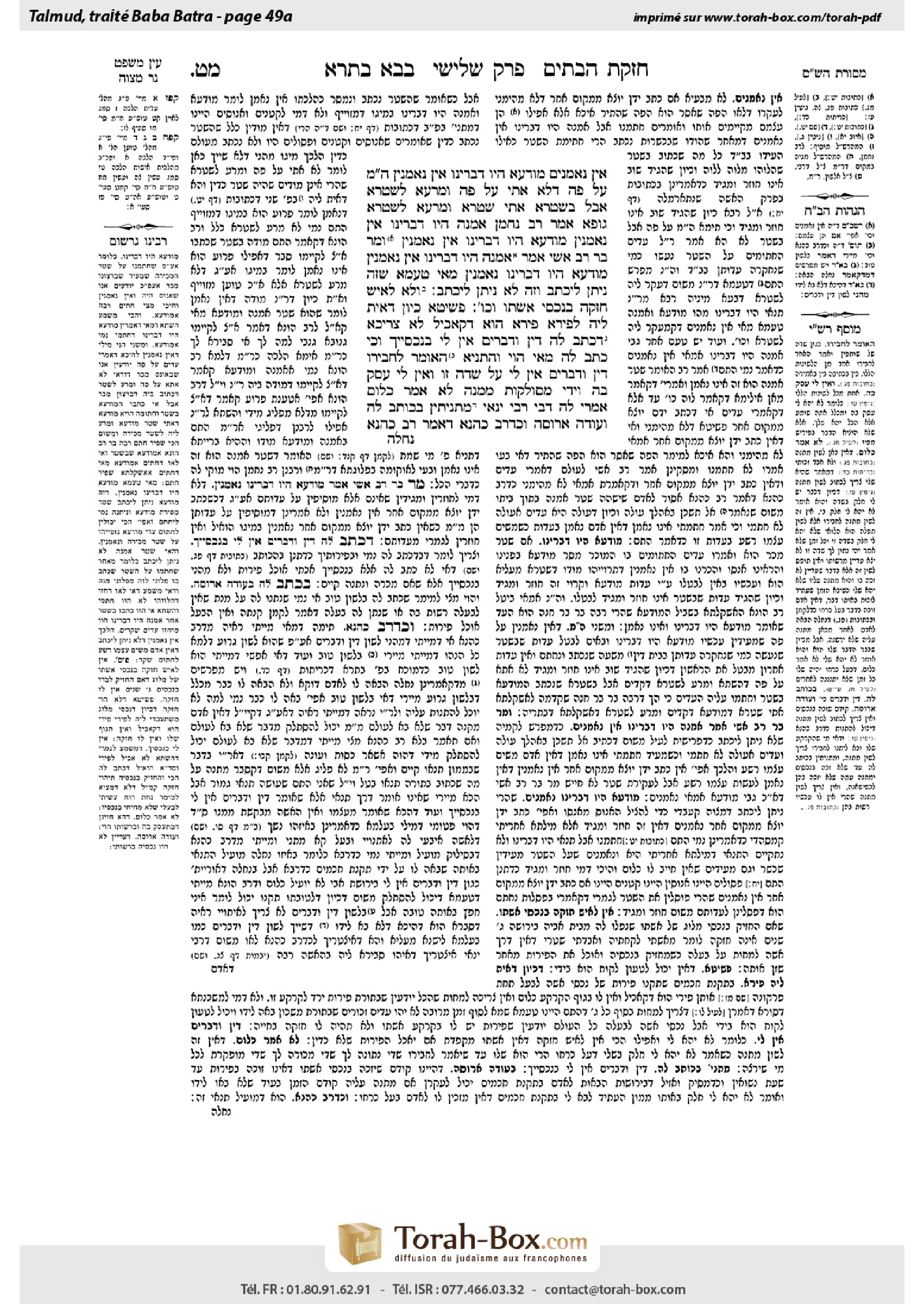
Bava Batra 49a: Talmud study for Daf Yomi
Study the Talmud for Daf Yomi with scanned pages, Hebrew text, English translations from Sefaria and AI-generated French translations.
Passage selection and English or AI-generated French translation are available where the scan has annotations. Daf Study is independent of Torah-Box and Sefaria.
Browse Bava Batra · בבא בתרא · All tractatesBava Batra 49a text and translations
This page of Bava Batra includes the Aramaic text, an English translation and an AI-generated French translation, alongside the scan above.
בבא בתרא מ״ט א · Aramaic and Hebrew text
אֵין נֶאֱמָנִים; ״מוֹדָעָא הָיוּ דְּבָרֵינוּ״ – אֵין נֶאֱמָנִין!
הָנֵי מִילֵּי עַל פֶּה – דְּלָא אָתֵי עַל פֶּה וּמַרַע לִשְׁטָרָא, אֲבָל בִּשְׁטָרָא – אָתֵי שְׁטָרָא וּמַרַע לִשְׁטָרָא.
גּוּפָא – אָמַר רַב נַחְמָן: ״אֲמָנָה הָיוּ דְּבָרֵינוּ״ – אֵין נֶאֱמָנִין, ״מוֹדָעָא הָיוּ דְּבָרֵינוּ״ – אֵין נֶאֱמָנִין.
וּמָר בַּר רַב אָשֵׁי אָמַר: ״אֲמָנָה הָיוּ דְּבָרֵינוּ״ – אֵין נֶאֱמָנִין, ״מוֹדָעָא הָיוּ דְּבָרֵינוּ״ – נֶאֱמָנִין. מַאי טַעְמָא? שֶׁזֶּה נִיתַּן לִיכָּתֵב, וְזֶה לֹא נִיתַּן לִיכָּתֵב.
וְלֹא לָאִישׁ חֲזָקָה בְּנִכְסֵי אִשְׁתּוֹ וְכוּ׳. פְּשִׁיטָא – כֵּיוָן דְּאִית לֵיהּ לְפֵירָא, פֵּירָא הוּא דְּקָאָכֵיל!
לָא צְרִיכָא, דִּכְתַב לַהּ: ״דִּין וּדְבָרִים אֵין לִי בִּנְכָסַיִיךְ״.
וְכִי כְּתַב לַהּ – מַאי הָוֵי? וְהָתַנְיָא, הָאוֹמֵר לַחֲבֵירוֹ: ״דִּין וּדְבָרִים אֵין לִי עַל שָׂדֶה זוֹ״, וְ״אֵין לִי עֵסֶק בָּהּ״, וְ״יָדַי מְסוּלָּקוֹת מִמֶּנָּה״ – לֹא אָמַר כְּלוּם!
אָמְרִי לַהּ דְּבֵי רַבִּי יַנַּאי: מַתְנִיתִין בְּכוֹתֵב לָהּ וְעוֹדָהּ אֲרוּסָה – וְכִדְרַב כָּהֲנָא, דְּאָמַר רַב כָּהֲנָא:
Bava Batra 49a · English translation
they are not deemed credible. And similarly, witnesses who said: Our statement that we signed was accompanied by a preemptive declaration, are not deemed credible. They cannot negate the testimony of the document that they themselves signed by claiming that there had been a preemptive declaration. Similarly, how could Rabba bar bar Ḥana’s signing of the preemptive declaration override his signing the bill of sale?
The Gemara answers: That matter of witnesses not being deemed credible to nullify a document applies only when the witnesses attempt to nullify the document by means of an oral declaration, as an oral declaration cannot come and weaken a written document. But if the witnesses attempt to nullify the bill of sale by means of testimony in another document, e.g., by signing the preemptive declaration, then this preemptive document can come and weaken a written document, in this case, the bill of sale.
The Gemara returns to discuss the matter itself: Rav Naḥman says that witnesses who said: Our statement that we signed was a document of trust, are not deemed credible. And similarly, witnesses who said: Our statement that we signed was accompanied by a preemptive declaration, are not deemed credible.
And Mar bar Rav Ashi says that witnesses who said: Our statement that we signed was a statement of trust, are not deemed credible; but witnesses who said: Our statement that we signed was accompanied by a preemptive declaration, are deemed credible. What is the reason for the difference between the cases? The reason is that this document that was accompanied by a preemptive declaration may be written, as it is merely written under duress, but that document of trust may not be written, as it is a false document. Testifying that they wrote it is self-incriminating, and the witnesses are not deemed credible to incriminate themselves.
§ The mishna teaches that a man does not have the ability to establish the presumption of ownership with regard to his wife’s property and a wife does not have the ability to establish the presumption of ownership with regard to her husband’s property. The Gemara asks: Isn’t this obvious? Since he has the right to enjoy the profits of her property while they are married, it is known that he is only enjoying the profits and that he has no claim to the field itself. On what grounds, then, would he establish the presumption of ownership?
The Gemara responds: No, it is necessary to teach this halakha in a case where the husband wrote to his wife: I do not have any legal dealings or involvement with your property, i.e., he forfeits his right to enjoy the profits of her property, and therefore if he subsequently did enjoy the profits of her field, one might assume that it is because he acquired the land from her. It was therefore necessary for the mishna to teach that this does not indicate that he owns the land, since it is possible that she does not prevent him from enjoying the profits, due to their relationship.
The Gemara asks: And if he wrote this to her, what of it? And isn’t it taught in a baraita: One who says to another: I do not have any legal dealings or involvement concerning this field, or: I have no dealings with it, or: My hands are removed from it, has not said anything. That is to say, these statements have no legal standing.
The scholars of the school of Rabbi Yannai said with regard to this: The mishna states its ruling with regard to one who writes this formulation to her while she is still only betrothed, before he had any rights to her property. Therefore, he is able to prevent his rights from taking effect after the marriage. And this is in accordance with the statement of Rav Kahana, as Rav Kahana says:
Bava Batra 49a · Traduction française (IA)
ils ne sont pas considérés comme crédibles. De même, les témoins qui ont déclaré : Notre déclaration, que nous avons signée, était accompagnée d'une déclaration préventive, ne sont pas considérés comme crédibles. Ils ne peuvent pas invalider le témoignage du document qu'ils ont eux-mêmes signé en affirmant qu'il y avait eu une déclaration préventive. De même, comment la signature de Rabba bar bar Ḥana dans la déclaration préventive pourrait-elle annuler sa signature sur le contrat de vente ?
La Guemara répond : Cette question des témoins ne pouvant pas invalider un document s'applique uniquement lorsque les témoins tentent d'annuler le document par l'intermédiaire d'une déclaration orale, car une déclaration orale ne peut pas venir affaiblir un document écrit. Mais si les témoins tentent d'annuler le contrat de vente par l'intermédiaire d'un témoignage dans un autre document, par exemple en signant une déclaration préventive, alors ce document préventif peut venir affaiblir un document écrit, à savoir le contrat de vente.
La Guemara reprend la discussion sur ce sujet : Rav Naḥman dit que les témoins qui ont déclaré : Notre déclaration, que nous avons signée, était un document de confiance, ne sont pas considérés comme crédibles. De même, les témoins qui ont déclaré : Notre déclaration, que nous avons signée, était accompagnée d'une déclaration préventive, ne sont pas considérés comme crédibles.
Et Mar bar Rav Ashi dit que les témoins qui dirent : Notre déclaration que nous avons signée était une déclaration de confiance, ne sont pas considérés comme crédibles ; mais les témoins qui dirent : Notre déclaration que nous avons signée était accompagnée d'une déclaration préventive, sont considérés comme crédibles. Quelle est la raison de la différence entre ces cas ? La raison est que ce document accompagné d'une déclaration préventive peut être écrit, car il est simplement écrit sous la contrainte, mais que ce document de confiance ne peut pas être écrit, car il s'agit d'un document faux. Témoigner qu'ils l'ont écrit est une auto-incrimination, et les témoins ne sont pas considérés comme crédibles pour s'auto-incriminer.
§ La Michna enseigne que l'homme n'a pas la capacité d'établir la présomption de propriété concernant la propriété de sa femme et que la femme n'a pas la capacité d'établir la présomption de propriété concernant la propriété de son mari. La Guemara demande : N'est-ce pas évident ? Puisque l'homme a le droit de profiter des bénéfices de sa propriété pendant leur mariage, on sait qu'il ne possède que les bénéfices et qu'il n'a aucun droit sur le champ lui-même. Sur quel fondement, alors, pourrait-il établir la présomption de propriété ?
La Guemara répond : Non, il est nécessaire d'enseigner cette halakha dans un cas où l'époux écrivit à sa femme : Je n'ai aucun droit juridique ou implication concernant votre propriété, c'est-à-dire qu'il renonce à son droit de profiter des bénéfices de votre propriété, et donc si, par la suite, il profita des bénéfices du champ de sa femme, on pourrait penser qu'il l'a acquis. Il était donc nécessaire que la Michna enseigne que cela ne signifie pas qu'il possède le champ, car il est possible que la femme ne l'empêche pas de profiter des bénéfices, en raison de leur relation.
La Guemara demande : Et s'il a écrit cela à elle, qu'est-ce que cela change ? Et n'est-ce pas enseigné dans une baraïta : Celui qui dit à un autre : Je n'ai aucun droit juridique ou implication concernant ce champ, ou : Je n'ai aucun droit sur cela, ou : Mes mains sont éloignées de cela, n'a dit rien. C'est-à-dire que ces déclarations n'ont aucun fondement juridique.
Les savants de l'école de Rabbi Yannai dirent à propos de cela : La mitsna énonce sa décision concernant celui qui écrit cette formulation à elle pendant qu'elle est encore fiancée, avant qu'il n'ait aucun droit sur sa propriété. Il est donc capable d'empêcher ses droits d'entrer en vigueur après le mariage. Et cela est conforme à la déclaration de Rav Kahana, car Rav Kahana dit :
Traduction française générée par IA à partir de l’édition anglaise de Sefaria. Vérifie toujours un passage avec le texte source.
Text from Sefaria: William Davidson Edition - Vocalized Aramaic (CC BY NC); William Davidson Edition - English (CC BY NC).