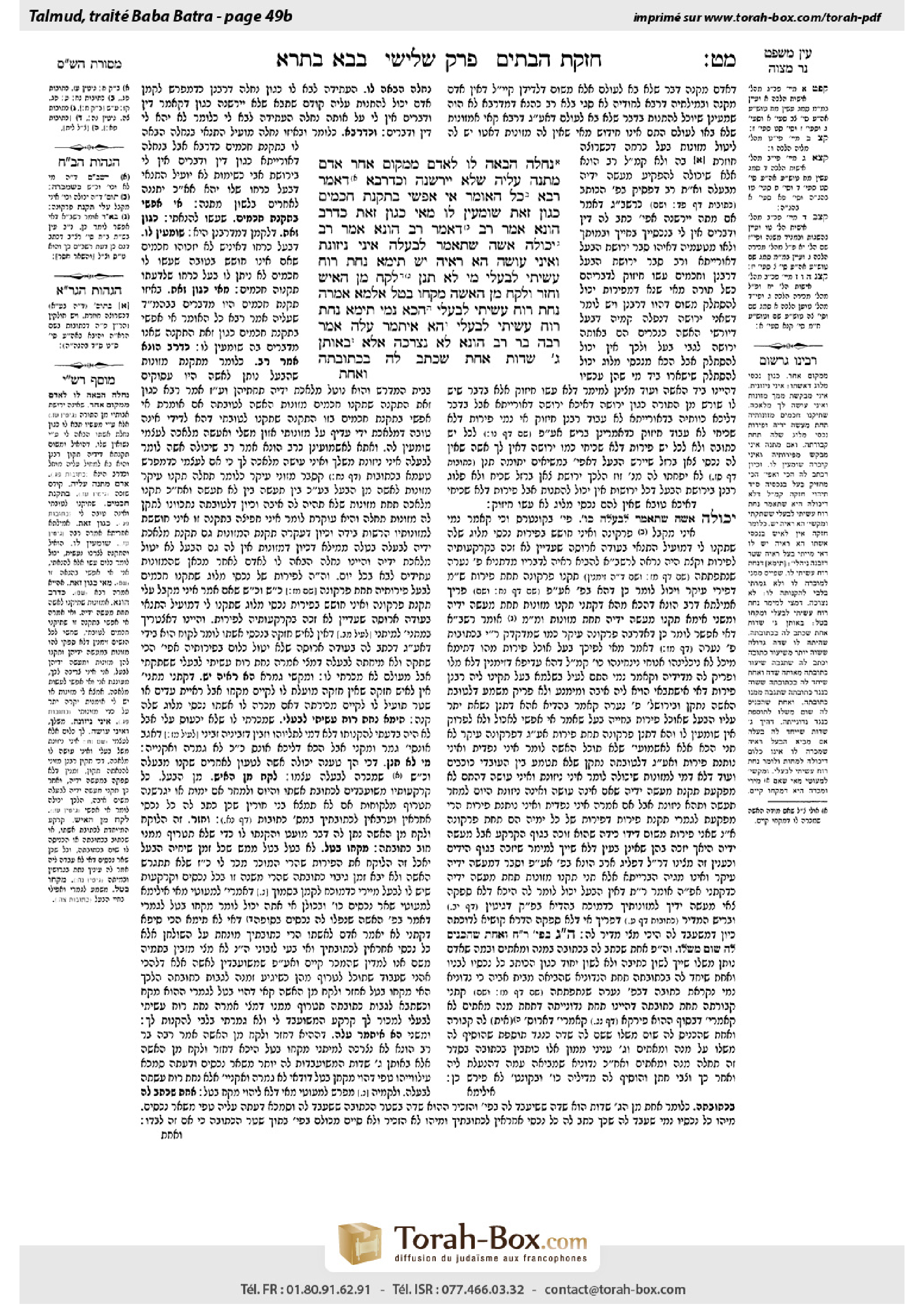
Bava Batra 49b: Talmud study for Daf Yomi
Study the Talmud for Daf Yomi with scanned pages, Hebrew text, English translations from Sefaria and AI-generated French translations.
Passage selection and English or AI-generated French translation are available where the scan has annotations. Daf Study is independent of Torah-Box and Sefaria.
Browse Bava Batra · בבא בתרא · All tractatesBava Batra 49b text and translations
This page of Bava Batra includes the Aramaic text, an English translation and an AI-generated French translation, alongside the scan above.
בבא בתרא מ״ט ב · Aramaic and Hebrew text
נַחֲלָה הַבָּאָה לוֹ לְאָדָם מִמָּקוֹם אַחֵר, אָדָם מַתְנֶה עָלֶיהָ שֶׁלֹּא יִירָשֶׁנָּה. וְכִדְרָבָא – דְּאָמַר רָבָא: כׇּל הָאוֹמֵר ״אִי אֶפְשִׁי בְּתַקָּנַת חֲכָמִים״ כְּגוֹן זֹאת, שׁוֹמְעִין לוֹ.
מַאי ״כְּגוֹן זֹאת״? כִּדְרַב הוּנָא אָמַר רַב – דְּאָמַר רַב הוּנָא אָמַר רַב: יְכוֹלָה אִשָּׁה שֶׁתֹּאמַר לְבַעְלָהּ: ״אֵינִי נִיזּוֹנֶת וְאֵינִי עוֹשָׂה״.
הָא רְאָיָה – יֵשׁ? תֵּימָא: ״נַחַת רוּחַ עָשִׂיתִי לְבַעְלִי״!
מִי לָא תְּנַן: לָקַח מִן הָאִישׁ, וְחָזַר וְלָקַח מִן הָאִשָּׁה – מִקָּחוֹ בָּטֵל; אַלְמָא אָמְרָה: ״נַחַת רוּחַ עָשִׂיתִי לְבַעְלִי״, הָכָא נָמֵי תֵּימָא: ״נַחַת רוּחַ עָשִׂיתִי לְבַעְלִי״!
הָא אִיתְּמַר עֲלַהּ, אָמַר רַבָּה בַּר רַב הוּנָא: לֹא נִצְרְכָה אֶלָּא בְּאוֹתָן שָׁלֹשׁ שָׂדוֹת – אַחַת שֶׁכָּתַב לָהּ בִּכְתוּבָּתָהּ,
Bava Batra 49b · English translation
With regard to an inheritance that comes to a person from another place, i.e., an inheritance one will receive in the future, a person can make a condition about it from the outset that he will not inherit it, since one can waive his future rights to property that is not currently his. And this ruling is in accordance with the opinion of Rava, as Rava said that with regard to anyone who says: I do not want to avail myself of an ordinance of the Sages such as this one that was instituted for my benefit, one listens to him.
The Gemara asks: What is meant by: Such as this one? The Gemara explains: Rava is referring to that statement of Rav Huna, who said that Rav says a certain ruling. As Rav Huna says that Rav says: A woman can say to her husband: I will not be sustained by you and, in turn, I will not work, i.e., you will not keep my earnings. The Sages instituted that a husband must provide sustenance for his wife, and in exchange is entitled to her wages. Since this was instituted for the benefit of wives, the wife is able to opt out of this arrangement. Similarly, the husband may waive his rights to the profits from his wife’s land. It is in such a circumstance that the mishna rules that even if he relinquished his rights, he does not establish the presumption of ownership by enjoying the profits.
§ The mishna teaches that a husband does not establish the presumption of ownership of his wife’s field by enjoying its profits. The Gemara suggests: By inference, the husband has the ability to bring proof that he purchased the field from his wife or received it as a gift from her and consequently be regarded as the owner of the field. The Gemara asks: Why is this proof decisive? Let her say: I did it, i.e., I gave or sold the field to my husband, only to please my husband, but I did not mean it.
The Gemara quotes a source for this claim: Didn’t we learn in a mishna (Gittin 55b): If one first purchased land from the husband and afterward returned and purchased it from the wife, i.e., he purchased her rights to this land for after the death of her husband or in the event of their divorce, as stipulated in her marriage contract, then his transaction is void. Apparently, she said: I did it, i.e., signed this bill of sale, only to please my husband, but I did not mean it. Here too let her say: I did it only to please my husband but did not mean to give or sell the field to him.
The Gemara answers: But wasn’t it stated with regard to that mishna that Rabba bar Rav Huna says: The halakha that a woman can claim that she acted only in order to please her husband is not stated with regard to all of her property, but is necessary only with regard to those three types of fields that have special status: One field about which he wrote to her in her marriage contract that it would serve as payment of her marriage contract;
Bava Batra 49b · Traduction française (IA)
Concernant une succession qui vient à une personne d'un autre lieu, c'est-à-dire une succession que l'on recevra à l'avenir, une personne peut établir une condition dès le départ qu'elle ne souhaite pas la recevoir, car on peut renoncer à ses droits futurs sur une propriété qui n'est pas encore la sienne. Et cette décision est conforme à l'opinion de Rava, car Rava a dit que concernant celui qui dit : Je ne veux pas bénéficier d'une ordonnance des Sages telle que celle-ci, qui a été instituée à son bénéfice, on l'écoute.
La Guemara pose la question : De quoi s'agit-il par « telle ordonnance » ? La Guemara explique : Rava fait référence à la déclaration de Rav Huna, qui a dit que Rav a établi une certaine décision. Rav Huna dit que Rav a dit : Une femme peut dire à son mari : Je ne veux pas être sustentée par toi, et à l'inverse, je ne travaillerai pas, c'est-à-dire que tu ne conserveras pas mes revenus. Les Sages ont institué que le mari doit fournir une subsistance à sa femme, et en échange il a le droit sur ses salaires. Puisque cela a été institué à profit des épouses, la femme peut se désister de ce dispositif. De même, le mari peut renoncer à ses droits sur les profits issus des terres de sa femme. C'est dans un tel cas que la Michna déclare que même s'il a renoncé à ses droits, il ne peut pas établir la présomption d'ownership en profitant des revenus.
§ La Michna enseigne que le mari ne peut établir la présomption d'ownership sur le champ de sa femme en profitant de ses revenus. La Guemara suggère : Par déduction, le mari a la capacité de présenter une preuve qu'il a acheté le champ auprès de sa femme ou qu'il l'a reçu en cadeau d'elle, et par conséquent être considéré comme propriétaire du champ. La Guemara pose la question : Pourquoi cette preuve est-elle décisive ? Qu'elle dise : J'ai fait cela, c'est-à-dire j'ai donné ou vendu le champ à mon mari, uniquement pour plaire à mon mari, mais je n'avais pas l'intention de le faire.
La Guemara cite une source pour cette affirmation : N'avons-nous pas appris dans une Michna (Gittin 55b) : Si l'on achète d'abord un terrain auprès du mari et ensuite revient et achète ce terrain auprès de la femme, c'est-à-dire qu'il achète ses droits sur ce terrain après la mort de son mari ou en cas de divorce, selon le contrat de mariage, alors cette transaction est nulle. Apparemment, elle dit : J'ai fait cela, c'est-à-dire j'ai signé ce contrat de vente, uniquement pour plaire à mon mari, mais je n'avais pas l'intention de le faire. Ici aussi, qu'elle dise : J'ai fait cela uniquement pour plaire à mon mari mais je n'avais pas l'intention de lui donner ou de vendre le champ.
La Guemara répond : Mais n'avait-on pas dit concernant cette Michna que Rabba bar Rav Huna dit : La halakha selon laquelle une femme peut affirmer qu'elle a agi uniquement pour plaire à son mari n'est pas établie concernant toute sa propriété, mais est nécessaire uniquement concernant ces trois types de champs qui ont un statut spécial : un champ concernant lequel il a écrit à elle dans son contrat de mariage qu'il servirait de paiement de son mariage ;
Traduction française générée par IA à partir de l’édition anglaise de Sefaria. Vérifie toujours un passage avec le texte source.
Text from Sefaria: William Davidson Edition - Vocalized Aramaic (CC BY NC); William Davidson Edition - English (CC BY NC).