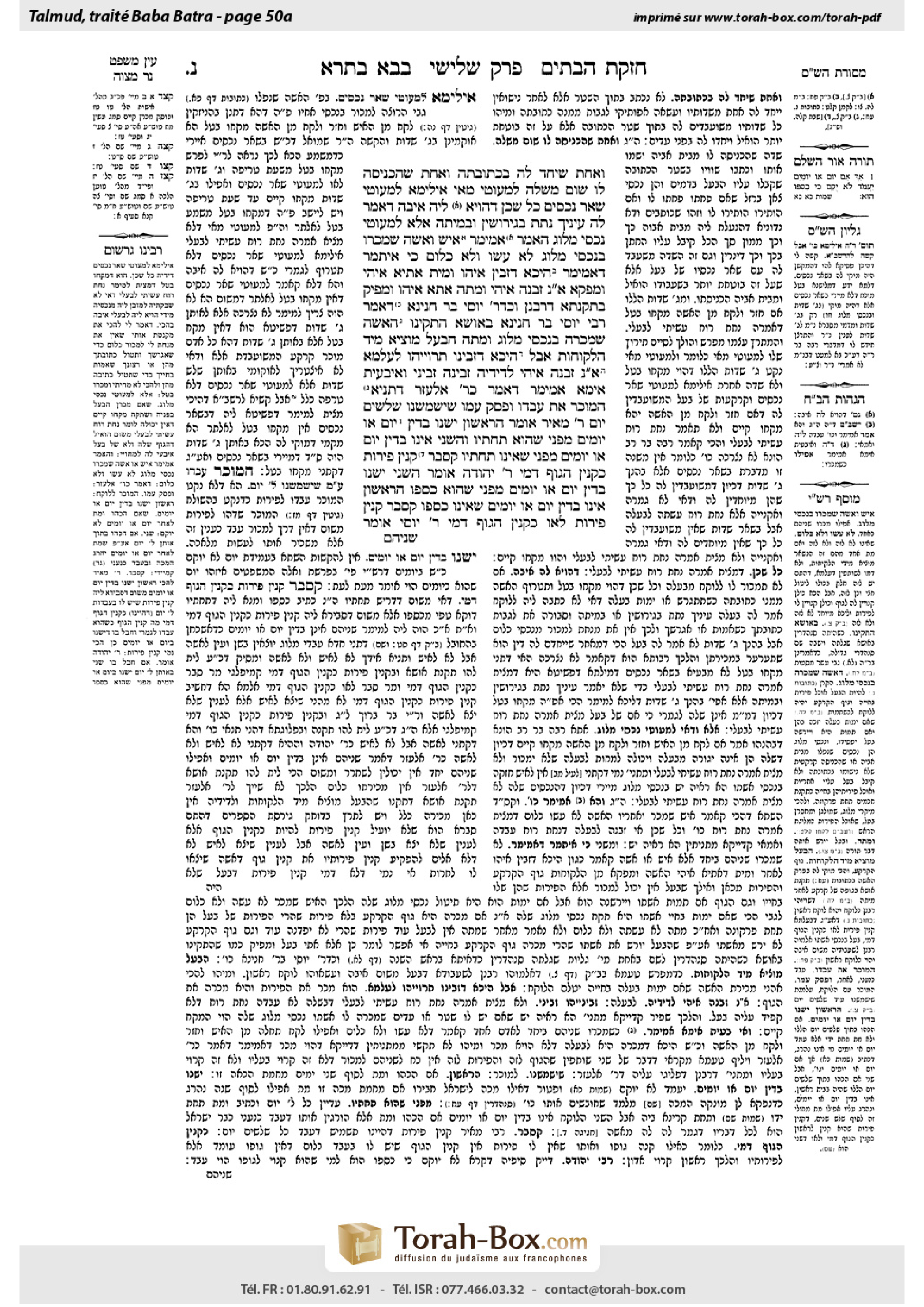
Bava Batra 50a: Talmud study for Daf Yomi
Study the Talmud for Daf Yomi with scanned pages, Hebrew text, English translations from Sefaria and AI-generated French translations.
Passage selection and English or AI-generated French translation are available where the scan has annotations. Daf Study is independent of Torah-Box and Sefaria.
Browse Bava Batra · בבא בתרא · All tractatesBava Batra 50a text and translations
This page of Bava Batra includes the Aramaic text, an English translation and an AI-generated French translation, alongside the scan above.
בבא בתרא נ׳ א · Aramaic and Hebrew text
וְאַחַת שֶׁיִּחֵד לָהּ בִּכְתוּבָּתָהּ, וְאַחַת שֶׁהִכְנִיסָה לוֹ שׁוּם מִשֶּׁלָּהּ.
לְמַעוֹטֵי מַאי? אִילֵּימָא לְמַעוֹטֵי שְׁאָר נְכָסִים – כׇּל שֶׁכֵּן דְּהָוְיָא לֵיהּ אֵיבָה, דְּאָמַר לַהּ: עֵינַיִךְ נָתַתְּ בְּגֵירוּשִׁין וּבְמִיתָה!
אֶלָּא לְמַעוֹטֵי נִכְסֵי מְלוֹג – הָאָמַר אַמֵּימָר: אִישׁ וְאִשָּׁה שֶׁמָּכְרוּ בְּנִכְסֵי מְלוֹג – לֹא עָשׂוּ וְלֹא כְּלוּם!
כִּי אִיתְּמַר דְּאַמֵּימַר – הֵיכָא דְּזַבֵּין אִיהוּ וּמִית, אַתְיָא אִיהִי וּמַפְּקָא; אִי נָמֵי זַבִּנָה אִיהִי וּמִתָה, אָתֵא אִיהוּ וּמַפֵּיק בְּתַקַּנְתָּא דְרַבָּנַן – וְכִדְרַבִּי יוֹסֵי בַּר חֲנִינָא, דְּאָמַר רַבִּי יוֹסֵי בַּר חֲנִינָא: בְּאוּשָׁא הִתְקִינוּ, הָאִשָּׁה שֶׁמָּכְרָה בְּנִכְסֵי מְלוֹג, וּמֵתָה – הַבַּעַל מוֹצִיא מִיַּד הַלָּקוֹחוֹת;
אֲבָל הֵיכָא דְּזַבִּינוּ תַּרְוַיְיהוּ לְעָלְמָא, אִי נָמֵי זַבִּנָה אִיהִי לְדִידֵיהּ – זְבִינַהּ זְבִינֵי.
וְאִיבָּעֵית אֵימָא: אַמֵּימָר דְּאָמַר – כְּרַבִּי אֶלְעָזָר,
דְּתַנְיָא: הַמּוֹכֵר אֶת עַבְדּוֹ, וּפָסַק עִמּוֹ שֶׁיְּשַׁמְּשֶׁנּוּ שְׁלֹשִׁים יוֹם –
רַבִּי מֵאִיר אוֹמֵר: הָרִאשׁוֹן יֶשְׁנוֹ בְּדִין יוֹם אוֹ יוֹמַיִם, מִפְּנֵי שֶׁהוּא תַּחְתָּיו; וְהַשֵּׁנִי אֵינוֹ בְּדִין יוֹם אוֹ יוֹמַיִם, מִפְּנֵי שֶׁאֵינוֹ תַּחְתָּיו –
קָסָבַר: קִנְיַן פֵּירוֹת כְּקִנְיַן הַגּוּף דָּמֵי.
רַבִּי יְהוּדָה אוֹמֵר: הַשֵּׁנִי יֶשְׁנוֹ בְּדִין יוֹם אוֹ יוֹמַיִם, מִפְּנֵי שֶׁהוּא כַּסְפּוֹ; הָרִאשׁוֹן אֵינוֹ בְּדִין יוֹם אוֹ יוֹמַיִם, שֶׁאֵינוֹ כַּסְפּוֹ – קָסָבַר: קִנְיַן פֵּירוֹת לָאו כְּקִנְיַן הַגּוּף דָּמֵי.
רַבִּי יוֹסֵי אוֹמֵר:
Bava Batra 50a · English translation
and one that he specified to her as payment for her marriage contract, even though it was not stipulated explicitly in the contract; and one in a case where she brought into the marriage an appraisal of a field from her own property that she owned prior to the marriage, which took on the status of guaranteed property, meaning that she will receive it if her husband dies or divorces her. If a field of one of these three types is sold with her approval, she can claim that she did not truly consent to this sale, but stated her consent only in order to please her husband.
The Gemara clarifies: To exclude what type of property did Rabba specify these three types of fields? If we say that he intends to exclude the rest of the husband’s property secured to pay her marriage contract, it is all the more so the case that he will bear her enmity if she does not agree to the sale, as he will say to her: You have placed your eyes on divorce or on my death, i.e., you will not allow me to sell my property because you are expecting and planning for my death or our divorce. Therefore, she should be able to claim that she consented to the sale only in order to please her husband with regard to other property as well.
Rather, these three types of fields were specified in order to exclude usufruct property, i.e., property that belongs to the wife and remains in her possession while the husband has the right to enjoy the profits, in which case if the wife consents to the sale, it is valid. The Gemara asks: But doesn’t Ameimar say that if there was a man or a woman, i.e., a husband or a wife, who sold the wife’s usufruct property, they did not accomplish anything, as the sale does not take effect?
The Gemara answers: When the statement of Ameimar was stated, it was to say that neither the husband nor the wife can sell the property unilaterally. Where he sold the property and then died, she can come and remove it from the buyer. Alternatively, in a case where she sold it and then died, he can come and remove it, due to a rabbinic ordinance, and in accordance with the statement of Rabbi Yosei bar Ḥanina, as Rabbi Yosei bar Ḥanina says: When the Sanhedrin convened in Usha, they instituted that in the case of a woman who sold her usufruct property in her husband’s lifetime and then died, the husband repossesses it from the buyers.
But where the two of them sold it to someone, or if she sold it to her husband, the sale is valid. The inference that the Gemara drew from the mishna, that if the husband produces evidence that his wife sold usufruct property to him then he is regarded as the owner, is relevant when she sells her usufruct property to him.
And if you wish, say instead that Ameimar said his statement in accordance with the opinion of Rabbi Elazar, who holds that one can sell property only if he possesses the item itself and also has the right to enjoy its profits.
This is as it is taught in a baraita: In the case of one who sells his Canaanite slave to another, and contracted with him that the sale is on the condition that the slave will serve the seller for thirty days before he is transferred to the buyer, the outcome of this sale is that during those thirty days, the first master enjoys the use of the slave and the buyer is the owner of the slave himself. As detailed in the Torah (Exodus 21:18–21), if one strikes another and the injury leads directly to the victim’s death, the one who struck him is subject to court-imposed capital punishment. But if a master strikes his Canaanite slave, and the slave lingers with his injuries for more than a day or two days and then dies, the master is exempt from court-imposed capital punishment. The baraita addresses who is considered the owner of the slave with regard to this halakha.
The baraita states four opinions: Rabbi Meir says that during those thirty days, only the first master is included in the halakha of “a day or two days” (Exodus 21:21). Rabbi Meir holds that in this case, the first master is included in this exemption, because the slave is under his authority, as he enjoys the use of the slave, but the second master is not included in the halakha of “a day or two days,” because the slave is not under his authority.
Rabbi Meir’s reasoning is that he holds that ownership of the rights to use an item and the profits it engenders is like ownership of the item itself. The status of the first master as the owner negates the possibility that the second master would be regarded as the owner with regard to this halakha, and he would not be included in the exemption.
The baraita continues: Rabbi Yehuda says that the second master is included in the halakha of “a day or two days,” because the slave is “his money” (Exodus 21:21), i.e., his property; but the first master is not included in the halakha of “a day or two days,” because the slave is not “his money.” Rabbi Yehuda’s reasoning is that he holds that ownership of the rights to use an item and the profits it engenders is not like ownership of the item itself. Therefore, the first master, who currently enjoys the use of the slave, does not have the status of an owner with regard to this halakha.
The baraita continues: Rabbi Yosei says that
Bava Batra 50a · Traduction française (IA)
et un autre qu’il avait spécifié comme paiement pour son contrat de mariage, même si cela n’était pas stipulé explicitement dans le contrat ; et un cas où elle apportait dans le mariage une estimation d’un champ provenant de sa propre propriété qu’elle possédait avant le mariage, ce qui prenait le statut de propriété garantie, c’est-à-dire qu’elle recevrait ce champ si son mari meurt ou divorce d’elle. Si un champ de l’un de ces trois types est vendu avec son accord, elle peut réclamer qu’elle n’a pas véritablement consenti à cette vente, mais qu’elle a simplement exprimé son accord pour plaire à son mari.
La Guemara clarifie : De quel type de propriété Rabba a-t-il spécifié ces trois types de champs ? Si nous disons qu’il entend exclure la propriété restante du mari assurée pour payer son contrat de mariage, il est encore plus vrai qu’il ressentira sa colère si elle ne consent pas à la vente, car il dira à elle : Tu as mis tes yeux sur le divorce ou sur ma mort, c’est-à-dire que tu ne permettras pas que je vende ma propriété car tu attends et planifies ma mort ou notre divorce. Ainsi, elle devrait pouvoir réclamer qu’elle a consenti à la vente uniquement pour plaire à son mari concernant d’autres biens.
Au contraire, ces trois types de champs ont été spécifiés afin d’exclure la propriété en usufruit, c’est-à-dire la propriété qui appartient à la femme et reste en son possession tandis que le mari a le droit de profiter des revenus, dans le cas où la femme consent à la vente, celle-ci est valide. La Guemara demande : Mais ne dit pas Ameimar que si un homme ou une femme, c’est-à-dire un mari ou une femme, avait vendu la propriété en usufruit de la femme, ils n’avaient pas accompli quoi que ce soit, car la vente ne prend effet ?
La Guemara répond : Lorsque la déclaration d’Ameimar a été faite, elle signifiait que ni le mari ni la femme ne peuvent vendre la propriété unilatéralement. Lorsqu’il a vendu la propriété puis est décédé, elle peut venir et la retirer du acheteur. Alternativement, dans le cas où elle l’a vendue puis est décédée, il peut venir et la retirer, en vertu d’un ordonnance rabbinique, et conformément à la déclaration de Rabbi Yosei bar Ḥanina, car Rabbi Yosei bar Ḥanina dit : Lorsque le Sanhédrin s’est réuni à Usha, ils ont institué que dans le cas d’une femme qui a vendu sa propriété en usufruit pendant la vie de son mari et est ensuite décédée, le mari récupère cette propriété auprès des acheteurs.
Mais dans le cas où les deux d’entre eux l’ont vendue à quelqu’un, ou si elle l’a vendue à son mari, la vente est valide. L’inférence que la Guemara a tirée de la mitsna, que si le mari produit des preuves que sa femme a vendu sa propriété en usufruit à lui, alors il est considéré comme le propriétaire, est pertinente lorsqu’elle vend sa propriété en usufruit à lui.
Et si vous le souhaitez, dites plutôt que Ameimar a dit sa déclaration conformément à l’opinion de Rabbi Elazar, qui considère que l’on peut vendre une propriété uniquement si l’on possède l’objet lui-même et qu’on a le droit de profiter de ses revenus.
C’est ce qui est enseigné dans une baraïta : Dans le cas d’un homme qui vend son esclave cananéen à un autre, et a conclu un contrat selon lequel la vente est conditionnelle à ce que l’esclave serve le vendeur pendant trente jours avant d’être transféré à l’acheteur, le résultat de cette vente est que pendant ces trente jours, le premier maître profite de l’esclave et l’acheteur est le propriétaire de l’esclave lui-même. Comme détaillé dans la Torah (Exode 21:18–21), si l’un frappe un autre et que l’injury mène directement à la mort de la victime, celui qui a frappé est soumis à une peine de mort imposée par le tribunal. Mais si un maître frappe son esclave cananéen, et que l’esclave meurt après avoir subi des blessures pendant plus d’un ou deux jours, le maître est exempt de la peine de mort imposée par le tribunal. La baraïta aborde qui est considéré comme le propriétaire de l’esclave concernant cette halakha.
La baraïta affirme quatre opinions : Rabbi Meir dit que pendant ces trente jours, seul le premier maître est inclus dans la halakha de « un ou deux jours » (Exode 21:21). Rabbi Meir considère que dans ce cas, le premier maître est inclus dans cette exemption, car l’esclave est sous son autorité, car il profite de l’esclave, mais le second maître n’est pas inclus dans la halakha de « un ou deux jours », car l’esclave n’est pas sous son autorité.
La raison de Rabbi Meir est qu’il considère que la propriété des droits d’utilisation d’un objet et des profits qu’il génère est comme la propriété de l’objet lui-même. Le statut du premier maître en tant que propriétaire annule la possibilité que le second maître soit considéré comme propriétaire concernant cette halakha, et il ne serait pas inclus dans l’exemption.
La baraïta continue : Rabbi Yehuda dit que le second maître est inclus dans la halakha de « un ou deux jours », car l’esclave est « son argent » (Exode 21:21), c’est-à-dire sa propriété ; mais le premier maître n’est pas inclus dans la halakha de « un ou deux jours », car l’esclave n’est pas « son argent ». La raison de Rabbi Yehuda est qu’il considère que la propriété des droits d’utilisation d’un objet et des profits qu’il génère n’est pas comme la propriété de l’objet lui-même. Ainsi, le premier maître, qui profite actuellement de l’esclave, n’a pas le statut de propriétaire concernant cette halakha.
La baraïta continue : Rabbi Yosei dit que
Traduction française générée par IA à partir de l’édition anglaise de Sefaria. Vérifie toujours un passage avec le texte source.
Text from Sefaria: William Davidson Edition - Vocalized Aramaic (CC BY NC); William Davidson Edition - English (CC BY NC).