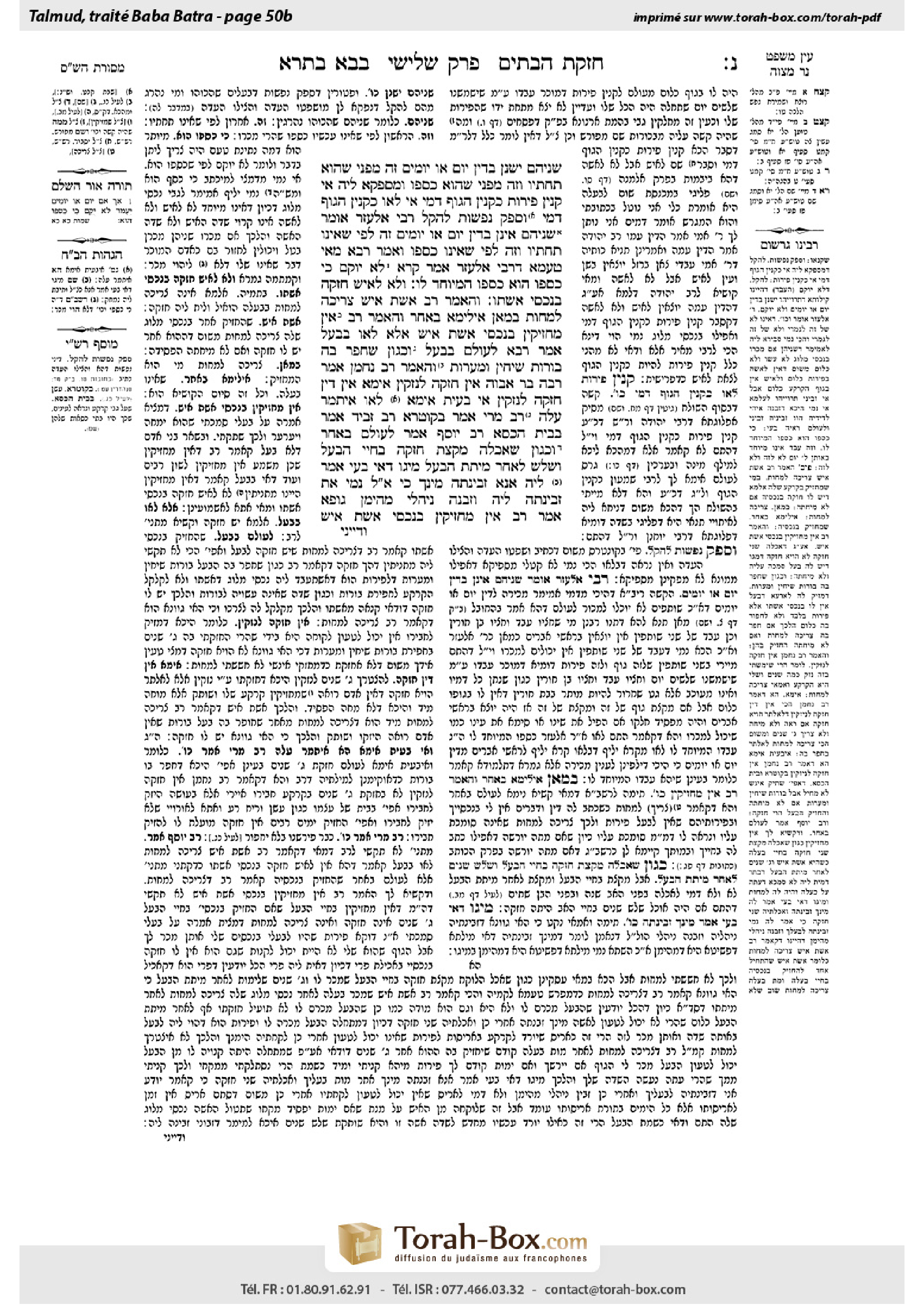
Bava Batra 50b: Talmud study for Daf Yomi
Study the Talmud for Daf Yomi with scanned pages, Hebrew text, English translations from Sefaria and AI-generated French translations.
Passage selection and English or AI-generated French translation are available where the scan has annotations. Daf Study is independent of Torah-Box and Sefaria.
Browse Bava Batra · בבא בתרא · All tractatesBava Batra 50b text and translations
This page of Bava Batra includes the Aramaic text, an English translation and an AI-generated French translation, alongside the scan above.
בבא בתרא נ׳ ב · Aramaic and Hebrew text
שְׁנֵיהֶם יֶשְׁנָן בְּדִין יוֹם אוֹ יוֹמַיִם – זֶה מִפְּנֵי שֶׁהוּא תַּחְתָּיו, וְזֶה מִפְּנֵי שֶׁהוּא כַּסְפּוֹ – וּמְסַפְּקָא לֵיהּ אִי קִנְיַן פֵּירוֹת כְּקִנְיַן הַגּוּף דָּמֵי, אִי לָאו כְּקִנְיַן הַגּוּף דָּמֵי, וְסָפֵק נְפָשׁוֹת לְהָקֵל.
רַבִּי אֶלְעָזָר אוֹמֵר: שְׁנֵיהֶם אֵינָן בְּדִין יוֹם אוֹ יוֹמַיִם – זֶה לְפִי שֶׁאֵינוֹ תַּחְתָּיו, וְזֶה לְפִי שֶׁאֵינוֹ כַּסְפּוֹ.
וְאָמַר רָבָא: מַאי טַעְמָא דְּרַבִּי אֶלְעָזָר? אָמַר קְרָא: ״לֹא יֻקַּם כִּי כַסְפּוֹ הוּא״ – כַּסְפּוֹ הַמְיוּחָד לוֹ.
וְלֹא לָאִישׁ חֲזָקָה בְּנִכְסֵי אִשְׁתּוֹ. וְהָאָמַר רַב: אֵשֶׁת אִישׁ צְרִיכָה לְמַחוֹת! בְּמַאן? אִילֵימָא בְּאַחֵר – וְהָאָמַר רַב: אֵין מַחֲזִיקִין בְּנִכְסֵי אֵשֶׁת אִישׁ. אֶלָּא לָאו בְּבַעַל?
אָמַר רָבָא: לְעוֹלָם בְּבַעַל, וּכְגוֹן שֶׁחָפַר בָּהּ בּוֹרוֹת, שִׁיחִין וּמְעָרוֹת.
וְהָאָמַר רַב נַחְמָן אָמַר רַבָּה בַּר אֲבוּהּ: אֵין חֲזָקָה לִנְזָקִין!
אֵימָא: אֵין דִּין חֲזָקָה לִנְזָקִין.
אִי בָּעֵית אֵימָא: לָאו אִיתְּמַר עֲלַהּ, רַב מָרִי אָמַר: בְּקוּטְרָא, רַב זְבִיד אָמַר: בְּבֵית הַכִּסֵּא?
רַב יוֹסֵף אָמַר: לְעוֹלָם בְּאַחֵר, וּכְגוֹן שֶׁאֲכָלָהּ מִקְצָת חֲזָקָה בְּחַיֵּי הַבַּעַל, וְשָׁלֹשׁ לְאַחַר מִיתַת הַבַּעַל; מִיגּוֹ דְּאִי בָּעֵי אָמַר לַיהּ: ״אֲנָא זְבֵינְתַּהּ מִינָּךְ״, כִּי אָמַר לַהּ נָמֵי: ״אַתְּ זַבֵּינְתַּהּ לֵיהּ וְזַבְּנַהּ נִיהֲלִי״ – מְהֵימַן.
גּוּפָא – אָמַר רַב: אֵין מַחְזִיקִין בְּנִכְסֵי אֵשֶׁת אִישׁ.
Bava Batra 50b · English translation
both of them are included in the halakha of “a day or two days.” This first master is included because the slave is under his authority, and that second master is included because the slave is “his money.” The Gemara explains Rabbi Yosei’s reasoning: And he is uncertain if ownership of the rights to use an item and the profits it engenders is like ownership of the item itself, in which case only the first master would be exempt, or if it is not like ownership of the item itself, in which case only the second master would be exempt. And where there is an uncertainty in a case of capital law, the ruling is to be lenient. Therefore, neither of them would receive court-imposed capital punishment in this case.
The baraita continues: Rabbi Elazar says that both of them are not included in the halakha of “a day or two days,” and both would receive court-imposed capital punishment. This second master is not included because the slave is not under his authority, and that first master is not included because the slave is not “his money.” Rabbi Eliezer holds that one must both own the slave himself and enjoy the use of the slave to be included in the exemption.
The Gemara explains how Ameimar’s statement is in accordance with the opinion of Rabbi Elazar. And Rava says: What is the reason for the opinion of Rabbi Elazar? The verse states: “Notwithstanding if he continue a day or two days, he shall not be punished; for he is his money” (Exodus 21:21), and he understands this to be referring to a slave that is “his money,” a slave that is unique to him, so this exemption does not apply to one who does not have total ownership of the slave. Rabbi Elazar holds that one is considered to own an item only if he owns the item itself and also enjoys the use of it. This is the source of Ameimar’s statement that neither the husband nor the wife can sell usufruct property: The husband cannot sell it because he does not own it, and the wife cannot sell it because only the husband has the right to enjoy the profits.
§ The mishna teaches that a man does not have the ability to establish the presumption of ownership with regard to his wife’s property. The Gemara asks: But doesn’t Rav say that a married woman must protest? The Gemara clarifies: With regard to whom must she protest? If we say: With regard to another, i.e., one who is not her husband who has taken possession of her property, that is problematic: But doesn’t Rav say that one cannot establish the presumption of ownership with regard to the property of a married woman, as she can claim that she did not lodge a protest because she expected her husband to do so? Rather, Rav’s intention must be that she must lodge a protest with regard to the husband. This indicates that absent her protest, it is possible for a husband to establish the presumption of ownership with regard to her property, in contrast to the ruling of the mishna.
Rava said: Actually, Rav is referring to her lodging a protest with regard to the husband, and is speaking of a case where he dug pits, ditches, and caves in her property. In other words, he did not simply work and profit from the land, but damaged it in a way that demonstrates that he considered himself the owner. If he does this for three years and she does not lodge a protest, he establishes the presumption of ownership. The mishna, which states that he cannot establish the presumption of ownership, is referring to standard use.
The Gemara asks: But doesn’t Rav Naḥman say that Rabba bar Avuh said: There is no presumptive ownership with regard to damage? This is understood to mean that one cannot establish the presumption of ownership of another’s field by damaging it, as it is not considered to be standard use. Therefore, even after three years have passed the owner can remove one from his field. Since in this case the husband is damaging the field, he should not be able to establish the presumption of ownership.
The Gemara answers: Say that this means that the halakha of presumptive ownership does not apply with regard to damage, meaning that one who damages another’s property without the owner lodging a protest does not need three years to establish the presumption of ownership, but does so immediately, as an owner who sees another damage his land is expected to protest without delay. Consequently, a husband who digs pits and the like in his wife’s property without her lodging a protest establishes the presumption of ownership immediately.
The Gemara offers an alternative answer. If you wish, say instead: Was it not stated with regard to the halakha that there is no presumptive ownership with regard to damage that Rav Mari says: Damage is referring specifically to smoke, and Rav Zevid says that it is referring to a bathroom? The statement that there is no presumptive ownership [ḥazaka] with regard to damage was not stated concerning establishing the presumption of ownership of property, but concerning acquiring the privilege [ḥazaka] to engage in certain activities on one’s own property, and is stating that even if one has engaged in activities that produce smoke or foul odors, the fact that the neighbors did not lodge a protest in the past does not prevent them from doing so in the future.
Rav Yosef said: Actually, Rav is referring to her lodging a protest with regard to another, and is speaking of a case where the one who has possession of her property worked and profited from the field for part of the time necessary to establish the presumption of ownership during the husband’s lifetime, and for three additional years after the husband’s death. In this case, if the woman does not lodge a protest, the possessor establishes the presumption of ownership, since if he wanted to, he could say to the woman: I purchased it from you and then possessed the field for three years, and he would be awarded the field. When he said to her as well: You sold the field to your husband and he sold it to me, he is deemed credible.
The Gemara returns to discuss Rav’s statement: With regard to the matter itself, Rav says that one cannot establish the presumption of ownership with regard to the property of a married woman,
Bava Batra 50b · Traduction française (IA)
Les deux sont inclus dans la halakha de « un jour ou deux jours ». Ce premier maître est inclus car l’esclave est sous son autorité, et ce second maître est inclus car l’esclave est « son argent ». La Guemara explique la raison du Rabbi Yosei : et il est incertain si l'ownership des droits d'utilisation d'un objet et des profits qu'il génère est comme l'ownership de l'objet lui-même, dans ce cas seul le premier maître serait exempt, ou si ce n'est pas comme l'ownership de l'objet lui-même, dans ce cas seul le second maître serait exempt. Et dans un cas de loi pénale, lorsqu'il y a une incertitude, la décision est de lenir. Par conséquent, ni l'un ni l'autre ne recevraient une peine de mort imposée par le tribunal dans ce cas-ci.
La baraïta continue : le Rabbi Elazar dit que les deux ne sont pas inclus dans la halakha de « un jour ou deux jours », et les deux recevraient une peine de mort imposée par le tribunal. Ce second maître n'est pas inclus car l'esclave n'est pas sous son autorité, et ce premier maître n'est pas inclus car l'esclave n'est pas « son argent ». Le Rabbi Eliezer affirme qu'il faut que l'esclave soit possédé par soi-même et que l'on profite de son utilisation pour être inclus dans l'exemption.
La Guemara explique comment l’affirmation d’Ameimar est en conformité avec l’opinion de Rabbi Elazar. Et Rava dit : Quel est le motif de l’opinion de Rabbi Elazar ? La Parashah dit : « Et s’il continue un jour ou deux jours, il ne sera pas puni ; car il est son argent » (Exode 21:21), et il comprend cela comme se référant à un esclave qui est « son argent », un esclave unique à lui, donc cette exemption ne s’applique pas à celui qui ne possède pas la propriété totale de l’esclave. Rabbi Elazar affirme qu’on considère qu’on possède un objet uniquement si l’on possède l’objet lui-même et qu’on profite de son utilisation. C’est la source de l’affirmation d’Ameimar que ni le mari ni la femme ne peuvent vendre un droit de jouissance : le mari ne peut le vendre car il ne le possède pas, et la femme ne peut le vendre car seul le mari a le droit de profiter des profits.
§ La mitsva enseigne que le mari ne peut pas établir la présomption de propriété concernant la propriété de sa femme. La Guemara demande : Mais ne dit pas Rav que la femme doit protester ? La Guemara clarifie : Concernant qui doit-elle protester ? Si nous disons : Concernant un autre, c’est-à-dire une personne qui n’est pas son mari et qui a pris possession de sa propriété, cela est problématique : Mais ne dit pas Rav que l’on ne peut pas établir la présomption de propriété concernant la propriété d’une femme mariée, car elle peut affirmer qu’elle n’a pas protesté car elle attendait que son mari le fasse ? Plutôt, l’intention de Rav doit être qu’elle doive protester concernant son mari. Cela indique que, sans sa protestation, il est possible pour un mari d’établir la présomption de propriété concernant sa propriété, contrairement à la décision de la mitsva.
Rava dit : En réalité, Rav fait référence à sa protestation concernant son mari, et parle d’un cas où il a creusé des puits, des fossés et des grottes dans sa propriété. En d’autres termes, il n’a pas simplement travaillé et profité du terrain, mais a endommagé le terrain de manière à montrer qu’il considérait être le propriétaire. Si il fait cela pendant trois ans et qu’elle ne proteste pas, il établit la présomption d’ownership. La mitsna, qui affirme qu’il ne peut pas établir la présomption d’ownership, fait référence à l’utilisation standard.
La Guemara demande : Mais ne dit pas Rav Naḥman que Rabba bar Avuh a dit : Il n’y a pas de présomption d’ownership concernant les dommages ? Cela signifie que l’on ne peut pas établir la présomption d’ownership d’un autre champ en le dégradant, car cela n’est pas considéré comme une utilisation standard. Par conséquent, même après que trois ans aient passé, l’propriétaire peut expulser l’autre du champ. Dans ce cas-ci, le mari dégrade le champ, il ne devrait donc pas pouvoir établir la présomption d’ownership.
La Guemara répond : Disons que cela signifie que la halakha de présomption d’ownership ne s’applique pas concernant les dommages, c’est-à-dire qu’un qui dégrade la propriété d’autrui sans que l’propriétaire ne proteste n’a pas besoin de trois ans pour établir la présomption d’ownership, mais le fait immédiatement, car un propriétaire qui voit un autre dégrader son terrain est attendu de protester sans délai. Par conséquent, un mari qui creuse des puits et le reste dans la propriété de sa femme sans que celle-ci ne proteste établit la présomption d’ownership immédiatement.
La Guemara propose une autre réponse. Si tu veux, dis plutôt : N’a-t-il pas été dit concernant la halakha que la présomption d’ownership n’existe pas concernant les dommages que Rav Mari dit : Les dommages font référence spécifiquement à la fumée, et Rav Zevid dit qu’ils font référence à une salle de bain ? L’affirmation que la présomption d’ownership n’existe pas [ḥazaka] concernant les dommages n’a pas été faite concernant l’établissement de la présomption d’ownership de la propriété, mais concernant l’acquisition du privilège [ḥazaka] d’engager certaines activités sur sa propre propriété, et affirme que même si l’on a engagé des activités qui produisent de la fumée ou des odeurs nausébnes, le fait que les voisins n’aient pas protesté dans le passé ne les empêche pas de le faire dans le futur.
Rav Yosef dit : En réalité, Rav fait référence à sa protestation concernant un autre, et parle d’un cas où la personne qui a la possession de sa propriété a travaillé et profité du champ pendant une partie du temps nécessaire pour établir la présomption d’ownership pendant la vie du mari, et pendant trois ans supplémentaires après la mort du mari. Dans ce cas, si la femme ne proteste pas, le possesseur établit la présomption d’ownership, car s’il voulait, il pourrait dire à la femme : J’ai acheté cela de vous et j’ai possédé le champ pendant trois ans, et il serait récompensé du champ. Lorsqu’il a dit à elle aussi : Vous avez vendu le champ à votre mari et il l’a vendu à moi, il est considéré comme crédible.
La Guemara retourne à discuter de l’affirmation de Rav : Concernant la chose elle-même, Rav dit que l’on ne peut pas établir la présomption d’ownership concernant la propriété d’une femme mariée,
Traduction française générée par IA à partir de l’édition anglaise de Sefaria. Vérifie toujours un passage avec le texte source.
Text from Sefaria: William Davidson Edition - Vocalized Aramaic (CC BY NC); William Davidson Edition - English (CC BY NC).