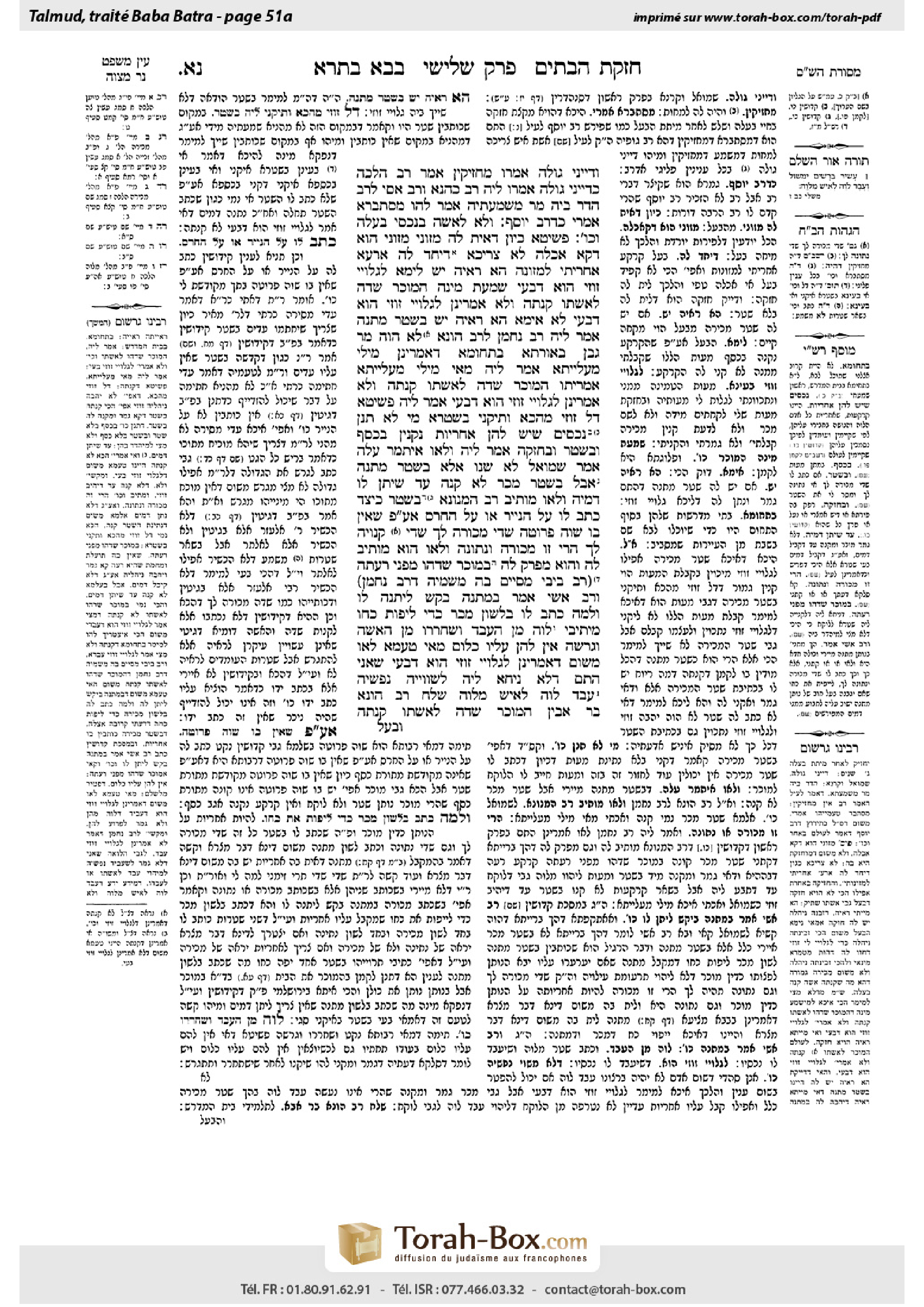
Bava Batra 51a: Talmud study for Daf Yomi
Study the Talmud for Daf Yomi with scanned pages, Hebrew text, English translations from Sefaria and AI-generated French translations.
Passage selection and English or AI-generated French translation are available where the scan has annotations. Daf Study is independent of Torah-Box and Sefaria.
Browse Bava Batra · בבא בתרא · All tractatesBava Batra 51a text and translations
This page of Bava Batra includes the Aramaic text, an English translation and an AI-generated French translation, alongside the scan above.
בבא בתרא נ״א א · Aramaic and Hebrew text
וְדַיָּינֵי גוֹלָה אָמְרוּ: מַחְזִיקִין. אָמַר רַב: הֲלָכָה כְּדַיָּינֵי גוֹלָה. אֲמַרוּ לֵיהּ רַב כָּהֲנָא וְרַב אַסִּי לְרַב: הֲדַר בֵּיהּ מָר מִשְּׁמַעְתֵּיהּ? אֲמַר לְהוּ: מִסְתַּבְּרָא אֲמַרִי – כִּדְרַב יוֹסֵף.
וְלֹא לְאִשָּׁה בְּנִכְסֵי בַעְלָהּ וְכוּ׳. פְּשִׁיטָא – כֵּיוָן דְּאִית לַהּ מְזוֹנֵי, מְזוֹנֵי הוּא דְּקָא אָכְלָה! לָא צְרִיכָא, דְּיַחֵד לַהּ אַרְעָא אַחֲרִיתִי לִמְזוֹנַהּ.
הָא רְאָיָה – יֵשׁ? לֵימָא לְגַלּוֹיֵי זוּזֵי הוּא דְּבָעֵי!
שָׁמְעַתְּ מִינַּהּ, הַמּוֹכֵר שָׂדֶה לְאִשְׁתּוֹ – קָנְתָה, וְלָא אָמְרִינַן: לְגַלּוֹיֵי זוּזֵי הוּא דְּבָעֵי?! לָא; אֵימָא: הָא רְאָיָה יֵשׁ – בִּשְׁטַר מַתָּנָה.
אֲמַר לֵיהּ רַב נַחְמָן לְרַב הוּנָא: לָא הֲוָה מָר גַּבָּן בְּאוּרְתָּא בִּתְחוּמָא, דְּאָמְרִינַן מִילֵּי מְעַלְּיָיתָא. אֲמַר לֵיהּ: מַאי מִילֵּי מְעַלְּיָיתָא אָמְרִיתוּ? הַמּוֹכֵר שָׂדֶה לְאִשְׁתּוֹ – קָנְתָה, וְלָא אָמְרִינַן לְגַלּוֹיֵי זוּזֵי הוּא דְּבָעֵי.
אֲמַר לֵיהּ: פְּשִׁיטָא, דַּל זוּזֵי מֵהָכָא – וְתִיקְנֵי בִּשְׁטָרָא! מִי לָא תְּנַן: נְכָסִים שֶׁיֵּשׁ לָהֶן אַחְרָיוּת נִקְנִין בְּכֶסֶף וּבִשְׁטָר וּבַחֲזָקָה?
אֲמַר לֵיהּ: וְלָאו אִיתְּמַר עֲלַהּ, אָמַר שְׁמוּאֵל: לֹא שָׁנוּ אֶלָּא בִּשְׁטַר מַתָּנָה, אֲבָל בִּשְׁטַר מֶכֶר – לֹא קָנָה עַד שֶׁיִּתֵּן לוֹ דָּמֶיהָ? וְלָאו מוֹתֵיב רַב הַמְנוּנָא: בִּשְׁטָר – כֵּיצַד? כָּתַב לוֹ עַל הַנְּיָיר אוֹ עַל הַחֶרֶס – אַף עַל פִּי שֶׁאֵין בּוֹ שָׁוֶה פְּרוּטָה: ״שָׂדִי מְכוּרָה לָךְ״, ״שָׂדִי קְנוּיָה לָךְ״ – הֲרֵי זוֹ מְכוּרָה וּנְתוּנָה?
וְלָאו הוּא מוֹתֵיב לַהּ וְהוּא מְפָרֵק לַהּ – בְּמוֹכֵר שָׂדֵהוּ מִפְּנֵי רָעָתָהּ?
(רַב בִּיבִי מְסַיֵּים בַּהּ מִשְּׁמֵיהּ דְּרַב נַחְמָן) וְרַב אָשֵׁי אָמַר: בְּמַתָּנָה בִּקֵּשׁ לִיתְּנָהּ לוֹ, וְלָמָּה כָּתַב לוֹ בִּלְשׁוֹן מֶכֶר? כְּדֵי לְיַפּוֹת כֹּחוֹ.
מֵיתִיבִי: לָוָה מִן הָעֶבֶד, וְשִׁחְרְרוֹ; מִן הָאִשָּׁה, וְגֵרְשָׁהּ – אֵין לָהֶן עָלָיו כְּלוּם. מַאי טַעְמָא? לָאו מִשּׁוּם דְּאָמְרִינַן: לְגַלּוֹיֵי זוּזֵי הוּא דְּבָעֵי?
שָׁאנֵי הָתָם, דְּלָא נִיחָא לֵיהּ לְשַׁוּוֹיֵיהּ נַפְשֵׁיהּ ״עֶבֶד לֹוֶה לְאִישׁ מַלְוֶה״.
שְׁלַח רַב הוּנָא בַּר אָבִין: הַמּוֹכֵר שָׂדֶה לְאִשְׁתּוֹ – קָנְתָה,
Bava Batra 51a · English translation
but the judges of the exile said that one can establish the presumption of ownership. Rav says: The halakha is in accordance with the opinion of the judges of the exile. Rav Kahana and Rav Asi said to Rav: Has the Master retracted his halakha that one cannot establish the presumption of ownership with regard to the property of a married woman? Rav said to them: I said that the opinion of the judges of the exile is reasonable, as the presumption of ownership can be established with regard the property of a married woman under certain circumstances. The Gemara comments: This is like that ruling of Rav Yosef with regard to one who possesses the land for three years after the death of the husband.
§ The mishna teaches: And a wife does not have the ability to establish the presumption of ownership with regard to her husband’s property. The Gemara asks: Isn’t that obvious? Since she has the right to sustenance from her husband’s property, she is enjoying the profits as payment of her sustenance, so her use of the property does not establish the presumption of ownership. The Gemara responds: No, it is necessary to state this halakha in the event that he designated another parcel of land for her sustenance. The mishna teaches that even if she enjoys the profits of a second field for three years, she does not establish the presumption of ownership of that field.
The Gemara asks: By inference, the wife has the ability to bring proof of her ownership and take possession of her husband’s field. Why is this proof valid? Let him say that he desires to expose her concealed money. If he offers to sell the field to her and she agrees, it will be discovered that she has money of which he had been unaware. His intention was never to sell the property, but to claim money to which he is entitled.
Can one conclude from this mishna that in the case of one who sells a field to his wife, she has acquired it, and we do not say that he desires to expose her concealed money? The Gemara answers: No, as one may say that the inference from the mishna that if she has proof then she has ownership rights is the halakha only with regard to a deed of gift, as, if her husband gave her the field as a gift, he cannot claim that he did so in order to expose her concealed money.
The Gemara relates: Rav Naḥman said to Rav Huna: The Master was not with us in the evening in the study hall that is within the boundaries of the town, where we said a superior matter. Rav Huna said to him: What superior matter did you say? Rav Naḥman responded: In the case of one who sells a field to his wife, she has acquired it, and we do not say that he desires to expose her concealed money.
Rav Huna said to him: That is obvious; remove the money from here and she will acquire the property by means of the bill of sale, as, even if she has not yet given him the money, she acquires the land by means of the bill of sale. Didn’t we learn in a mishna (Kiddushin 26a): Property that serves as a guarantee, i.e., land, can be acquired by means of giving money, by means of giving a document, or by means of taking possession of it?
Rav Naḥman said to him: But wasn’t it stated with regard to this that Shmuel says: They taught that the document alone suffices only if the transaction is with a deed of gift, but if the transaction is with a bill of sale, the buyer does not acquire the property until he gives him its money? Rav Huna responded: But didn’t Rav Hamnuna raise an objection to this, based on this following baraita: How is acquisition by means of giving a document performed? If he wrote it for him on paper or earthenware, then even though the paper or the earthenware is not worth even one peruta, if he writes: My field is sold to you, or: My field is acquired by you as a gift, it is thereby sold or given. This indicates that a document suffices to complete an acquisition both in the case of a sale and a gift.
Rav Naḥman responded: But is it not so that he, Rav Hamnuna, raises the objection and he himself resolves it? The baraita states its ruling with regard to one who sells his field due to its poor quality. The seller wants to be rid of his field due to its low value, and would like to transfer ownership of it as quickly as possible. In this case, writing a document suffices to complete the acquisition. By contrast, in standard cases it does not. Since the acquisition of a field requires monetary payment in addition to a bill of sale, Rav Naḥman’s statement, that if one sells a field to his wife the sale is valid and we do not say that he desires to expose her concealed money, is a novelty.
The Gemara notes that in interpreting this baraita, Rav Beivai would conclude in the name of Rav Naḥman, or, according to another version, Rav Ashi says: Why does a document suffice for him to acquire the land? It is because it is assumed that he wanted to give it to him as a gift. And why did he write the document for him employing the terminology of a sale? It was in order to enhance the power of the one acquiring the land, since with regard to a property guarantee, i.e., a document that states that if the property is seized by the seller’s creditor, the seller will reimburse the buyer for his loss, a bill of sale is superior to a deed of gift.
The Gemara raises an objection to the ruling of Rav Naḥman, that we do not say that he desires to expose her concealed money, from a baraita: If one borrowed money from his own slave and then frees him, or if one borrowed money from his wife and then divorces her, they do not have any claim on him, and he need not repay them. What is the reason for this? Is it not because we say that he desires to expose their concealed money, and his taking of the loan was a mere artifice to claim money to which he was entitled?
The Gemara answers: It is different there, because there is an additional reason to think it was an artifice, as it is uncomfortable for him to make applicable to himself the verse: “The rich rules over the poor, and the borrower is servant to the lender” (Proverbs 22:7). It is therefore reasonable to posit that his intention was not to borrow money, but to expose the concealed money that was in the possession of his slave or wife. This concern does not apply to one who sells property to his wife, and therefore the sale is valid.
The Gemara relates that Rav Huna bar Avin sent a ruling to those in the study hall: In the case of one who sells a field to his wife, she has acquired it,
Bava Batra 51a · Traduction française (IA)
mais les juges de l’exil dirent que l’on peut établir la présomption de propriété. Rav dit : La halakha suit l’opinion des juges de l’exil. Rav Kahana et Rav Asi dirent à Rav : Le Maître a-t-il rétracté sa halakha selon laquelle l’on ne peut établir la présomption de propriété concernant la propriété d’une femme mariée ? Rav répondit à eux : J’ai dit que l’opinion des juges de l’exil est raisonnable, car la présomption de propriété peut être établie concernant la propriété d’une femme mariée sous certaines conditions. La Guemara commente : C’est comme la décision de Rav Yosef concernant celui qui possède la terre pendant trois ans après la mort de son époux.
§ La mitsva enseigne : Une femme ne peut pas établir la présomption de propriété concernant la propriété de son époux. La Guemara demande : N’est-ce pas évident ? Puisqu’elle a le droit à la subsistance provenant de la propriété de son époux, elle profite des profits comme paiement de sa subsistance, donc son utilisation de la propriété ne permet pas d’établir la présomption de propriété. La Guemara répond : Non, il est nécessaire d’énoncer cette halakha dans le cas où il a désigné une autre parcelle de terre pour sa subsistance. La mitsva enseigne que même si elle profite des profits d’un second champ pendant trois ans, elle ne peut pas établir la présomption de propriété de ce champ.
La Guemara demande : Par déduction, la femme a la capacité de présenter une preuve de sa propriété et d’acquérir le champ de son époux. Pourquoi cette preuve est-elle valable ? Lui dit qu’il désire découvrir l’argent caché de la femme. S’il propose de vendre le champ à elle et qu’elle accepte, on découvrira qu’elle possède de l’argent dont il n’était pas conscient. Son intention n’était pas de vendre la propriété, mais de revendiquer de l’argent auquel il avait droit.
Peut-on conclure de cette mitsna que dans le cas d’un homme qui vend un champ à sa femme, elle l’a acquis, et nous ne disons pas qu’il désire découvrir son argent caché ? La Guemara répond : Non, car on peut dire que la déduction tirée de la mitsna selon laquelle si elle a une preuve alors elle a des droits de propriété est valable uniquement concernant un don, car, si son époux lui a donné le champ en don, il ne peut pas affirmer qu’il l’a fait pour découvrir son argent caché.
La Guemara rapporte : Rav Naḥman dit à Rav Huna : Le Maître n’était pas avec nous dans la salle de étude située dans les limites de la ville, où nous avons dit une affaire supérieure. Rav Huna dit à lui : Quelle affaire supérieure avez-vous dit ? Rav Naḥman répondit : Dans le cas d’un homme qui vend un champ à sa femme, elle l’a acquis, et nous ne disons pas qu’il désire découvrir son argent caché.
Rav Huna dit à lui : C’est évident ; retirez l’argent d’ici et elle acquerra la propriété par le contrat de vente, car même si elle n’a pas encore donné l’argent, elle acquiert la terre par le contrat de vente. N’avons-nous pas appris dans une mitsna (Kiddushin 26a) : La propriété qui sert de garantie, c’est-à-dire la terre, peut être acquise par le paiement d’argent, par un document, ou par la possession ?
Rav Naḥman dit à lui : Mais n’a-t-il pas été dit à propos de cela que Shmuel dit : Ils apprirent que le document seul suffit uniquement si la transaction est un don, mais si la transaction est un contrat de vente, l’acheteur ne possède la propriété qu’après avoir versé l’argent ? Rav Huna répondit : Mais n’a-t-il pas été contesté par Rav Hamnuna, sur la base de la baraïta suivante : Comment l’acquisition par le document est-elle accomplie ? S’il l’a écrit sur du papier ou de la terre, même si le papier ou la terre ne vaut pas même un peruta, s’il écrit : Mon champ est vendu à vous, ou : Mon champ est acquis par vous en don, il est ainsi vendu ou donné. Cela indique que le document suffit à accomplir l’acquisition à la fois dans le cas d’une vente et d’un don.
Rav Naḥman répondit : Mais n’est-ce pas ainsi que Rav Hamnuna soulève l’objection et qu’il résout lui-même ? La baraïta énonce sa décision concernant celui qui vend son champ en raison de sa mauvaise qualité. Le vendeur veut se débarrasser de son champ en raison de sa faible valeur et souhaite transférer la propriété aussi rapidement que possible. Dans ce cas, écrire un document suffit à accomplir l’acquisition. À l’inverse, dans les cas normaux, cela ne suffit pas. Puisque l’acquisition d’un champ nécessite un paiement monétaire en plus du contrat de vente, la déclaration de Rav Naḥman, selon laquelle si l’on vend un champ à sa femme la vente est valide et nous ne disons pas qu’il désire découvrir son argent caché, est une nouveauté.
La Guemara souligne que dans l'interprétation de cette baraïta, Rav Beivai conclurait au nom de Rav Naḥman, ou, selon une autre version, Rav Ashi dit : Pourquoi un document suffit-il à lui permettre d'acquérir la terre ? C'est parce qu'on suppose qu'il voulait le lui donner en don. Et pourquoi a-t-il écrit le document en utilisant le terme de vente ? C'était pour renforcer le pouvoir de celui qui acquiert la terre, car concernant une propriété garantie, c'est-à-dire un document stipulant que si la propriété est saisie par le créancier du vendeur, le vendeur remboursera la perte à l'acheteur, un contrat de vente est supérieur à un don.
La Guemara soulève une objection contre la décision de Rav Naḥman, selon laquelle nous ne disons pas qu'il désire découvrir l'argent caché de l'autre, à partir d'une baraïta : Si l'on emprunte de l'argent à son propre serviteur et puis le libère, ou si l'on emprunte de l'argent à sa femme et puis la divorce, ils n'ont aucun droit sur lui, et il n'a pas besoin de les rembourser. Quelle est la raison de cela ? N'est-ce pas parce qu'on dit qu'il désire découvrir leur argent caché, et son emprunt était une ruse pour revendiquer de l'argent auquel il avait droit ?
La Guemara répond : C’est différent là, car il y a une raison supplémentaire pour penser qu’il s’agissait d’un artifice, à savoir que cela lui est inconfortable d’appliquer à lui-même la parole : « Le riche domine le pauvre, et le prêteur est esclave du créancier » (Proverbes 22:7). Il est donc raisonnable de penser que son intention n’était pas de prêter de l’argent, mais d’exposer l’argent caché qui était en possession de son esclave ou de sa femme. Cette préoccupation ne s’applique pas à celui qui vend une propriété à sa femme, et par conséquent la vente est valide.
La Guemara rapporte que Rav Huna bar Avin a envoyé un avis à ceux qui étudient : Dans le cas d’un homme qui vend un champ à sa femme, elle l’a acquis,
Traduction française générée par IA à partir de l’édition anglaise de Sefaria. Vérifie toujours un passage avec le texte source.
Text from Sefaria: William Davidson Edition - Vocalized Aramaic (CC BY NC); William Davidson Edition - English (CC BY NC).