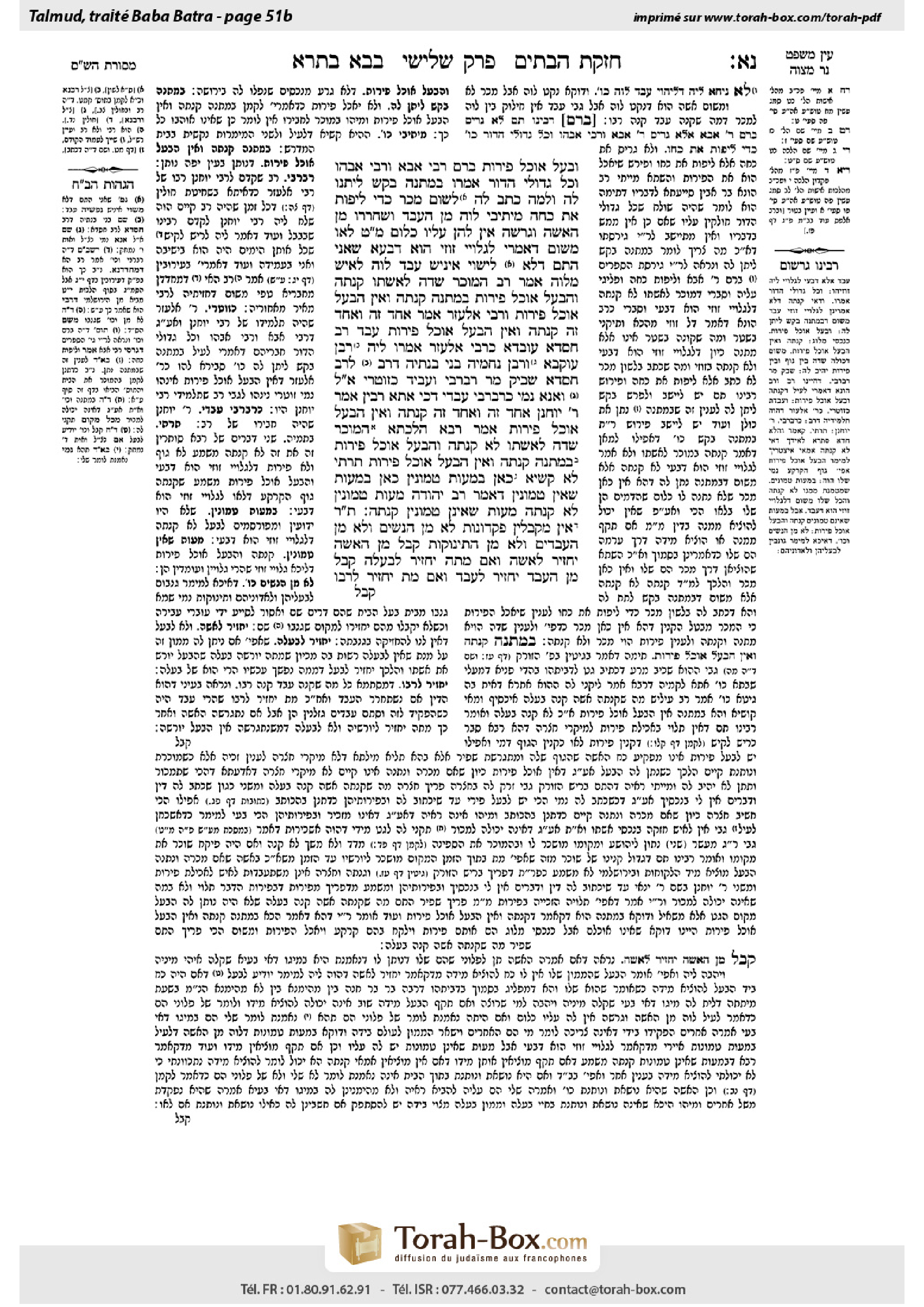
Bava Batra 51b: Talmud study for Daf Yomi
Study the Talmud for Daf Yomi with scanned pages, Hebrew text, English translations from Sefaria and AI-generated French translations.
Passage selection and English or AI-generated French translation are available where the scan has annotations. Daf Study is independent of Torah-Box and Sefaria.
Browse Bava Batra · בבא בתרא · All tractatesBava Batra 51b text and translations
This page of Bava Batra includes the Aramaic text, an English translation and an AI-generated French translation, alongside the scan above.
בבא בתרא נ״א ב · Aramaic and Hebrew text
וּבַעַל אוֹכֵל פֵּירוֹת. בְּרַם, רַבִּי אַבָּא וְרַבִּי אֲבָהוּ וְכׇל גְּדוֹלֵי הַדּוֹר אָמְרוּ: בְּמַתָּנָה בִּקֵּשׁ לִיתְּנוֹ לָהּ, וְלָמָּה כָּתַב לָהּ לְשׁוּם מֶכֶר? כְּדֵי לְיַפּוֹת אֶת כֹּחָהּ.
מֵיתִיבִי: לָוָה מִן הָעֶבֶד וְשִׁחְרְרוֹ, מִן הָאִשָּׁה וְגֵרְשָׁהּ – אֵין לָהֶן עָלָיו כְּלוּם. מַאי טַעְמָא? לָאו מִשּׁוּם דְּאָמְרִי: לְגַלּוֹיֵי זוּזֵי הוּא דִּבְעָא?
שָׁאנֵי הָתָם, דְּלָא לִישַׁוֵּי אִינִישׁ ״עֶבֶד לֹוֶה לְאִישׁ מַלְוֶה״.
אָמַר רַב: הַמּוֹכֵר שָׂדֶה לְאִשְׁתּוֹ – קָנְתָה, וְהַבַּעַל אוֹכֵל פֵּירוֹת. בְּמַתָּנָה – קָנְתָה, וְאֵין הַבַּעַל אוֹכֵל פֵּירוֹת. וְרַבִּי אֶלְעָזָר אָמַר: אֶחָד זֶה וְאֶחָד זֶה – קָנְתָה, וְאֵין הַבַּעַל אוֹכֵל פֵּירוֹת.
עֲבַד רַב חִסְדָּא עוֹבָדָא כְּרַבִּי אֶלְעָזָר. אֲמַרוּ לֵיהּ רַבָּן עוּקְבָא וְרַבָּן נְחֶמְיָה בְּנֵי בְנָתֵיהּ דְּרַב, לְרַב חִסְדָּא: שָׁבֵיק מָר רַבְרְבֵי, וְעָבֵיד כְּזוּטְרֵי?! אֲמַר לְהוּ: וַאֲנָא נָמֵי כְּרַבְרְבֵי עֲבַדִי, דְּכִי אֲתָא רָבִין אָמַר רַבִּי יוֹחָנָן: אֶחָד זֶה וְאֶחָד זֶה – קָנְתָה, וְאֵין הַבַּעַל אוֹכֵל פֵּירוֹת.
אָמַר רָבָא, הִלְכְתָא: הַמּוֹכֵר שָׂדֶה לְאִשְׁתּוֹ – לֹא קָנְתָה, וְהַבַּעַל אוֹכֵל פֵּירוֹת. בְּמַתָּנָה – קָנְתָה, וְאֵין הַבַּעַל אוֹכֵל פֵּירוֹת. תַּרְתֵּי?!
לָא קַשְׁיָא; כָּאן בְּמָעוֹת טְמוּנִין, כָּאן בְּמָעוֹת שֶׁאֵין טְמוּנִין – דְּאָמַר רַב יְהוּדָה: מָעוֹת טְמוּנִין – לֹא קָנְתָה, מָעוֹת שֶׁאֵינָן טְמוּנִין – קָנְתָה.
תָּנוּ רַבָּנַן: אֵין מְקַבְּלִין פִּקְדוֹנוֹת – לֹא מִן הַנָּשִׁים, וְלֹא מִן הָעֲבָדִים, וְלֹא מִן הַתִּינוֹקוֹת. קִבֵּל מִן הָאִשָּׁה – יַחְזִיר לָאִשָּׁה, וְאִם מֵתָה – יַחְזִיר לְבַעְלָהּ. קִבֵּל מִן הָעֶבֶד – יַחְזִיר לָעֶבֶד, וְאִם מֵת – יַחְזִיר לְרַבּוֹ.
Bava Batra 51b · English translation
and as long as they remain married, the husband enjoys the profits, as he would with any usufruct property. But Rabbi Abba and Rabbi Abbahu and all of the great Sages of the generation said that the assumption is that the husband wanted to give it to her as a gift. And why did he write the deed for her employing terminology indicating that it is for the sake of a sale? It was in order to enhance her power.
The Gemara raises an objection from a baraita to the ruling that the wife acquires the property: If one borrowed from his own slave and then freed him, or if one borrowed from his wife and then divorced her, they do not have any claim on him, and he need not repay them. What is the reason for this? Is it not because we say that he desired to expose their concealed money, and his taking of the loan was merely an artifice to claim money to which he was entitled? Similarly, the assumption should be that his sale to her was merely an artifice.
The Gemara answers: It is different there, because there is an additional reason to think it was an artifice, as it is uncomfortable for a person to be described by the verse: “The rich rules over the poor, and the borrower is servant to the lender” (Proverbs 22:7). It is therefore reasonable to posit that his intention was not to borrow money, but to expose the concealed money that was in the possession of his slave or wife. This concern does not apply to one who sells property to his wife, and therefore the sale is valid.
The Gemara quotes a related statement. Rav says: In the case of one who sells a field to his wife, she has acquired it, and the husband enjoys the profits. In the case of one who gives a married woman the field as a gift, she has acquired it and the husband does not enjoy the profits, since he gave it to her completely. And Rabbi Elazar says: In both this case and that case she has acquired it, and the husband does not enjoy the profits.
The Gemara relates: Rav Ḥisda performed an action in accordance with the opinion of Rabbi Elazar, and did not allow a husband to enjoy the profits of a field he sold to his wife. Rabban Ukva and Rabban Neḥemya, the sons of Rav’s daughters, said to Rav Ḥisda: Does the Master abandon a greater Sage, i.e., Rav, the greatest Sage of his generation, and act in accordance with the opinion of a lesser Sage, i.e., Rabbi Elazar, who was Rav’s student? Rav Ḥisda said to them: But I too am acting in accordance with the opinion of a greater Sage, as when Ravin came from Eretz Yisrael, he said that Rabbi Yoḥanan said: In both this case and that case she has acquired it, and the husband does not enjoy the profits. I am consequently not relying exclusively on Rabbi Elazar’s opinion, but also on that of Rabbi Yoḥanan.
Rava says that the halakha is: In the case of one who sells a field to his wife, she has not acquired it, and the husband enjoys the profits. In the case of one who gives a married woman the field as a gift, she has acquired it and the husband does not enjoy the profits. The Gemara asks with regard to the first halakha: Can these two ostensibly contradictory rulings be given? Rava’s statement that the wife has not acquired the field means that the husband still owns it, while his statement that the husband enjoys the profits, i.e., he merely enjoys the profits but does not own the field, indicates that the field itself is owned by the wife.
The Gemara responds: This is not difficult, because Rava is referring to two different cases. Here, where he says that she has not acquired the land, he is referring to a case where her money was concealed, and the sale was an artifice to expose it; while there, where he says that she acquires the land, he is referring to a case where she had money that is not concealed. As Rav Yehuda says: If she purchased the field with concealed money, she has not acquired it; if she purchased it with money that is not concealed, she has acquired it.
§ The Sages taught in a baraita: One may not accept deposits from women, and not from slaves, and not from children. Since it is likely that they do not own property, they might have taken the item without authorization from their husband, master, or parent, respectively. Consequently, one should not accept the deposit. If, however, one accepted a deposit from a woman, he must return it to the woman, as he cannot be certain that it is not hers. And if the woman died, he must return it to her husband, as he is her heir. If one accepted a deposit from a slave, he must return it to the slave, since it might not belong to the master. And if the slave died, he must return it to his master.
Bava Batra 51b · Traduction française (IA)
et tant que les époux restent mariés, le mari profite des revenus, comme s'il s'agissait d'une propriété en usufruit. Mais Rabbi Abba et Rabbi Abbahu et tous les grands Sages de la génération ont dit que l'hypothèse est que le mari voulait lui offrir la chose en cadeau. Et pourquoi a-t-il rédigé le contrat en utilisant des termes indiquant qu'il s'agit d'une vente ? C'était afin de renforcer son pouvoir.
La Guemara soulève une objection contre la décision selon laquelle la femme acquiert la propriété : Si l'on emprunte à son propre serviteur et puis on le libère, ou si l'on emprunte à sa femme et puis on la divorce, ils n'ont aucun droit sur lui, et il n'a pas besoin de les rembourser. Quelle est la raison de cela ? N'est-ce pas parce que nous disons qu'il voulait exposer leur argent caché, et que son emprunt était simplement une ruse pour revendiquer de l'argent à son titre ? De même, l'hypothèse devrait être que sa vente à elle était simplement une ruse.
La Guemara répond : C'est différent là, car il y a une raison supplémentaire pour penser qu'il s'agissait d'une ruse, car il est inconfortable pour une personne d'être décrit par la parole : « Le riche domine le pauvre, et le prêteur est le serviteur du créancier » (Proverbes 22:7). Il est donc raisonnable de penser que son intention n'était pas d'emprunter de l'argent, mais d'exposer l'argent caché qui était en possession de son serviteur ou de sa femme. Cette préoccupation ne s'applique pas à celui qui vend une propriété à sa femme, et par conséquent la vente est valide.
La Guemara cite une déclaration liée. Rav dit : Dans le cas d'une personne qui vend un champ à sa femme, elle l'a acquis, et le mari profite des revenus. Dans le cas d'une personne qui donne un champ à une femme mariée en cadeau, elle l'a acquis et le mari ne profite pas des revenus, car il lui a donné le champ entièrement. Et Rabbi Elazar dit : Dans les deux cas, elle l'a acquis, et le mari ne profite pas des revenus.
La Guemara rapporte : Rav Ḥisda a accompli une action conformément à l'opinion de Rabbi Elazar, et n'a pas permis au mari de profiter des revenus d'un champ qu'il avait vendu à sa femme. Rabban Ukva et Rabban Neḥemya, les fils des filles de Rav, ont dit à Rav Ḥisda : Le Maître abandonne-t-il un Sage plus grand, c'est-à-dire Rav, le plus grand Sage de sa génération, et agit-il selon l'opinion d'un Sage moindre, c'est-à-dire Rabbi Elazar, qui était son élève ? Rav Ḥisda a dit à eux : Mais je fais aussi selon l'opinion d'un Sage plus grand, car lorsque Rabin est venu d'Israël, il a dit que Rabbi Yoḥanan a dit : Dans les deux cas, elle l'a acquis, et le mari ne profite pas des revenus. Je ne me base donc pas uniquement sur l'opinion de Rabbi Elazar, mais aussi sur celle de Rabbi Yoḥanan.
Rava dit que la halakha est : Dans le cas d'une personne qui vend un champ à sa femme, elle ne l'a pas acquis, et le mari profite des revenus. Dans le cas d'une personne qui donne un champ à une femme mariée en cadeau, elle l'a acquis et le mari ne profite pas des revenus. La Guemara pose une question concernant la première halakha : Ces deux décisions apparemment contradictoires peuvent-elles être données ? La déclaration de Rava selon laquelle la femme n'a pas acquis le champ signifie que le mari le possède encore, tandis que sa déclaration selon laquelle le mari profite des revenus, c'est-à-dire qu'il profite des revenus mais ne possède pas le champ, indique que le champ lui-même est possédé par la femme.
La Guemara répond : Ce n'est pas difficile, car Rava fait référence à deux cas différents. Ici, où il dit qu'elle n'a pas acquis la terre, il fait référence à un cas où son argent était caché, et la vente était une ruse pour l'exposer ; tandis que là, où il dit qu'elle acquiert la terre, il fait référence à un cas où elle avait de l'argent qui n'était pas caché. Comme Rav Yehuda dit : Si elle a acheté la terre avec de l'argent caché, elle n'a pas acquis la terre ; si elle l'a achetée avec de l'argent qui n'est pas caché, elle l'a acquise.
§ Les Sages ont enseigné dans une baraïta : On ne peut pas accepter des dépôts de femmes, ni de serviteurs, ni d'enfants. Car il est probable qu'ils n'aient pas de propriété, et ils pourraient avoir pris l'objet sans autorisation de leur mari, de leur maître ou de leur père, respectivement. Il convient donc de ne pas accepter le dépôt. Cependant, si l'on a accepté un dépôt d'une femme, il faut le rendre à la femme, car on ne peut pas être certain qu'il ne soit pas sien. Et si la femme est décédée, il faut le rendre à son mari, car il est son héritier. Si l'on a accepté un dépôt d'un serviteur, il faut le rendre au serviteur, car il pourrait ne pas appartenir à son maître. Et si le serviteur est décédé, il faut le rendre à son maître.
Traduction française générée par IA à partir de l’édition anglaise de Sefaria. Vérifie toujours un passage avec le texte source.
Text from Sefaria: William Davidson Edition - Vocalized Aramaic (CC BY NC); William Davidson Edition - English (CC BY NC).