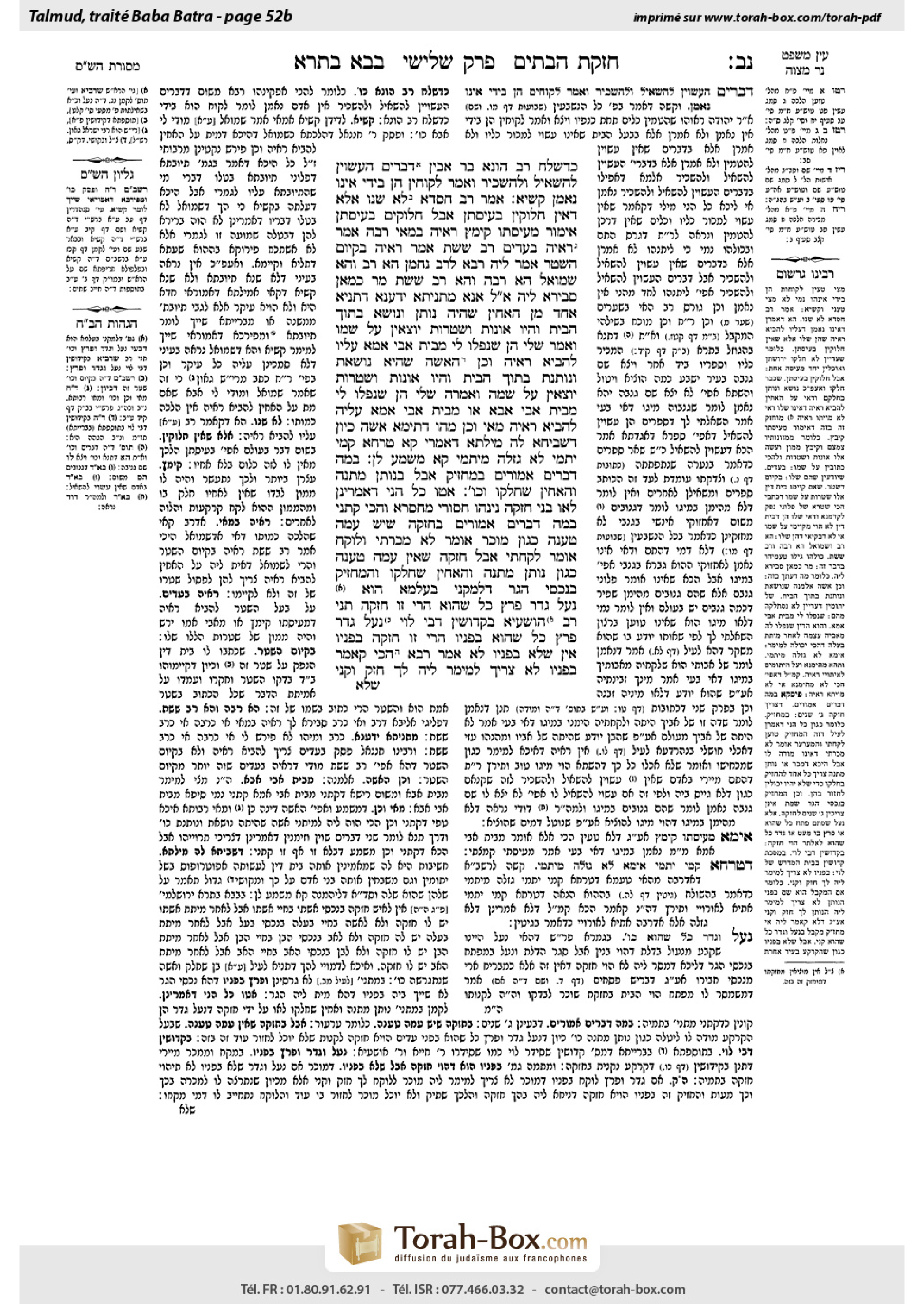
Bava Batra 52b: Talmud study for Daf Yomi
Study the Talmud for Daf Yomi with scanned pages, Hebrew text, English translations from Sefaria and AI-generated French translations.
Passage selection and English or AI-generated French translation are available where the scan has annotations. Daf Study is independent of Torah-Box and Sefaria.
Browse Bava Batra · בבא בתרא · All tractatesBava Batra 52b text and translations
This page of Bava Batra includes the Aramaic text, an English translation and an AI-generated French translation, alongside the scan above.
בבא בתרא נ״ב ב · Aramaic and Hebrew text
כְּדִשְׁלַח רַב הוּנָא בַּר אָבִין: דְּבָרִים הָעֲשׂוּיִן לְהַשְׁאִיל וּלְהַשְׂכִּיר, וְאָמַר ״לְקוּחִין הֵן בְּיָדִי״, אֵינוֹ נֶאֱמָן! קַשְׁיָא.
אָמַר רַב חִסְדָּא: לֹא שָׁנוּ אֶלָּא דְּאֵין חֲלוּקִין בְּעִיסָּתָן, אֲבָל חֲלוּקִים בְּעִיסָּתָן – אֵימוֹר מֵעִיסָּתוֹ קִימֵּץ.
רְאָיָה בְּמַאי? רַבָּה אָמַר: רְאָיָה בְּעֵדִים, רַב שֵׁשֶׁת אָמַר: רְאָיָה בְּקִיּוּם הַשְּׁטָר.
אֲמַר לֵיהּ רָבָא לְרַב נַחְמָן: הָא רַב וְהָא שְׁמוּאֵל, הָא רַבָּה וְהָא רַב שֵׁשֶׁת; מָר –, כְּמַאן סְבִירָא לֵיהּ? אֲמַר לֵיהּ: אֲנָא מַתְנִיתָא יָדַעְנָא, דְּתַנְיָא: אֶחָד מִן הָאַחִין שֶׁהָיָה נוֹתֵן וְנוֹשֵׂא בְּתוֹךְ הַבַּיִת, וְהָיוּ אוֹנוֹת וּשְׁטָרוֹת יוֹצְאִין עַל שְׁמוֹ, וְאָמַר: שֶׁלִּי הֵן, שֶׁנָּפְלוּ לִי מִבֵּית אֲבִי אִמָּא – עָלָיו לְהָבִיא רְאָיָה.
וְכֵן הָאִשָּׁה שֶׁהִיא נוֹשֵׂאת וְנוֹתֶנֶת בְּתוֹךְ הַבַּיִת, וְהָיוּ אוֹנוֹת וּשְׁטָרוֹת יוֹצְאִין עַל שְׁמָהּ, וְאָמְרָה: שֶׁלִּי הֵן, שֶׁנָּפְלוּ לִי מִבֵּית אֲבִי אַבָּא אוֹ מִבֵּית אֲבִי אִמָּא – עָלֶיהָ לְהָבִיא רְאָיָה.
מַאי ״וְכֵן״? מַהוּ דְּתֵימָא: אִשָּׁה, כֵּיוָן דִּשְׁבִיחָא לַהּ מִילְּתָא – דְּאָמְרִי קָא טָרְחָא קַמֵּי יַתְמֵי, לָא גָּזְלָה מִיַּתְמֵי; קָא מַשְׁמַע לַן:.
בַּמֶּה דְּבָרִים אֲמוּרִים – בְּמַחְזִיק, אֲבָל בְּנוֹתֵן מַתָּנָה וְהָאַחִין שֶׁחָלְקוּ וְכוּ׳. אַטּוּ כֹּל הָנֵי דְּאָמְרִינַן, לָאו בְּנֵי חֲזָקָה נִינְהוּ?
חַסּוֹרֵי מְחַסְּרָא, וְהָכִי קָתָנֵי: בַּמֶּה דְּבָרִים אֲמוּרִים – בַּחֲזָקָה שֶׁיֵּשׁ עִמָּהּ טַעֲנָה, כְּגוֹן מוֹכֵר אוֹמֵר: ״לֹא מָכַרְתִּי״, וְלוֹקֵחַ אוֹמֵר: ״לָקַחְתִּי״;
אֲבָל חֲזָקָה שֶׁאֵין עִמָּהּ טַעֲנָה – כְּגוֹן נוֹתֵן מַתָּנָה, וְהָאַחִין שֶׁחָלְקוּ, וְהַמַּחְזִיק בְּנִכְסֵי הַגֵּר – דִּלְמִקְנֵי בְּעָלְמָא הוּא; נָעַל, גָּדַר, פָּרַץ כׇּל שֶׁהוּא – הֲרֵי זוֹ חֲזָקָה.
תָּנֵי רַב הוֹשַׁעְיָא בְּקִדּוּשִׁין דְּבֵי לֵוִי: נָעַל, גָּדַר, פָּרַץ כׇּל שֶׁהוּא בְּפָנָיו – הֲרֵי זוֹ חֲזָקָה. בְּפָנָיו – אִין, שֶׁלֹּא בְּפָנָיו – לָא? אָמַר רָבָא, הָכִי קָאָמַר: בְּפָנָיו – לָא צְרִיךְ לְמֵימַר לֵיהּ: ״לֵךְ חֲזֵק וּקְנִי״,
Bava Batra 52b · English translation
As Rav Huna bar Avin sent a ruling: If one other than the one previously established to be the owner is in possession of items that are typically lent or rented, and says: They are purchased, and that is why they are in my possession, he is not deemed credible. In this case as well, as the father of the orphans could not be awarded these documents without bringing proof, the same should be true of his orphans. Why, then, would Rav concede to Shmuel? The Gemara concedes: This is difficult.
Rav Ḥisda says: They, i.e., Rav, taught his ruling, that the brother must bring proof that he owns the property listed in the documents that appear under his name, only when they do not divide any of their property, even with regard to their dough, i.e., they share everything, even their food. But if they divide with regard to their dough, say that this brother removed money from his dough, i.e., reduced his expenses for food, thereby amassing his own property.
With regard to the requirement that proof be brought, the Gemara asks: With what is one considered to have brought proof? Rabba says: Proof is brought with the testimony of witnesses that he purchased the property listed in the document or granted the loan with his own money or that he inherited it from his mother’s family. Rav Sheshet says: Proof is brought with the court’s ratification of the document in which his name appears.
Rava said to Rav Naḥman: This is the opinion of Rav and this is the opinion of Shmuel; this is the opinion of Rabba and this is the opinion of Rav Sheshet. In accordance with whose opinion does the Master hold? Rav Naḥman said to him: I know a baraita, which is the source of my opinion, as it is taught (Tosefta 9:2): In a case where there was one of the brothers who was engaging in commerce in the house, managing the family finances, and there were bills of sale and other documents circulating with his name appearing as the owner of the property or as a lender, and that brother said: The money and property are mine, as they fell to me as an inheritance from the house of the father of my mother, who is not the mother of the other brothers, it is upon him to bring proof of ownership.
The baraita continues: And similarly, in the case of a woman, i.e., a widow, if her husband’s heirs see that she is engaging in commerce in the house with the property that had belonged to her husband, and there were bills of sale and other documents circulating with her name appearing on them as the owner, and she said: The money and property are mine alone, as they fell to me as an inheritance from the house of the father of my father or from the house of the father of my mother, and did not belong to my husband, it is upon her to bring proof. Rav Naḥman consequently holds in accordance with the opinion of Rav.
Having quoted the baraita, the Gemara seeks to clarify it, and asks: What is the purpose of the clause of the baraita that begins: And similarly, where the halakha appears to be identical to that of the first clause? Lest you say that in the case of the woman, since the matter is laudable for her, in that people say: She is toiling on behalf of orphans; she would not steal from the orphans, and is therefore deemed credible if she says that the property in the documents that bear her name is her own, the baraita teaches us that this assumption cannot be relied upon, and she must bring proof of ownership.
§ The mishna teaches: In what case is this statement, that one establishes the presumption of ownership after profiting from the property for a certain duration, said? It is said in a case of one who has mere possession of the property, which does in some cases serve as proof of ownership. But in a case of one who gives a gift, or brothers who divided their inheritance, or one who takes possession of the property of a convert who died without heirs and his property is now ownerless, as soon as one locked the door of the property, or fenced it or breached its fence even a bit, this is considered taking possession of the property, and effects acquisition. The Gemara asks: Is that to say that all of these whom we previously said possessed the field for three years are not subject to the halakhot of taking possession of property in this manner?
The Gemara responds that the mishna is incomplete and this is what it is teaching: In what case is this statement said? It is said with regard to possession that is accompanied by a claim, i.e., when the possessor has a claim to counter that of the claimant, such as where the seller, i.e., the claimant, says: I did not sell, and the buyer, i.e., the possessor, says: I purchased. In that case, working and profiting from the land for three years establishes the presumption of ownership.
But with regard to possession that does not need to be accompanied by a claim, as the prior owner concedes that the one in possession is the owner, such as a case where another person gives one a gift, or there are brothers who divided their property, or there is one who takes possession of the property of a convert who died without heirs, where the function of possessing the item is only to acquire it and not to establish the presumption of ownership, if one locked the door of the property, or fenced it or breached its fence even a bit, this is considered taking possession of the property.
Rav Hoshaya teaches in the baraita of tractate Kiddushin that was taught in the school of Levi: If one locked the door of the property, or fenced it or breached its fence even a bit, if this was done in the presence of the seller, this is considered taking possession of the property. The Gemara asks: One could infer that in his presence, yes, he acquires it; but not in his presence, no, he does not acquire it. Why not? In any event he has taken possession. Rava said that this is what Rav Hoshaya is saying: If the act was performed in the seller’s presence, the seller need not say to him: Go, take possession, and thereby acquire the property. Since the buyer is performing the act in the seller’s presence, there is no need for the seller to specify that he consents to the buyer’s acquiring it.
Bava Batra 52b · Traduction française (IA)
Comme Rav Huna bar Avin a envoyé un avis : Si une personne autre que celle qui avait été établie comme propriétaire possède des objets qui sont normalement prêtés ou loués, et dit : Ils sont achetés, et c'est pourquoi ils sont en mon possession, il n'est pas considéré comme crédible. Dans ce cas également, comme le père des orphelins ne pouvait pas être récompensé pour ces documents sans apporter de preuve, les orphelins devraient avoir la même situation. Pourquoi, alors, Rav accepte-t-il la position de Shmuel ? La Guemara répond : Cela est difficile.
Rav Ḥisda dit : Ils, c'est-à-dire Rav, ont enseigné sa décision, que le frère doit apporter la preuve qu'il possède la propriété mentionnée dans les documents qui portent son nom, uniquement lorsqu'ils ne divisent aucune de leurs propriétés, même concernant leur farine, c'est-à-dire qu'ils partagent tout, même leur nourriture. Mais si ils divisent concernant leur farine, disons que ce frère a retiré de l'argent de sa farine, c'est-à-dire a réduit ses dépenses alimentaires, accumulant ainsi sa propre propriété.
Concernant la nécessité d'apporter la preuve, la Guemara pose la question : Avec quoi est-on considéré comme avoir apporté la preuve ? Rabba dit : La preuve est apportée par le témoignage de témoins qui affirment qu'il a acheté la propriété mentionnée dans le document ou qu'il a prêté cet argent avec ses propres deniers ou qu'il l'a hérité de sa famille maternelle. Rav Sheshet dit : La preuve est apportée par l'approbation du tribunal du document dans lequel son nom apparaît.
Rava a dit à Rav Naḥman : C'est l'opinion de Rav et c'est l'opinion de Shmuel ; c'est l'opinion de Rabba et c'est l'opinion de Rav Sheshet. Selon l'opinion de qui le Maître est-il ? Rav Naḥman a dit à lui : Je connais un baraïta, qui est la source de mon opinion, comme il est enseigné (Tosefta 9:2) : Dans un cas où l'un des frères était engagé dans un commerce dans la maison, gérant les finances familiales, et où des actes de vente et d'autres documents circulaient avec son nom apparaissant comme propriétaire de la propriété ou comme prêteur, et ce frère disait : L'argent et la propriété sont à moi, car ils m'ont été transmis comme héritage de la maison du père de ma mère, qui n'est pas la mère des autres frères, il lui incombe d'apporter la preuve de propriété.
Le baraïta continue : Et de même, dans le cas d'une femme, c'est-à-dire une veuve, si ses héritiers du mari constatent qu'elle est engagée dans un commerce dans la maison avec la propriété qui appartenait à son mari, et où des actes de vente et d'autres documents circulaient avec son nom apparaissant sur eux comme propriétaire, et elle disait : L'argent et la propriété sont à moi seul, car ils m'ont été transmis comme héritage de la maison du père de mon père ou de la maison du père de ma mère, et n'appartenait pas à mon mari, il lui incombe d'apporter la preuve. Rav Naḥman en conclut donc qu'il suit l'opinion de Rav.
Ayant cité le baraïta, la Guemara cherche à clarifier ce dernier et pose la question : Quel est le but de la clause du baraïta qui commence par : Et de même, où la halakha semble être identique à celle du premier cas ? Pour éviter que l'on dise que dans le cas de la femme, puisque la situation est louable pour elle, car les gens disent : Elle travaille pour les orphelins ; elle ne volerait pas les orphelins, et est donc considérée comme crédible si elle affirme que la propriété des documents portant son nom est la sienne, le baraïta nous apprend que cette hypothèse ne peut pas être retenue, et elle doit apporter la preuve de propriété.
§ La Michna enseigne : Dans quel cas cette déclaration, que l'on établit la présomption de propriété après avoir profité de la propriété pendant une certaine durée, est-elle dite ? Elle est dite dans un cas où l'on a simplement la possession de la propriété, qui, dans certains cas, sert de preuve de propriété. Mais dans un cas où l'on fait un don, ou des frères qui divisent leur héritage, ou l'un qui prend possession de la propriété d'un converti décédé sans héritiers et dont la propriété est désormais sans propriétaire, dès qu'on a verrouillé la porte de la propriété, ou entouré la propriété ou percé son mur même un peu, cela est considéré comme prendre possession de la propriété, et cela constitue un acte d'acquisition. La Guemara pose la question : Est-ce que cela signifie que tous ceux que nous avions dit posséder le champ pendant trois ans ne sont pas soumis aux halakhot de la prise de possession de la propriété de cette manière ?
La Guemara répond que la Michna est incomplète et c'est ce qu'elle enseigne : Dans quel cas cette déclaration est-elle dite ? Elle est dite concernant une possession accompagnée d'une revendication, c'est-à-dire lorsque le possesseur a une revendication contre celle du réclamant, comme dans le cas où le vendeur, c'est-à-dire le réclamant, dit : Je n'ai pas vendu, et l'acheteur, c'est-à-dire le possesseur, dit : J'ai acheté. Dans ce cas, travailler et profiter du terrain pendant trois ans établit la présomption de propriété.
Mais concernant une possession qui n'a pas besoin d'être accompagnée d'une revendication, comme le propriétaire précédent reconnaît que celui en possession est le propriétaire, tel que dans le cas où une autre personne donne un cadeau, ou des frères qui divisent leur propriété, ou l'un qui prend possession de la propriété d'un converti décédé sans héritiers, où la fonction de la possession est seulement d'acquérir et non d'établir la présomption de propriété, si l'on verrouille la porte de la propriété, ou l'on entoure la propriété ou l'on percé son mur même un peu, cela est considéré comme prendre possession de la propriété.
Rav Hoshaya enseigne dans le baraïta du tractat Kiddushin qui a été enseigné dans l'école de Levi : Si l'on verrouille la porte de la propriété, ou l'on entoure la propriété ou l'on percé son mur même un peu, et si cela a été fait en présence du vendeur, cela est considéré comme prendre possession de la propriété. La Guemara pose la question : On pouvait en déduire que, en sa présence, oui, il l'acquiert ; mais pas en sa présence, non, il ne l'acquiert pas. Pourquoi pas ? En tout cas, il a pris possession. Rava dit que c'est ce que Rav Hoshaya dit : Si l'acte a été accompli en présence du vendeur, le vendeur n'a pas besoin de dire à lui : Allez, prenez possession, et ainsi acquérir la propriété. Puisque l'acheteur accomplit l'acte en présence du vendeur, il n'y a pas besoin que le vendeur spécifie qu'il consent à l'acquisition de l'acheteur.
Traduction française générée par IA à partir de l’édition anglaise de Sefaria. Vérifie toujours un passage avec le texte source.
Text from Sefaria: William Davidson Edition - Vocalized Aramaic (CC BY NC); William Davidson Edition - English (CC BY NC).